
Ekbasis
Papers: Look When Unsure, Check When Sure · DOI 10.5281/zenodo.23146970 · When Does a Consequence Model Make AI Agents Safer? · DOI 10.5281/zenodo.23197341 (data, scripts and the benchmark to rerun its studies: paper/agents) · Code: github.com/OpenInterpretability/ekbasis · Site: openinterp.org/ekbasis
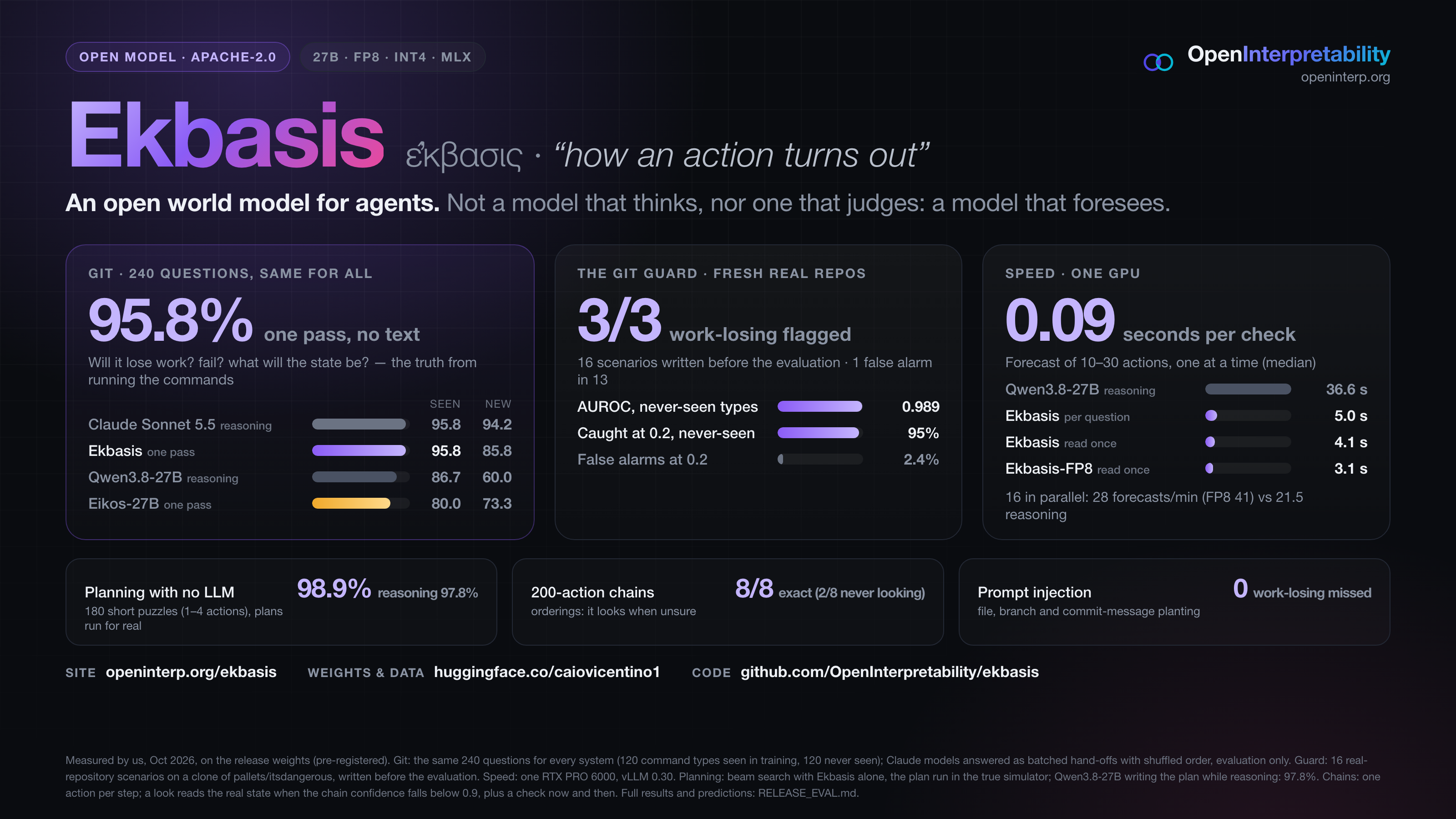
Ekbasis (ἔκβασις, "how an action turns out") is an open consequence model for agents: given the current state and an action, it answers typed questions about what will happen — will this command lose work? will it fail? what will X be afterwards? — with a calibrated probability, in one forward pass (no generated text).
It is the consequence layer of the Eikos family (Eikos decides; Ekbasis foresees), trained on synthetic worlds and on real executions of git commands in throwaway repositories, so its answers come from what actually happened, not from what an agent believes.
Every number on this page was measured on the exact release weights. RELEASE_EVAL.md has the results, every prediction, how this checkpoint was chosen, which measurements were pre-registered (PREREG_release_eval.md, paper/prereg/) and the deviations.
Install
The client needs a server: the hosted API (EKBASIS_URL=https://openinterp.org/api/v1 and EKBASIS_API_KEY=ekb_…,
key at openinterp.org/console) or your own, with the open weights
(Quick start).
-
Command line and Python (standard library only, Python ≥ 3.9):
ekbasis,ekbasis-claude-hook, andekbasis-mcpwith themcpextra.pip install ekbasis # or without installing: uvx ekbasis health pip install "ekbasis[mcp]" # with the MCP server (Python >= 3.10) pip install "git+https://github.com/OpenInterpretability/ekbasis" # from source
-
Claude Code plugin: the git guard hook, the
ekbasis-guardskill, the MCP server and theekbasiscommand on the Bash tool's PATH, in one install:claude plugin marketplace add OpenInterpretability/ekbasis --sparse .claude-plugin plugins claude plugin install ekbasis@ekbasis
or, inside Claude Code,
/plugin marketplace add OpenInterpretability/ekbasisthen/plugin install ekbasis@ekbasis(without--sparsethe marketplace step clones the whole repository, about 86 MB with the results and papers, once; with it, about 1 MB).The plugin (
plugins/ekbasis/, about 0.5 MB) runs its own copy of the client, so it needspython3(≥ 3.9) andshfor the hooks anduvfor the MCP server, and nothing from PyPI. SetEKBASIS_API_KEY(a key alone means the hosted API) orEKBASIS_URL, in your shell or in the"env"block of~/.claude/settings.json, and restart Claude Code. Until one of them is set the guard is off: each session starts with one line saying how to set it up, andekbasissays it is not set up (exit 3). Once set, the hook is the same fail-closed hook described in Claude Code and MCP, and a hook that cannot run (python3missing or older than 3.9, an error in the hook, no answer within 27 s) asks you to confirm, saying why, instead of letting the command through. If you addedekbasis-claude-hooktosettings.jsonby hand, remove it, or every line is checked twice. -
MCP server for any MCP client (Python ≥ 3.10):
uvx --python ">=3.10" --with "mcp>=1.2" ekbasis mcp # same as ekbasis-mcp from pip install "ekbasis[mcp]"
What kind of model is it?
Not a model that thinks. Not a model that judges. A model that foresees.
Ekbasis is a world model for agents in the precise sense: an action-conditioned model of how the state changes. It answers what will be, if I do this, as calibrated distributions over the next state's variables, in one forward pass.
| LLM, reasoning | System One (Eikos, Jev) | Ekbasis | |
|---|---|---|---|
| It answers | anything, in text | what is: which option holds now | what will be, if I do this |
| Kind of question | open | a judgment of the present | an intervention: the outcome of acting |
| Output | generated text | calibrated distribution over the options | calibrated distribution over the next state's variables |
| Learns from | human and model text | a teacher's judgments | what actually happened when the action ran |
| Time | seconds to minutes of reasoning | one forward pass | one forward pass per step; chains to long sequences |
| Role in an agent | plans and talks | judge | simulator and guard: it foresees |
Two ways to picture it:
- The forward model the agents were missing. Before you move your arm, the brain predicts the consequence of the motor command; that is what lets us act fast and correct before an error. One part plans, another predicts. The agent plans; Ekbasis predicts.
- The world-model module, made real. LeCun's architecture for autonomous machine intelligence separates a world model (it predicts the next state given an action) from the actor and the critic. The LLM agent is the actor, AgentGuard the critic, Ekbasis the world model. It was trained with a JEPA-style loss that aligns its internal state with the true outcome.
It is derived from an LLM (Qwen3.8-27B, through Eikos-27B) but does not work as one: its training objective and its readout make it answer with probabilities, not text.
What it is for
- A check before acting: ~0.1 s per question on one GPU, calibrated, so an agent can check every action and escalate only the risky or uncertain ones.
- A git guard for coding agents: the state of your real repository is described in the format the model was trained on (including what decides a conflict), and the commands are checked before they run.
- Simulation and state tracking: chain it one action at a time to follow long sequences; given a way to read the real state, it looks only when unsure (see Look when unsure).
- A fast first opinion before expensive reasoning: answer from Ekbasis when it is confident, escalate to a large reasoning model when it is not.
Quick start
-
Serve the model (one GPU with ~80 GB; vLLM ≥ 0.30). The model folder ships its serving code; run it in the Python environment where vLLM is installed:
hf download caiovicentino1/Ekbasis-27B --local-dir Ekbasis-27B
bash Ekbasis-27B/serve_vllm.sh Ekbasis-27B 8001             # vLLM on 127.0.0.1:8001
python Ekbasis-27B/serve.py --model Ekbasis-27B --vllm-url http://127.0.0.1:8001 --port 8000
-
Install the client (standard library only, Python ≥ 3.9), anywhere that can reach the server:
pip install "git+https://github.com/OpenInterpretability/ekbasis"   # ekbasis, ekbasis-claude-hook (MCP: below)
export EKBASIS_URL=http://127.0.0.1:8000
ekbasis health
-
Check git commands before running them (in any repository):
ekbasis git-check -- "git checkout -- app.py"
# Ekbasis: RISKY  (lose uncommitted work: 99%)
#     0% fails  git checkout -- app.py
#   - may permanently lose uncommitted work (99%)
Exit code 0 when no risk is found, 2 when the commands may lose uncommitted work, 3 when the guard cannot foresee (the server cannot be reached or does not answer in time, the repository cannot be read, or a command points git at another repository or uses an alias): treat 3 as risky. 1 is a usage error. The guard fails closed;
--fail-openturns "cannot foresee" into 0 with a warning. It is a warning layer that can be wrong, not a security boundary: keep confirmations, backups and least privilege (docs/SECURITY.md).
Builds
Every build that works is released, so each machine runs the one that fits; each build's card shows its quality
against bf16 on the same evaluation (the gate was pre-registered in PREREG_quantized.md).
| Build | Size | Runs on | Speed (one RTX PRO 6000) |
|---|---|---|---|
| Ekbasis-27B (bf16) | 55 GB | GPUs with 80 GB | the reference |
| Ekbasis-27B-FP8 | 30.4 GB | GPUs with 48 GB; fastest with FP8 kernels (Ada, Hopper, Blackwell) | 1.6× the throughput of bf16 |
| Ekbasis-27B-INT4 | 18.6 GB | GPUs with 32 GB; 24 GB with text only and a 4k context (command in its card) | about bf16's |
| Ekbasis-27B-MLX-4bit | 15 GB | Macs with Apple Silicon (32 GB or more recommended) | — |
GPU sizes were tested by limiting vLLM to that much memory on one RTX PRO 6000 and checking that the answers match the build at full memory; the MLX build's quality gate ran with MLX on a Linux GPU, and it was then tested on an Apple-silicon Mac (its card, "On a Mac: tested").
Python
from ekbasis import Ekbasis, world_state, choice, yes_no, simulate
from ekbasis import git

client = Ekbasis()                                     # EKBASIS_URL or http://127.0.0.1:8000

# a git guard
v = git.check(["git stash", "git checkout feature", "git stash pop"], repo=".")
print(v.risky, v.p_lost, v.p_fail, v.summary())

# any world whose rules you can write down
rules = ("World: containers A (holds 5 liters), B (holds 3 liters) of water. 'fill X' fills X to the top; "
         "'empty X' empties X; 'pour X into Y' moves water from X to Y until X is empty or Y is full, "
         "whichever comes first.")
ans = client.ask(world_state(rules, "A: 5 of 5 liters, B: 0 of 3 liters", ["pour A into B"]),
                 {"a": choice("How many liters are in A?", [str(k) for k in range(6)])})
print(ans["a"].value, ans["a"].confidence)

# a long sequence: one action at a time, every variable asked after each action
render = lambda s: f"A: {s['a']} of 5 liters, B: {s['b']} of 3 liters"
qs = {"a": choice("How many liters are in A?", [str(k) for k in range(6)]),
      "b": choice("How many liters are in B?", [str(k) for k in range(4)])}
sim = simulate(client, rules, {"a": "5", "b": "0"}, ["pour A into B", "empty B", "pour A into B"], qs, render)
print(sim.final, sim.confidence)   # use the chain confidence, not the last step's

# (0.1.2) the rule that decides the answer, repeated right before the question
from ekbasis import recap
q = recap(yes_no("Is the small disk still on peg A?"), "A disk can never be placed on a smaller disk.")

# (0.1.2) a running total: the model tracks the number, the code compares it with the limit
from ekbasis import number, threshold
t = threshold(client, "Each purchase adds its price to the month's spending.", {"spent": "0"},
              ["buy a 30-dollar plan", "buy a 45-dollar add-on", "buy a 25-dollar seat"],
              {"spent": number("How much has been spent this month, in dollars?", range(0, 205, 5))},
              lambda s: f"Spent this month: {s['spent']} dollars.", quantity="spent", op=">=", limit=100, when="ever")
print(t.value, t.holds, t.confidence)
- Recap (
recap,simulate(..., recap=True),ekbasis predict --recap): repeating the rule that decides the answer right before the question fixed the case where Ekbasis ignored a written prohibition that compares two values (Tower of Hanoi's size rule: 0 of 8 right, 8 of 8 with the recap; capability map,habit_vs_rule). On fresh items it helps on balance but not everywhere: 97.4% → 98.6% on familiar and invented single-rule worlds (12 answers fixed, none broken), 86.7% → 88.9% on invented worlds with chains of rules and captures along a line (51 fixed, but 26 of 1,120 right answers turned wrong). Use it for the rule you know decides the answer; it stays opt-in, and without it every prompt is the same as in 0.1.1. - Compare in code (
threshold): Ekbasis carries running totals well (98–100% exact step by step) but judges "is the limit reached?" poorly when the total is within a unit or two of it; asking it for the number and comparing in code gave 99.0% on budgets, timers, quotas, rate limits and lockouts (capability map,accumulation). Use it whenever an effect depends on a sum crossing a limit.
Look when unsure (predict, observe, correct)
The study behind this section is the paper Look When Unsure, Check When Sure (PDF, doi:10.5281/zenodo.23146970), every analysis pre-registered and re-run from the saved outputs.
Ekbasis follows long sequences one action at a time. Where a later action overwrites a mistake (a container refilled,
a lamp switched) the chain recovers by itself; where nothing ever undoes it (an ordering), mistakes compound. Give
simulate() a way to read the real state and it looks only when it is not sure, then continues from what it saw:
from ekbasis import simulate

sim = simulate(client, rules, state, actions, questions, render,
               observe=read_real_state,    # the real state as {variable: value}: git status, a query, a sensor
               ordering=list(questions))   # the state is an ordering: read the most probable valid one
print(sim.final, sim.looks, sim.surprises) # when it looked, and which looks found the forecast wrong
By default it looks when the chain confidence (the product of every answer's confidence since the last look) falls
below 0.9, and it checks the forecast now and then: after 8 actions without a look, a gap that doubles up to 64 while
the forecasts hold; a look that finds the forecast wrong (a surprise) brings the gap back to 8 and looks again after
the next action, until a look finds it right. look_below, look_step_below, look_every and checks set other
rules.
Chains of 100 · 200 actions (4 per world, 8 for cards):
| World | Exact at the end, never looking | Exact at the end, looking when unsure | Steps wrong along the way, per 100 actions | Looks per 100 actions |
|---|---|---|---|---|
| Containers (trained) | 4/4 · 4/4 | 4/4 · 4/4 | 2.3 → 1.5 | 3.5 · 2.9 |
| Lamps (trained) | 4/4 · 4/4 | 4/4 · 4/4 | 0 → 0 | 3 · 3.1 |
| Machines (never seen in training) | 4/4 · 4/4 | 4/4 · 4/4 | 2.3 → 0 | 6.8 · 10 |
| Card orderings (never seen in training) | 0/8 · 2/8 | 8/8 · 8/8 | 67.8 → 0 | 42.3 · 32.6 |
On 200 more chains with new seeds, run after the release evaluation (the default rule; 80 of cards, 40 of each other
world; RELEASE_EVAL.md, "200 more chains"), 198 ended exact. Of the two that did not, a container chain of 100
actions went wrong at action 87 with a confidence of 0.99, after the last check, and stayed wrong to the end (its
final answer right); a card chain of 200 actions missed only its last action, which the loop never checks, and the
model had flagged it (that step's probability 0.0006). Steps wrong along the way: 0.23 per 100 actions (containers
0.4, lamps 0.7, machines 0, cards 0.01); looks: 16.9 per 100.
To look less, look_below=0.5: every chain still ended exact (40 of 40), with 11.2 looks per 100 actions over these
four worlds instead of 17.3, and 0.7 steps wrong along the way per 100 instead of 0.3.
For an ordering, also ask where each value is: where={value: question}, each question's options being the ordering's
variables ("At which position is the 7 of hearts?"). Both views are read together, in the same request, and the card
chains looked about half as often for the same exactness (20 · 15 looks per 100 actions instead of 40 · 31 at chain
confidence < 0.9, every chain exact; RELEASE_EVAL.md, "Two views").
What the confidence sees, and what it does not. In card orderings, a world it never saw, 2.7 steps in 100 went wrong and it gave every one of them a probability below 0.7: looking when unsure finds them. In the worlds it was trained on, errors are rare (0–0.17 steps in 100) but come with confidence (0.972–0.996): a fixed threshold misses them, and the checks are what find them (containers: 2.3 → 1.5 steps wrong along the way per 100 with the checks). A pre-registered test on 15,008 generated questions in 12 world families, run on V42 (the first release candidate), confirmed the pattern: 58% of its wrong answers carried a confidence of 0.9 or more in the families it was trained on, 28% in the families it never saw (30 points apart, 95% interval 24 to 37), while its confidence ranks right above wrong about equally well in both (AUROC 0.92 and 0.91). Eikos-27B, the same model before consequence training, was almost never confidently wrong (1.9% and 0.5% of its errors): the training made it (report). On the same questions the release gives 48% and 25%, with 2.06 confident errors per 100 answers in the trained families against V42's 2.79 (report): fewer, not gone, which is why the checks stay on by default. Correction (6 October 2026): 5,318 of the 15,008 questions, all in the trained families, turned out to repeat or nearly repeat a training row, because the generator's small worlds repeat across seeds. Without them the test still confirms the pattern (50.5% against 27.8%, 22.7 points apart, 95% interval 12.6 to 32.5), the training still made it, and the release gives 50.0% and 25.1%, with 1.46 confident errors per 100 answers in the trained families against V42's 1.69 (audit).
The idea is classic: the predict–update loop of a state estimator (a Kalman filter), with observations triggered by the predictor's own uncertainty (event-based state estimation; with learned models, active observing); the checks' backoff is the Trickle algorithm's. What Ekbasis adds is a calibrated forecast in one pass, cheap enough to run at every action. Prior work: REFERENCES.
What it unlocks
- Long sessions that stay on track. 238 of the 240 measured chains ended exact (one missed only its last action, which the model had flagged; one went wrong at a confident step after the last check) while looking at a fraction of the steps (2.9–3.5 looks per 100 actions in the worlds it was trained on, 33–42 in an ordering world it never saw), which matters when observing is expensive (a screenshot read by a vision model, a slow API, a human check).
- A horizon for planning. With no observations,
sim.horizon()gives how many actions the forecast holds by the model's own confidence: act up to there, look, plan again. - A safety signal. A sudden drop in confidence, or a surprise at a look (
sim.surprises), means the world left what the model expected: the agent did something unexpected, the environment changed, or the task is outside what Ekbasis knows. A moment to look, or to alert. - One rule for escalation. Looking at reality, calling a large reasoning model or asking a person: the same calibrated confidence decides.
Where to use it (the loop was measured on worlds whose rules are written in the prompt; in the two it never saw it looked more often, and all but one of 144 chains ended exact, that one on its last action. Measure on your own environment before relying on it.)
- Coding and devops agents: the state of a repository, files and infrastructure across a long session, with
git statusonly when unsure. - Browser and computer-use agents: the screen after each action, with a screenshot only when unsure (Ekbasis already reads a starting state from a picture of a simple world; real screens are not measured yet).
- Business processes: orders, stock and balances after a sequence of transactions, reconciled with the database only when unsure.
- Digital twins and IoT: machine states between sensor reads; read the sensor when unsure.
- Finance operations: positions and margins after a sequence of orders, checked with the broker when unsure.
Check when sure (ekbasis.verify, since 0.1.4)
Looking when unsure covers the answers below 0.9 confidence. What remains are the confident errors: answers with
confidence ≥ 0.9 that are wrong. Confidence alone ranks them poorly: to catch 80% of them you would verify about half
of all confident answers. ekbasis.verify says which confident answers to check by real execution, and why.
from ekbasis import Ekbasis, git, verify, world_state, yes_no

client = Ekbasis()
tracker = verify.FamilyTracker("~/.ekbasis/families.json")  # outcomes you observed, per family of question

# rules, state, actions, questions and render as for simulate() (see Look when unsure)
text = world_state(rules, render(state), actions)            # the question, asked about all the actions at once
q = yes_no("Does the alarm ring?")
ans = client.ask(text, {"q": q})["q"]
d = verify.check(client, text, q, ans, family="alarms|threshold", tracker=tracker)
if d.verify:
    print("check before acting:", *d.reasons, sep="\n  ")

# after acting and reading the real outcome
tracker.observe("alarms|threshold", correct=(observed == d.answer))
# a blocked action has no outcome: never observe() it
tracker.unobserved("alarms|threshold")

# git: one decision per guard question (no self-check for git)
decisions = verify.git(git.check(["git stash", "git checkout main"]), client, tracker)

# several actions in a row: the direct answer against the step-by-step one
d = verify.check_steps(client, rules, state, actions, questions, render, target="alarm")
For a confident answer, check combines three signals, each placed against fixed reference answers:
- the error rate of its question family, from the outcomes you observed;
- how stable the answer is when the options are reversed or the question reworded (one extra request);
- the model's own self-check (one extra request). It is not used for git and shell, where it misleads.
It asks to verify when their mean percentile reaches the threshold of the answer's domain (domain=):
domain |
Threshold |
|---|---|
"rules" |
0.6056 |
"sql" |
0.4836 |
"shell" |
0.6571 |
"git" |
0.7675 |
"totals" |
0.7361 |
| anything else | 0.6414 |
rule="conformal" uses per-family thresholds at α = 0.15 instead, and rule="global" uses 0.6414 everywhere.
rule="certified" (0.1.5) acts without verifying only where a Learn-then-Test certificate holds (≤ 2% errors among
the answers it accepts, δ = 0.05); every other answer is verified. Each Decision records its rule, node and
threshold. check_steps asks to verify when the step-by-step answer moves the direct answer's probability by
≥ 0.0334.
Measured in two pre-registered tests on fresh items from five capability suites (rules, SQL, shell, git, running totals). The second, confirm-2, had 18,615 confident answers, 1,202 of them wrong, with every item new against the first test too.
| Rule | Confident errors caught | Confident answers verified |
|---|---|---|
rule="domain" (default) |
84.5% | 22.6% |
rule="conformal" |
86.3% | 26.2% |
rule="global" (first test / confirm-2) |
84.9% / 83.5% | 23.4% / 23.4% |
| Confidence alone, at the same verified share | 65.7% | 23.4% |
verify.check_steps, running totals near a limit only (first test / confirm-2) |
87.9% / 86.3% | 22.8% / 22.2% |
Per domain under the default, caught / verified on confirm-2:
- rules 85.5% / 12.8%;
- sql 87.6% / 50.3%;
- shell 79.9% / 21.6%;
- git 83.7% / 20.1%;
- totals 87.0% / 44.4%.
Under one global threshold SQL was caught at 67%. Telling the model to answer "unsure" when unsure caught 1%: it almost never says it.
Certified mode (0.1.5). A first Learn-then-Test rule did not pass in confirm-2: rare rule families that fell back to their suite's threshold reached 3.4%. Its fix passed a third pre-registered test (confirm-3, 12,667 fresh scenarios): a rare family falls back to a (domain, difficulty) node.
| Errors among the answers it accepts | Verified | Confident errors caught | |
|---|---|---|---|
rule="certified" |
0.39% | 26.9% | 94.8% |
No node exceeded 2%. In the same test the default caught 85.1% while verifying 22.8%.
The certificate holds per node, for this model and these generators. It does not cover:
- real traffic;
- blocked actions;
- families outside the calibration, which are always verified, including any family key other than the evaluation's labels.
Details: docs/VERIFY.md.
The items of all three tests share no identical and no near-duplicate item with any training file of this model's lineage (2.2M rows checked; report, confirm-3).
Limits
- What the test used. Family labels came from the evaluation, with a history of 29,029 evaluation answers. The
client's own keys (
git_family,shell_family, yours) are not measured. Starting with no history was measured only with the evaluation's labels and every earlier outcome known: 85.0% caught, 27.3% verified. A family with no history starts at a 50% error rate, so new families are checked more until outcomes come in. - Blocked actions. Count only outcomes you actually observed. Blocked actions are the ones that looked risky, so a
family's observed error rate can be too low. Label some of them anyway:
verify.audit(0.05)picks a random 5% to replay in a sandbox. Blocking also changes what an agent proposes next, so rates learned offline may not hold live. - Domains. The thresholds belong to the five measured domains. Pass
domainfor them. Any other domain gets the global threshold, whose numbers come from these five domains, not from yours. - Conformal groups. They use the evaluation's family labels. With your own family keys, only each domain's "rest" threshold applies, and that combination is not what was tested.
- One model version. The reference answers and thresholds belong to this model (w4a5), measured on its bf16 build. With the FP8 and INT4 builds they are untested. On the MLX build, a re-test on fresh items with the thresholds unchanged kept the error among accepted answers at 0.15% (1 of 666; docs/VERIFY.md). A new model needs a new calibration.
- Cost. One extra request per confident answer for git and shell, two otherwise.
check_stepscosts one request per action, plus one.
Details: docs/VERIFY.md. Pre-registrations, results and the overlap check: results/client_0.1.4.
Claude Code and MCP
The agent studies behind this section, on demo apps, on real self-hosted Gitea, Nextcloud and Roundcube, and in a real terminal, are in the paper When Does a Consequence Model Make AI Agents Safer? (PDF, doi:10.5281/zenodo.23197341), pre-registered, with the hypotheses that failed reported. Its tasks, app setups, adapters and judges are in paper/agents/benchmark, to rerun the studies with your own agent.
-
Claude Code plugin — the hook, the skill and the MCP server below in one install: see Install.
-
Claude Code hook — Claude Code asks you to confirm (or blocks) git commands that may lose uncommitted work, with the reason; it stays silent otherwise. Since 0.1.2 it fails closed: when it cannot foresee a line (the server cannot be reached or does not answer within
EKBASIS_HOOK_DEADLINE, the repository cannot be read, git is pointed at another repository, the line changes folder in a way the hook does not follow, or it has parts the hook cannot evaluate: subshells, variables in a git command, nested shells, aliases), Claude Code asks you to confirm and says why.EKBASIS_FAIL_OPEN=1restores 0.1.1's silence. The hook answers in JSON and exits 0, since in Claude Code an exit code other than 2 does not block. The hook is a warning layer that can be wrong, not a security boundary: keep Claude Code's own confirmations, backups and least privilege. In.claude/settings.json(one project) or~/.claude/settings.json(all):{"hooks": {"PreToolUse": [{"matcher": "Bash", "hooks": [{"type": "command", "command": "ekbasis-claude-hook", "timeout": 30}]}]}}
Environment:
EKBASIS_URL,EKBASIS_LOST_THRESHOLD(0.2),EKBASIS_GUARD_MODE(ask,deny, orlog: never block, and append what it would have done (ask,ask_cannot_foreseeorpass, with the reason and the command) to~/.cache/ekbasis/hook_log.jsonlorEKBASIS_HOOK_LOG, on this machine only, to try it for a while and see what it would have stopped before letting it stop anything),EKBASIS_FETCH=1(fetch first so the state shows the real remote),EKBASIS_FAIL_OPEN=1(stay silent when it cannot foresee),EKBASIS_HOOK_DEADLINE(seconds, default 25, for the whole line; keep it below the hook'stimeout, or Claude Code stops the hook first and the command goes through unchecked; with the MLX build on a Mac, where a preflight check that asks the model can take 30–40 s, useEKBASIS_HOOK_DEADLINE=60with a hooktimeoutof 90),EKBASIS_SHELL_GUARD=1(below),EKBASIS_SHORTCUTS=0(always ask the model, as 0.1.2 did),EKBASIS_SAFER=0(no safer route in the warning).Less friction (0.1.3, from a study of a Claude Code agent on real repositories).
- Read-only git (
status,log,diff,show, listings of branches, tags, stashes and worktrees,clean -n) does not ask the model. cd DIRanywhere in the line,pushd/popd, subshells andgit -C DIRare followed instead of "cannot foresee". A folder that an earliergit worktree add(orgit clone,mkdir) in the same line creates holds no uncommitted work. So the safe route for a backport (git worktree add ../wt release && cd ../wt && git cherry-pick X) passes, while the main repository'sgit worktree addis still judged.- With
EKBASIS_SHELL_GUARD=1, the shell part of a line that also runs git goes to the shell guard too. Each git command is replaced bytrue, and its redirections are kept. - No model call and no ask when nothing could be lost for good, checked by code
(
ekbasis.recover):- a repository with no uncommitted work: every work tree holds only clean tracked files and ignored, rebuildable ones, the stash is empty, and nothing is under way;
- a
git clean -Xwhose dry run removes only rebuildable paths; - a shell line where every path it could change is committed in git, or is ignored and rebuildable by name (build
outputs, caches,
node_modules,__pycache__; not.env, virtual environments or editor settings). Test, build and lint runners (go test,python -m pytest,npm test,gofmt -l) count as reads there. A line that runsxargsnever skips.
- Lost committed work, checked by code and reported apart from the model's question about uncommitted work:
git branch -D(or-d -f,-r -D), forced branch moves and renames (branch -f,-M,-C,checkout -B,switch -C,worktree add -B),git reset --hard/--keep/--merge <commit>on the checked-out branch, and tag deletion or moves. The hook asks when they would leave commits that no branch, tag, remote-tracking branch or stash entry holds.
Measured on fresh Claude Code sessions on real repositories (results/client_0.1.3):
- With Sonnet 5.5: 2.9 asks per 100 commands, against 10.7 for 0.1.2 on the same commands. The median added per command was 0.08 s.
- With Haiku 4.5, on tasks with a tempting destructive shortcut: 7 of 7 real losses caught, as with 0.1.2.
The fixes were designed on an earlier study's calls; these sessions are new.
- Read-only git (
-
Shell guard (prototype, 0.1.2) —
ekbasis shell-check -- "rm -r build/"(orekbasis.shell.check) asks whether shell command lines lose file content or fail, from a listing of the paths they could touch: names, types, sizes, ages, links and where they point, hidden names, and never file contents (each file appears as a short fingerprint keyed anew for each check, so equal contents can be compared without copying a secret into the prompt). It writes out what the shell decides before running (how unquoted patterns expand here, how unquoted spaces split names, other files with the same content) and how the arguments apply here (where rsync copies, how many lines a sed or grep pattern matches, whatfind … | xargspasses), and adds short shell rules only for the forms that need them (>emptying a file it also reads,;after a failedcd, rsync's trailing slash,cp -r SRC/., a link with a trailing slash, xargs and spaces,tar -x, commands that refuse and change nothing,rm -f,cp -u). Same exit codes and the same fail-closed rule asgit-check; a line with variables in its paths, subshells or nested shells is "cannot foresee". In the Claude Code hook it is opt-in (EKBASIS_SHELL_GUARD=1) for lines that can change files (since 0.1.3 also the shell part of lines with git). Measured on 292 fresh scenarios of 46 command forms it was not designed on (bash on Linux, the truth from running them): content lost right 91.4%, 93.2% of the losses flagged with 11.9% false alarms, failures right 96.2%, against 54.8% for a list of destructive commands (82.0% flagged, 67.9% false alarms). What it misses: see Limits. -
Preflight (since 0.1.6) —
ekbasis preflight -- "sqlite3 app.db < migrations/0012.sql"(orekbasis.preflight.check_line) checks a multi-step change before it runs: a sqlite3 run of several statements (a file through<,.read, a pipe, a here-document,{ echo "BEGIN;"; cat f.sql; echo "COMMIT;"; } | sqlite3 db, a file written earlier on the same line), a shell script (bash x.sh,./x.sh), or a chain of commands. It warns only when the first failure would leave the change half applied: a table rebuild whose copy fails but whoseDROP TABLEstill runs, a move that fails followed by thermthat cleans up,cd build/output; rm -rf *when the folder is missing.- On a copy when it can be. Local files and local SQLite databases: the plan runs on a clone of the folder or
the database (APFS clonefile on macOS; reflinks or a size-capped copy elsewhere), one step at a time, with a
timeout. The first real failure and its error are known exactly, and your files are never touched. Only plans
whose every step is a local file or SQLite command from an allowlist (and so is any program it would start, as
with
xargsorfind -exec), writing inside the folder or the temporary folder, run on a copy.- Shell steps run on a copy only inside
sandbox-exec(macOS): no network, no writes outside the copy. Where there is no sandbox (Linux), or it cannot start (preflight itself running inside another sandbox), shell plans are judged by Ekbasis instead. - SQL plans run on a copy wherever the
sqlite3command-line tool is installed (insidesandbox-execon macOS). SQL that writes other files (ATTACH,VACUUM INTO,readfile/writefile, extensions) never does. - Without the
sqlite3tool, asqlite3command fails before any statement runs: preflight says so and does not warn. SQL given to the Python API (check_sql, for SQL you run some other way) is judged by Ekbasis.
- Shell steps run on a copy only inside
- Otherwise by Ekbasis (remote or side-effectful targets: a script that calls a service, pushes, or uses a tool
outside the allowlist). One request asks whether each step fails on the current state; scripts and chains also
get a step walk (each step asked with only the steps before it). Facts that code can state decide their step: a
mkdironto a file, a trailing-slash destination that is not a folder, a missing source, acdinto a missing folder, writing into a folder you cannot write, an archive into a folder that is not there, a command that is not installed. Numbers within a CHECK bound are decided in code. SQL run by sqlite3 inside a chain is judged as SQL. - Not warned on: a failing step that only reads (
git status,ls, acurlnotification) and steps that only add (a backup copy, a new folder, CREATE TABLE), on their own; a plan that fails atomically (sqlite3 -bailinsideBEGIN ... COMMIT). - When it cannot foresee (loops, conditionals, functions, other dot-commands, variables it cannot resolve), it says
nothing: it is an extra check (
--fail-closed/EKBASIS_PREFLIGHT_FAIL_CLOSED=1warns instead).
In the Claude Code hook it is opt-in:
EKBASIS_PREFLIGHT=1. In headless runs an "ask" is a denial, so the warning says so, and the same command run again in the same session goes through (EKBASIS_PREFLIGHT_REPEAT=0: always warn).EKBASIS_PREFLIGHT_COPY=0never runs on a copy;EKBASIS_GIT_GUARD=0runs preflight alone. The MCP server exposes it aspreflight_command. Rows go to your Ekbasis server when the model is asked about SQL (--no-rowssends the schema, counts and facts instead).Measured (results/client_0.1.6; pre-registered, 20 new tasks, Claude Code agents, on one Mac: macOS 26.3, sqlite3 shell 3.51.0):
- With Claude Haiku 4.5, damage in trap tasks fell from 23/28 to 3/28 sessions and tasks done rose from 17/40 to 34/40, with no warning on a control.
- With Claude Sonnet 5.5, all 7 warnings were right, no session got a needless one, and damage fell from 5/14 to 1/14.
Limits:
- The tasks are ours.
- Most traps (9 of 14) ran on a copy, which is exact.
- On the model's path (commands that cannot run on a copy), 58 of 69 half-applied changes were caught (37 by
code-stated facts) and 4 of 51 warnings were needless. The model alone missed macOS
sed -itaking the next word as a suffix. - On Linux, shell plans are always on the model's path. It was not measured with agents on the 3 shell traps and 2 shell controls that ran on a copy on the Mac. On the first study's 20 task commands, with copies off, it warned on 14 of 14 traps and on 0 of 6 controls.
- SQL plans run on a copy on Linux too, where the
sqlite3tool is installed. That is checked by unit tests only (sqlite3 3.46, Python 3.9 and 3.12).
- On a copy when it can be. Local files and local SQLite databases: the plan runs on a clone of the folder or
the database (APFS clonefile on macOS; reflinks or a size-capped copy elsewhere), one step at a time, with a
timeout. The first real failure and its error are known exactly, and your files are never touched. Only plans
whose every step is a local file or SQLite command from an allowlist (and so is any program it would start, as
with
-
MCP server (
pip install "ekbasis[mcp] @ git+https://github.com/OpenInterpretability/ekbasis", Python ≥ 3.10): the commandekbasis-mcpexposescheck_git_commands,predict_consequencesand (since 0.1.6)preflight_commandto any MCP client. Whencheck_git_commandsfinds the commands risky, it also returnssafer({commands, p_lost, keeps}, or null; safer route). In Claude Code:claude mcp add --scope user ekbasis -e EKBASIS_URL=http://127.0.0.1:8000 -- ekbasis-mcp
or a project
.mcp.json:{"mcpServers": {"ekbasis": {"type": "stdio", "command": "ekbasis-mcp", "env": {"EKBASIS_URL": "http://127.0.0.1:8000"}}}}
If the client was installed in a virtualenv, use the absolute path of the command (
which ekbasis-mcp), in.mcp.jsonand in other MCP clients' configuration files.
Safer route
A warning alone often does not make a smaller agent change course: in our studies, Claude Haiku on real apps went on
after warnings. So when git commands are risky, git-check, the Claude Code hook and the MCP tool also give the
alternative with the same intent that Ekbasis checked and found safe:
ekbasis git-check -- "git reset --hard"
# Ekbasis: RISKY  (lose uncommitted work: 99%)
#     0% fails  git reset --hard
#   - may permanently lose uncommitted work (99%)
# Safer: git stash push && git reset --hard  (lose uncommitted work: 0%)
#   keeps: the discarded changes stay in a stash (git stash list; git stash pop brings them back)
The alternatives come from rules, not from a language model (the table of intents is in
ekbasis/safer.py): git stash push before reset --hard, checkout -- <file>, restore and a
forced switch; git stash push -u -- <what git clean -n lists> instead of clean -f; git branch -m N backup/N
instead of branch -D N; a backup branch before reset --hard <commit> or rebase --onto drops commits, before
stash drop and before deleting a remote branch; git push --force-with-lease --force-if-includes (git >= 2.30)
instead of push --force, which is rejected if the remote moved (fetch and rebase first). Never --force-with-lease
alone: after a fetch it overwrites the fetched commits (measured). Each alternative is then checked like the original (the
same state, the same RISKY threshold, no step likely to fail, and the code checks for lost commits and overwritten
remote commits). Only one that passes is offered; the lowest chance of losing work wins, then the fewest extra steps.
When none passes, it says so (Safer: none (...)) and suggests nothing. --json adds safer and safer_note.
The alternatives are checked in parallel, one request each, so a search adds about one round trip, and only when the
commands are risky. --no-safer (CLI), EKBASIS_SAFER=0 (CLI and hook) or safer=false (MCP) turn it off. In the
hook it runs last, in the time the deadline leaves; if it cannot finish, the warning goes out without a route. Measured
on throwaway repositories against the hosted API: results/safer_route.
Migration guard (pull requests)
Before a pull request is merged: will its new PostgreSQL migrations lose data or fail? ekbasis migrate-check builds
the schema by applying the base branch's migrations to a scratch PostgreSQL, adds row and NULL statistics from a
read-only replica if you give one (planner statistics only, never values), and writes the rule your tool follows (one
transaction per file for Prisma, Diesel and golang-migrate). A migration that fails on the schema alone is decided in
code. A GitHub Action posts one comment per pull request and can fail the check:
- uses: actions/checkout@v4
  with: {fetch-depth: 0}
- uses: OpenInterpretability/ekbasis/actions/migration-guard@main
  with:
    api-key: ${{ secrets.EKBASIS_API_KEY }}
A migration already checked with the same file, base schema, client version and rules is not sent again: its answer is reused from a 30-day verdict cache (no model call, no tokens).
Alembic (supported) and Django (experimental: it missed 6 of 34 risky migrations in its pre-registered evaluation)
migrations are rendered as SQL by the framework itself, inside a container with no network and no secrets (opt-in:
framework: in the Action, ekbasis migrate-gen). Measured in pre-registered evaluations on real
migrations executed on seeded databases. On 184 migrations held out
from the study, the guard's verdict was right 87.5% of the time against 69.6% for regex rules, its reason ("fails"
vs "loses") was right 92.5% of the time, and false alarms on benign migrations were 15.6% against 43.0%. Details, exit codes and limits:
docs/MIGRATION_GUARD.md.
Feedback (hosted API)
When an answer turned out right or wrong, say so. It is free, takes one command, and is how we measure the model on real use rather than on our own scenarios:
ekbasis feedback --last --prevented-harm      # it warned and that stopped a real mistake
ekbasis feedback --last --false-alarm --note "the folder was a build cache"
ekbasis feedback req_0123456789abcdef01234567 --correct
Verdicts: --correct, --wrong, --prevented-harm, --false-alarm. --last is the last answer this machine got
from the hosted API (the client keeps only its request id, in ~/.cache/ekbasis/last_request_id). One feedback per
request id, within 30 days. Exit 0 when recorded, 4 when refused (unknown id, already sent, rate limit, no key), 3 when
the server cannot be reached. In Python: client.feedback("wrong", note="...") after a client.ask(...). Self-hosted
servers have no feedback endpoint.
Read-once
When a request carries several questions about the same state, client.ask(..., read_once=True) reads the state once
and answers every question in the same forward pass: about half the prompt tokens, for 0.9–3.1 points of accuracy on
the answers the actions change (never-trained worlds: 710 instead of 1,442 prompt tokens per state, 78.0% instead of
81.2%; trained ones: 91.5% instead of 92.4%). Text only.
Limits (read before relying on it)
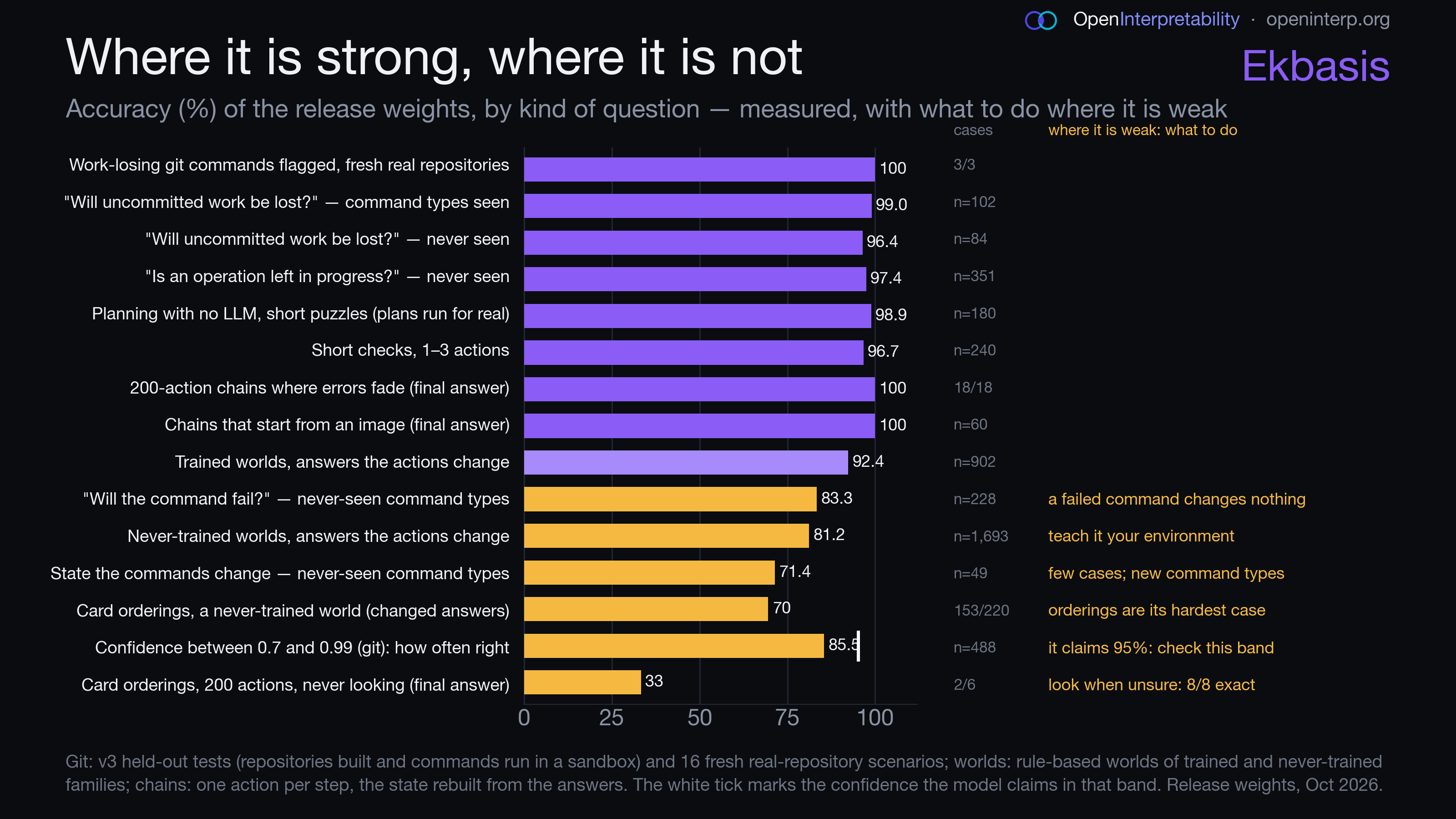
- It knows what it was trained on, and it is not git-only. Trained on git and on rule-based worlds whose rules are written in the prompt, it works wherever the state writes down the facts and rules that decide the outcome. Measured after training (cookbook, Oct 2026): 171 scenarios in 21 domains — money, files and shell, databases/SQL, email, calendar, cloud and Kubernetes, cloud storage, docker, deploys and CI pipelines, identity and access, network, data pipelines, ML ops, scheduled jobs, numbers and plans — 168 of 168 scored right (results); and with agents, less harm on real Gitea, Nextcloud and Roundcube and on a real Kubernetes cluster (see the agent studies). Those scenarios were written by us with the deciding facts in the state; real states that leave facts out do worse, and so do things it never saw (85.8% against 95.8% on git command types never seen in training).
- The state must contain what decides the outcome. The git guard adds it for you (since client 0.1.1 also ignored files, linked worktrees, submodules, conflicts resolved by hand and ahead/behind, when a command could touch them); in your own uses, include it.
- Errors that never fade compound in long chains (orderings), and in the worlds it knows its rare errors come with
confidence: give
simulate()a way to read the real state (observe=) and it looks when it is not sure, with a check now and then. Card orderings, 200 actions: 8 of 8 chains exact with about 33 looks per 100 actions, against 2 of 8 never looking. See Look when unsure. - With written rules and time to think, large reasoning models are more accurate (100% against 96.7% on short checks); Ekbasis wins on cost, latency and calibrated confidence there.
- Git cases it still gets wrong with client 0.1.1 (334 fresh sandbox scenarios over 75 command types, the truth
from running git; results/client_0.1.1):
- An ignored file that a checkout, merge or
reset --hard <ref>overwrites because the target has a file at the same path: 6 of 6 missed, although the state names the file. Rungit status --ignoredbefore switching to a branch that tracks a path you ignore (an.env, for example). git sparse-checkout setdeleting ignored files outside the kept directories (2 of 2 missed), andgit rebase --abortafter the resolution was staged withgit add(2 of 2 missed).git stash -athengit clean -fdxis flagged although-asaved the ignored files.- A commit followed by a destructive command in one check is flagged although the commit saved the work
(
git commit -am wipthengit reset --hard: 98% "loses work"; nothing was lost). Check the commands after the commit has run: the guard reads the repository as it is. git rmon a file with uncommitted changes: "fails" (right: git refuses) and also 96% "loses work" (nothing is lost, since it fails). When "fails" is high, read "loses work" as "if it succeeded".- Some failures are still read from the command instead of the state:
git switch -andgit checkout <tag>are predicted to fail when they work;git worktree addof a branch checked out elsewhere,git stash poponto a re-created untracked file,git reset --keep/--merge <commit>stopped by a local change, and agit pullstopped by local changes are predicted to work.
- An ignored file that a checkout, merge or
- Committed work: checked by code since 0.1.3, partly. The model asks whether uncommitted work is lost (with
0.1.0 and 0.1.1 it flagged 2 of 27 and 4 of 21 scenarios that drop commits). Since 0.1.3 the hook simulates the refs
for branch and tag deletion, forced branch moves and
git reset --hard <commit>.- Not covered:
git push --force(the remote's state is not read) and arebasethat drops commits. - Branch names passed through
xargsare "cannot foresee".
- Not covered:
- The 0.1.3 shortcuts trust folder names and git.
- "Rebuildable" is decided by folder name, so irreplaceable data inside an ignored
build/,dist/,node_modules/or cache folder is not protected. - Content counts as recoverable when git holds it in the last commit.
- A command that could also touch
.gitnever skips. EKBASIS_SHORTCUTS=0turns the shortcuts off.
- "Rebuildable" is decided by folder name, so irreplaceable data inside an ignored
- The shell guard is a prototype (results/client_0.1.2). On 292 fresh scenarios (46 command forms it was not designed on) it missed 9 of
133 content losses, all copies or moves into a folder that replace a same-named file there (
cp -a SRC DESTwhen DEST/SRC holds one,cp -t DIR f,mv -t DIR a b), and raised 19 false alarms in 159 safe cases, mostly where the outcome depends on content it does not show (head -n 9 f > f.tmp && mv f.tmp fon a short file,perl -piwith no match) or on a backup taken first; 26 of its 36 errors came with confidence of 0.9 or more. It reads bash on Linux; macOS's BSD tools and zsh differ in places, and it does not know what programs and scripts do to files (python x.py,make), file permissions or who owns a file. - It is a warning layer that can be wrong, not a security boundary. It can miss a destructive command and it can flag a safe one; text in a repository or a folder can try to steer it; an adversary can hide a command from it. Use it with Claude Code's confirmations, backups and least privilege. See docs/SECURITY.md for the threat model, the measured injection results and the recommended defense-in-depth stack.
More: docs/PLAYBOOK.md (how to use it day to day) · docs/REFERENCES.md (credits) · PREREG_release_eval.md.
Citation
@misc{vicentino2026lookwhenunsure,
  title        = {Look When Unsure, Check When Sure: Consequence Training Makes a World Model's Remaining Errors Confident, Most of All Where It Knows the World Best},
  author       = {Vicentino, Caio},
  year         = {2026},
  publisher    = {Zenodo},
  doi          = {10.5281/zenodo.23146970},
  url          = {https://doi.org/10.5281/zenodo.23146970}
}

@misc{vicentino2026agentssafer,
  title        = {When Does a Consequence Model Make AI Agents Safer? Pre-registered Studies on Demo Apps, Real Self-Hosted Apps and a Real Terminal},
  author       = {Vicentino, Caio},
  year         = {2026},
  publisher    = {Zenodo},
  doi          = {10.5281/zenodo.23197341},
  url          = {https://doi.org/10.5281/zenodo.23197341}
}
Contact
Questions, collaborations and commercial use: caio@openinterp.org. Security problems with the guard: see docs/SECURITY.md (email first, please).
Acknowledgments
Ekbasis was built by Caio Vicentino (OpenInterp) with the help of Claude Opus 5.5 (Anthropic). Claude worked on the project with him:
- planning and running the experiments;
- writing and reviewing the code and the documentation;
- checking the numbers and the references.
1 maintainer

Metadata
1 maintainer
Release files for ekbasis 0.1.15
For a detailed explanation of source distributions (sdists) and built distributions (wheels), please see the package formats documentation.
Source distribution (sdist)
| File | Size | Uploaded | |
|---|---|---|---|
| ekbasis-0.1.15.tar.gz | 245.0 kB | Details |
Built distribution (wheel)
| File | Interpreter | ABI | Platform | Reset |
|---|---|---|---|---|
| ekbasis-0.1.15-py3-none-any.whl | Python 3 | none | any | Details |
Total release size: 459.1 kB
Release files / ekbasis-0.1.15.tar.gz
| Download URL | ekbasis-0.1.15.tar.gz |
|---|---|
| Size | 245.0 kB |
| Tags | Source |
|
SHA-256 checksum How to use checksums |
e091cdb20228da22eed111baed61d8ac9b2fa76a2139769785fea437510a34be
|
|
BLAKE2b-256 checksum How to use checksums |
2ae9169667cb49264bfe6df7254eae8a3af48b0121da5d17ead289d594b62a36
|
| Upload date | |
|
Uploaded using Trusted Publishing? What is trusted publishing? |
Yes |
| Uploaded via |
twine/7.0.0 CPython/3.13.14
|
Provenance
Provenance describes where a file came from. On PyPI, provenance is shared via attestations, which provide a verifiable record of the build or publishing details. View details, limitations and caveats.


PyPI Publish Attestation
PyPI verified that this artifact, at this checksum, originated from the publisher listed below.
Signed by GitHub Actions, verified by PyPI on Oct 11, 2026.
Transparency logRelease files / ekbasis-0.1.15-py3-none-any.whl
| Download URL | ekbasis-0.1.15-py3-none-any.whl |
|---|---|
| Size | 214.1 kB |
| Tags | Python 3 |
|
SHA-256 checksum How to use checksums |
17650b928ef727beef069200bb0c03b1bed0e382e577545ac2c7dc43ec2c85da
|
|
BLAKE2b-256 checksum How to use checksums |
7c772e1d0ef9f0784dea3fdca1fc309dde6f315b121c7f7925484a73b135e6dd
|
| Upload date | |
|
Uploaded using Trusted Publishing? What is trusted publishing? |
Yes |
| Uploaded via |
twine/7.0.0 CPython/3.13.14
|
Provenance
Provenance describes where a file came from. On PyPI, provenance is shared via attestations, which provide a verifiable record of the build or publishing details. View details, limitations and caveats.
PyPI Publish Attestation
PyPI verified that this artifact, at this checksum, originated from the publisher listed below.
Signed by GitHub Actions, verified by PyPI on Oct 11, 2026.
Transparency log













