
A comprehensive pipeline for detection and analysis of large genomic rearrangements from Oxford Nanopore Technologies (ONT) sequencing data.

Project description
eLaRodON
A comprehensive pipeline for detection and analysis of large genomic rearrangements from Oxford Nanopore Technologies (ONT) sequencing data.


Table of Contents
- Overview
- Installation
- Quick Start
- Detailed Usage
- Output Files
- Example
- Troubleshooting
- Citation
- License
Overview
The ONTLRcaller pipeline performs detection and characterization of large genomic rearrangements through four integrated modules:
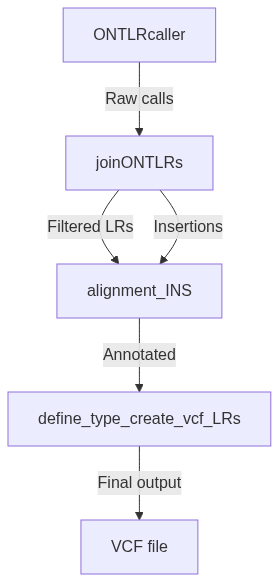
Detailed description of the algorithm
The eLaRodON algorithm is a specialized computational pipeline designed for comprehensive detection of large genomic rearrangements (LGRs) from Oxford Nanopore sequencing data. Unlike conventional tools developed primarily for germline variants, eLaRodON incorporates several innovative features specifically optimized for identifying somatic LGRs, including those supported by single reads. Input Processing
The algorithm begins by processing aligned sequencing data in BAM format. It performs chromosome-by-chromosome analysis to optimize memory usage, with an option to focus on specific genomic regions of interest. The tool only considers primary alignments containing complete mapping information to ensure analysis quality.
Core Detection Mechanism
1. Split-read Analysis:
- Identifies reads with fragments mapped to different genomic locations
- Detects strand changes and structural variants >50bp through CIGAR tag analysis
- Extracts all insertions and deletions from primary alignments
2. Junction Characterization:
Records all junction sites with their genomic features in two separate files:
- fusions.csv: Contains genome region junctions
- insertions.csv: Stores CIGAR-derived insertions
For fusion events, combines split reads corresponding to:
- Translocation boundaries (TRL)
- Inversion breakpoints (INV)
- Tandem duplication junctions (TD)
Variant Classification
The algorithm employs a sophisticated classification system that:
Merges Similar Events:
- Combines fusions and insertions across genomic regions
- Uses precise coordinates, strand orientation, and junction characteristics
- Optional merging via companion script for mechanistic studies
Insertion Sequence Analysis:
- Maps CIGAR-derived insertion sequences to reference genome using minimap2
- Reclassifies as tandem duplications when sequences map near original positions
Structural Annotation:
-
Determines LGR types using strand orientation and junction characteristics
-
Evaluates four key genomic features for each rearrangement:
- Proximity to repeat sequences and mobile elements (via vcfanno)
- Presence of 2-5 nucleotide microhomology
- ≥80% sequence similarity over ≤35 nucleotide homeology between breakpoints
- Presence of novel inserted sequences not matching either breakpoint region
Quality Assessment
eLaRodON incorporates several quality control metrics:
New Sequence Pattern (NSP) Scoring:
score=∑x ∈[An, Tn,Gn,Cn]1L(x)−L(s)/100score=∑x ∈[An, Tn,Gn,Cn]1L(x)−L(s)/100
- Identifies homopolymeric tracts (≥4bp) in novel junction sequences
- Helps discriminate true rearrangements from artifacts
Output Generation
The final output includes:
1. Comprehensive VCF File:
- Special tags for LGRs sharing coordinates but differing in variant type
- Annotations for:
- Intersection sequences (ISMFS tag)
- Novel inserted sequences (NSMFS tag)
- Microhomology/homeology patterns
- Repeat element proximity
2. Additional Outputs:
- Raw junction calls for downstream analysis
- Quality metrics for each detected variant
- Intermediate files for debugging and method development
Technical Innovations
Key algorithmic advancements include:
- Treatment of multiple split-reads as single sequences for accurate two-boundary detection
- Optional non-merging of similar LGRs to preserve mechanistic signatures
- Memory-efficient chromosomal processing
- Specialized handling of Nanopore-specific artifacts
The tool demonstrates particular strength in identifying complex rearrangements that most existing algorithms miss, including multiple tandem duplications, non-reciprocal translocations, and inversions with two defined boundaries. Its performance has been validated across multiple datasets, showing superior accuracy compared to existing tools like Sniffles2, NanoSV, and SVIM, particularly for variants in repetitive regions and those with low read support.
Installation
Prerequisites:
Python 3.7+

minimap2 (v2.24+)

vcfanno (v0.3.3+)

samtools (v1.15+)

htslib (v1.21+)

git (for cloning)
💡 Pro tip: see full list of program versions in requirements.txt
1. Clone the Repository
git clone https://github.com/aakechin/eLaRodON.git
2. Install Dependencies
pip install -r requirements.txt
3. Verify Installation
python3 ./eLaRodON-main/main.py -h
No errors = successful installation
Quick Start
Basic Pipeline Execution
python3 main.py \
    -dir ./results_elarodon \
    -bam sample.bam \
    -ref hg38.fa \
    -vcfanno path/to/vcfanno \
    -bed annotations.bed \
    -th 4
Detailed Usage
Core Arguments
| Parameter | Required | Description |
|---|---|---|
-bam, --bam_file |
Yes | BAM file |
-dir, --workdir |
Yes | Output directory |
-ref, --ref-genome |
Yes | Reference genome FASTA |
-bed, --bed-file |
Yes | Annotation BED file |
-vcfanno, --vcf-anno |
Yes | vcfanno executable path |
Processing Parameters
| Parameter | Default | Required | Description |
|---|---|---|---|
-div, --divide-chroms |
False | No | Divide chromosome to analyze |
-dvlen, --div-length |
None | No | Length of regions for division chromosome to analyze |
-len, --minimal-length |
50 | No | Min variant length (bp) |
-clip, --minimal-clipped-length |
100 | No | Min clipped length (bp) |
-dist,-dist-to-join-trl |
1000 | No | Min clipped length (bp) |
-join,-maximal-distance-join |
30 | No | Max distance for fusion joining (bp) |
-th, --threads |
4 | No | CPU threads |
-cont, --continue |
all | No | Name of stage for start: bam, join, def |
Special file names
| Parameter | Default | Required | Description |
|---|---|---|---|
-in, --input-files |
auto | No | Regular expression for CSV files |
-lrs, --output-lrs |
auto | No | CSV output file for LGRs |
-ins, --output-ins |
auto | No | CSV output file for INS |
-sam, --sam_file |
auto | No | SAM file with INS alignment |
Output Control
| Parameter | Default | Description |
|---|---|---|
-out, --out-vcf |
auto | VCF output filename |
-nrt_ins, --not-remove-trash-align |
False | Keep temp alignment files |
-nrt_anno, --not-remove-trash-anno |
False | Keep temp annotation files |
To view all parameters and their descriptions, you can use
python3 main.py -h
Output Files
Main Outputs
*.junction_stat.LRs_join100.csv - Merged large rearrangements

*.junction_stat.INS_join100.csv - Insertion calls

*_all_LGRS.vcf - Final annotated variants
Example
Input Preparation
samtools index sample.bam
Full Analysis
python3 main.py \
    -bam sample.bam \
    -dir lr_results \
    -ref hg38.fa \
    -vcfanno ~/tools/vcfanno \
    -bed repeats.bed \
    -th 8 \
Expected Output vcf
| #CHROM | POS | ID | REF | ALT | QUAL | FILTER | INFO | FORMAT | SAMPLE_NAME |
|---|---|---|---|---|---|---|---|---|---|
| chr12 | 3456789 | LR1 | N | DEL | 0.78 | PASS | SVTYPE=DEL;SVLEN=1200;CHROM2=chr12... | GT:DP:AD:VF | 0/1:330:1,329:0.0 |
| chr13 | 4123456 | INS1 | N | INS | 0.65 | PASS | SVTYPE=INS;SVLEN=350... | GT:DP:AD:VF | 0/1:244:1,243:0.0 |
Troubleshooting
Common Issues
Missing dependencies:
Error: minimap2 not found in PATH
Solution: Install via bioconda or add to PATH
Memory errors:
Killed (process exited)
Solution: Reduce thread count or increase memory
Too many open files
Solution:
Run before eLaRodN:
ulimit -n 4096
BAM index missing:
[E::idx_find_and_load] Could not retrieve index file for 'sample.bam'
Solution: Run samtools index sample.bam
Citation
Please cite:
eLaRodON: identification of large genomic rearrangements in Oxford Nanopore sequencing data
License


Download files
Download the file for your platform. If you're not sure which to choose, learn more about installing packages.
Source Distribution
Built Distribution
Filter files by name, interpreter, ABI, and platform.
If you're not sure about the file name format, learn more about wheel file names.
Copy a direct link to the current filters
File details
Details for the file elarodon-0.1.1.tar.gz.
File metadata
- Download URL: elarodon-0.1.1.tar.gz
- Upload date:
- Size: 56.2 kB
- Tags: Source
- Uploaded using Trusted Publishing? No
- Uploaded via: twine/6.1.0 CPython/3.12.7
File hashes
| Algorithm | Hash digest | |
|---|---|---|
| SHA256 |
aded7bb9bffd9a853d76f2fc1508b0688d3fbc06a0be77ef5ebf9b02975f7b2d
|
|
| MD5 |
03f3045478acafa8041ae47d1de5ae21
|
|
| BLAKE2b-256 |
2a6672654a57277d47ba6a00cb06872d34215573f8ce1e8afa4e20263ba83c94
|
File details
Details for the file elarodon-0.1.1-py3-none-any.whl.
File metadata
- Download URL: elarodon-0.1.1-py3-none-any.whl
- Upload date:
- Size: 53.9 kB
- Tags: Python 3
- Uploaded using Trusted Publishing? No
- Uploaded via: twine/6.1.0 CPython/3.12.7
File hashes
| Algorithm | Hash digest | |
|---|---|---|
| SHA256 |
d5b45f956d62ffe11cc8252c34fd688a0d149ad3b5a42846e8c776b1889aed67
|
|
| MD5 |
e100a9360901dda451058673868bd104
|
|
| BLAKE2b-256 |
cd20678a4b29bebee2db4389c0d3b15580ba3852851804730ff3acd08c2c63fb
|






