
elbow-helper
Noise-robust knee and elbow detection: it reports a knee with uncertainty; it abstains outright otherwise.
An algorithm can answer the question "where might a knee or an elbow be?" and it will always return something, even on a straight line or on pure noise. elbow-helper wraps a from-scratch knee locator in a conservative decision procedure that answers a harder question instead:
Is any candidate knee strong, unique, persistent, reproducible, and unlikely under a no-knee model? If not, say so.
The design priority is to minimise false-positive knees, even at the cost of more abstentions.
Status
Published on PyPI, six semantic-versioned releases so far (v0.1.0 through v0.1.5, see git tag), with CI green on every commit (Python 3.12, plus a weekly sweep across 3.10 to 3.13) and 85 tests (96% line coverage) covering the pipeline end to end plus the CLI, HTTP API and MCP surfaces. Still an early release (v0.1.x): treat the calibrated thresholds in RobustKneeConfig as a validated starting point, not a universal constant, see Configuration and Limitations below.
Documentation
Why it exists
A knee, on a curve of diminishing returns, marks the point past which extra input buys little extra output: more clusters in k-means, more iterations in an optimiser, more budget on a marketing channel. Existing knee-detection heuristics are excellent at proposing where that point sits, but they carry no notion of confidence. A single point estimate on a noisy curve is easy to over-trust in practice. This package turns that point estimate into a decision backed by evidence. It refuses to answer when the evidence is weak.
Dependencies
The whole package depends on numpy and os-helper only: nothing else, not even for the diagnostic figure. The knee-locating algorithm is implemented from scratch, in NumPy only, so there is no scipy, scikit-learn, statsmodels, or joblib runtime dependency. elbow_helper.plotting writes hand-authored SVG (see Diagnostics below) rather than reaching for matplotlib, so it needs no extra install. See Acknowledgements below for the implementation this algorithm follows.
Installation
pip install -e .            # everything: numpy + os-helper, diagnostics included
pip install -e ".[dev]"     # + pytest
Prefer conda? conda env create -f environment.yaml && conda activate elbow-helper sets up Python and pip, then installs from requirements.txt, the same dependency list pyproject.toml declares.
Quickstart
See EXAMPLES.md for more recipes: the k-means elbow, an explicit abstention, an exponential-saturation curve, the diagnostic figure, the standalone locator, and configuration tuning.
import numpy as np
from elbow_helper import robust_knee, RobustKneeConfig

x = np.linspace(0, 1, 80)
y = np.where(x <= 0.3, 3*x, 0.9 + 0.2*(x - 0.3))
y = y / y.max() + np.random.default_rng(0).normal(0, 0.02, x.size)

result = robust_knee(x, y, config=RobustKneeConfig(random_seed=0))

if result.is_clear:
    print(result.knee_x, result.ci90, result.detection_rate, result.null_p_value)
else:
    print("no clear knee:", result.reason)
curve and direction are optional: left unset, both are inferred from the data (see below) and can still be passed explicitly, e.g. robust_knee(x, y, curve="concave", direction="increasing", ...). y is optional too: call robust_knee(y) alone and x is taken to be the implicit 0, 1, ..., n-1.
For the classic k-means or scree "elbow" (convex, decreasing):
from elbow_helper import robust_elbow
result = robust_elbow(k_values, inertia)   # curve/direction fixed to convex/decreasing
Automatic shape and direction
Leaving curve or direction unset infers them from the cleaned, normalised data. direction comes from the sign of the trend between x and y. curve comes from whether the (lightly smoothed) curve lies above or below the straight chord connecting its first and last point: above is concave, below is convex, the mathematical definition, holding for both increasing and decreasing curves. This covers all four concave/convex × increasing/decreasing combinations without asking the caller to name the shape up front. Passing curve or direction explicitly always overrides the inferred value.
The contract: a tagged union
robust_knee always returns one of two types, both subclasses of KneeResult and distinguished by .is_clear:
ClearKnee:knee_x,knee_x_norm,knee_index,ci90(a 90% bootstrap interval, in data units),detection_rate,smoothing_window,sensitivity,prominence,slope_contrast,bic_improvement,null_p_value, and the fulldiagnostics.NoClearKnee: a machine-readablereasoncode plusdiagnostics.
You are forced to handle abstention explicitly: there is no silent fallback to a guess.
How it decides: the pipeline
- Preprocess. Clean, sort, deduplicate, and robustly normalise the data to the unit square, then screen its global shape with a Spearman correlation (a rank-based measure of how monotonic the curve is) and a magnitude-weighted monotonicity check.
- Scale-space search. Run the from-scratch locator across a grid of Gaussian smoothing windows and sensitivities; collect every candidate it proposes.
- Basic filters. Reject boundary knees, weak prominence, and a low prominence-to-noise ratio.
- Persistence clustering. Keep only knees that recur at a stable location across consecutive smoothing scales and most sensitivities. Abstain if two knees look equally plausible (
MULTIPLE_PLAUSIBLE_KNEES). - Model confirmation. Require a robust slope change, via a Theil-Sen estimator (a regression method that stays accurate even with outliers), plus a continuous broken-line fit that beats a single straight line on blocked cross-validation (holding out whole contiguous chunks of the curve rather than scattered points, so a held-out stretch cannot leak information from the smooth neighbours right next to it, the way a single held-out point could) and on the BIC (Bayesian Information Criterion, a score that rewards fit while penalising extra parameters).
- Bootstrap. Re-run the whole search on an IID residual bootstrap (independent, identically distributed resampling of the leftover noise). The knee must be redetected at least 90% of the time, with a tight, unimodal interval.
- No-knee null test. Run a Monte Carlo test against a straight-line null model that carries the accepted model's noise scale. The observed knee must be significant at p ≤ 0.01.
Only a candidate that clears every gate becomes a ClearKnee.
Abstention reason codes
INSUFFICIENT_DATA, INVALID_INPUT, ZERO_RANGE, INCOMPATIBLE_GLOBAL_SHAPE,
NO_KNEE_CANDIDATES, ALL_CANDIDATES_WEAK, NO_PERSISTENT_CLUSTER,
MULTIPLE_PLAUSIBLE_KNEES, BOUNDARY_KNEE, WEAK_SLOPE_CHANGE,
SEGMENTED_MODEL_NOT_BETTER, BOOTSTRAP_UNSTABLE, BOOTSTRAP_MULTIMODAL,
NULL_NOT_REJECTED, INTERNAL_NUMERICAL_FAILURE.
Configuration
Every threshold lives in RobustKneeConfig, a frozen dataclass; call config.with_(...) to change one. All positional thresholds are expressed in normalised x-range units. The shipped defaults suit a first practical prototype: modest replicate counts, so a run finishes in seconds.
RobustKneeConfig(bootstrap_replicates=100, null_replicates=200)
# validation-grade:
config.with_(bootstrap_replicates=500, null_replicates=1000)
A note on these thresholds: they are calibrated, conservative defaults, not universal constants. cluster_tolerance and max_neighbor_shift sit slightly above the reference plan's 0.05 to absorb the locator's one- or two-sample discretisation jitter at modest sample sizes (n of about 60 to 100). Recalibrate them against your own curve and noise family if needed.
Diagnostics
from elbow_helper.plotting import plot_diagnostics
plot_diagnostics(x, y, curve="concave", direction="increasing", out="diag.svg")
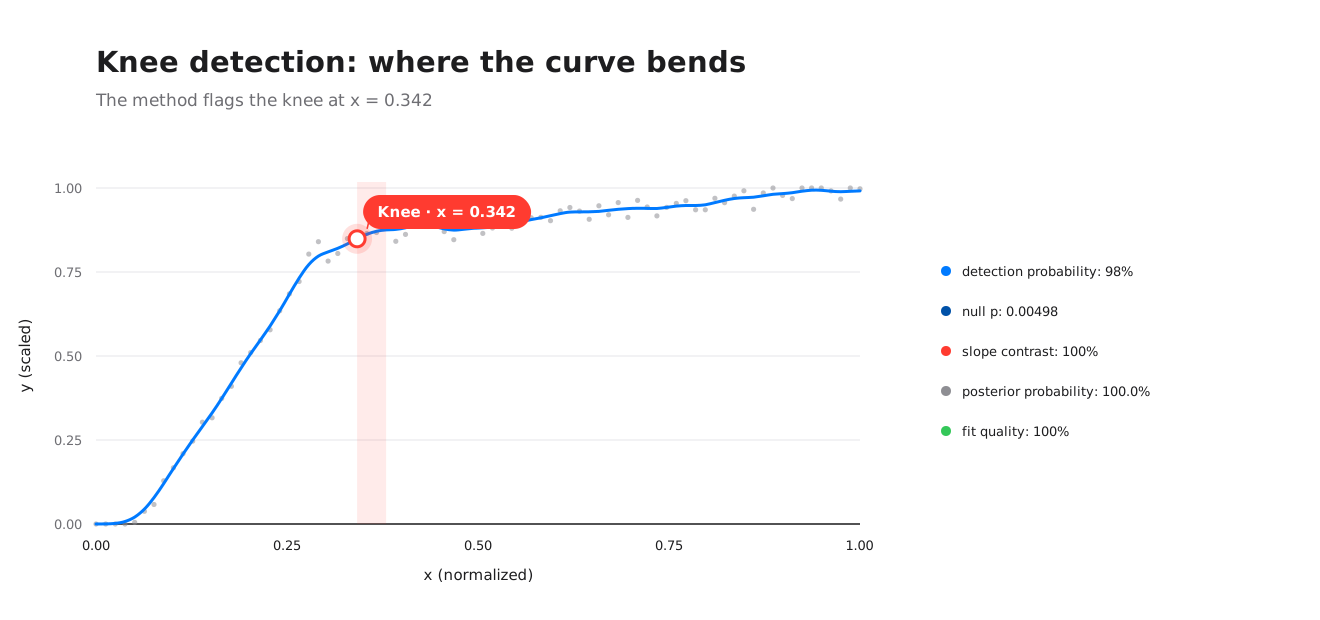
Hand-authored SVG, no matplotlib, no extra to install: the diagnostic is a core feature. The curve and its located knee sit next to a compact evidence legend backing the point estimate: the detection probability, the null-model p-value, the slope contrast, a BIC-derived posterior probability (the odds, under Kass & Raftery's Bayes-factor approximation, that the knee model is correct), and a fit-quality score normalized against a deliberately pessimistic worst case rather than the easily-beaten sample mean (see doc/ELBOW-en.tex for the derivation of both). When the evidence is too weak, the figure switches to an honest abstention state instead: a greyed, dashed curve and the reason, never a marker implying more confidence than the data supports. Pass language="fr" for the French chrome text.
Limitations
- The current smoother assumes a regular or near-regular spacing in
x. - Auto-detected
curveanddirectionneed a curve with a real, unambiguous trend; on data too weak or noisy to classify confidently, the pipeline abstains withINCOMPATIBLE_GLOBAL_SHAPErather than guessing, the same gate that already screens explicitcurve/directionarguments. - Detection is discretised to sample locations. On modest
n, the located knee can sit within a few samples of the truth (median error at or below about 5% of the x-range, on the supported synthetic family). - The straight-line null and the IID residual bootstrap suit roughly homoscedastic (constant-variance), uncorrelated noise. Wild or moving-block bootstrap variants are future work.
- No finite-data method is infallible. The targets above hold for the documented simulation family, not for every possible curve.
Standalone locator
The from-scratch locator is usable on its own:
from elbow_helper import KneeLocator
kl = KneeLocator(x, y, S=1.0, curve="concave", direction="increasing", online=True)
kl.knee, kl.all_knees
Multiple knees: robust_knees
robust_knee answers "is there one knee?". A curve with several genuine
regime changes, three pricing tiers on a demand curve, say, needs a
different question: how many breakpoints does this curve actually have and
where are they? robust_knees (plural) answers that one. It searches over every
possible number of segments with a dynamic program, scores each candidate
with a modified BIC (a fit-quality score that penalises extra breakpoints,
so adding one has to earn its keep), then confirms the winning count with a
permutation test: reshuffling the data thousands of times and checking that
the real fit stands out from nearly all of those random reshuffles, none of
which have any true breakpoint structure. Trying more breakpoint counts
means running more such tests; running more tests raises the odds that
one looks significant by pure chance. A Bonferroni correction counters this
by tightening the significance bar each individual test must clear, roughly
in proportion to how many are run, holding the overall false-positive rate
down as the search space grows.
import numpy as np
from elbow_helper import RobustKneesConfig, robust_knees

rng = np.random.default_rng(3)
x = np.linspace(0, 1, 100)
y = np.piecewise(
    x,
    [x < 0.3, (x >= 0.3) & (x < 0.65), x >= 0.65],
    [lambda t: 3 * t, lambda t: 0.9 + 0.2 * (t - 0.3), lambda t: 0.97 + 2.2 * (t - 0.65)],
) + rng.normal(0, 0.02, x.size)

result = robust_knees(x, y, config=RobustKneesConfig(random_seed=0, fwer_permutations=200))
print(result)
Knees(k=2, x=[0.2929, 0.6465])
The two breakpoints land close to the curve's true regime changes at 0.3 and
0.65. Unlike robust_knee, an empty result here is not an abstention: it is
the pipeline's confident conclusion that the curve has no real breakpoint,
having survived the same search and false-positive gates a nonempty result
would have had to survive. Only a preprocessing failure (bad input, too
little data, zero range) returns InvalidKnees instead of Knees. See
research/multiknee/RESULTS.md and doc/ELBOW-en.tex (sections 5-20) for
the validation behind this design.
Mathematics
doc/ELBOW-en.tex derives every formula this package runs: the single-knee pipeline's normalisation, Spearman screen, difference-curve knee search, persistence clustering, Theil-Sen slope, BIC, blocked cross-validation, bootstrap and null test, and the multi-knee research behind robust_knees (see also research/multiknee/RESULTS.md). It is written intuition-first, with a worked example before every formula, for readers anywhere from the end of high school to a Ph.D. in applied mathematics. Its Gaussian likelihood foundation, the general theory behind why L := exp(E[log p]) rather than a raw product, and how the same construction reads on a classification model, is factored out into a companion note, doc/LIKELIHOOD-en.tex, since that foundation doesn't depend on curve-fitting at all. Citations are in doc/references.bib, including a few pointers into my own Favourite AI books where a technique used here deserves a book-length treatment. Native LaTeX (not Markdown), given the audience: compile with latexmk -pdf ELBOW-en.tex (or LIKELIHOOD-en.tex) from inside doc/, or read the compiled copies directly, doc/ELBOW-en.pdf / doc/LIKELIHOOD-en.pdf. Both math notes are English-only; the rest of this project's docs (this README, EXAMPLES.md, LANDSCAPE.md) still ship a French twin.
Landscape
🗺️ Landscape (🇫🇷 PAYSAGE.md): how elbow-helper compares to kneed, ruptures, kneebow, Yellowbrick's KElbowVisualizer, R's segmented package, manual eyeballing and asking an LLM, rated on 11 criteria and positioned on a map built with principal component analysis (PCA), a method that finds the few directions along which the tools differ the most and collapses the 11 criteria down onto those two axes.
CLI / API / MCP
Beyond the Python library, elbow-helper exposes three more doors onto the same pipeline: an argparse CLI (always installed), a click CLI twin, and an HTTP API with an MCP server mounted on it. All four are thin adapters over the same shared core (elbow_helper._core_cli), so none of them can drift from what the library itself returns.
pip install -e .                 # library + argparse CLI
pip install -e ".[cli]"          # + the click twin
pip install -e ".[api]"          # + the FastAPI HTTP surface
pip install -e ".[mcp]"          # + the MCP server (pulls in [api] too)
# argparse (always available)
elbow-helper knee --y-values 0,0.1,0.3,0.6,0.85,0.9,0.92,0.93,0.94,0.95

# click twin
elbow-helper-click knee --y-values 0,0.1,0.3,0.6,0.85,0.9,0.92,0.93,0.94,0.95

# HTTP API
uvicorn elbow_helper.api:app --reload
curl -X POST localhost:8000/knee -d '{"x": [0,0.1,0.3,0.6,0.85,0.9]}'

# MCP (fastapi-mcp mounted on the same app, at /mcp)
uvicorn elbow_helper.mcp_server:app --port 8021
Every surface exposes the same four operations (knee, elbow, diagnostics, locator), matching robust_knee, robust_elbow, plot_diagnostics, and the standalone KneeLocator one-to-one. Data goes in as inline comma-separated values, a .npy file, or a CSV column (CLI), or a JSON body (x/y lists, HTTP). RobustKneeConfig overrides travel as --config-json '{"bootstrap_replicates": 500}' (CLI) or a config_overrides object (HTTP). The diagnostics operation returns the SVG itself, not a JSON wrapper around it.
Author
Acknowledgements
The from-scratch Kneedle implementation in elbow_helper/locator.py follows the algorithm described by Satopää, Albrecht, Irwin and Raghavan (ICDCSW 2011). Its traversal logic, orientation table and sensitivity threshold closely follow the implementation choices of kneed by Kevin Arvai, released under the BSD-3-Clause license:
Copyright (c) 2017, Kevin Arvai All rights reserved.
Redistribution and use in source and binary forms, with or without modification, are permitted provided that the following conditions are met: (1) redistributions of source code must retain the above copyright notice, this list of conditions and the following disclaimer; (2) redistributions in binary form must reproduce the above copyright notice, this list of conditions and the following disclaimer in the documentation and/or other materials provided with the distribution.
elbow-helper has no runtime dependency on kneed: the algorithm is reimplemented in NumPy only, with the scipy calls replaced as documented in locator.py.
License
BSD-3-Clause.
1 maintainer

Download files
Download the file for your platform. If you're not sure which to choose, learn more about installing packages.
Source Distribution
Built Distribution
Filter files by name, interpreter, ABI, and platform.
If you're not sure about the file name format, learn more about wheel file names.
Copy a direct link to the current filters
File details
Details for the file elbow_helper-0.1.6.tar.gz.
File metadata
- Download URL: elbow_helper-0.1.6.tar.gz
- Upload date:
- Size: 91.7 kB
- Tags: Source
- Uploaded using Trusted Publishing? No
- Uploaded via:
twine/6.2.0 CPython/3.13.13
File hashes
| Algorithm | Hash digest | |
|---|---|---|
| SHA256 |
efee3aa02d9baf83aad467e264608ed4224e5da38db960ba56c3e4aa61d8cd97
|
|
| MD5 |
d7504d129cb1d8680db8841f4711e06a
|
|
| BLAKE2b-256 |
5b1a770b03241eb9078ab464b1720f6b6b3dcb1a589735a8a74a70188c7fe051
|
File details
Details for the file elbow_helper-0.1.6-py3-none-any.whl.
File metadata
- Download URL: elbow_helper-0.1.6-py3-none-any.whl
- Upload date:
- Size: 80.5 kB
- Tags: Python 3
- Uploaded using Trusted Publishing? No
- Uploaded via:
twine/6.2.0 CPython/3.13.13
File hashes
| Algorithm | Hash digest | |
|---|---|---|
| SHA256 |
e50f1fff8da63211b7415a5d23dd814630ba932e22fc7a5b25cbe02c7b884449
|
|
| MD5 |
0e40e88769690e6d77360af59edd0c36
|
|
| BLAKE2b-256 |
f4499959f0be141bdee6202a4ddbd20d87a20a321a738f598de6ea0e55fe3c09
|














