
Production-grade Python toolkit for AI product engineering — LLM gateway, policy guardrails, RAG eval, agent collaboration, telemetry, and more.

Project description
ElectriPy Studio
Production-minded Python components and recipes (cookbook) by Inference Stack.


Overview
ElectriPy Studio is a curated collection of production-ready Python components and recipes designed to accelerate development while maintaining high code quality standards.
Design principles
- Ports & Adapters: swap providers (LLMs, embedders, vector stores) without rewriting business logic.
- Deterministic by default: stable IDs and reproducible evaluation runs.
- Safe logging posture: avoid leaking prompts/responses; prefer hashes + redaction seams.
- Typed, production APIs: small public surfaces, strict typing, structured outputs where it matters.
- Testability: unit tests are offline and deterministic by default (no network required).
How ElectriPy compares
ElectriPy is not a framework — it's a composable toolkit of production-grade building blocks for AI-powered Python applications. Here's how it relates to popular alternatives:
| Library | Stars | Overlap | ElectriPy's edge |
|---|---|---|---|
| LiteLLM | 40 k | Provider-agnostic LLM gateway | Bundles policy hooks, telemetry & structured output inline — no proxy server needed |
| Guardrails AI | 6.6 k | Input / output validation | Lighter-weight, composable policy gateway — no XML DSL or Hub dependency |
| CrewAI / AutoGen | 50 k+ | Multi-agent orchestration | Bounded & deterministic with hop limits; building-block, not a framework |
| RAGAS | 13 k | RAG evaluation metrics | Integrates eval directly into CLI & CI gating; ships with drift comparison |
| Instructor | 12.6 k | Structured LLM output | Wraps the pattern alongside retry, token budget & telemetry in one toolkit |
| Pydantic AI | 10 k+ | Typed AI agents | Narrower scope; ElectriPy ships concurrency, I/O, CLI & observability too |
| Haystack / LangChain | 40 k+ | Full RAG / agent framework | Composable building blocks you import — not a framework you adopt wholesale |
TL;DR — Use ElectriPy when you want discrete, well-typed utilities that compose into your architecture rather than a monolithic framework that owns it.
Status & recent updates
- Last updated: 2026-03-25
- Maturity: Early alpha (APIs may still evolve), but core components, CLI, concurrency primitives, and a growing suite of AI product engineering utilities are in place.
- Versioning: SemVer begins at
v0.x— expect breaking changes untilv1.0. - Recent highlights:
- Added
electripy demo policy-collabCLI command — run the full policy + agent collaboration pipeline offline with a Rich table report. - Added a Policy Gateway with regex-based detection, sanitization, deny/allow/require-approval actions across preflight, postflight, stream, and tool-call stages.
- Added a Agent Collaboration Runtime for bounded multi-agent orchestration with hop limits, deque-based message routing, and optional policy gateway integration.
- Added LLM Gateway request/response hooks and
build_llm_policy_hooks()bridge so policy decisions plug directly into the LLM call path. - Added an LLM Gateway for provider-agnostic LLM calls with structured output and safety seams.
- Added a RAG Evaluation Runner and
electripy rag evalCLI for benchmarking retrieval quality over JSONL datasets. - Added an AI Telemetry component for safe, provider-agnostic observability across HTTP resilience, LLM gateway, policy decisions, and RAG evaluation.
- Phase 1: Streaming chat, agent runtime, RAG quality/drift, hallucination guard, and response robustness utilities.
- Phase 2: Prompt engine, token budget management, context assembly, model routing, conversation memory, and tool registry.
- Expanded documentation and user guides for core, concurrency, I/O, CLI, AI, and observability components.
- Added
Features
- 🔧 Core Components: Configuration, logging, error handling, and type utilities
- ⚡ Concurrency: Retry mechanisms (sync/async) and async token bucket rate limiter
- 📁 I/O: JSONL read/write utilities for efficient data processing
- 💻 CLI: Typer-based command-line interface with health checks, RAG eval runner, and an offline demo showcase (
electripy demo policy-collab) - 🤖 AI building blocks: Provider-agnostic LLM Gateway with sync/async clients, request/response policy hooks, structured-output helpers, and a RAG Evaluation Runner for retrieval benchmarking.
- 📊 AI Telemetry: Provider-agnostic telemetry primitives and adapters (JSONL, optional OpenTelemetry) for HTTP resilience, LLM gateway, policy decisions, and RAG evaluation runs.
- 🧠 AI product engineering utilities: Streaming chat primitives, deterministic agent runtime helpers, RAG quality/drift metrics, grounding checks for hallucination reduction, response robustness helpers for structured outputs, prompt templating and composition, token budget tracking and truncation, priority-based context window assembly, rule-based model routing, sliding-window conversation memory, and a declarative tool registry with JSON schema generation.
- 🛡️ AI policy and collaboration runtime: Deterministic policy gateway checks for preflight/postflight/stream/tool flows, plus bounded agent-to-agent collaboration runtime for specialist orchestration patterns.
Quick Start
Using ElectriPy as a library
For most users, ElectriPy is just a Python library you depend on in your own project.
Install from PyPI:
pip install electripy-studio
To work against a local clone in editable mode (e.g., to experiment with changes while using it in another project):
pip install -e .
For development on this repo itself (full tooling and test extras):
pip install -e ".[dev]"
Verify Installation
electripy doctor
Basic Usage
from electripy import Config, get_logger
from electripy.concurrency import retry, AsyncTokenBucketRateLimiter
from electripy.io import read_jsonl, write_jsonl

# Configuration
config = Config.from_env()
logger = get_logger(__name__)

# Retry with exponential backoff
@retry(max_attempts=3, delay=1.0, backoff=2.0)
def fetch_data():
    return api_call()

# Rate limiting
limiter = AsyncTokenBucketRateLimiter(rate=10, capacity=10)
async with limiter:
    await rate_limited_operation()

# JSONL I/O
data = [{"id": 1, "name": "Alice"}, {"id": 2, "name": "Bob"}]
write_jsonl("output.jsonl", data)

for record in read_jsonl("output.jsonl"):
    print(record)
AI quick start (LLM + RAG eval)
- Run a basic RAG evaluation over JSONL datasets:
electripy rag eval --corpus data/corpus.jsonl --queries data/queries.jsonl \
    --top-k 3,5,10 --report-json out/report.json
- LLM Gateway usage (offline-friendly fake provider example): see recipes/02_llm_gateway/.
Demo: Policy Gateway + Agent Collaboration
Run the full pipeline offline — no API keys needed:
electripy demo policy-collab
Customise with --prompt and --max-hops:
electripy demo policy-collab --prompt "Alert user@corp.io about outage" --max-hops 6
See recipes/03_policy_collaboration/ for the standalone script.
Documentation
Full documentation is available in the docs/ directory:
- Installation Guide
- Quickstart
- Core Concepts
- Concurrency & Resilience
- I/O Utilities
- CLI Guide
- LLM Gateway & AI
- AI Telemetry
- AI Policy Gateway
- AI Agent Collaboration Runtime
- RAG Evaluation Runner
- AI Product Engineering Utilities
- Component Maturity Model
- Recipes
- API Reference
Build and serve docs locally:
pip install -e ".[docs]"
mkdocs serve
Visual Overview
Repository Map

Development Workflow
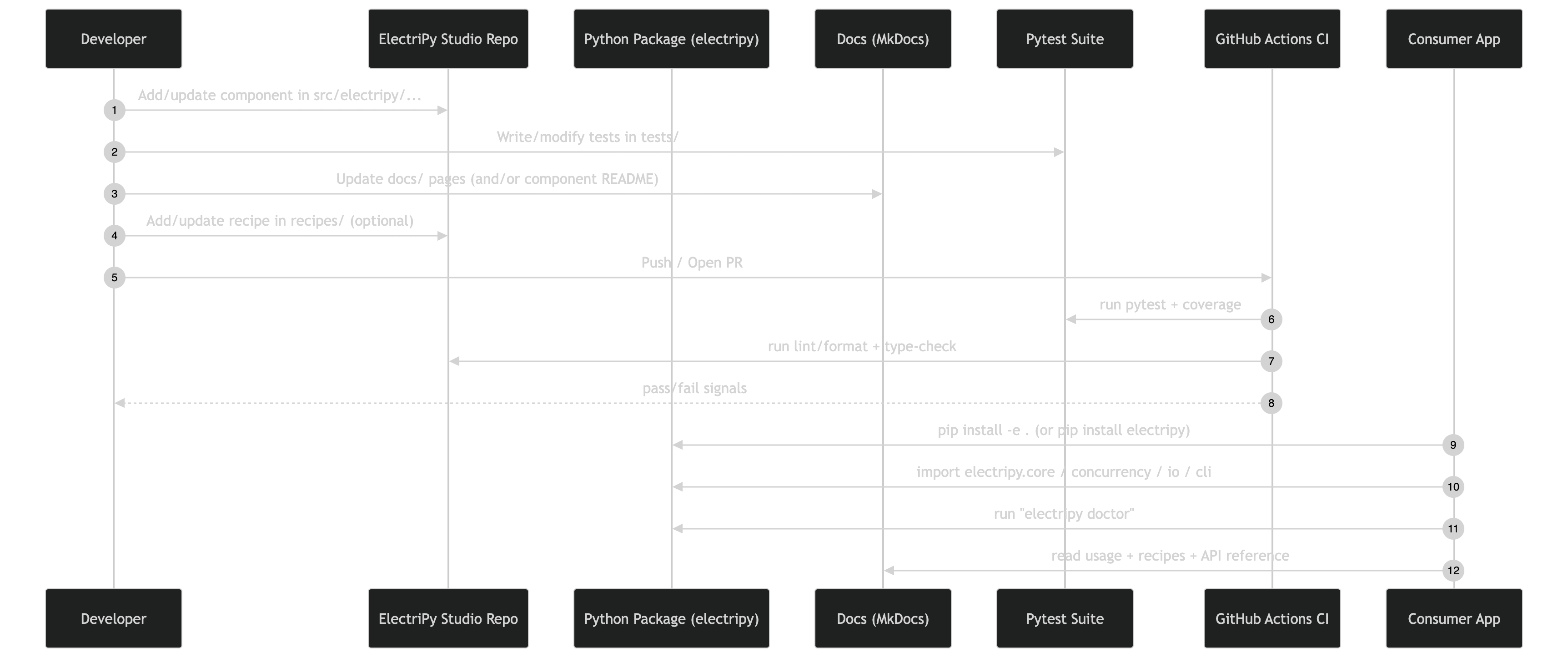
Project Structure
electripy-studio/
├── src/electripy/          # Main package
│   ├── core/               # Config, logging, errors, typing
│   ├── concurrency/        # Retry & rate limiting
│   ├── io/                 # JSONL utilities
│   ├── cli/                # CLI commands
│   └── ai/                 # AI building blocks and product-engineering utilities
│       ├── llm_gateway/    # Provider-agnostic LLM client + structured output helpers
│       ├── rag_eval_runner/# Dataset + eval runner + CLI benchmarking
│       ├── streaming_chat/ # Sync/async stream chunk and collection helpers
│       ├── agent_runtime/  # Deterministic tool-plan execution primitives
│       ├── rag_quality/    # Retrieval metrics and drift comparison helpers
│       ├── hallucination_guard/ # Grounding and citation checks
│       ├── response_robustness/ # JSON extraction/repair and output guards
│       ├── prompt_engine/       # Template composition and few-shot management
│       ├── token_budget/        # Pluggable token counting and truncation
│       ├── context_assembly/    # Priority-based context window packing
│       ├── model_router/        # Rule-based model selection and routing
│       ├── conversation_memory/ # Sliding window and token-aware chat history
│       ├── policy_gateway/      # Deterministic pre/post/tool/stream policy decisions
│       ├── tool_registry/       # Declarative tool definitions and JSON schema
│       └── agent_collaboration/ # Bounded multi-agent handoff orchestration
├── tests/                  # Test suite
├── docs/                   # Documentation
├── recipes/                # Example recipes
│   ├── 01_cli_tool/        # CLI tool example
│   ├── 02_llm_gateway/     # LLM gateway examples
│   └── 03_policy_collaboration/ # End-to-end policy + multi-agent flow
├── packages/               # NPM packages
│   └── electripy-cli/      # NPM CLI wrapper
├── pyproject.toml          # Project config
├── mkdocs.yml              # Docs config
└── LICENSE                 # MIT License
Development
Running Tests
pytest tests/ -v
With coverage:
pytest tests/ -v --cov=src --cov-report=term-missing
Code Quality
# Linting
ruff check .

# Formatting
black .

# Type checking
mypy src/
Python Tooling (recommended)
These tools are optional but recommended for contributors working on ElectriPy Studio itself. They are installed globally (via pipx) and then used inside whatever project or virtualenv you prefer.
1. Install global CLI tools with pipx
pipx lets you install Python CLIs in isolated environments, so they don't conflict with your project dependencies:
python -m pip install --upgrade pip

brew install pipx      # or see https://pipx.pypa.io for other platforms
pipx ensurepath

pipx install uv        # fast Python package/dependency manager
pipx install poetry    # project/virtualenv manager (optional; this repo uses pyproject + hatchling)
pipx install ruff      # fast linter (also available via .[dev] extra)
pipx install pre-commit  # git pre-commit hooks runner
2. Using uv (optional)
uv is a fast drop-in for many pip/python -m venv workflows. For example, to create a fresh environment for hacking on ElectriPy Studio:
uv venv .venv
source .venv/bin/activate

uv pip install -e ".[dev]"
You can also use uv pip install electripy-studio in your own projects.
3. Using poetry in your own projects (optional)
This repo is built with pyproject.toml + Hatchling, but you can happily consume ElectriPy from a Poetry-managed project:
poetry add electripy-studio
The library itself has no dependency on Poetry; it's just a convenient project manager if you already use it.
4. pre-commit (for contributors)
Once pre-commit is installed, enable the hooks defined in .pre-commit-config.yaml:
pre-commit install
This will automatically run Black, Ruff, and basic whitespace checks on changed files before each commit.
CI/CD
GitHub Actions automatically runs tests, linting, and type checking on all pull requests. See .github/workflows/ci.yml.
Recipes
Check out the recipes/ directory for complete examples:
- 01_cli_tool — Building a production-ready CLI tool
- 02_llm_gateway — LLM Gateway basics using a fake provider (offline-friendly)
- 03_policy_collaboration — End-to-end policy gateway + LLM hooks + multi-agent collaboration demo
Additional recipe guides are available in the docs:
- Policy Gateway recipe — standalone policy evaluation walkthrough
- Agent Collaboration Runtime recipe — bounded agent handoff patterns
- Policy + Collaboration E2E recipe — full pipeline with telemetry
- RAG Evaluation Runner recipe — benchmarking retrieval quality
- AI Telemetry recipe — wiring observability across components
Requirements
- Python 3.11 or higher
- Dependencies managed via
pyproject.toml
License
MIT License - See LICENSE for details.
Contributing
Contributions are welcome! Please read our Contributing Guide and Code of Conduct before submitting PRs. For security issues, see SECURITY.md.
Links


Download files
Download the file for your platform. If you're not sure which to choose, learn more about installing packages.
Source Distribution
Built Distribution
Filter files by name, interpreter, ABI, and platform.
If you're not sure about the file name format, learn more about wheel file names.
Copy a direct link to the current filters
File details
Details for the file electripy_studio-0.1.2.tar.gz.
File metadata
- Download URL: electripy_studio-0.1.2.tar.gz
- Upload date:
- Size: 116.3 kB
- Tags: Source
- Uploaded using Trusted Publishing? No
- Uploaded via: twine/6.2.0 CPython/3.11.2
File hashes
| Algorithm | Hash digest | |
|---|---|---|
| SHA256 |
38634c56aa8d9856a807bccb9a133c592ae3ef7075e206c0ddf960819a03b269
|
|
| MD5 |
bca42a1c150cee093b4c01d9ad8c9d2c
|
|
| BLAKE2b-256 |
1e42518353132f1e911535ae5bd39c8f6b9e32b7571244b74293faad712d5496
|
File details
Details for the file electripy_studio-0.1.2-py3-none-any.whl.
File metadata
- Download URL: electripy_studio-0.1.2-py3-none-any.whl
- Upload date:
- Size: 146.2 kB
- Tags: Python 3
- Uploaded using Trusted Publishing? No
- Uploaded via: twine/6.2.0 CPython/3.11.2
File hashes
| Algorithm | Hash digest | |
|---|---|---|
| SHA256 |
fee16d2eef85cef011e6fef7feee91d727d69426deba0080e3e9002f982a5e73
|
|
| MD5 |
4a8bf7f5020c058c546847b36931db95
|
|
| BLAKE2b-256 |
5b14cb2b62c720393eade6b5ad368ddca5b77a1ac0b336269e55f98ff225df1a
|






