
Elemctl
English · Русский
Documentation: docs.keyfire.ru/elemctl
A command-line tool, MCP server and Python library for managing applications on the 1C:Enterprise.Element cloud platform (1cmycloud.com) through Console API v2.
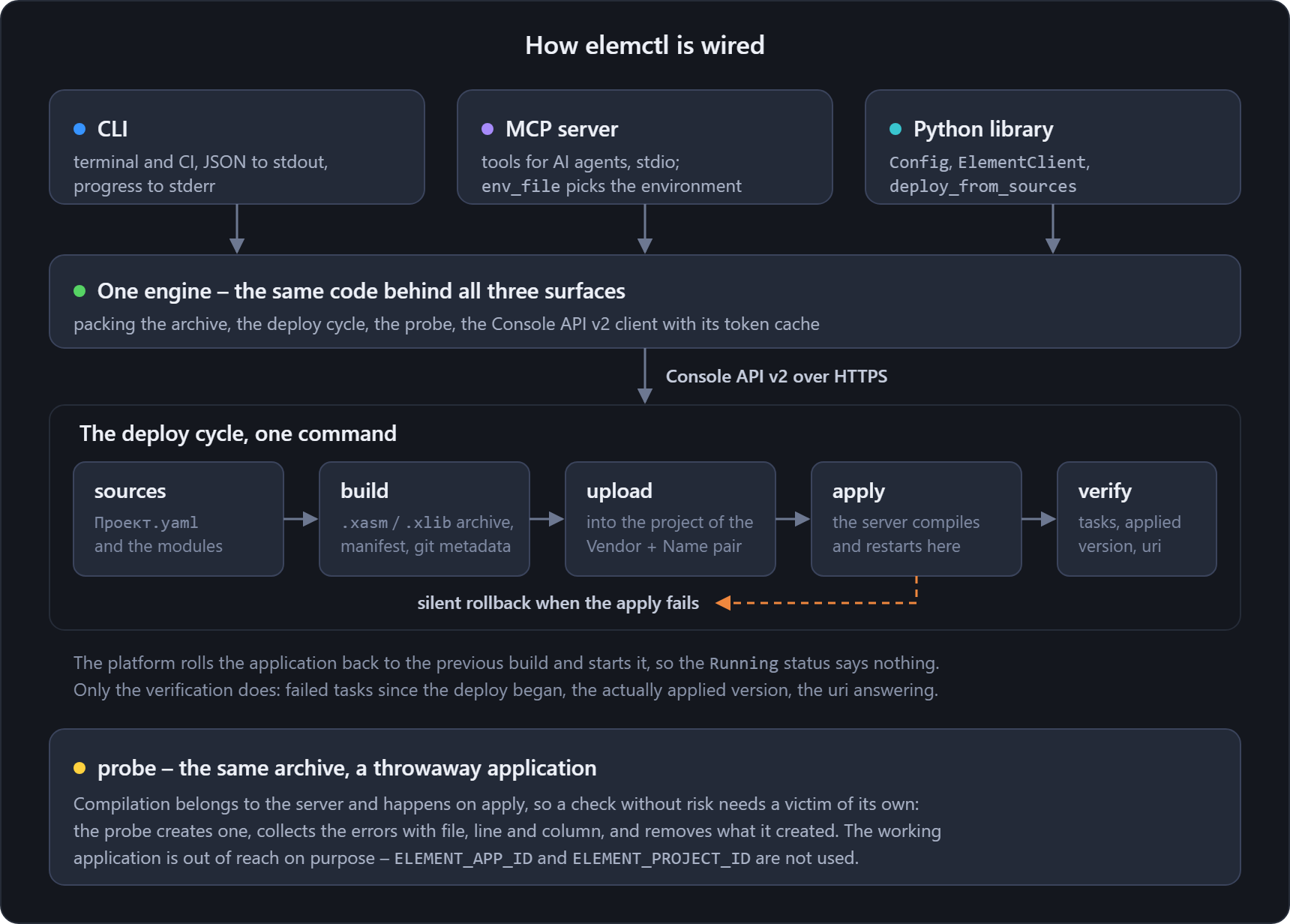
elemctl covers an application's lifecycle on the platform without the web console: create an application, build a .xasm/.xlib build archive from project sources, upload the build, apply it to the application and make sure the apply actually happened (the platform can silently roll back), check compilation with a probe that never touches the working application, and manage development-environment branches, dumps and the technology version. The same engine is available in three ways: the elemctl command for the terminal and CI, an MCP server for AI agents (Claude Code and other MCP clients), and the elemctl Python module for your own scripts.
elemctl is a CLI tool, MCP server and Python library for the 1C:Enterprise.Element (1cmycloud) Console API: manage applications, upload builds, deploy with honest apply verification and check compilation with a probe. The CLI output is plain JSON.
Development notes and updates (in Russian): the 1C × AI: engineering workshop Telegram channel.
Features
- Applications: list (with a client-side name filter and
--briefcards), details, create, start, stop, delete, technology version, debug-session data (apps debug). Commands addressing one application accept its id or its exact name. - Projects and builds: upload
.xasm/.xlib, list builds, delete. - Build from sources: package a project directory (
Проект.yaml+ modules) into a build archive with a manifest and git metadata. The version comes from the flag, the last build's counter or the CI run number in the environment (CI_PIPELINE_IID/GITHUB_RUN_NUMBER/BUILD_NUMBER), and the output carries it as a field. Descriptors written with English key spellings (Name/Vendor/Version) are read as well as Russian ones. - One-command deploy: build -> upload -> apply -> restart -> verification that the apply actually took effect. Uncommitted changes of the project directory are reported (
dirtyin the report);--require-cleanaborts on a dirty tree. - Compilation check without risking the application (
elemctl probe): the sources are compiled by the SERVER through a throwaway application, the errors come back with file, line and column, and the probe removes what it created. The working application is out of reach on purpose –ELEMENT_APP_IDandELEMENT_PROJECT_IDare not used. - User lists: the sign-in settings a control panel usually holds – self-registration and signing in with a login and a password (
elemctl user-lists). The list is addressed by id, by presentation or by the application whose own list it is. - Development-environment branches: list, create, bind to an application, merge.
- Dumps: create and check readiness.
- MCP server: the same operations exposed as tools for AI agents (Claude Code and other MCP clients).
- Plugins:
importlib.metadataentry points – an external package supplies the platform debug adapter (elemctl debug-adapter) and commands of its own without bloating the core. OneCommanddeclaration becomes both a CLI subcommand and an MCP tool, so a command that knows about your own environment lives in your package rather than in a public core. - Self-update:
elemctl self-update– update the package by unpacking the wheel, even whileelemctl.exeis held by a running MCP server (where plain pipx/pip would break the install). - In VS Code: deploy and debugging live in the XBSL extension – it calls elemctl:
elemctl deploybehind the deploy button,elemctl apps debugfor the debug-session coordinates.
Honest apply verification
A platform quirk: if a project apply fails, the platform silently rolls back the application to the previous build – the Running status says nothing about whether the deploy succeeded. elemctl deploy therefore does not trust the status and, after the deploy, checks:
- application tasks with the
Error/Failedstatus that started after the deploy began (old errors from the history are ignored); - the application's actual project version (
source.project-version) – it must match the build that was just uploaded; - the application uri's availability via a health-check HTTP request (informational, the
uri-statusfield in the report: 401/403 are normal for closed applications).
The deploy exit code is zero only if the build was actually applied.
Installation
pipx install elemctl            # or: pip install elemctl
pip install "elemctl[mcp]"      # with the MCP server
Python 3.10+ is required. The core and CLI have no external dependencies (standard library only).
Configuration
Connection credentials are taken from environment variables or from a .env file in the current directory (environment variables take priority):
| Variable | Purpose |
|---|---|
ELEMENT_BASE_URL |
the platform base URL, e.g. https://1cmycloud.com |
ELEMENT_CLIENT_ID |
Client-Id used to obtain a token |
ELEMENT_CLIENT_SECRET |
Client-Secret |
ELEMENT_APP_ID |
default application (optional) |
ELEMENT_PROJECT_ID |
default project (optional) |
ELEMENT_SPACE_ID |
default space (optional) |
ELEMENT_CA_FILE |
additional PEM CA bundle for a private cloud (optional) |
ELEMENT_TLS_STRICT |
strict RFC 5280 certificate checks; true by default |
ELEMENT_TLS_VERIFY |
certificate and hostname verification; true by default |
Client-Id/Client-Secret are issued in the 1cmycloud control panel (the Console API integrations section). A file template is .env.example.
Configuring with .env
Copy the template into the directory from which you will run elemctl:
cp .env.example .env
Then fill in at least the platform address, Client-Id and Client-Secret:
ELEMENT_BASE_URL=https://1cmycloud.com
ELEMENT_CLIENT_ID=client-id
ELEMENT_CLIENT_SECRET=client-secret
Without --env-file, the tool looks for a file named exactly .env in the
current working directory. That is not necessarily the project directory or
the directory where elemctl is installed. The elemctl repository excludes
.env from Git; if you create one in another repository, add .env to its
.gitignore. The file contains a secret and must stay out of commits and logs.
When the configuration lives elsewhere, pass it explicitly. An absolute path is more reliable for the MCP server, background jobs and CI:
elemctl --env-file /opt/elemctl/cloud.env apps list
The option is also accepted after the command:
elemctl apps list --env-file /opt/elemctl/cloud.env
A relative path is resolved from the current working directory. Separate files let one installation address multiple stands without changing process variables:
elemctl --env-file ./env/public-cloud.env apps list
elemctl --env-file ./env/local-cloud.env apps list
Example for a local cloud with a trusted but legacy internal CA that Python 3.13 rejects under strict RFC 5280 checks:
ELEMENT_BASE_URL=https://cloud.internal.example
ELEMENT_CLIENT_ID=client-id
ELEMENT_CLIENT_SECRET=client-secret
ELEMENT_TLS_STRICT=false
For an internal CA that is trusted but rejected by Python 3.13 with
Basic Constraints of CA cert not marked critical, set
ELEMENT_TLS_STRICT=false. This keeps certificate-chain, validity, signature,
and hostname verification enabled; it only relaxes OpenSSL's strict RFC 5280
profile. Prefer fixing or reissuing the CA certificate when possible.
Use ELEMENT_CA_FILE=/path/to/internal-ca.pem when the private CA is not in the
system trust store. ELEMENT_TLS_VERIFY=false disables both certificate and
hostname verification and is intended only as a last resort in an isolated test
network. With verification off every command prints a warning to stderr - stdout
keeps the answer, so a piped JSON output is not spoiled by it. Boolean values
accept true/false, yes/no, on/off, or 1/0.
ELEMCTL_NO_PROXY solves a different problem: it routes requests past the
environment's proxy. It can help when the proxy cannot reach an internal address
or replaces its certificate, but it does not disable server-certificate
verification. If the direct connection reaches the server and ends with
CERTIFICATE_VERIFY_FAILED, configure the trusted CA or ELEMENT_TLS_* options.
Behaviour of the tool
These are set through the environment only – a connection .env is not their place:
| Variable | Purpose |
|---|---|
ELEMCTL_LANG |
language of the messages and the help (ru, en); the --lang flag wins over it |
ELEMCTL_NO_PROXY |
set it to bypass the environment's proxy for every call (loopback and private addresses are bypassed anyway) |
ELEMCTL_NO_PLUGINS |
do not look for plugins: a run with the core capabilities only |
The CI environment
The build declares no variables of its own, but it reads the ones CI sets itself – which is why a pipeline needs neither a version flag nor an edit of the sources:
| Variable | Purpose |
|---|---|
CI_PIPELINE_IID |
run number; the build version suffix comes from it when there is neither --build-version nor a previous build |
GITHUB_RUN_NUMBER |
the same, second in order |
BUILD_NUMBER |
the same, third in order (the first NUMERIC value wins) |
CI_COMMIT_BRANCH |
the branch name for the manifest when git is in a detached HEAD |
CI_COMMIT_REF_NAME |
the same, second in order |
GITHUB_REF_NAME |
the same, third in order; the value HEAD is discarded and the field stays empty |
Quick start
# list applications
elemctl apps list

# application details (status, uri, actual project version)
elemctl apps get <app-id>

# create the application only if it does not exist yet:
# {"id": ..., "created": true|false, "sign-in": ...} - the last field is the way in
elemctl apps ensure acme-crm-dev --project-id <project-id> --latest-build --wait

# full deploy cycle from sources with apply verification
elemctl deploy --app-id <app-id> --project-id <project-id> --project-dir acme/crm

# compile the sources on the server without touching the working application:
# ok, plus errors with file, line and column; cleans up after itself
elemctl probe --project-dir acme/crm

# debug-session data: {"debug-token": ..., "debug-address": ...}
# (debugging must be enabled on the server: config/debug.yml enabled: true)
elemctl apps debug <app-id>

# only build the .xasm archive, without uploading it anywhere
elemctl build --project-dir acme/crm --output ./dist

# parse a built archive: manifest, subsystems, global types with qualified names
elemctl inspect ./dist/e1c-CurrencyConverter-2.0.xlib

# forbid signing in by password and self-registration in the application's user list
elemctl user-lists password-login --app crm-dev --disable
elemctl user-lists self-registration --app crm-dev --disable

# merge changes from a development-environment branch
elemctl branches merge <branch-id>
All commands output JSON to stdout; progress of long-running operations goes to stderr. Errors are returned as a JSON object with an error field and exit code 1.
For the full list of commands: elemctl --help, and by group: elemctl apps --help, elemctl deploy --help, etc.
Language
Error and progress messages, and the --help text, come in Russian and English (the JSON result is language-neutral). The language is picked by --lang ru|en > the ELEMCTL_LANG env var > the system locale (LC_ALL, then LANG) > Russian; --lang is read before the parser is built, so elemctl --lang en --help prints English help.
MCP server
The server exposes platform operations as MCP tools (stdio transport):
pip install "elemctl[mcp]"
claude mcp add elemctl -- elemctl mcp
The server reads connection credentials from the same ELEMENT_* variables / .env.
Tools
| Tool | What it does |
|---|---|
list_apps |
list of applications; name filters by a substring of the name on the client, brief (the default) keeps id, name, status, uri and the applied version |
find_app |
find an application by its exact name: the id and a found flag; deleted ones are skipped unless include_deleted is set |
get_app |
application card: status, uri, the actual project version |
create_app |
create an application; with only a project_id the source is the project's latest build. The answer carries sign-in – the way in |
ensure_app |
create an application by name only if it does not exist yet; an existing one is not recreated (created: false) |
start_app |
start the application |
stop_app |
stop the application |
delete_app |
delete the application. IRREVERSIBLE: the data is lost, and a recreated application gets a different URL |
list_app_tasks |
tasks of the applications; app_id is an optional filter |
debug_info |
debug-session data: debug-token and debug-address (debugging must be enabled on the server) |
list_spaces |
list of spaces |
list_projects |
list of projects; brief (the default) – id, name, project kind, space, application count, deletion flag |
list_builds |
list of a project's builds, newest first; limit (default 10, 0 – all), brief (the default) keeps id, versions, date, branch and commit |
build_assembly |
build a .xasm/.xlib archive from the sources locally (does not talk to the platform) |
inspect_assembly |
parse a built archive: manifest, project properties, subsystems and global types with qualified names (local) |
deploy |
the whole cycle from sources with the honest apply verification; the verdict is ok, the details are problems and log |
probe |
check the compilation with the server compiler WITHOUT touching the working application; errors with file, line and column, cleans up after itself |
apply_build |
apply an uploaded build to the application by its id |
verify_deploy |
verify the apply actually took effect: failed tasks, the applied build, the availability of the uri |
list_user_lists |
user lists; name filters by a substring of the presentation |
configure_user_list |
self-registration and password sign-in; without the flags it only reports the current state |
list_branches |
list of development-environment branches; the project_id and name filters are optional |
merge_branch |
accept the changes of a development-environment branch |
debug_adapter |
the path to the platform debug adapter from a plugin; a missing plugin is an answer (found: false), not an error (local) |
The tools a plugin brings stand next to these (see below).
A single environment is not a limit: every tool that talks to the platform takes an optional env_file - a path to another installation's .env. One server thus serves both the cloud and a local installation without a restart with different credentials. list_apps returns brief cards by default (id, name, status, uri, applied version): full cards of a whole space are tens of thousands of characters in an agent's response - pass brief=false for them; its name parameter filters by a case-insensitive substring on the client (the platform ignores the query parameter). list_projects behaves the same way (id, name, project kind, space, application count, deletion flag), and so does list_builds (id, versions, date, branch, commit) - which on top of that answers with the ten newest assemblies unless limit says otherwise (0 lifts the cut): a long-lived project holds assemblies by the thousand. get_app, delete_app, start_app, stop_app and debug_info accept the application id (UUID) or its exact name - a non-UUID value is resolved through the list, and several matches are an error rather than a guess. create_app and ensure_app add a sign-in field to the answer – the address and the account that gets into a freshly created application (a CONTROL PANEL one; the accounts of an external provider do not work there) – because an agent sees only the JSON.
Plugins
elemctl discovers external packages through importlib.metadata entry points: it declares nothing about plugins in its own pyproject.toml and reads them on demand. This keeps non-publishable vendor artifacts in a separate package while the elemctl core stays clean and public.
elemctl.debug_adapter – a plugin package declares the directory of the platform debug adapter (proprietary 1C jars, not shipped with elemctl). The entry-point value is a path or a zero-argument callable returning a path; the path points to a directory that contains a repo/ subdirectory with the adapter jars.
elemctl.commands – a plugin package brings commands of its own. The entry-point value is a Command, a list of them, or a zero-argument callable returning either. ONE declaration gives both surfaces: elemctl builds a CLI subcommand out of it and an MCP tool with a proper schema, and knows nothing about what the command does. That is where a command belongs when it is about your own environment – internal circuits, other systems, your stands – and therefore has no place in a public core.
# a plugin package's pyproject.toml
[project.entry-points."elemctl.debug_adapter"]
name = "my_package:adapter_root"     # () -> Path to the directory containing repo/

[project.entry-points."elemctl.commands"]
name = "my_package.commands:commands"   # () -> list[Command]
# my_package/commands.py
from elemctl.plugins import Argument, Command

def warm_up(context, stand="", force=False):
    context.log(f"warming up {stand}")          # progress: stderr in the CLI, the log field in MCP
    card = context.client.get_app(stand)        # the client is built on first use
    return {"ok": True, "status": card.get("status")}

def commands():
    return [Command(
        name="warm-up",
        help="open the admin page of a fresh stand",
        handler=warm_up,
        arguments=[Argument("--stand", help="the application"), Argument("--force", type=bool)],
    )]
The result of a handler has to be JSON-serializable: the CLI prints it, the MCP tool returns it. A result that is a dict with "ok": false gives exit code 1 in the CLI – the same convention the reports of deploy and probe follow. Argument types are str, int, float and bool (a flag); env_file is added to the MCP tool by elemctl, so a plugin command reaches other environments exactly like the core tools do. A command may not take over a name the core already occupies – that is an error, not a silent override.
# the adapter path from the installed plugin (for the VS Code extension):
# {"path": "...", "found": true} or {"path": null, "found": false}
elemctl debug-adapter

# what the plugins bring – adapter directories and commands
elemctl plugins
The adapter itself (proprietary 1C jars) is extracted from the platform distribution by tools/extract_adapter.py – into a directory for a manual xbsl.debug.adapterPath, or for building the plugin package. The script is not shipped in the package distribution.
Plugin discovery is disabled by ELEMCTL_NO_PLUGINS=1 (a run with the core capabilities only).
VS Code
A companion extension integrates elemctl into the editor:
- XBSL (the
xbsl project) – highlighting, linting, the form designer,
the metadata tree, the XBSL: deploy the project button that runs
elemctl deployas a terminal task with the apply verification, and debugging 1C:Element applications with the platform's DAP adapter, whose session data comes fromelemctl apps debug. Debugging used to be a separate XBSL Debug extension living in the elemctl repository; since XBSL 0.57 it is part of the one extension, and the repository keeps only the elemctl side of it.
It is also published to Open VSX.
Use as a library
from elemctl import Config, ElementClient
from elemctl.deploy import deploy_from_sources

client = ElementClient(Config.from_env())
apps = client.list_apps()

report = deploy_from_sources(
    client,
    app_id="...",
    project_id="...",
    project_dir="acme/crm",
    log=print,
)
assert report.ok, report.problems
A compilation check that does not touch the working application – the same cycle
the probe command runs:
from elemctl.probe import probe_project

report = probe_project(client, project_dir="acme/crm", log=print)
for error in report.errors:
    print(f"{error['file']}:{error['line']}:{error['column']} {error['message']}")
assert report.ok, report.messages
Build format
.xasm (application) and .xlib (library) are a ZIP archive:
Assembly.yaml            # manifest: ProjectKind, Vendor, Name, Version, ...
{vendor}/{name}/...      # project files: .yaml, .xbsl, resources
The project directory must follow the {repo}/{vendor}/{name}/Проект.yaml layout – paths inside the archive are built relative to the repository root. The project kind (application/library) is determined by the ВидПроекта field in Проект.yaml. When an application references libraries whose source projects are present under the same repository root, their files are included in the application archive automatically (including transitive local dependencies). A referenced library that is not present locally remains an external platform dependency.
Limitations and status
- The tool is unofficial and not affiliated with 1C Company; the Console API may change without notice.
- Only the documented Console API v2 is used – the tool does not call or describe the platform console's internal APIs.
- Creating an application from
--project-idalone produces, on some platform configurations, an empty skeleton without project data. The reliable path is a build source:elemctl apps create <name> --project-id <id> --latest-build(thecreate_appMCP tool substitutes the latest build automatically), followed byelemctl deployafter creation. - An application created with an
Errorstatus is described by the platform only as "Неизвестная ошибка. Обратитесь к администратору"; the details - files, lines and columns of the compilation errors - live in the application's task.apps create --waitandapps ensureprint them after the generic text, the waydeployandverifyhave long done, so there is no need to dig through the server log. - There is no way to compile the sources without creating something on the platform: compilation is the server's and it happens when a build is applied. That is what
probeis for – it takes the hit on a throwaway application instead of the working one. A probe run costs as long as creating an application does (minutes), so it belongs before a deploy or in CI, not in a per-keystroke loop. - A platform project is identified by the
Vendor+Namepair of the manifest, not by theИдofПроект.yaml: a build upload without a project id lands in the project that already owns the pair, and a second project for the same pair is refused with a 409. - A freshly created application is signed in to with a CONTROL PANEL account: it gets its OWN, empty user list, password sign-in is off and no account service is attached, so the accounts used to sign in to other applications do not work here – and neither connecting another application's user list nor enabling the local sign-in changes it.
apps createandapps ensuresay so themselves: thesign-infield of the answer plus the same on stderr. - Deleted applications remain in the platform's list with a
Deletedstatus and their formerid, on whichapps getanddeployreturn 404.apps findandapps ensureskip them; to restore the previous search behavior, useapps find --include-deleted. - The platform will not let you delete an application that has unpublished changes in the development environment (HTTP 400
FAILED_PRECONDITION), and there is no forced deletion in the Console API – only through the control panel; elemctl points this out in the error message. - Recreating an application (delete + create) changes its URL – external settings tied to the address (OIDC redirect, etc.) will need to be updated. There is no "soft" wipe of application data in the Console API; it is done in the management console.
Origin and legal notes
The code is written from scratch against the platform's external interface specification – the process and guarantees are described in ORIGIN.md. Trademarks and the absence of affiliation with 1C Company are covered in the NOTICE file.
License
1 maintainer

Download files
Download the file for your platform. If you're not sure which to choose, learn more about installing packages.
Source Distribution
Built Distribution
Filter files by name, interpreter, ABI, and platform.
If you're not sure about the file name format, learn more about wheel file names.
Copy a direct link to the current filters
File details
Details for the file elemctl-0.32.3.tar.gz.
File metadata
- Download URL: elemctl-0.32.3.tar.gz
- Upload date:
- Size: 264.2 kB
- Tags: Source
- Uploaded using Trusted Publishing? Yes
- Uploaded via:
twine/7.0.0 CPython/3.13.14
File hashes
| Algorithm | Hash digest | |
|---|---|---|
| SHA256 |
3973613dab59d4a1335fa49b275eee270a8296cbe536887780ab35e2dc2b6b87
|
|
| MD5 |
ce7e0012a53ea063426e979943cc0886
|
|
| BLAKE2b-256 |
d8c8773be12dce114e57d0036a6d71a754d6122b387345eee7e424671c7eff42
|
Provenance
The following attestation bundles were made for elemctl-0.32.3.tar.gz:
Publisher:
pypi-publish.yml on keyfire/elemctl
-
Statement:
-
Statement type:
https://in-toto.io/Statement/v1 -
Predicate type:
https://docs.pypi.org/attestations/publish/v1 -
Subject name:
elemctl-0.32.3.tar.gz -
Subject digest:
3973613dab59d4a1335fa49b275eee270a8296cbe536887780ab35e2dc2b6b87 - Sigstore transparency entry: 2649179066
- Sigstore integration time:
-
Permalink:
keyfire/elemctl@831ccd4d63fca38be21ebe938886a436aea6c32b -
Branch / Tag:
refs/tags/v0.32.3 - Owner: https://github.com/keyfire
-
Access:
public
-
Token Issuer:
https://token.actions.githubusercontent.com -
Runner Environment:
github-hosted -
Publication workflow:
pypi-publish.yml@831ccd4d63fca38be21ebe938886a436aea6c32b -
Trigger Event:
push
-
Statement type:
File details
Details for the file elemctl-0.32.3-py3-none-any.whl.
File metadata
- Download URL: elemctl-0.32.3-py3-none-any.whl
- Upload date:
- Size: 107.7 kB
- Tags: Python 3
- Uploaded using Trusted Publishing? Yes
- Uploaded via:
twine/7.0.0 CPython/3.13.14
File hashes
| Algorithm | Hash digest | |
|---|---|---|
| SHA256 |
96d206733e5d8269f692eb6f52521f8ad6e11140e6cd2b38e49f64dd0c4dd562
|
|
| MD5 |
7360fc59f7b116736ffeb3637f63fbe7
|
|
| BLAKE2b-256 |
0a8e0a4c13030b1b2b0483b31387793fa24c05496ee4d9ddeabd88e689cdd952
|
Provenance
The following attestation bundles were made for elemctl-0.32.3-py3-none-any.whl:
Publisher:
pypi-publish.yml on keyfire/elemctl
-
Statement:
-
Statement type:
https://in-toto.io/Statement/v1 -
Predicate type:
https://docs.pypi.org/attestations/publish/v1 -
Subject name:
elemctl-0.32.3-py3-none-any.whl -
Subject digest:
96d206733e5d8269f692eb6f52521f8ad6e11140e6cd2b38e49f64dd0c4dd562 - Sigstore transparency entry: 2649179117
- Sigstore integration time:
-
Permalink:
keyfire/elemctl@831ccd4d63fca38be21ebe938886a436aea6c32b -
Branch / Tag:
refs/tags/v0.32.3 - Owner: https://github.com/keyfire
-
Access:
public
-
Token Issuer:
https://token.actions.githubusercontent.com -
Runner Environment:
github-hosted -
Publication workflow:
pypi-publish.yml@831ccd4d63fca38be21ebe938886a436aea6c32b -
Trigger Event:
push
-
Statement type:














