
emBEADings


Find engineering work that may trip over the same code—without changing the tracker or sending issue text to an embedding API.
emBEADings is a read-only coordination CLI for Beads and Linear. It combines typed tracker relationships, local semantic retrieval, explicit code pointers, and genuine Git worktree changes into a bounded, deterministic review queue.
Dependencies answer “what blocks this?” emBEADings asks “what else should I inspect before these changes merge?” It provides evidence, not an automatic verdict.
Status: v0.4 technical preview. The CLI and GitHub release are public; the bundled Codex and Claude Code plugin is still a local developer preview.
Quick start
Python 3.11 or later is required. The default Beads source also requires an installed bd CLI.
pipx install embeadings
# or: uv tool install embeadings

# Check the environment without loading issue text
embead doctor

# Produce a bounded coordination packet
embead triage

# Find active work touching the same files or modules
embead collisions

# Inspect semantic neighbors for one record
embead neighbors ISSUE_ID --include-closed

# Find the stragglers: similar records with no structural link
embead neighbors ISSUE_ID --orphans-only
Without pipx or uv, the standard library is enough:
python3 -m venv .venv
. .venv/bin/activate  # Windows PowerShell: .venv\Scripts\Activate.ps1
python -m pip install embeadings
For an immutable GitHub fallback, install the verified release wheel directly:
python -m pip install \
  "https://github.com/DyrtyJax/embeadings/releases/download/v0.4.3/embeadings-0.4.3-py3-none-any.whl"
The first semantic command downloads the pinned
minishlab/potion-base-8M model. Embedding happens
locally. collisions does not load an embedding model.
Release assets include a source archive and SHA256SUMS. See the
v0.4.3 release for versioned artifacts and
checksums.
What a lead looks like
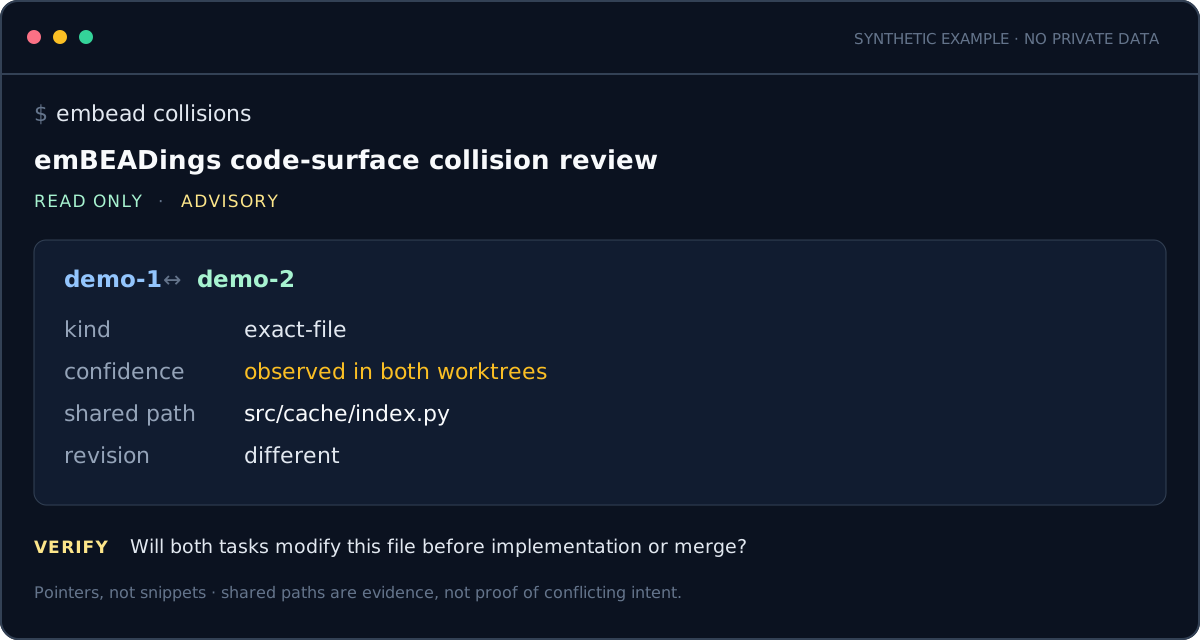
This shortened example is derived from the committed synthetic collision fixture:
{
  "issue_id": "demo-1",
  "related_issue_id": "demo-2",
  "kind": "exact-file",
  "confidence": "observed",
  "shared_paths": ["src/cache/index.py"],
  "evidence_sources": ["active-worktree-diff"],
  "what_to_verify": "Verify whether concurrent work will modify the shared file paths before implementation or merge."
}
The full report also records repository provenance, revision relation, hub suppression, warnings, and
the read-only policy. It contains pointers rather than source snippets. See
examples/collisions.json
and the
example guide.
Why trust it?
| Evidence | Result | Boundary |
|---|---|---|
| Concurrent-worktree release gate | Recovered all 3 known exact-file collisions across 4 genuine active worktrees | One repository; not universal recall |
| Dogfooding | Found 2 real association/scope defects before v0.4.0 | Demonstrates workflow value, not broad precision |
| Ruff scale surrogate | 17/20 top-packet pairs were at least contextually useful across 8,143 public issues | Converted GitHub corpus; no native Beads graph or worktrees |
| Release validation | Full CI passed across Linux, macOS, Windows, Python 3.11 and 3.14; wheel/sdist checksums and provenance published | Supply-chain and test evidence, not semantic quality |
| Repeatability | Evaluation outputs were byte-stable and non-mutating | Determinism does not make a weak lead correct |
Read the dogfood release-gate story, aggregate v0.4.0 worktree gate, Ruff scale review, and the research index for methods, failure patterns, and limitations.
How it works
Beads or one Linear team
        │
        ├── typed relationships and lifecycle
        ├── explicit paths and observed worktree changes
        └── local whole-record and field-level embeddings
                              │
                              ▼
                   bounded candidate union
                              │
                              ▼
                evidence receipts + review packet
triage is the opinionated front door. It admits at most 20 semantic candidates by default, includes
code-surface analysis when genuine local Git evidence exists, and writes a complete audit report to
external user state. Use sweep for experimental policy controls and neighbors for one-record
inspection. The default is a reviewer-capacity budget, not corpus coverage; see the
review-budget decision.
For triage, sweep, and batch, use --output-dir DIRECTORY when you want the complete JSON,
Markdown, and per-batch artifact set. Use --output report.json or --output report.md for one
primary report file; the extension chooses the file format independently of --json stdout.
Any other --output PATH remains a backward-compatible directory spelling. neighbors and
collisions always treat --output as one atomic report file.
collisions reviews open, in_progress, and blocked work by default. It associates Git worktrees
when a branch contains a full Bead ID or unambiguous bead-N suffix. Explicitly map an otherwise
unassociated worktree with:
embead collisions --worktree-map embead-42=../feature-worktree
Never fabricate a mapping: observed evidence must describe genuine active implementation work. Shared paths are coordination evidence, not proof that two tasks conflict.
Linear
Create a personal API key in Linear's Security & access settings and load it without placing the value directly in a shell-history entry:
LINEAR_API_KEY="$(python -c 'import getpass; print(getpass.getpass("Linear API key: "))')"
export LINEAR_API_KEY

embead --source linear --linear-team ENG triage
embead --source linear --linear-team ENG collisions
LINEAR_ACCESS_TOKEN accepts an OAuth token instead; set only one credential. The CLI queries one
selected team through Linear GraphQL and does not reuse credentials held by an MCP or agent host. See
the Linear adapter contract.
Privacy and data boundary
- Tracker adapters contain no mutation operations.
- The default model embeds issue text locally; issue text is not sent to Hugging Face.
- Linear mode sends tracker queries only to Linear itself.
- Models and vectors use the platform user cache; reports use the platform user state directory.
- Neither cache nor reports are written into the analyzed repository by default.
- Collision reports contain code pointers, not source snippets.
- A human or coordinator must verify every lead before changing tracker or source state.
The first model download is network activity. Prepare it before loading private issues when evaluating under OS-level network denial. See the safe offline evaluation guide.
Good fit / poor fit
emBEADings is most useful when a tracker is too large for repeated full-context review, several people or agents work concurrently, and the team values a reproducible offline shortlist.
It is less useful for a small tracker that one reviewer can read directly, repositories without meaningful tracker-to-code evidence, or teams seeking automatic issue mutation, orchestration, a dashboard, or a general memory system. Typed dependencies remain tracker truth; semantics complement them rather than re-deriving authority.
Development
Every clone or Git worktree must own its virtual environment:
python3 scripts/worktree_env.py
. .venv/bin/activate  # Windows PowerShell: .venv\Scripts\Activate.ps1
python scripts/validate.py
The bootstrap refuses to reuse an active environment from another checkout. Validation checks the
editable embead import target before formatting, lint, tests, and release checks. Read
CONTRIBUTING.md
before submitting fixtures or reports; private tracker content
must never be committed.
Agent plugin preview
plugins/embeadings
packages triage, collisions, and evaluate
skills for local Codex and Claude Code development. It delegates to the installed CLI, forces schema-v1
JSON, and verifies the read-only policy. It is not yet a marketplace release and grants no tracker-write
authority.
Documentation
- Documentation index
- CLI and product specification
- Consumer and schema contract
- Performance and scale evaluation
- Research and evaluation ledger
- Versioned JSON Schemas and synthetic examples
Principles
- Read-only means read-only. Analysis never closes, edits, labels, or reprioritizes work.
- The tracker remains authoritative. Structure and lifecycle stay tracker data.
- Local-first and private. The default semantic provider sends no issue content to a network API.
- Bounded and auditable. A stable receipt explains what entered or was omitted from the queue.
- Agent-neutral. Core analysis does not depend on Codex, Claude Code, Cursor, or another runtime.
MIT licensed. emBEADings is not affiliated with Beads or Linear.
1 maintainer

Release files for embeadings 0.4.3
For a detailed explanation of source distributions (sdists) and built distributions (wheels), please see the package formats documentation.
Source distribution (sdist)
| File | Size | Uploaded | |
|---|---|---|---|
| embeadings-0.4.3.tar.gz | 98.9 kB | Details |
Built distribution (wheel)
| File | Interpreter | ABI | Platform | Reset |
|---|---|---|---|---|
| embeadings-0.4.3-py3-none-any.whl | Python 3 | none | any | Details |
Total release size: 215.2 kB
Release files / embeadings-0.4.3.tar.gz
| Download URL | embeadings-0.4.3.tar.gz |
|---|---|
| Size | 98.9 kB |
| Tags | Source |
|
SHA-256 checksum How to use checksums |
98da8216ac214430c5abc082451cbf4580d69f4eb7640e747669b11e2708e515
|
|
BLAKE2b-256 checksum How to use checksums |
2fb8ac28f37a444ebed302e62dcb564faec98f3de3ff2053565d7ba913207070
|
| Upload date | |
|
Uploaded using Trusted Publishing? What is trusted publishing? |
Yes |
| Uploaded via |
twine/6.1.0 CPython/3.13.13
|
Provenance
Provenance describes where a file came from. On PyPI, provenance is shared via attestations, which provide a verifiable record of the build or publishing details. View details, limitations and caveats.


PyPI Publish Attestation
PyPI verified that this artifact, at this checksum, originated from the publisher listed below.
Signed by GitHub Actions, verified by PyPI on Jul 29, 2026.
Transparency logRelease files / embeadings-0.4.3-py3-none-any.whl
| Download URL | embeadings-0.4.3-py3-none-any.whl |
|---|---|
| Size | 116.4 kB |
| Tags | Python 3 |
|
SHA-256 checksum How to use checksums |
9dabe81a69170448858455cd6ca56f719b9190f6cdb87f1c2853c207e1b6e4c0
|
|
BLAKE2b-256 checksum How to use checksums |
edbea76d34e1d21e8e2884fa426bb843ba3d6be68988fe1c9610aace628343d9
|
| Upload date | |
|
Uploaded using Trusted Publishing? What is trusted publishing? |
Yes |
| Uploaded via |
twine/6.1.0 CPython/3.13.13
|
Provenance
Provenance describes where a file came from. On PyPI, provenance is shared via attestations, which provide a verifiable record of the build or publishing details. View details, limitations and caveats.
PyPI Publish Attestation
PyPI verified that this artifact, at this checksum, originated from the publisher listed below.
Signed by GitHub Actions, verified by PyPI on Jul 29, 2026.
Transparency log













