
embedded-etrace
Decode and visualize embedded execution traces over RTT or any byte transport.
The companion Rust crate (execution_trace) provided by the Cargo
package execution-trace
runs on your firmware and emits length-delimited protobuf frames for task activations,
ISR entries, and point-in-time markers. This Python package decodes those frames on the
host and produces interactive HTML timing diagrams.
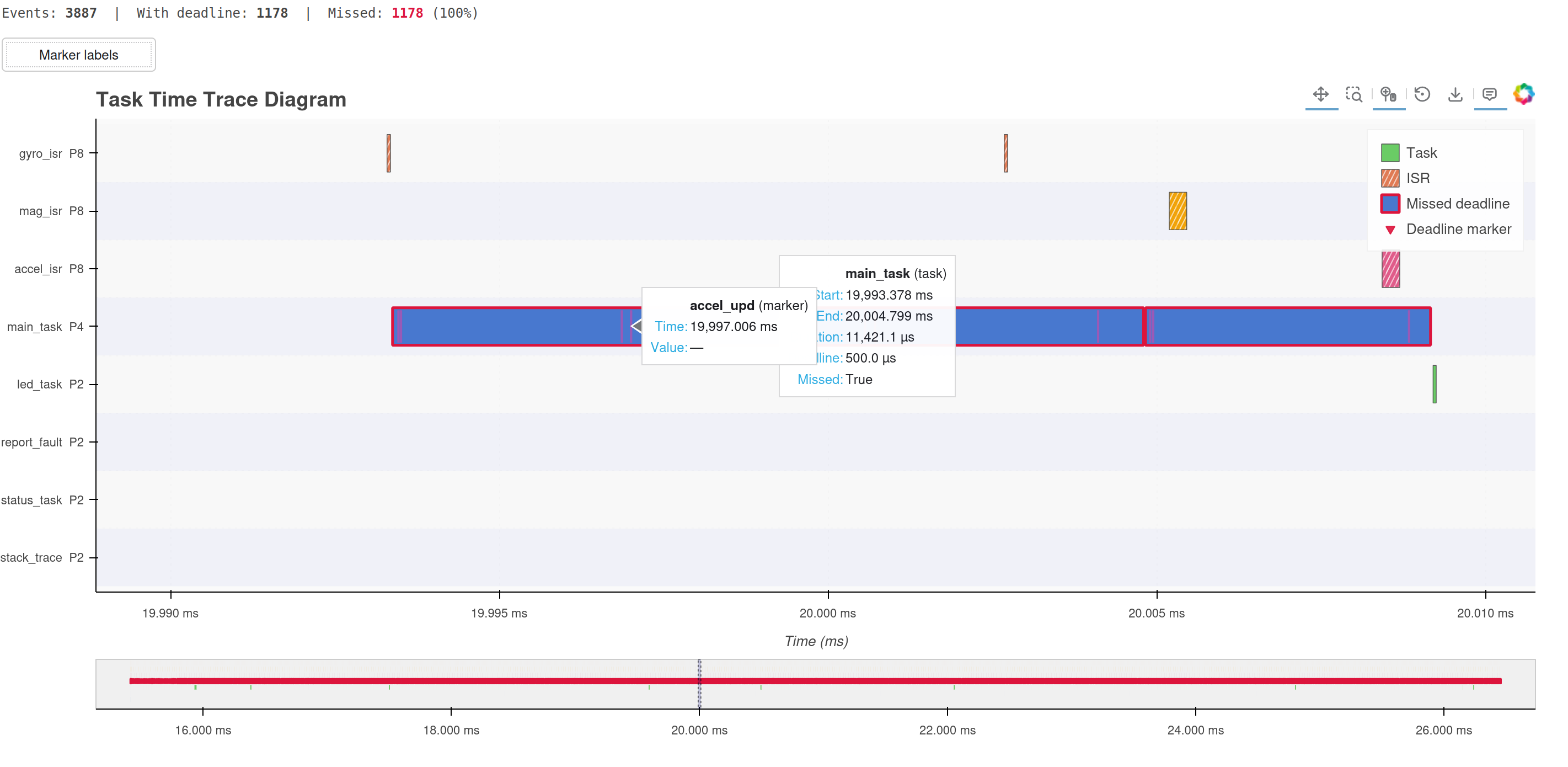
Example of a time trace diagram
Installation
# Core decoder only (no diagram dependencies):
pip install embedded-etrace

# With the interactive Bokeh diagram generator:
pip install embedded-etrace[diagram]
Requires Python 3.11+.
Quick start
1. Custom transport — decode a live stream
Implement a loop that appends raw bytes from your transport (RTT, UART, TCP…) into a
bytearray and call decode_tracing_stream each iteration:
from execution_trace import (
    TraceEventBuffer, TraceStreamState, decode_tracing_stream, write_tracing_csv,
)

buf = bytearray()
state = TraceStreamState("my-device")               # one per connection
event_buffer = TraceEventBuffer()

while True:
    buf += transport.read()                         # append whatever arrived
    decode_tracing_stream(buf, state, event_buffer)

# When the session ends:
event_buffer.flush_pending()                        # warn about open spans
csv_path = write_tracing_csv(
    [*event_buffer.records, *event_buffer.markers, *event_buffer.gaps],
    output_dir="data",
)
print(f"Trace written → {csv_path}")
decode_tracing_stream consumes complete frames from buf in-place and handles
device resets transparently (the sequence number jumps backward on firmware reboot).
TraceStreamState is what makes the decode stateful, and it must be the same object
across every call for one connection: a frame carries a dictionary id rather than a
name and a delta rather than a timestamp, so the name table and the running clock live
there. Create a fresh one per connection — the device restarts both when it does.
Pass event_buffer.gaps to the CSV writer as above. A gap is a stretch where the
sequence numbers say frames were lost; writing those rows is what keeps missing data
looking missing rather than silently closing up.
2. Decode a recorded binary file
Use the etrace-decode console script:
etrace-decode recording.bin
etrace-decode recording.bin --output ./data
This produces a timestamped trace_YYYYMMDD_HHMMSS.csv and updates the
trace_latest.csv symlink.
3. Generate a timing diagram
etrace-diagram                          # reads trace_latest.csv, writes diagram.html
etrace-diagram data/trace_latest.csv --output out/diagram.html --title "Flight run #7"
Or call the API directly:
from pathlib import Path
from execution_trace.diagram import generate_diagram

result = generate_diagram(
    csv_path=Path("trace_latest.csv"),
    output_path=Path("diagram.html"),
    title="Flight run #7",
)
print(f"{result.n_events} events, {result.n_lanes} lanes, {result.n_missed} deadline misses")
CSV format
| Column | Type | Description |
|---|---|---|
name |
string | Span or marker name; trace gap on a gap row |
type |
string | task, isr, marker, or gap |
start_us |
float | Activation timestamp in µs; for a gap, the last frame before it |
end_us |
float | Completion timestamp in µs (= start_us for markers); for a gap, the first frame after it |
priority |
int | Scheduler priority (0 if unknown) |
deadline_us |
float | Absolute deadline in µs (empty when absent) |
value |
int | Optional u32 marker payload; frames lost on a gap row |
interrupted |
int | 1 when a gap cut the span short, so its real end is unknown and at least end_us |
An empty deadline_us or value cell means the field was absent. A 0 is a real
payload and is written as 0.
Wire format
Each frame is a standard protobuf length-delimited record:
[ varint: payload_length ][ proto bytes: TraceFrame ]
A frame is not self-contained, which is why the decoder is stateful. TraceFrame is
one flat message discriminated by event_type, and the stream carries three kinds:
TRACE_START, once at the head of the stream, declaring the timebase (nanoseconds or raw core cycles plus the core frequency) and the source-group mask the firmware was built with. A group absent from the mask is silent by design — that is what tells it apart from a group whose frames were lost.NAME_REGISTERED, once per distinct name, assigning the dictionary id and everything fixed about that span or marker: its source type, priority and relative deadline.SPAN_START,SPAN_ENDandMARKER, which carry only a dictionary id, a signed timestamp delta against the previous frame, and a sequence number wrapping at 16384.
TRACE_START and NAME_REGISTERED carry an absolute timestamp and re-establish the
time origin; every other frame is a delta against it. The delta is signed because an
event is stamped when recorded rather than when queued, so a preempting ISR can put a
later timestamp ahead of an earlier one.
This is v2, and it is not compatible with the v1 format that embedded-etrace 0.1.x
decoded. A v2 stream is recognised by its leading TRACE_START frame.
The protobuf schema lives in proto/tracing.proto in the
repository, alongside the Rust crate.
Development
# Editable install with all dev dependencies:
pip install -e ".[diagram,dev]"

# Run the test suite:
pytest tests/ -v

# Type-check:
mypy src/execution_trace
1 maintainer

Metadata
1 maintainer
Release files for embedded-etrace 0.2.0
For a detailed explanation of source distributions (sdists) and built distributions (wheels), please see the package formats documentation.
Source distribution (sdist)
| File | Size | Uploaded | Provenance | Actions |
|---|---|---|---|---|
| embedded_etrace-0.2.0.tar.gz | 46.0 kB | With provenance | Details for embedded_etrace-0.2.0.tar.gz |
Built distribution (wheel)
| File | Interpreter | ABI | Platform | Actions Reset |
|---|---|---|---|---|
| embedded_etrace-0.2.0-py3-none-any.whl | Python 3 | none | any | Details for embedded_etrace-0.2.0-py3-none-any.whl |
Total release size: 82.2 kB
Release files / embedded_etrace-0.2.0.tar.gz
| Download URL | embedded_etrace-0.2.0.tar.gz |
|---|---|
| Size | 46.0 kB |
| Tags | Source |
|
SHA-256 checksum How to use checksums |
cee820630bd839276b168d4e1c9b27a2e3cd686a16d9bd0b955aa4c63b523517
|
|
BLAKE2b-256 checksum How to use checksums |
e02fe29068a164bfe325db8b9d9c2c651de1616f0c7c872845713d36ee371130
|
| Upload date | |
|
Uploaded using Trusted Publishing? What is trusted publishing? |
Yes |
| Uploaded via |
twine/7.0.0 CPython/3.13.14
|
Provenance
Provenance describes where a file came from. On PyPI, provenance is shared via attestations, which provide a verifiable record of the build or publishing details. View details, limitations and caveats.


PyPI Publish Attestation
PyPI verified that this artifact, at this checksum, originated from the publisher listed below.
Signed by GitHub Actions, verified by PyPI on Sep 19, 2026.
Transparency logRelease files / embedded_etrace-0.2.0-py3-none-any.whl
| Download URL | embedded_etrace-0.2.0-py3-none-any.whl |
|---|---|
| Size | 36.2 kB |
| Tags | Python 3 |
|
SHA-256 checksum How to use checksums |
78cd3bab1fa118179c767e438fc1ccaac581abb0575173150f16c132bc09c2ed
|
|
BLAKE2b-256 checksum How to use checksums |
103574df05c0e4b5a38dc5ff9b6442ab2302fbf1413b1f5ac9774fa15f6c3a4c
|
| Upload date | |
|
Uploaded using Trusted Publishing? What is trusted publishing? |
Yes |
| Uploaded via |
twine/7.0.0 CPython/3.13.14
|
Provenance
Provenance describes where a file came from. On PyPI, provenance is shared via attestations, which provide a verifiable record of the build or publishing details. View details, limitations and caveats.
PyPI Publish Attestation
PyPI verified that this artifact, at this checksum, originated from the publisher listed below.
Signed by GitHub Actions, verified by PyPI on Sep 19, 2026.
Transparency logSecurity for embedded-etrace 0.2.0
Provenance
Provenance describes where a file came from. On PyPI, provenance is shared via attestations, which provide a verifiable record of the build or publishing details. View details, limitations and caveats.
Full provenance
Both files in this release have been uploaded with provenance metadata.
Attestation for embedded_etrace-0.2.0.tar.gz
PyPI Publish Attestation
PyPI verified that this artifact, at this checksum, originated from the publisher listed below.
Signed by GitHub Actions, verified by PyPI on Sep 19, 2026.
Transparency logA note on package security
PyPI is a repository for distributing packages, not a service for auditing them. While third-party security researchers and our staff do their best to detect and remove malicious packages, PyPI cannot guarantee the quality, security or suitability of any given package.
To learn more about protecting yourself from malicious actors, visit our package security documentation.














