
EMG fatigue detection (training + inference) with a packaged pretrained model.

Project description
Estimating Optimal Training Repetitions Using EMG-Based Muscle Fatigue Detection
Team: BioTeam7
Course: Biomedical Signal Processing — 2025/26/1
Team Members: Dario Ranieri, Islam Muhammad Muqsit, Zsuzsanna Rohán
Abstract
This project focuses on the independent measurement and analysis of surface electromyography (EMG) signals to detect muscle fatigue in human arms during resistance training. By analyzing EMG signal characteristics, we aim to estimate the optimal number of repetitions per set for each individual, providing a personalized approach to training and rehabilitation.
Research Objectives
- Data Collection: Conduct self-collected biomedical signal measurements using surface EMG on the Biceps Brachii during resistance training until task failure.
- Pipeline Development: Design and document a complete, reproducible data processing workflow in Python.
- Feature Analysis: Perform statistical and mathematical analysis on extracted features like Root Mean Square (RMS) and Median Frequency (MDF) to identify fatigue thresholds.
- Optimization: Estimate the optimal number of repetitions based on fatigue detection and validate these estimates against subjective feedback.
Hypothesis
- Null Hypothesis ($H_0$): There is no significant change in the Median Frequency (MDF) or Root Mean Square (RMS) of the EMG signal as contraction time increases during a set of repetitions.
- Alternative Hypothesis ($H_1$): As muscle fatigue progresses, the Median Frequency (MDF) will significantly decrease due to slowing muscle fiber conduction velocity, while the RMS amplitude will increase due to motor unit recruitment to maintain force.
Methodology
1. Experimental Setup
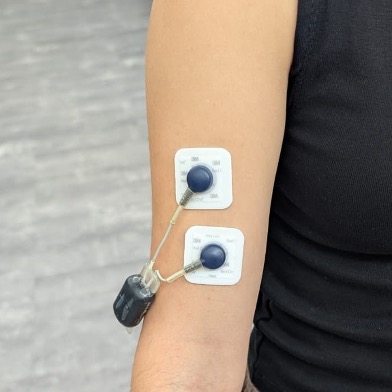
- Equipment: Cometa MiniWave wireless EMG device with 3M Red Dot ECG surface electrodes.
- Sampling Rate: 2000 Hz.
- Electrode Placement: Biceps Brachii (2-3 cm inter-electrode distance).
- Protocol:
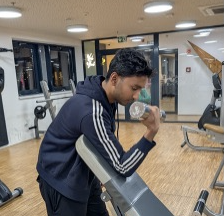
- Participants: 12 healthy university students (aged 22-24) with varying fitness levels.
- Calibration: Determined 1-Repetition Maximum (1RM) or suitable load (4x8 capability) for each subject.
- Exercise: Bicep curls using a load of 60-70% 1RM performed until task failure.
- Rest: 90-second rest periods between sets (3-5 sets total).
- Ground Truth: Subjective feedback on perceived soreness/fatigue recorded after each set.
2. Data Processing Pipeline
All processing steps are implemented in Python within this repository.
-
Preprocessing & Filtering:
- Bandpass Filter: 20–450 Hz to remove motion artifacts and high-frequency noise.
- Notch Filter: 50 Hz to eliminate power line interference.
- Envelope Extraction: Signal rectification followed by a Low-pass Envelope for smoothing.
-
Segmentation:
- Isolation of individual repetitions (approx. 2-second windows) based on signal envelopes.
-
Feature Extraction:
- RMS (Root Mean Square): Represents signal amplitude and muscle force. Increases with fatigue. $$RMS = \sqrt{\frac{1}{n} \sum_{i=1}^{n} x_i^2}$$
- MDF (Median Frequency): The frequency dividing the power spectrum into two equal parts. Decreases with fatigue due to metabolic changes.
-
Analysis:
- Trend Analysis: Monitoring the increase in RMS and decrease in MDF across repetitions.
- Fatigue Threshold: Identifying the crossover or significant deviation points in feature trends.
- Optimal Rep Estimation: Correlating the identified fatigue point with the "optimal" repetition count.
Results & Validation
The project successfully identifies trends where RMS increases and MDF decreases as the set progresses toward failure. The algorithm's estimated "optimal repetition" is compared against the user's recorded subjective soreness point (Ground Truth) to validate accuracy.
Visualizations
Figure 1: Raw vs. Filtered EMG Signal
Comparison of raw EMG signal and the signal after Bandpass and Notch filtering.
Figure 2: Optimal Repetition Estimation
Peak detection on a 2-second interval.
Installation & Usage
Prerequisites: Ensure you have Python 3.10 installed.
- Clone the repository:
git clone https://github.com/muqsitamir/EMG_fatigue_detection.git
cd EMG_fatigue_detection
pip install -r requirements.txt
python main.py
Performance Summary
• files_total = 32
Total number of evaluated sessions (file_ids).
• files_with_onset_and_trigger = 26
Sessions where a labeled fatigue onset exists and the trigger fired at least once.
• never_triggered = 2
Sessions where the trigger never fired — these represent file-level false negatives.
• mean_delta_reps = 0.308, median_delta_reps = 0.0
On average, the trigger fires about 0.3 reps late, while the median indicates it fires exactly on time in half of the sessions.
• mae_reps = 1.231
Mean absolute timing error: the trigger is typically within about 1 rep of the true onset.
• pct_within_0_reps = 0.269
The trigger fires exactly on the onset rep in ~26.9% of cases.
• pct_within_1_rep = 0.692
About 69.2% of triggers occur within ±1 rep of the true fatigue onset.
• pct_within_2_reps = 0.885
Roughly 88.5% of triggers occur within ±2 reps of onset.
• early_rate = 0.308, late_rate = 0.423
Among sessions where the trigger fires:
- Early in 30.8% of cases
- Late in 42.3% of cases
This reflects a system slightly biased toward late detection, which reduces false alarms but may delay early-warning functionality.
End-to-End Workflow
This repository supports two complementary usage modes:
- Signal-analysis mode (no ML training required): process a set, segment repetitions, compute RMS/MDF trends, and estimate an “optimal rep” using a lightweight heuristic.
- ML-trigger mode (recommended for deployment): train a classifier on labeled repetition features and use it to trigger a fatigue warning on new sessions.
1) Quick demo (runs on included test data)
A pre-trained model bundle and an example C3D file are included:
- Model:
models/fatigue_model_bundle.joblib - Example input:
test_data/test.c3d
Run a simple inference demo:
python -c "from pipeline.inference import inference_for_single_test_file; df_pred, trigger_rep = inference_for_single_test_file(); print('Fatigue detected at rep:', trigger_rep); print(df_pred[['rep','proba_used','pred']].head())"
2) Use your own C3D recordings
Expected file format
- Input format:
.c3d(analog EMG channels) - Default channel name:
Emg_1(configurable)
The loader prints available channel names if the requested channel is not found.
Recommended folder layout for training
Create a data/ folder at the repository root with:
data/Signals/— your.c3dsession filesdata/filtered_signals.csv— metadata/labels file
The label CSV is read with sep=';' and expects at least these columns:
id— the file identifier (must match the C3D filename without the.c3dextension)label— the fatigue onset repetition index (used to createis_fatigued = 1for reps>= label)
Note: repetition indices in the pipeline are 1-based (rep 1, 2, 3, ...). Provide your onset label accordingly.
3) Generate the training dataset (master_df.csv)
The ML pipeline trains on a per-repetition feature table saved to ./data/master_df.csv.
In Python (e.g., a notebook or a small script):
from emg_fd.src.utils.data_utils import load_with_csv, create_master_df

# 1) Load and extract EMG from C3D files using the label CSV
sessions = load_with_csv(
    folder_path="./data/Signals",
    csv_file_path="./data/filtered_signals.csv",
    channel_to_extract="Emg_1",
)

# 2) Process signals, segment reps, compute features, and write ./data/master_df.csv
master_df = create_master_df(sessions)
4) Train + evaluate the fatigue classifier
Training is grouped by file_id to reduce data leakage across repetitions from the same session.
import pandas as pd

from emg_fd.src.utils.ml_utils import TrainConfig
from emg_fd.src.pipeline.train_model import run_training_eval, train_final_model
from emg_fd.src.utils.eval_utils import evaluate_onset_timing

# Load the generated dataset
df = pd.read_csv("./data/master_df.csv")

# Cross-validated evaluation
cfg = TrainConfig(n_splits=5)
results, best_t = run_training_eval(df, cfg, plot=True)

# Optional: require M-of-N consecutive/near-consecutive probabilities above threshold
m, n = 2, 3

timing_df, timing_summary = evaluate_onset_timing(
    df,
    results["oof_proba"],
    thr=best_t,
    M=m,
    N=n,
    m_of_n=True,
)

# Train final model on all data and save bundle for inference
train_final_model(df, best_t, m, n)
This will produce models/fatigue_model_bundle.joblib, containing:
- the trained sklearn model
- the feature column list (ensures inference uses the same feature set)
- the tuned probability threshold
- trigger configuration (M-of-N)
5) Run inference on a new session
from emg_fd.src.utils.data_utils import load_model_bundle, load_and_extract_emg_from_c3d, predict_fatigue_on_emg

bundle = load_model_bundle("emg_fd/models/fatigue_model_bundle.joblib")

signal, fs, _ = load_and_extract_emg_from_c3d("/path/to/session.c3d", "Emg_1")

df_pred, trigger_rep = predict_fatigue_on_emg(
    signal_data=signal,
    fs=fs,
    model_bundle=bundle,
    file_id="my_session",
    distance_seconds=2.0,
    prominence=0.2,
)

print("Fatigue trigger rep:", trigger_rep)
print(df_pred[["rep", "proba_used", "pred"]].head())
Key Parameters You May Need to Tune
- Channel selection:
channel_to_extract/channel_label(defaultEmg_1). - Power-line frequency: notch filter defaults to 50 Hz. If your mains frequency is 60 Hz, update
notch_freqinprocess_emg(). - Repetition segmentation:
distance_seconds: minimum time between envelope peaks (depends on rep cadence)prominence: how “strong” a peak must be (depends on signal quality and electrode placement)
If rep detection is unstable, tune distance_seconds first (cadence) and then prominence (noise/quality).
Suggested Entry Points for Developers
If you want to extend or modify the pipeline, these files are the best starting points:
utils/emg_processing_utils.py— filtering, envelope, repetition segmentation, RMS/MDF extractionutils/data_utils.py— C3D loading, dataset creation, model-bundle I/O, inference helperpipeline/train_model.py— cross-validation, threshold selection, and final model trainingpipeline/inference.py— minimal inference example on a single C3D filepipeline/signal_analysis_pipeline.py— non-ML “optimal rep” heuristic workflow
For reproducible experiments, avoid editing the feature definitions mid-project; instead, version feature changes and re-generate
master_df.csv.
Out-of-the-Box Results (Bundled Model on Current Data)
This repository includes a ready-to-use model bundle at models/fatigue_model_bundle.joblib. The results below document the current performance of the bundled model/training configuration on the dataset produced from the repository’s current data/Signals/*.c3d files and data/filtered_signals.csv labels.
Reproducibility note: These results are dataset- and configuration-dependent. If you add/remove sessions, change repetition segmentation parameters (
distance_seconds,prominence), adjust filtering (50/60 Hz notch), or modify the feature set, your numbers will change. This section is included so new users know what to expect when using the model “out of the box.”
Dataset snapshot
- Total repetitions: 396
- Class balance (
is_fatigued):- 0 (not fatigued): 264
- 1 (fatigued): 132
- Total evaluated sessions (
file_id): 32
Cross-validated (OOF) classification performance
Threshold selection was performed on out-of-fold (OOF) probabilities by maximizing balanced accuracy.
- OOF best threshold:
0.385 - OOF Balanced Accuracy:
0.856 - OOF ROC AUC:
0.933 - OOF PR AUC:
0.868
OOF confusion matrix (repetition-level):
| Pred: Not fatigued | Pred: Fatigued | |
|---|---|---|
| True: Not fatigued | 216 | 48 |
| True: Fatigued | 14 | 118 |
Classification report (OOF):
- Not fatigued (0): precision 0.939, recall 0.818, F1 0.874 (support 264)
- Fatigued (1): precision 0.711, recall 0.894, F1 0.792 (support 132)
- Overall accuracy: 0.843 (396 repetitions)
Estimating Optimal Training Repetitions Using EMG-Based Muscle Fatigue Detection
Team: BioTeam7
Course: Biomedical Signal Processing — 2025/26/1
Team Members: Dario Ranieri, Islam Muhammad Muqsit, Zsuzsanna Rohán
Abstract
This project focuses on the independent measurement and analysis of surface electromyography (EMG) signals to detect muscle fatigue in human arms during resistance training. By analyzing EMG signal characteristics, we aim to estimate the optimal number of repetitions per set for each individual, providing a personalized approach to training and rehabilitation.
Research Objectives
- Data Collection: Conduct self-collected biomedical signal measurements using surface EMG on the Biceps Brachii during resistance training until task failure.
- Pipeline Development: Design and document a complete, reproducible data processing workflow in Python.
- Feature Analysis: Perform statistical and mathematical analysis on extracted features like Root Mean Square (RMS) and Median Frequency (MDF) to identify fatigue thresholds.
- Optimization: Estimate the optimal number of repetitions based on fatigue detection and validate these estimates against subjective feedback.
Hypothesis
- Null Hypothesis ($H_0$): There is no significant change in the Median Frequency (MDF) or Root Mean Square (RMS) of the EMG signal as contraction time increases during a set of repetitions.
- Alternative Hypothesis ($H_1$): As muscle fatigue progresses, the Median Frequency (MDF) will significantly decrease due to slowing muscle fiber conduction velocity, while the RMS amplitude will increase due to motor unit recruitment to maintain force.
Methodology
1. Experimental Setup
- Equipment: Cometa MiniWave wireless EMG device with 3M Red Dot ECG surface electrodes.
- Sampling Rate: 2000 Hz.
- Electrode Placement: Biceps Brachii (2-3 cm inter-electrode distance).
- Protocol:
- Participants: 12 healthy university students (aged 22-24) with varying fitness levels.
- Calibration: Determined 1-Repetition Maximum (1RM) or suitable load (4x8 capability) for each subject.
- Exercise: Bicep curls using a load of 60-70% 1RM performed until task failure.
- Rest: 90-second rest periods between sets (3-5 sets total).
- Ground Truth: Subjective feedback on perceived soreness/fatigue recorded after each set.


2. Data Processing Pipeline
All processing steps are implemented in Python within this repository.
-
Preprocessing & Filtering:
- Bandpass Filter: 20–450 Hz to remove motion artifacts and high-frequency noise.
- Notch Filter: 50 Hz to eliminate power line interference.
- Envelope Extraction: Signal rectification followed by a Low-pass Envelope for smoothing.
-
Segmentation:
- Isolation of individual repetitions (approx. 2-second windows) based on signal envelopes.
-
Feature Extraction:
- RMS (Root Mean Square): Represents signal amplitude and muscle force. Increases with fatigue. $$RMS = \sqrt{\frac{1}{n} \sum_{i=1}^{n} x_i^2}$$
- MDF (Median Frequency): The frequency dividing the power spectrum into two equal parts. Decreases with fatigue due to metabolic changes.
-
Analysis:
- Trend Analysis: Monitoring the increase in RMS and decrease in MDF across repetitions.
- Fatigue Threshold: Identifying the crossover or significant deviation points in feature trends.
- Optimal Rep Estimation: Correlating the identified fatigue point with the "optimal" repetition count.
Results & Validation
The project successfully identifies trends where RMS increases and MDF decreases as the set progresses toward failure. The algorithm's estimated "optimal repetition" is compared against the user's recorded subjective soreness point (Ground Truth) to validate accuracy.
Visualizations
Figure 1: Raw vs. Filtered EMG Signal
Figure 2: Optimal Repetition Estimation
Installation & Usage
Prerequisites: Ensure you have Python 3.10 installed.
- Clone the repository:
git clone https://github.com/muqsitamir/EMG_fatigue_detection.git
cd EMG_fatigue_detection
pip install -r requirements.txt
python main.py
Performance Summary
• files_total = 32
Total number of evaluated sessions (file_ids).
• files_with_onset_and_trigger = 26
Sessions where a labeled fatigue onset exists and the trigger fired at least once.
• never_triggered = 2
Sessions where the trigger never fired — these represent file-level false negatives.
• mean_delta_reps = 0.308, median_delta_reps = 0.0
On average, the trigger fires about 0.3 reps late, while the median indicates it fires exactly on time in half of the sessions.
• mae_reps = 1.231
Mean absolute timing error: the trigger is typically within about 1 rep of the true onset.
• pct_within_0_reps = 0.269
The trigger fires exactly on the onset rep in ~26.9% of cases.
• pct_within_1_rep = 0.692
About 69.2% of triggers occur within ±1 rep of the true fatigue onset.
• pct_within_2_reps = 0.885
Roughly 88.5% of triggers occur within ±2 reps of onset.
• early_rate = 0.308, late_rate = 0.423
Among sessions where the trigger fires:
- Early in 30.8% of cases
- Late in 42.3% of cases
This reflects a system slightly biased toward late detection, which reduces false alarms but may delay early-warning functionality.
End-to-End Workflow (New Users)
This repository supports two complementary usage modes:
- Signal-analysis mode (no ML training required): process a set, segment repetitions, compute RMS/MDF trends, and estimate an “optimal rep” using a lightweight heuristic.
- ML-trigger mode (recommended for deployment): train a classifier on labeled repetition features and use it to trigger a fatigue warning on new sessions.
1) Quick demo (runs on included test data)
A pre-trained model bundle and an example C3D file are included:
- Model:
models/fatigue_model_bundle.joblib - Example input:
test_data/test.c3d
Run a simple inference demo:
python -c "from pipeline.inference import inference_for_single_test_file; df_pred, trigger_rep = inference_for_single_test_file(); print('Fatigue detected at rep:', trigger_rep); print(df_pred[['rep','proba_used','pred']].head())"
2) Use your own C3D recordings
Expected file format
- Input format:
.c3d(analog EMG channels) - Default channel name:
Emg_1(configurable)
The loader prints available channel names if the requested channel is not found.
Recommended folder layout for training
Create a data/ folder at the repository root with:
data/Signals/— your.c3dsession filesdata/filtered_signals.csv— metadata/labels file
The label CSV is read with sep=';' and expects at least these columns:
id— the file identifier (must match the C3D filename without the.c3dextension)label— the fatigue onset repetition index (used to createis_fatigued = 1for reps>= label)
Note: repetition indices in the pipeline are 1-based (rep 1, 2, 3, ...). Provide your onset label accordingly.
3) Generate the training dataset (master_df.csv)
The ML pipeline trains on a per-repetition feature table saved to ./data/master_df.csv.
In Python (e.g., a notebook or a small script):
from emg_fd.src.utils.data_utils import load_with_csv, create_master_df

# 1) Load and extract EMG from C3D files using the label CSV
sessions = load_with_csv(
    folder_path="./data/Signals",
    csv_file_path="./data/filtered_signals.csv",
    channel_to_extract="Emg_1",
)

# 2) Process signals, segment reps, compute features, and write ./data/master_df.csv
master_df = create_master_df(sessions)
4) Train + evaluate the fatigue classifier
Training is grouped by file_id to reduce data leakage across repetitions from the same session.
import pandas as pd

from emg_fd.src.utils.ml_utils import TrainConfig
from emg_fd.src.pipeline.train_model import run_training_eval, train_final_model
from emg_fd.src.utils.eval_utils import evaluate_onset_timing

# Load the generated dataset
df = pd.read_csv("./data/master_df.csv")

# Cross-validated evaluation
cfg = TrainConfig(n_splits=5)
results, best_t = run_training_eval(df, cfg, plot=True)

# Optional: require M-of-N consecutive/near-consecutive probabilities above threshold
m, n = 2, 3

timing_df, timing_summary = evaluate_onset_timing(
    df,
    results["oof_proba"],
    thr=best_t,
    M=m,
    N=n,
    m_of_n=True,
)

# Train final model on all data and save bundle for inference
train_final_model(df, best_t, m, n)
This will produce models/fatigue_model_bundle.joblib, containing:
- the trained sklearn model
- the feature column list (ensures inference uses the same feature set)
- the tuned probability threshold
- trigger configuration (M-of-N)
5) Run inference on a new session
from emg_fd.src.utils.data_utils import load_model_bundle, load_and_extract_emg_from_c3d, predict_fatigue_on_emg

bundle = load_model_bundle("emg_fd/models/fatigue_model_bundle.joblib")

signal, fs, _ = load_and_extract_emg_from_c3d("/path/to/session.c3d", "Emg_1")

df_pred, trigger_rep = predict_fatigue_on_emg(
    signal_data=signal,
    fs=fs,
    model_bundle=bundle,
    file_id="my_session",
    distance_seconds=2.0,
    prominence=0.2,
)

print("Fatigue trigger rep:", trigger_rep)
print(df_pred[["rep", "proba_used", "pred"]].head())
Key Parameters You May Need to Tune
- Channel selection:
channel_to_extract/channel_label(defaultEmg_1). - Power-line frequency: notch filter defaults to 50 Hz. If your mains frequency is 60 Hz, update
notch_freqinprocess_emg(). - Repetition segmentation:
distance_seconds: minimum time between envelope peaks (depends on rep cadence)prominence: how “strong” a peak must be (depends on signal quality and electrode placement)
If rep detection is unstable, tune distance_seconds first (cadence) and then prominence (noise/quality).
Suggested Entry Points for Developers
If you want to extend or modify the pipeline, these files are the best starting points:
utils/emg_processing_utils.py— filtering, envelope, repetition segmentation, RMS/MDF extractionutils/data_utils.py— C3D loading, dataset creation, model-bundle I/O, inference helperpipeline/train_model.py— cross-validation, threshold selection, and final model trainingpipeline/inference.py— minimal inference example on a single C3D filepipeline/signal_analysis_pipeline.py— non-ML “optimal rep” heuristic workflow
For reproducible experiments, avoid editing the feature definitions mid-project; instead, version feature changes and re-generate
master_df.csv.
Out-of-the-Box Results (Bundled Model on Current Data)
This repository includes a ready-to-use model bundle at models/fatigue_model_bundle.joblib. The results below document the current performance of the bundled model/training configuration on the dataset produced from the repository’s current data/Signals/*.c3d files and data/filtered_signals.csv labels.
Reproducibility note: These results are dataset- and configuration-dependent. If you add/remove sessions, change repetition segmentation parameters (
distance_seconds,prominence), adjust filtering (50/60 Hz notch), or modify the feature set, your numbers will change. This section is included so new users know what to expect when using the model “out of the box.”
Dataset snapshot
- Total repetitions: 396
- Class balance (
is_fatigued):- 0 (not fatigued): 264
- 1 (fatigued): 132
- Total evaluated sessions (
file_id): 32
Cross-validated (OOF) classification performance
Threshold selection was performed on out-of-fold (OOF) probabilities by maximizing balanced accuracy.
- OOF best threshold:
0.385 - OOF Balanced Accuracy:
0.856 - OOF ROC AUC:
0.933 - OOF PR AUC:
0.868
OOF confusion matrix (repetition-level):
| Pred: Not fatigued | Pred: Fatigued | |
|---|---|---|
| True: Not fatigued | 216 | 48 |
| True: Fatigued | 14 | 118 |
Classification report (OOF):
- Not fatigued (0): precision 0.939, recall 0.818, F1 0.874 (support 264)
- Fatigued (1): precision 0.711, recall 0.894, F1 0.792 (support 132)
- Overall accuracy: 0.843 (396 repetitions)
Trigger timing performance (session-level)
Trigger evaluation measures how closely the first trigger aligns with labeled onset (when available). Errors are reported in repetitions.
- Sessions with onset + a trigger: 26
- Never triggered (file-level false negatives): 2
- Mean Δ reps (trigger − onset): 0.308 (median 0.0)
- MAE (timing error): 1.231 reps
- % within ±0 reps: 0.269
- % within ±1 rep: 0.692
- % within ±2 reps: 0.885
- Early vs late triggers: early_rate 0.308, late_rate 0.423
Included inference demo (test_data/test.c3d)
Running the bundled model on the included test file triggers fatigue at:
- Fatigue trigger repetition: 9
Predicted class stream (pred per repetition) from the demo run:
0 0 0 0 0 0 0 1 1 1 1 1 1
Figures (Current Model)
The figures below were generated from the current dataset/training run and are included in docs/images/.
Model evaluation (OOF)


Signal-analysis pipeline (example)

Included inference demo (test_data/test.c3d)
Running the bundled model on the included test file triggers fatigue at:
- Fatigue trigger repetition: 9
Predicted class stream (pred per repetition) from the demo run:
0 0 0 0 0 0 0 1 1 1 1 1 1


Download files
Download the file for your platform. If you're not sure which to choose, learn more about installing packages.
Source Distribution
Built Distribution
Filter files by name, interpreter, ABI, and platform.
If you're not sure about the file name format, learn more about wheel file names.
Copy a direct link to the current filters
File details
Details for the file emg_fatigue_detection_toolbox-0.1.3.tar.gz.
File metadata
- Download URL: emg_fatigue_detection_toolbox-0.1.3.tar.gz
- Upload date:
- Size: 23.6 kB
- Tags: Source
- Uploaded using Trusted Publishing? Yes
- Uploaded via: twine/6.1.0 CPython/3.13.7
File hashes
| Algorithm | Hash digest | |
|---|---|---|
| SHA256 |
c8e7b4c3f79c750eb7f6c4b5460146a2c662f7319e0ae11cf300f75144d7dee2
|
|
| MD5 |
036d92c6f06741eb2f84585e5e4ee332
|
|
| BLAKE2b-256 |
c9a34921a7091c8123f9b39dcbcefb40670d240bc863fe77db0bf6be6221167b
|
Provenance
The following attestation bundles were made for emg_fatigue_detection_toolbox-0.1.3.tar.gz:
Publisher:
publish.yml on muqsitamir/EMG_fatigue_detection
-
Statement:
-
Statement type:
https://in-toto.io/Statement/v1 -
Predicate type:
https://docs.pypi.org/attestations/publish/v1 -
Subject name:
emg_fatigue_detection_toolbox-0.1.3.tar.gz -
Subject digest:
c8e7b4c3f79c750eb7f6c4b5460146a2c662f7319e0ae11cf300f75144d7dee2 - Sigstore transparency entry: 763986458
- Sigstore integration time:
-
Permalink:
muqsitamir/EMG_fatigue_detection@ededc0f3159badf202ca66a3686072d2bbc85202 -
Branch / Tag:
refs/tags/v0.1.3 - Owner: https://github.com/muqsitamir
-
Access:
public
-
Token Issuer:
https://token.actions.githubusercontent.com -
Runner Environment:
github-hosted -
Publication workflow:
publish.yml@ededc0f3159badf202ca66a3686072d2bbc85202 -
Trigger Event:
push
-
Statement type:
File details
Details for the file emg_fatigue_detection_toolbox-0.1.3-py3-none-any.whl.
File metadata
- Download URL: emg_fatigue_detection_toolbox-0.1.3-py3-none-any.whl
- Upload date:
- Size: 24.9 kB
- Tags: Python 3
- Uploaded using Trusted Publishing? Yes
- Uploaded via: twine/6.1.0 CPython/3.13.7
File hashes
| Algorithm | Hash digest | |
|---|---|---|
| SHA256 |
8b21e0e2a892e2e01852e07787e0a72762bec930ecff21a30ddfb58203eb04d9
|
|
| MD5 |
9d871af322a501a340ebf2d103afbbd8
|
|
| BLAKE2b-256 |
f3db21600e2e8b777078d5e981a9eb8a8d00edef8c4874f3ac0486a5f31809e5
|
Provenance
The following attestation bundles were made for emg_fatigue_detection_toolbox-0.1.3-py3-none-any.whl:
Publisher:
publish.yml on muqsitamir/EMG_fatigue_detection
-
Statement:
-
Statement type:
https://in-toto.io/Statement/v1 -
Predicate type:
https://docs.pypi.org/attestations/publish/v1 -
Subject name:
emg_fatigue_detection_toolbox-0.1.3-py3-none-any.whl -
Subject digest:
8b21e0e2a892e2e01852e07787e0a72762bec930ecff21a30ddfb58203eb04d9 - Sigstore transparency entry: 763986459
- Sigstore integration time:
-
Permalink:
muqsitamir/EMG_fatigue_detection@ededc0f3159badf202ca66a3686072d2bbc85202 -
Branch / Tag:
refs/tags/v0.1.3 - Owner: https://github.com/muqsitamir
-
Access:
public
-
Token Issuer:
https://token.actions.githubusercontent.com -
Runner Environment:
github-hosted -
Publication workflow:
publish.yml@ededc0f3159badf202ca66a3686072d2bbc85202 -
Trigger Event:
push
-
Statement type:






