
ENAMEL



Getting Started | Library Usage | LLM Leaderboard | Acknowledgements
What is ENAMEL?
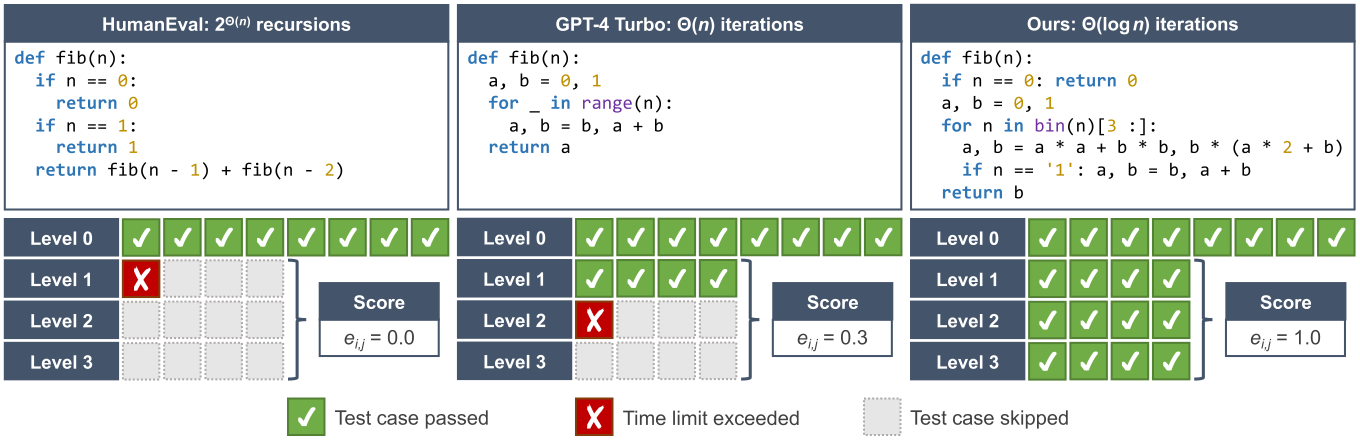
ENAMEL is a rigorous and high-standard benchmark for evaluating the capability of large language models (LLMs) in generating efficient code. We provide:
- A new metric $\text{eff}@k$ characterizing the relationship between code efficiency and sample size $k$;
- A problem set consisting of 142 high-quality problems selected from OpenAI HumanEval;
- Expert-written efficient reference solutions, setting a high-standard for efficiency evaluation;
- Expert-written strong test case generators, enabling a rigorous evaluation of both correctness and efficiency;
- A Python library
enamfor easily evaluating the efficiency of LLM-generated code.
If you are interested in our work, please feel free to check our paper for detail.
Getting Started
Dependencies
Before running the code, please ensure the following dependencies:
- Python >= 3.10
- Tqdm >= 3.1.4
- NumPy >= 1.4.0
- Pandas >= 1.0
Using our generated test cases and LLM-generated code samples
To facilitate reproduction, we share on HuggingFace our generated test cases and LLM-generated code samples used in our evaluation. Please download eval~tests.pkl into the cache/ folder and download the code samples into the samples/ folder.
To reproduce our results, please run demo.py, where --load_name specifies the file name of code samples (without file extension), and --tests specifies the generated test cases. For example, to evaluate the HumanEval+ canonical solutions, please run:
python3 demo.py --load_name humanevalplus-canonical --tests cache/eval~tests.pkl
Evaluating zipped code samples provided by EvalPlus
Our demo also supports the zipped code samples provided by EvalPlus. Please put their .zip files into our samples/ folder without renaming the files. For example, to evaluate the GPT-4 code samples gpt-4_temp_0.0.zip from EvalPlus, please run:
python3 demo.py --load_name gpt-4_temp_0.0 --tests cache/eval~tests.pkl
Warning: It is known to us that our evaluator might be unable to kill a code sample if the code uses try ... except ... within an infinity loop because the killing signal will be caught. We have decided not to resolve this issue because resolving it with multiprocessing will significantly slow down the evaluation process. If you do encounter this issue, please consider removing such code samples. (This issue indeed happens for two code samples provided by EvalPlus, so our demo will automatically handle it if you use the zipped code samples from EvalPlus.)
Evaluating new code samples
If you want to evaluate your own code samples, please organize them as a .json file, put it in the samples/ folder, and run demo.py. For example, if the code samples are in the file samples/codes.json, please run:
python3 demo.py --load_name codes --tests cache/eval~tests.pkl
The .json file should be a dict of lists such that codes[str(i)][j] is the $j$-th code sample of problem $i$.
Library Usage
Our benchmark is also available as a Python library. Please see demo.py for an example usage of our library.
Notice: DO NOT use multiple threads or processes in efficiency evaluation. That might negatively affect the efficiency results.
Installation
Our library enam can be installed via pip:
pip install enam --upgrade
Note: To distinguish from our benchmark ENAMEL, we name our library enam.
LLM Leaderboard
The following table is a leaderboard of 30 LLMs (under greedy decoding) as well as HumanEval/HumanEval+ canonical solutions. Results show that LLMs fall short of generating expert-level efficient code. For more results, please refer to our paper.
We welcome LLM developers to submit their results to enrich this leaderboard. If you would like to submit your results, please organize your generated code samples into a .json file as described above and contact Ruizhong Qiu (rq5 AT illinois DOT edu).
| No. | Name | eff@1 | pass@1 |
|---|---|---|---|
| 1 | HumanEval+ | 0.517 | 0.958 |
| 2 | GPT-4 Turbo (Nov 2023) | 0.470 | 0.796 |
| 3 | HumanEval | 0.458 | 0.908 |
| 4 | GPT-4 (Jun 2023) | 0.454 | 0.831 |
| 5 | Llama 3 70B Instruct | 0.421 | 0.746 |
| 6 | Mixtral 8x22B Instruct | 0.408 | 0.746 |
| 7 | Claude 3 Opus | 0.401 | 0.789 |
| 8 | Phind Code Llama V2 | 0.394 | 0.683 |
| 9 | Claude 3 Haiku | 0.386 | 0.739 |
| 10 | ChatGPT | 0.364 | 0.683 |
| 11 | Claude 3 Sonnet | 0.345 | 0.662 |
| 12 | Llama 3 8B Instruct | 0.344 | 0.592 |
| 13 | Code Llama 34B Python | 0.268 | 0.458 |
| 14 | Mixtral 8x7B Instruct | 0.266 | 0.444 |
| 15 | Code Llama 70B Python | 0.264 | 0.500 |
| 16 | Code Llama 7B Python | 0.247 | 0.373 |
| 17 | Code Llama 13B Python | 0.216 | 0.408 |
| 18 | StarCoder | 0.195 | 0.352 |
| 19 | CodeGen 6B | 0.193 | 0.296 |
| 20 | CodeGen 16B | 0.169 | 0.310 |
| 21 | CodeT5+ 16B | 0.160 | 0.317 |
| 22 | CodeGen 2B | 0.153 | 0.254 |
| 23 | Mistral 7B | 0.152 | 0.275 |
| 24 | Vicuna 13B | 0.123 | 0.176 |
| 25 | SantaCoder | 0.100 | 0.141 |
| 26 | Incoder 6B | 0.091 | 0.127 |
| 27 | GPT-J | 0.083 | 0.106 |
| 28 | Incoder 1B | 0.066 | 0.092 |
| 29 | Vicuna 7B | 0.061 | 0.099 |
| 30 | GPT-Neo 2B | 0.043 | 0.056 |
| 31 | PolyCoder | 0.037 | 0.049 |
| 32 | StableLM 7B | 0.020 | 0.021 |
Acknowledgements
1 maintainer

Release files for enam 0.2.0
For a detailed explanation of source distributions (sdists) and built distributions (wheels), please see the package formats documentation.
Source distribution (sdist)
| File | Size | Uploaded | |
|---|---|---|---|
| enam-0.2.0.tar.gz | 16.6 kB | Details |
Built distribution (wheel)
| File | Interpreter | ABI | Platform | Reset |
|---|---|---|---|---|
| enam-0.2.0-py3-none-any.whl | Python 3 | none | any | Details |
Total release size: 31.5 kB
Release files / enam-0.2.0.tar.gz
| Download URL | enam-0.2.0.tar.gz |
|---|---|
| Size | 16.6 kB |
| Tags | Source |
|
SHA-256 checksum How to use checksums |
1d055acdac7e63682e11ee0356ea32ac7bfae6b7342c4243d369bae265b158fe
|
|
BLAKE2b-256 checksum How to use checksums |
f7d8bfbbe7d2e4786bae861e10d548c57d32d1c52864852e89f4f8ca21a4a95e
|
| Upload date | |
|
Uploaded using Trusted Publishing? What is trusted publishing? |
No |
| Uploaded via |
twine/5.1.1 CPython/3.10.12
|
Release files / enam-0.2.0-py3-none-any.whl
| Download URL | enam-0.2.0-py3-none-any.whl |
|---|---|
| Size | 14.9 kB |
| Tags | Python 3 |
|
SHA-256 checksum How to use checksums |
2e3fe0e46a1651a4cb03e6686030e99a996402eab942b24adea11796cb291cdd
|
|
BLAKE2b-256 checksum How to use checksums |
de35e035402918940d9203b2863941a9f6b19b2626c6910dd69bca907ad49d00
|
| Upload date | |
|
Uploaded using Trusted Publishing? What is trusted publishing? |
No |
| Uploaded via |
twine/5.1.1 CPython/3.10.12
|














