

EncouRAGe
the all-in one solution for evaluate RAG methods.






About
This repository provides a flexible library for running Retrieval-Augmented Generation (RAG) methods and evaluate them. It is designed to be modular and extensible, allowing users to easily integrate their own data and test them on RAG methods and calculate metrics.
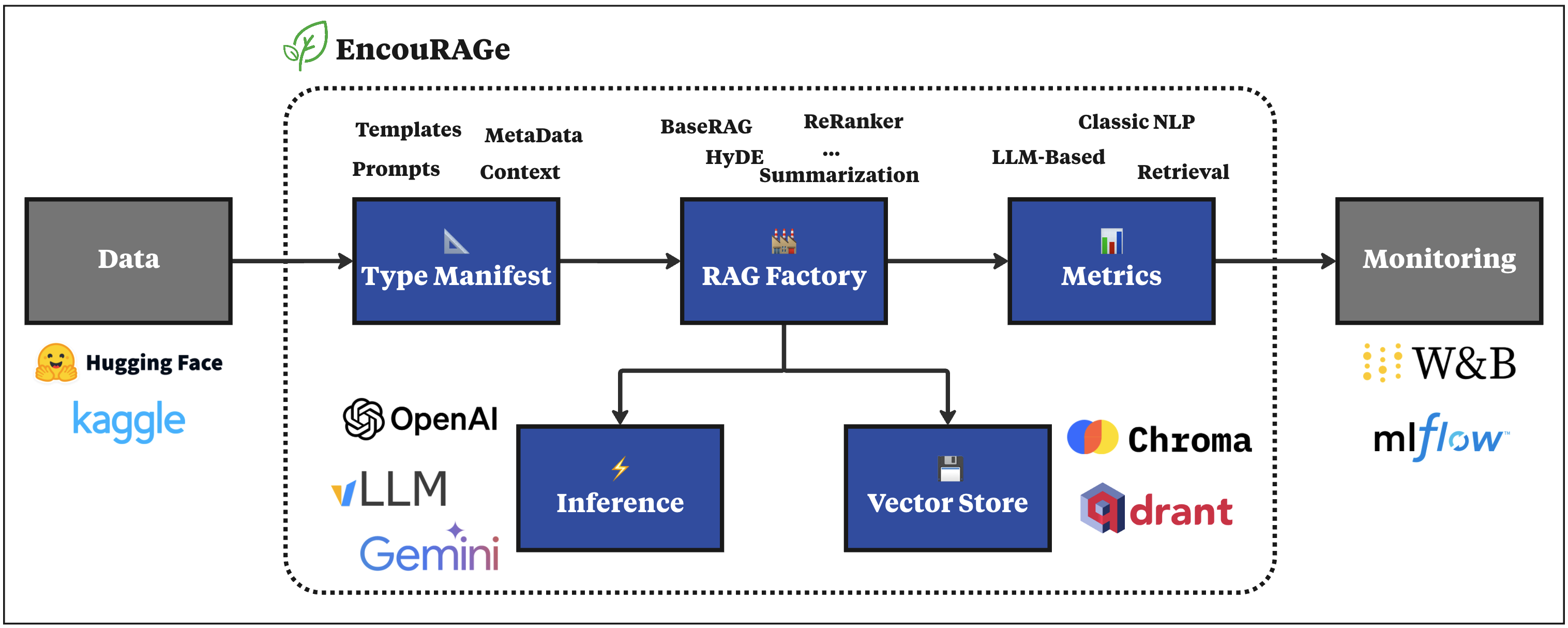
Overview
The following libraries are used to provide the core functionality:
For Inference Runners:
- 🏃 vllm
- A fast and flexible framework for LLM inference.
For Templates:
- ⚙️ jinja2
- Offers a template engine for dynamic prompt generation.
For Evaluation Metrics:
- 📊 evaluate
- A library for easily accessing and computing a wide range of evaluation metrics.
For Vector Databases:
- 🔄 chroma
- Strong in-memory vector database for efficient data retrieval.
- 🧭 qdrant
- Supports robust vector search for efficient data retrieval.
🚀 Getting Started
pip install encourage-rag
To initialize the environment using uv, run the following command:
uv sync
⚡ Usage Inference Runners
For understanding how to use the inference runners, refer to the following tutorials:
🔍 RAG Methods
Encourage provides several RAG (Retrieval-Augmented Generation) methods to enhance your LLM responses with relevant context:
📊 Evaluation Metrics
Encourage offers a comprehensive set of metrics for evaluating LLM and RAG performance:
- Metrics Overview - Table of all available metrics
- Metrics Explanation - Detailed explanations and formulas
- Metrics Tutorial - Step-by-step guide to using metrics
⚙️ Custom Templates
To use a custom template for the inference, follow the steps below:
📈 Model Tracking
For tracking the model performance, use the following commands:
Contributing
We welcome and value any contributions and collaborations. Please check out Contributing to encourage for how to get involved.
Credits
This project is developed as cooperation project by the HCDS at the University of Hamburg and dida GmbH.
The research and development project is funded by the Federal Ministry of Research, Technology and Space (BMFTR) and supervised by the German Aerospace Center (DLR).
Funding code of the University of Hamburg: 16IS24044B


1 maintainer

Metadata
1 maintainer
Release files for encourage-rag 0.3.8.0
For a detailed explanation of source distributions (sdists) and built distributions (wheels), please see the package formats documentation.
Source distribution (sdist)
| File | Size | Uploaded | |
|---|---|---|---|
| encourage_rag-0.3.8.0.tar.gz | 836.8 kB | Details |
Built distribution (wheel)
| File | Interpreter | ABI | Platform | Reset |
|---|---|---|---|---|
| encourage_rag-0.3.8.0-py3-none-any.whl | Python 3 | none | any | Details |
Total release size: 928.8 kB
Release files / encourage_rag-0.3.8.0.tar.gz
| Download URL | encourage_rag-0.3.8.0.tar.gz |
|---|---|
| Size | 836.8 kB |
| Tags | Source |
|
SHA-256 checksum How to use checksums |
2cde243cb918a6e4ed8c1c6920f2a99888262b861cbd9a6fd7b5b27e6fc62dce
|
|
BLAKE2b-256 checksum How to use checksums |
1b65269e2eebe25eedaab29c765738fffd03674237b99e92a7a3b2e947ba721e
|
| Upload date | |
|
Uploaded using Trusted Publishing? What is trusted publishing? |
Yes |
| Uploaded via |
twine/6.1.0 CPython/3.13.12
|
Provenance
Provenance describes where a file came from. On PyPI, provenance is shared via attestations, which provide a verifiable record of the build or publishing details. View details, limitations and caveats.


PyPI Publish Attestation
PyPI verified that this artifact, at this checksum, originated from the publisher listed below.
Signed by GitHub Actions, verified by PyPI on May 13, 2026.
Transparency logRelease files / encourage_rag-0.3.8.0-py3-none-any.whl
| Download URL | encourage_rag-0.3.8.0-py3-none-any.whl |
|---|---|
| Size | 91.9 kB |
| Tags | Python 3 |
|
SHA-256 checksum How to use checksums |
be5cc4cf6f7c89da84af3296fd237f50a40356563783b8c32451d5c7bd220f70
|
|
BLAKE2b-256 checksum How to use checksums |
d9527ec64d288537baf6c4a7c33c08f936c6d5f1fcc826e2640d03b77c0131b8
|
| Upload date | |
|
Uploaded using Trusted Publishing? What is trusted publishing? |
Yes |
| Uploaded via |
twine/6.1.0 CPython/3.13.12
|
Provenance
Provenance describes where a file came from. On PyPI, provenance is shared via attestations, which provide a verifiable record of the build or publishing details. View details, limitations and caveats.
PyPI Publish Attestation
PyPI verified that this artifact, at this checksum, originated from the publisher listed below.
Signed by GitHub Actions, verified by PyPI on May 13, 2026.
Transparency log













