
engine-mcp
English | 日本語


Let an AI agent drive the Spine 2D animation editor, and plug a Godot MCP endpoint into every AI client with one command.
Game-engine tools are built for hands on a mouse. engine-mcp exposes them over the Model Context Protocol so an agent can export, import, pack, repair and compose skeletal animation assets itself, and get back a structured result it can branch on instead of a wall of console text.
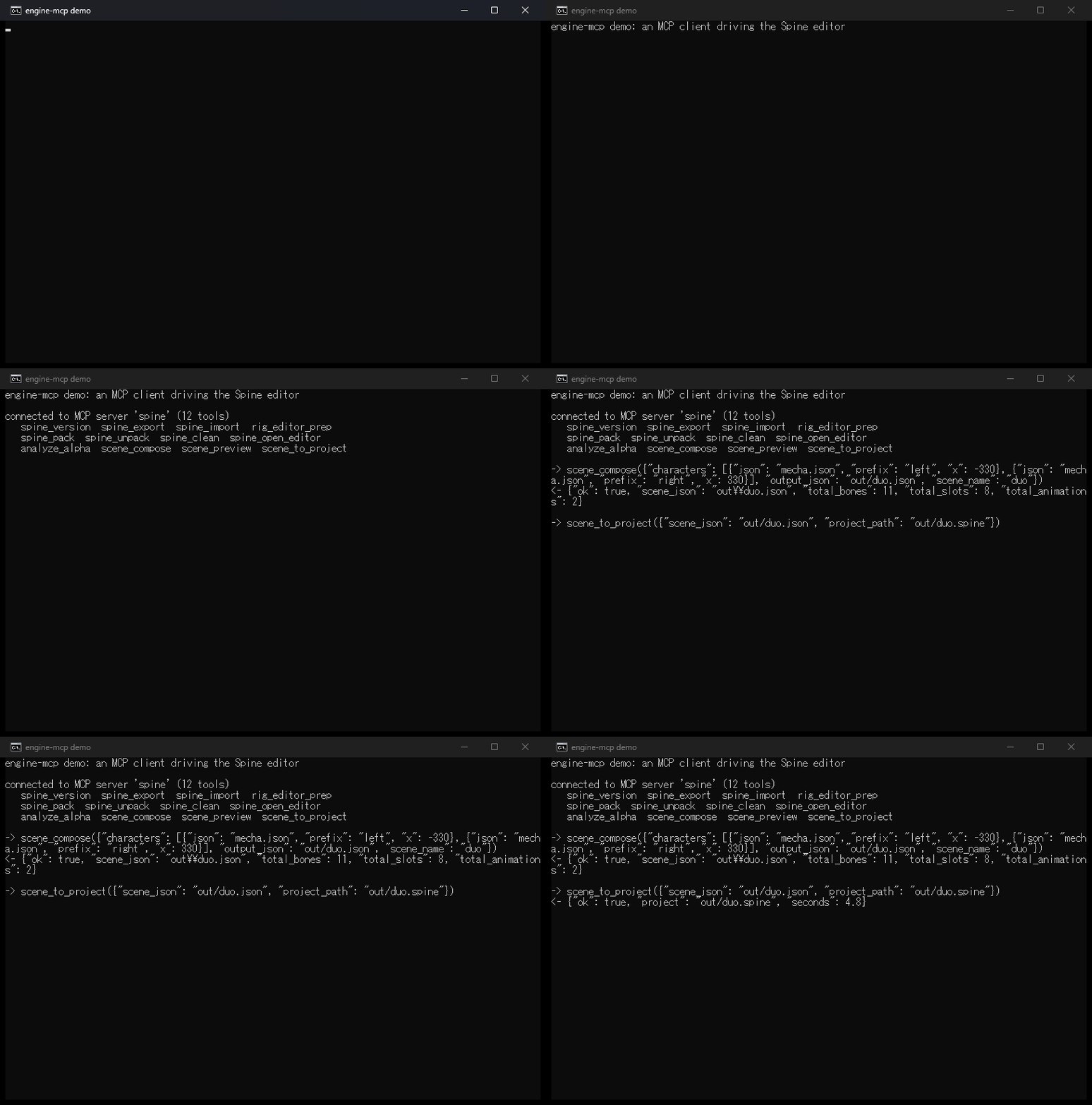
A real client session against the server: connect, list tools, compose two characters into one scene, import it into a Spine project.
Status: v0.1, early. Small on purpose.
Features
- Spine MCP server: 12 tools over stdio, usable from Claude Desktop, Claude Code, Cursor, Codex CLI or any other MCP client.
- Editor lane: wraps the official Spine command-line interface (export, import, texture pack and unpack, animation clean-up, open the editor).
- Prep lane: repairs generated skeleton JSON so the Spine 4.x importer accepts it. Converts weighted meshes to unweighted, loose keyframe lists to proper timelines, and 3.x Bezier curves to 4.x form. Pure Python, writes a new file, never touches the source.
- Scene lane: merges several rigged characters into one skeleton with prefixed names and re-based mesh bone indices, and renders a layout preview PNG. Pure Python.
- Godot connector: a small CLI that checks a Godot MCP addon's HTTP endpoint and registers it with Claude Code, Codex, Grok, Hermes and a project
.mcp.json. - One result contract: every tool returns a dict with an
okflag.
Quickstart
pip install engine-mcp
engine-mcp-spine --selftest
To run the examples, work from a clone instead:
git clone https://github.com/kurtstaines/engine-mcp.git
cd engine-mcp
pip install -e .
python examples/compose_scene.py
--selftest lists the registered tools and reports whether the Spine CLI was found. The example composes two characters into one scene with no Spine install needed.
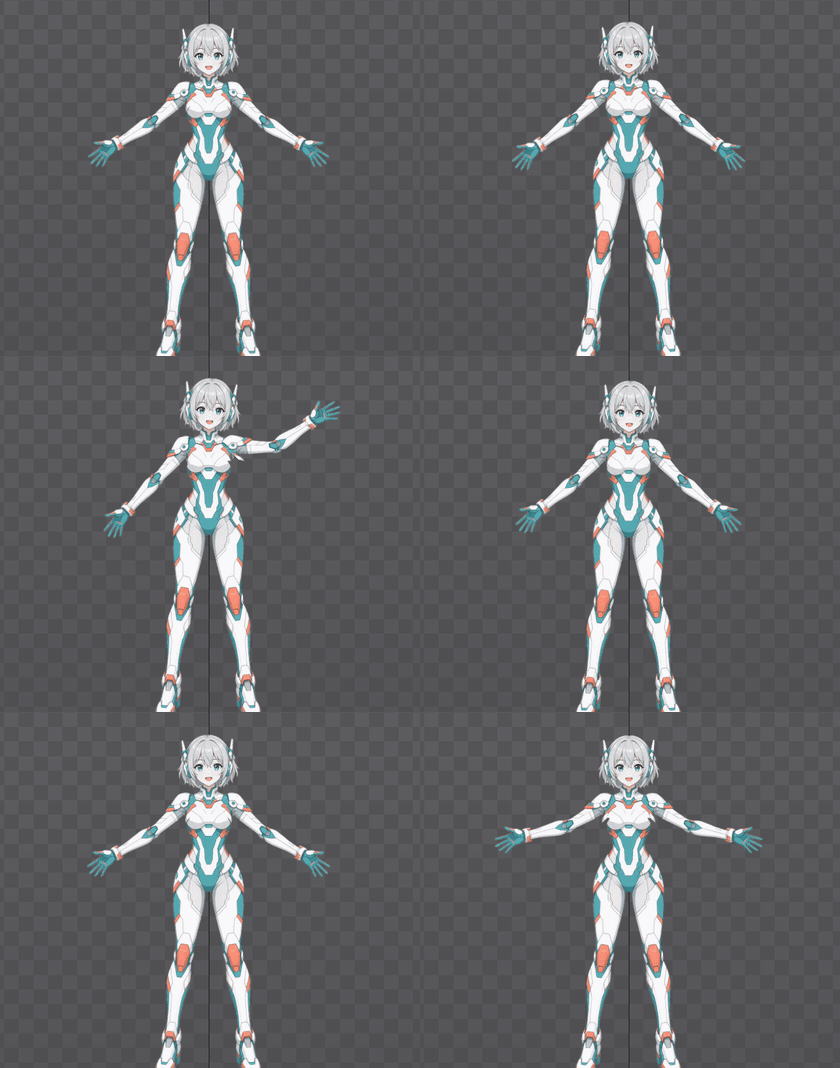
The sample rig's idle, wave and cheer animations, recorded playing in the Spine editor.
The sample rig
examples/build_rig.py turns one flat character image into a Spine skeleton:
- keys out the background and cuts the art into six parts (body, head, upper arms, forearms)
- writes
examples/mecha.jsonwith seven bones and region attachments - generates three animations as functions of time, with each part trailing the body a beat late so the idle loop breathes instead of bobbing
The cut lines and joint positions are hand-picked for this one image; it is an example, not a general auto-rigger. The source art was generated with Grok Imagine.
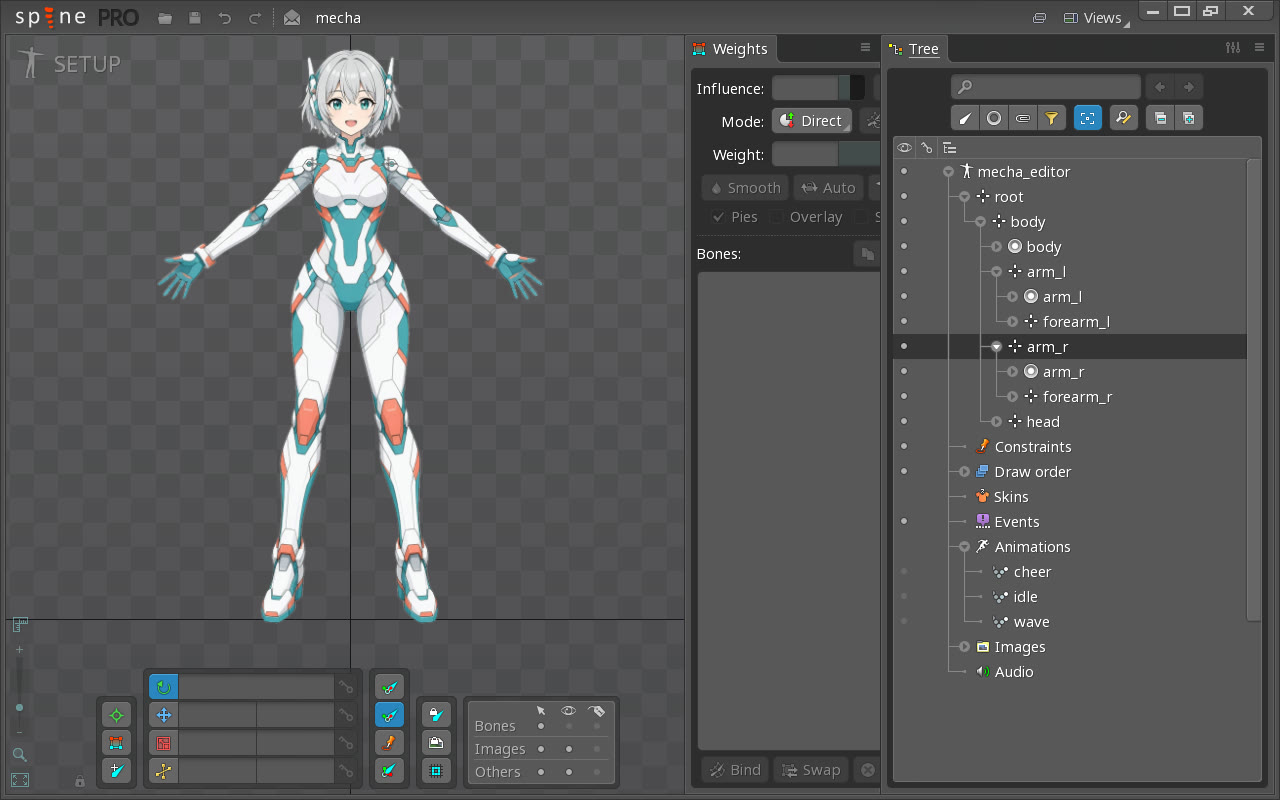
examples/mecha.json imported into a Spine project with spine_import and opened with spine_open_editor: seven bones, six image parts and three animations.
Requirements: Python 3.10+. The editor lane also needs a licensed Spine install; set SPINE_EXE if the CLI is not at C:\Program Files\Spine\Spine.com. The prep, scene and image tools work without it.
Connect an MCP client
Claude Code
claude mcp add spine -- engine-mcp-spine
Claude Desktop (claude_desktop_config.json), Cursor, or a project .mcp.json:
{
  "mcpServers": {
    "spine": {
      "command": "engine-mcp-spine",
      "env": { "SPINE_EXE": "C:/Program Files/Spine/Spine.com" }
    }
  }
}
With uv installed you can skip the install step and let the client fetch the package: set "command": "uvx" and "args": ["--from", "engine-mcp", "engine-mcp-spine"].
If the client cannot find engine-mcp-spine on its PATH (common when you installed into a virtual environment), point command at that environment's Python and use "args": ["-m", "engine_mcp.spine_server"]. A copy of this config lives in examples/mcp.json.
| Variable | Purpose |
|---|---|
SPINE_EXE |
Path to the Spine CLI. Default C:\Program Files\Spine\Spine.com. |
SPINE_UPDATE |
Optional. Pins the editor version for every call, for example 4.2.43. |
Tools
| Tool | Inputs | What it does |
|---|---|---|
spine_version |
none | Reports the Spine version and the CLI path in use. |
spine_export |
input_path, output_path, export="json", clean=False, version="" |
Exports a project or skeleton data. export is json, binary, json+pack, binary+pack, or a path to an export-settings JSON saved from the editor. |
spine_import |
data_path, project_path, name="", scale=0.0, prep=True |
Imports skeleton JSON or .skel into a .spine project. Runs rig_editor_prep on JSON first unless prep is false. |
spine_pack |
images_dir, output_dir, name="atlas", pack_settings="", project="" |
Packs a folder of images into a texture atlas. |
spine_unpack |
atlas_path, images_dir, output_dir |
Unpacks a texture atlas back into images. |
spine_clean |
project_path, output_path="" |
Runs Spine's animation clean-up. |
spine_open_editor |
project_path="" |
Opens the Spine editor, optionally with a project. Does not block. Spine shows its launcher first and waits for Start unless "Start automatically" is ticked there. The editor closes when the MCP client disconnects. |
rig_editor_prep |
rig_json, output="" |
Repairs skeleton JSON for the editor importer. Writes <stem>_editor.json. |
analyze_alpha |
image |
Reports transparent, opaque and partial alpha percentages and whether the image is already keyed. |
scene_compose |
characters, output_json, scene_name="scene" |
Merges characters into one skeleton. Each character is {"json", "prefix", "x", "y", "scale", "rotation"}. |
scene_preview |
characters, output_png, width=1920, height=1080 |
Composites each character's texture at its placement into a layout PNG. |
scene_to_project |
scene_json, project_path, scale=0.0 |
Imports a composed scene into a .spine project. |
Godot connector
Needs a Godot project with an MCP addon that serves HTTP from the running editor. Defaults: endpoint http://127.0.0.1:8000/mcp, addon folder addons/godot_ai, server name godot-ai; override with --url, --addon, --name.
engine-mcp-godot --project path/to/godot_project doctor
engine-mcp-godot verify
engine-mcp-godot --clients claude,codex connect
| Command | What it does |
|---|---|
status |
Shows whether the endpoint port is open and which clients are registered. |
doctor |
Reports addon install, endpoint liveness and client registration as three separate facts, because each fails for a different reason. |
verify |
Sends a real MCP initialize request and reports the response. |
connect |
Registers the endpoint with claude, codex, grok, hermes and/or project (.mcp.json). |
Architecture
flowchart LR
    client["MCP client<br/>Claude Desktop, Claude Code, Cursor"]
    server["spine_server.py<br/>FastMCP, 12 tools"]
    core["spine_core.py"]
    cli["Spine CLI"]
    json["Skeleton JSON<br/>prep and scene lanes"]
    png["Pillow<br/>alpha check, preview"]
    connector["godot_connect.py<br/>engine-mcp-godot"]
    godot["Godot editor<br/>MCP addon over HTTP"]
    configs["Client configs<br/>Claude, Codex, Grok, Hermes, .mcp.json"]

    client -- stdio --> server --> core
    core -- subprocess --> cli
    core --> json
    core --> png
    connector -- "initialize probe" --> godot
    connector -- registers --> configs
    client -. "HTTP, after connect" .-> godot
The server is a thin layer: each tool is one call into spine_core, which you can also import directly from a script (see examples/compose_scene.py).
Tests
pip install -e ".[dev]"
pytest
24 tests cover the prep, scene and image lanes end to end on a synthetic rig, the MCP tool registration and a tool call round trip, and the Godot connector against a local stand-in HTTP endpoint. The editor lane is tested at the level of the arguments it passes to the Spine CLI; CI does not have Spine installed, so the CLI itself is not exercised there. Registration through the claude and codex CLIs is not covered.
Roadmap
- Command-line front door for the Spine tools, for agents without an MCP client
- Engine registry and status server (which engine adapters are installed and live)
- Bone-marker tool: draw markers on art and save them as rig presets
- Automatic rigging lane (image to rigged skeleton)
- 3D animation workflow for Godot driven through MCP
Contributing
Issues and pull requests are welcome. Before opening a PR:
ruff check . && ruff format --check . && pytest
Keep tools returning the {"ok": bool, ...} contract, and add a test for anything that does not need the Spine editor to run.
License
MIT. See LICENSE.
1 maintainer

Metadata
1 maintainer
Release files for engine-mcp 0.1.2
For a detailed explanation of source distributions (sdists) and built distributions (wheels), please see the package formats documentation.
Source distribution (sdist)
| File | Size | Uploaded | Provenance | Actions |
|---|---|---|---|---|
| engine_mcp-0.1.2.tar.gz | 26.1 kB | With provenance | Details for engine_mcp-0.1.2.tar.gz |
Built distribution (wheel)
| File | Interpreter | ABI | Platform | Actions Reset |
|---|---|---|---|---|
| engine_mcp-0.1.2-py3-none-any.whl | Python 3 | none | any | Details for engine_mcp-0.1.2-py3-none-any.whl |
Total release size: 46.0 kB
Release files / engine_mcp-0.1.2.tar.gz
| Download URL | engine_mcp-0.1.2.tar.gz |
|---|---|
| Size | 26.1 kB |
| Tags | Source |
|
SHA-256 checksum How to use checksums |
38684c4fe95647482993153c10b8bcbddb6c8b9a2d5ce6f3cb13b23b521e91eb
|
|
BLAKE2b-256 checksum How to use checksums |
b687d36826af86c06743c71dcd4fa3d0e3ff040499127b12a2a929970f441780
|
| Upload date | |
|
Uploaded using Trusted Publishing? What is trusted publishing? |
Yes |
| Uploaded via |
twine/7.0.0 CPython/3.13.16
|
Provenance
Provenance describes where a file came from. On PyPI, provenance is shared via attestations, which provide a verifiable record of the build or publishing details. View details, limitations and caveats.


PyPI Publish Attestation
PyPI verified that this artifact, at this checksum, originated from the publisher listed below.
Signed by GitHub Actions, verified by PyPI on Nov 15, 2026.
Transparency logRelease files / engine_mcp-0.1.2-py3-none-any.whl
| Download URL | engine_mcp-0.1.2-py3-none-any.whl |
|---|---|
| Size | 19.8 kB |
| Tags | Python 3 |
|
SHA-256 checksum How to use checksums |
2a7f5d7730dcfc4711a3b18c2950c94239c09fbcf8929c3ed9c57e99f5e4a20f
|
|
BLAKE2b-256 checksum How to use checksums |
49134690aed191d31a81cb8c8356a9f715a7e9f3e68248058714115718e6f6f9
|
| Upload date | |
|
Uploaded using Trusted Publishing? What is trusted publishing? |
Yes |
| Uploaded via |
twine/7.0.0 CPython/3.13.16
|
Provenance
Provenance describes where a file came from. On PyPI, provenance is shared via attestations, which provide a verifiable record of the build or publishing details. View details, limitations and caveats.
PyPI Publish Attestation
PyPI verified that this artifact, at this checksum, originated from the publisher listed below.
Signed by GitHub Actions, verified by PyPI on Nov 15, 2026.
Transparency logSecurity for engine-mcp 0.1.2
Provenance
Provenance describes where a file came from. On PyPI, provenance is shared via attestations, which provide a verifiable record of the build or publishing details. View details, limitations and caveats.
Full provenance
Both files in this release have been uploaded with provenance metadata.
Attestation for engine_mcp-0.1.2.tar.gz
PyPI Publish Attestation
PyPI verified that this artifact, at this checksum, originated from the publisher listed below.
Signed by GitHub Actions, verified by PyPI on Nov 15, 2026.
Transparency logA note on package security
PyPI is a repository for distributing packages, not a service for auditing them. While third-party security researchers and our staff do their best to detect and remove malicious packages, PyPI cannot guarantee the quality, security or suitability of any given package.
To learn more about protecting yourself from malicious actors, visit our package security documentation.














