
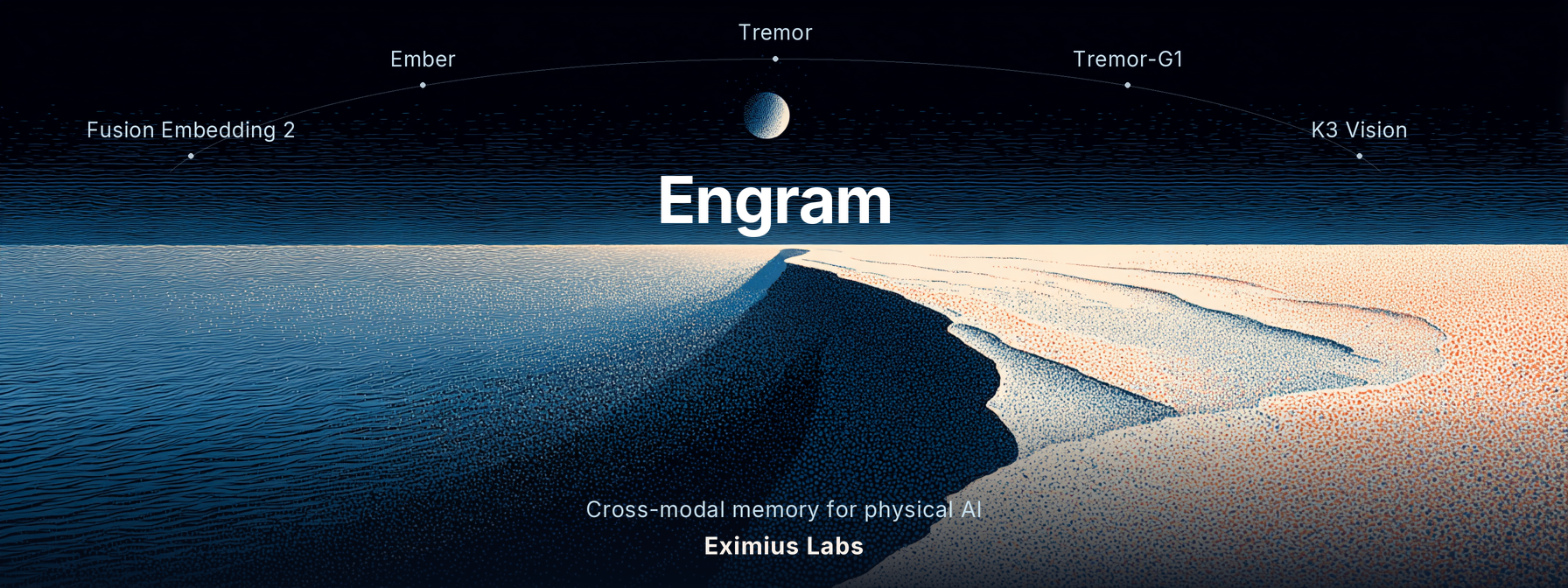
The open cross-modal memory layer for physical AI.
Index a robot's video, audio, motion, and touch into one embedding space, then search and reason about it in plain language, including temporal reasoning that retrieval alone cannot do.




Engram indexes everything a robot sees, hears, and feels into one embedding space on a shared clock, and answers questions about it in plain language. It goes past retrieval: it reasons about when things happened, not just what happened, with deterministic temporal operators that pure similarity search cannot answer.
It is built on the Fusion Embedding family (a unified text / image / video / audio / motion space) but stays model-agnostic: it takes an embedder through a small injected interface, so the whole ingest, index, and recall path runs with no model, no GPU, and no network in tests.
Try a real robot's memory in the live playground. The package installs as
engram-robomemand imports asrobomem.
What it does
Give it a recorded multimodal session (timestamped events from a robot's sensors) and it will:
- Index it: group events by modality, embed each window with the injected embedder, segment the stream into episodes, score salience, and write one row per window into a local LanceDB table on a shared clock.
- Recall by natural language, across modalities:
mem.recall("someone handed me a red mug"), or query by example (hand it any stored vector, get the nearest windows of another modality). - Reason about time, which is the part retrieval cannot do:
mem.last("shaking violently")returns the most recent matching moment.mem.count("a person shouting")counts distinct occurrences.mem.before(anchor="the alarm")finds what came just before an event.mem.timeline()returns an ordered chronological index.
Because motion is a first-class modality, Engram answers questions no camera can, such as "when was it last shaken," straight from the accelerometer with no video in the result.
The full suite is GPU-free and validated on real data: Ego4D human egocentric recordings and a real Unitree humanoid shift, not only synthetic sessions.
Quickstart (CPU, no model)
from robomem import RobotMemory, FakeEmbedder

session = [
    {"id": "img_dog", "t": 1.0, "modality": "image", "path_or_data": "cam0/dog_01.png", "source": "cam0"},
    {"id": "aud_bark", "t": 1.2, "duration": 0.5, "modality": "audio", "path_or_data": "mic0/bark.wav", "source": "mic0"},
    {"id": "mot_shake", "t": 4.0, "modality": "motion", "path_or_data": {"data": [[0.1, 0.2, 0.3]], "sr": 30}, "source": "imu"},
]

mem = RobotMemory.open("./session.lancedb", embedder=FakeEmbedder())
mem.index(session, segment=True)                 # populates episodes + salience

hits = mem.recall("a dog", modality="image", k=5)
last_shake = mem.last("shaking", modality="motion")
n_barks = mem.count("a dog barking", modality="audio")
Wiring in the real embedder
from fusion_embedding.unified import UnifiedEmbedder
from robomem import RobotMemory

embedder = UnifiedEmbedder.from_pretrained(
    "EximiusLabs/fusion-embedding-2-2b-preview", device="cuda", revision="v0.3-preview",
)
mem = RobotMemory.open("./session.lancedb", embedder=embedder)
mem.index("session.jsonl", segment=True)
hits = mem.recall("someone handed me a red mug", k=10, after=120.0, before=180.0)
Install with pip install engram-robomem (imports as robomem). The base package needs only
LanceDB, numpy, and Pillow. For the real embedder, install the model extra, which pulls
fusion-embedding; the weights download from Hugging Face
at runtime:
pip install "engram-robomem[model]"
Design: dependency injection at the embedder seam
Engram never builds an embedder. It takes one that implements the embed_* protocol
(robomem.embedder.Embedder):
embed_text  embed_image  embed_video  embed_audio  embed_thermal  embed_motion  embed_geometry
embed_tactile
center      rank_cross_modal
Every embed_* returns a full-width, L2-normalized vector. In production that object is the trained
UnifiedEmbedder; in tests it is FakeEmbedder, a deterministic CPU stand-in. This keeps the whole
pipeline runnable with no model, no GPU, and no network, following the model core's own "DI at the
seams plus tiny CPU stand-ins" discipline.
Session manifest
A session is a JSONL file, a JSON array, or an in-memory list of events:
{"t": 12.5, "modality": "image", "path_or_data": "cam0/frame_00012.png", "source": "cam0"}
{"t": 12.5, "modality": "audio", "path_or_data": "mic0/clip_012.wav", "source": "mic0", "duration": 1.0}
{"t": 13.0, "modality": "text",  "path_or_data": "operator said stop", "source": "log"}
Required per event: t (or t_start), modality, and path_or_data. Optional: id, source,
duration (or t_end), meta, thumb. modality is one of
text | image | video | audio | thermal | motion | geometry | tactile. For image, video, thermal, geometry,
and audio, path_or_data is normally a path the embedder loads itself; audio and motion may also be
passed as {"data": [...], "sr": 16000}; tactile takes a pressure window as a path or
{"data": [[...], ...]} (frames of a 32x32 taxel grid, embedded by the Tactus pack).
CLI
robomem index <manifest> --db <path> [--dedup-tau 0.98] [--fake]
robomem query "<text>" --db <path> [--modality image] [-k 10] [--after 10 --before 30] [--fake]
robomem show <event_id> --db <path> [--fake]
--fake uses the CPU stand-in embedder. Without it, the CLI loads
UnifiedEmbedder.from_pretrained(--model, device=--device).
Data model (Tier-0 events table)
| column | type | note |
|---|---|---|
event_id |
string | unique |
t_start, t_end |
float64 | window time bounds (seconds) |
modality |
string | text / image / video / audio / thermal / motion / geometry / tactile |
source |
string | stream key (camera / mic / channel) |
vector |
list[2048] | full-width, L2-normalized unified embedding |
thumb, meta |
string | preview path, JSON metadata |
episode_id, salience |
string, float32 | episode assignment and novelty score |
How recall and reasoning work
recall embeds the query, applies a LanceDB SQL prefilter on time and modality, scores an exact
cosine scan over the candidates (session scale, no ANN index), optionally mean-centers per modality
to correct the cross-modal gap, merges temporally adjacent same-source hits into segments, and
ranks. recall_like is the same path starting from a supplied vector.
Episode segmentation runs an online change-point over each stream's embedding sequence; salience
scores per-window novelty. The temporal operators (last, count, before, after, timeline)
are deterministic programs over the LanceDB time filter plus relevance and episode grouping, with
no LLM in the loop. Ranking can weight relevance, recency, and salience together, so a "last" query
returns the most recent match rather than the most similar one.
Development
uv venv --system-site-packages
uv pip install lancedb pyarrow pillow pytest
uv run python -m pytest
The suite is GPU-free and uses FakeEmbedder with small synthetic sessions.
License
Apache-2.0. See LICENSE.
1 maintainer

Download files
Download the file for your platform. If you're not sure which to choose, learn more about installing packages.
Source Distribution
Built Distribution
Filter files by name, interpreter, ABI, and platform.
If you're not sure about the file name format, learn more about wheel file names.
Copy a direct link to the current filters
File details
Details for the file engram_robomem-0.2.0.tar.gz.
File metadata
- Download URL: engram_robomem-0.2.0.tar.gz
- Upload date:
- Size: 41.9 kB
- Tags: Source
- Uploaded using Trusted Publishing? Yes
- Uploaded via:
twine/7.0.0 CPython/3.13.14
File hashes
| Algorithm | Hash digest | |
|---|---|---|
| SHA256 |
fc02f8abca5b01d421380b75eed1bd36e3967cc1010e1a3409928d3c467ea7b6
|
|
| MD5 |
1b7b9a2c23d0ecd407e51fa172d6a8d0
|
|
| BLAKE2b-256 |
4e2e1c12efb88cb32f7d9328c13d3ea52002c6639fd23e7ae22c1e85a34b7187
|
Provenance
The following attestation bundles were made for engram_robomem-0.2.0.tar.gz:
Publisher:
publish.yml on Eximius-Labs/engram
-
Statement:
-
Statement type:
https://in-toto.io/Statement/v1 -
Predicate type:
https://docs.pypi.org/attestations/publish/v1 -
Subject name:
engram_robomem-0.2.0.tar.gz -
Subject digest:
fc02f8abca5b01d421380b75eed1bd36e3967cc1010e1a3409928d3c467ea7b6 - Sigstore transparency entry: 2329853271
- Sigstore integration time:
-
Permalink:
Eximius-Labs/engram@b8078fd1030234af8dd6b26a4f383ee5dc27e1b1 -
Branch / Tag:
refs/tags/v0.2.0 - Owner: https://github.com/Eximius-Labs
-
Access:
public
-
Token Issuer:
https://token.actions.githubusercontent.com -
Runner Environment:
github-hosted -
Publication workflow:
publish.yml@b8078fd1030234af8dd6b26a4f383ee5dc27e1b1 -
Trigger Event:
release
-
Statement type:
File details
Details for the file engram_robomem-0.2.0-py3-none-any.whl.
File metadata
- Download URL: engram_robomem-0.2.0-py3-none-any.whl
- Upload date:
- Size: 38.0 kB
- Tags: Python 3
- Uploaded using Trusted Publishing? Yes
- Uploaded via:
twine/7.0.0 CPython/3.13.14
File hashes
| Algorithm | Hash digest | |
|---|---|---|
| SHA256 |
48eacee2714a7e280bc669f84a50356ffd11ef7748ee6a1c3e5eef696b93f005
|
|
| MD5 |
25aa3722e968f70727b82eb6bd20d7b1
|
|
| BLAKE2b-256 |
ebe403c1bedd66f58a81ef45bcd49697c70cf7d8a9f3bbeecb24445dd4948a9f
|
Provenance
The following attestation bundles were made for engram_robomem-0.2.0-py3-none-any.whl:
Publisher:
publish.yml on Eximius-Labs/engram
-
Statement:
-
Statement type:
https://in-toto.io/Statement/v1 -
Predicate type:
https://docs.pypi.org/attestations/publish/v1 -
Subject name:
engram_robomem-0.2.0-py3-none-any.whl -
Subject digest:
48eacee2714a7e280bc669f84a50356ffd11ef7748ee6a1c3e5eef696b93f005 - Sigstore transparency entry: 2329853638
- Sigstore integration time:
-
Permalink:
Eximius-Labs/engram@b8078fd1030234af8dd6b26a4f383ee5dc27e1b1 -
Branch / Tag:
refs/tags/v0.2.0 - Owner: https://github.com/Eximius-Labs
-
Access:
public
-
Token Issuer:
https://token.actions.githubusercontent.com -
Runner Environment:
github-hosted -
Publication workflow:
publish.yml@b8078fd1030234af8dd6b26a4f383ee5dc27e1b1 -
Trigger Event:
release
-
Statement type:














