
EnrichMap: Spatially-aware gene set enrichment

EnrichMap is a lightweight tool designed to compute and visualise enrichment scores of a given gene set or signature in spatial transcriptomics datasets across different platforms. It offers flexible scoring, batch correction, spatial smoothing and visual outputs for intuitive exploration of biological signatures.
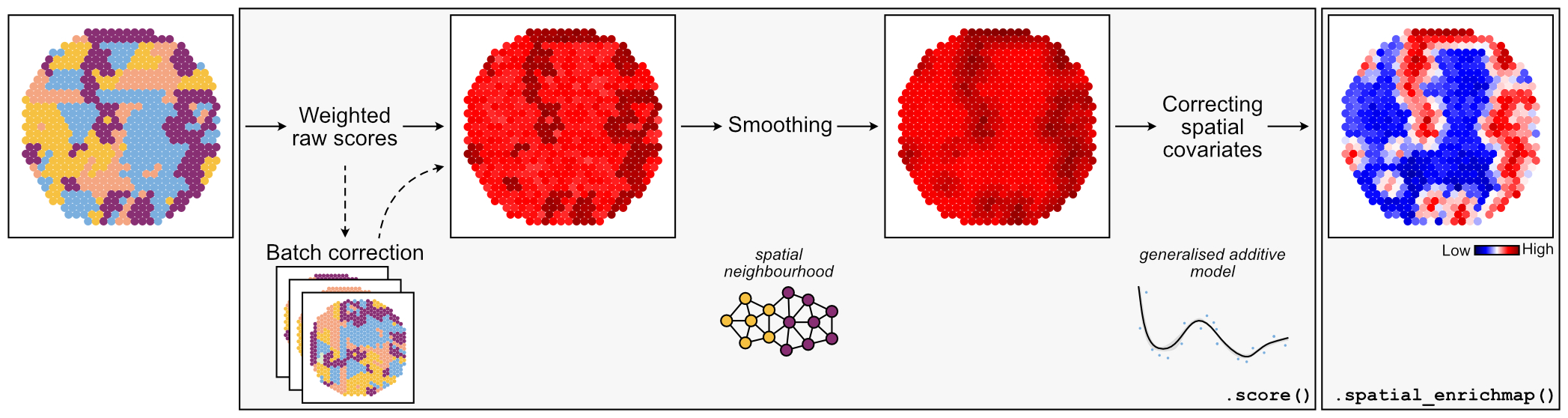
Features
- Fast computation of enrichment scores
- Scores standardised against a null model of expression-matched random gene sets, so a positive score means enrichment over random genes at that spot
- Support for batch correction and optional spatial covariate correction
- Built-in spatial smoothing
- Visualisation tools for intuitive mapping
- Easy integration with AnnData (.h5ad) objects
System requirements
- Operating system: developed and tested on macOS 26 (Apple M2 Pro, 16 GB RAM) and Ubuntu 22.04 Server.
EnrichMapis a pure-Python package with pip-installable dependencies, so it is expected to run on Linux and Windows as well, but these have not been tested. - Python: ≥ 3.10. Tested with Python 3.11.9 and 3.12.4.
- Hardware: no non-standard hardware is required (no GPU). The demo below peaks at about 1.4 GB of RAM; memory use grows with the size of the dataset.
- Dependencies: installed automatically by
pip. The resolved versions below were recorded when testingEnrichMap0.2.4 (dependencies are not pinned; versions resolved bypipon 7 October 2026). Version 0.3.0 adds no dependencies and was tested with Python 3.11 on Ubuntu 22.04:
| Package | Python 3.11.9 | Python 3.12.4 |
|---|---|---|
| numpy | 2.4.6 | 2.4.6 |
| pandas | 2.3.3 | 3.0.6 |
| scipy | 1.16.3 | 1.16.3 |
| scikit-learn | 1.9.1 | 1.9.1 |
| scanpy | 1.11.5 | 1.12.4 |
| anndata | 0.12.19 | 0.13.4 |
| squidpy | 1.8.2 | 1.8.3 |
| matplotlib | 3.11.2 | 3.11.2 |
| seaborn | 0.13.2 | 0.13.2 |
| dask | 2026.1.1 | 2026.8.0 |
| pygam | 0.12.0 | 0.12.0 |
| POT | 0.9.7.post1 | 0.9.7.post1 |
| esda | 2.9.0 | 2.10.0 |
| libpysal | 4.14.1 | 4.15.0 |
| scikit-gstat | 1.0.24 | 1.0.24 |
| statannotations | 0.7.2 | 0.7.2 |
| adjustText | 1.4.0 | 1.4.0 |
Installation
A conda environment is strongly recommended with python ≥ 3.10.
conda create -n enrichmap_env python=3.11
conda activate enrichmap_env
Then, install enrichmap via pip.
pip install enrichmap
or directly from GitHub:
pip install git+https://github.com/secrierlab/enrichmap.git
Typical install time on a normal desktop computer: about 5 minutes (measured 4.5–5 minutes into a fresh environment with an empty pip cache, mostly spent downloading the dependencies).
Basic usage
import scanpy as sc
import enrichmap as em

# Load your AnnData object
adata = sc.read_h5ad("PATH/TO/YOUR/DATA.h5ad")

# Define a gene set
gene_set = ["CD3D", "CD3E", "CD8A"]

# Run scoring
em.tl.score(
    adata=adata,
    gene_set=gene_set,
    score_key="T_cell_signature",
    smoothing=True,  # by default
    null_model=True,  # by default: z-score against 100 random gene sets matched on mean and CV
    compute_q_vals=False,  # by default; True uses 1000 random gene sets and adds per-spot q-values to adata.obs
    correct_spatial_covariates=False,  # by default; True fits a spatial GAM to each score
    batch_key=None,  # Set batch_key if working with multiple slides
)

# Visualise
em.pl.spatial_enrichmap(adata=adata, score_key="T_cell_signature_score")
Important note: EnrichMap currently does not support reading in
SpatialDataformat. However, users can simply convertSpatialDatato legacyAnnDatato use EnrichMap.
import spatialdata_io as sd

# read in SpatialData
sdata = sd.visium_hd("PATH_TO_DATA_FOLDER/")
# convert to AnnData
adata = to_legacy_anndata(
    sdata,
    include_images=True,
    table_name="square_008um",
    coordinate_system="downscaled_hires",
)
Demo
The demo scores the hybrid epithelial-to-mesenchymal transition (EMT) signature (Malagoli Tagliazucchi et al., 2023) on a small spatial transcriptomics dataset of two breast cancer Visium slides (5,870 spots × 14,664 genes, raw counts, 72 MB). The dataset is included in this repository at tests/dataset/adata_breast.h5ad and is downloaded automatically by the code below. It corresponds to adata_slides_0_3.h5ad in the Zenodo record 10.5281/zenodo.15438169 (CC BY 4.0), with the metadata reduced to keep the file small.
Instructions. Install EnrichMap (see above), then run the following code as a Python script or in a notebook:
import scanpy as sc
import enrichmap as em

# Download the demo dataset (72 MB; cached in the working directory)
adata = sc.read(
    "adata_breast.h5ad",
    backup_url="https://github.com/secrierlab/EnrichMap/raw/main/tests/dataset/adata_breast.h5ad",
)
print(
    f"{adata.n_obs} spots x {adata.n_vars} genes; slides: {sorted(adata.obs['batch'].unique())}"
)

# The data are raw counts: normalise and log-transform
sc.pp.normalize_total(adata, target_sum=1e4)
sc.pp.log1p(adata)

# Hybrid EMT signature
hybrid = [
    "PDPN",
    "ITGA5",
    "ITGA6",
    "TGFBI",
    "LAMC2",
    "MMP10",
    "LAMA3",
    "CDH13",
    "SERPINE1",
    "P4HA2",
    "TNC",
    "MMP1",
]

# Score; batch_key makes smoothing and spatial correction run per slide
em.tl.score(adata, gene_set=hybrid, score_key="Hybrid", batch_key="batch")
print(adata.obs["Hybrid_score"].describe().round(3).to_string())

# Visualise both slides and save the figure to figures/demo_hybrid_score.png
em.pl.spatial_enrichmap(
    adata,
    score_key=["Hybrid_score"],
    size=2,
    library_key="batch",
    library_id=["0", "3"],
    cmap="RdBu_r",
    shape=None,
    save="demo_hybrid_score.png",
)
Expected output. The console prints:
5870 spots x 14664 genes; slides: ['0', '3']
Scoring Hybrid: 12/12 genes found: 100%|██████████| 1/1 [...]
count    5870.000
mean       -0.022
std         1.570
min        -4.326
25%        -1.066
50%        -0.250
75%         0.762
max        10.011
and a two-panel figure is saved (one spatial map per slide, spots coloured by the Hybrid enrichment score on a diverging red-blue scale, centred at zero). The scores are stored in adata.obs["Hybrid_score"]. Since 0.3.0 the default score is a z-score against 100 expression-matched random gene sets (null_model=True): 0 means no different from random genes, positive values mean enrichment. Earlier versions (0.2.x) used a spatial GAM by default and gave scores on a different scale for the same call; to reproduce them, pass null_model=False, correct_spatial_covariates=True. Depending on your squidpy and anndata versions, harmless FutureWarning deprecation messages may also be printed.
Expected run time. About 10 seconds on a normal desktop computer once the dataset is cached (the scoring itself, including the null model, takes about 1.5 seconds). The very first run after installation takes longer (about 1 minute in our tests) because of one-off library start-up and compilation costs, plus the 72 MB dataset download.
Reproducing the manuscript results
The notebooks used to generate the figures and supplementary figures are available in a separate repository: secrierlab/enrichmap-reproducibility. Its README lists, for each figure, the notebook that produces it, covering the simulated benchmarks, Visium (mouse brain and human breast cancer), Visium HD, Xenium, MERFISH and imaging mass cytometry analyses. Figure numbering in that repository follows the bioRxiv preprint. Its README describes the environment (requirements.txt), where to obtain each dataset (a Zenodo record, built-in squidpy datasets and public downloads) and the order in which to run the notebooks.
Documentation
Comprehensive documentation is available at: https://enrichmap.readthedocs.io/en/latest
Contributing
If you have ideas for new features or spot a bug, please open an issue or submit a pull request.
License
This project is licensed under the GNU General Public License v3.0 (GPL-3.0-only); see the LICENSE file.
Citation
Celik C & Secrier M (2025). EnrichMap: Spatially-informed enrichment analysis for functional interpretation of spatial transcriptomics. biorxiv.com
Copyright
This code is free and is distributed in the hope that it will be useful, but WITHOUT ANY WARRANTY. See the GNU General Public License for more details.
1 maintainer

Metadata
1 maintainer
Release files for enrichmap 0.3.0
For a detailed explanation of source distributions (sdists) and built distributions (wheels), please see the package formats documentation.
Source distribution (sdist)
| File | Size | Uploaded | Provenance | Actions |
|---|---|---|---|---|
| enrichmap-0.3.0.tar.gz | 77.3 MB | Without provenance | Details for enrichmap-0.3.0.tar.gz |
Built distribution (wheel)
| File | Interpreter | ABI | Platform | Actions Reset |
|---|---|---|---|---|
| enrichmap-0.3.0-py3-none-any.whl | Python 3 | none | any | Details for enrichmap-0.3.0-py3-none-any.whl |
Total release size: 77.4 MB
Release files / enrichmap-0.3.0.tar.gz
| Download URL | enrichmap-0.3.0.tar.gz |
|---|---|
| Size | 77.3 MB |
| Tags | Source |
|
SHA-256 checksum How to use checksums |
035c9c811bbb44c350a9dee8531c8121f923c60a9ece4d6f547fe52cb70fa811
|
|
BLAKE2b-256 checksum How to use checksums |
52042d35ab168b4dc66ad9d44479dc2e2ea7d4f789a29cab37b1d3c90bd0db85
|
| Upload date | |
|
Uploaded using Trusted Publishing? What is trusted publishing? |
No |
| Uploaded via |
twine/7.0.0 CPython/3.14.6
|
Release files / enrichmap-0.3.0-py3-none-any.whl
| Download URL | enrichmap-0.3.0-py3-none-any.whl |
|---|---|
| Size | 87.8 kB |
| Tags | Python 3 |
|
SHA-256 checksum How to use checksums |
bb8fe19f219ef3a1dfa83b7e7da8825d9be403af9478ed2d7bdf1951bad51858
|
|
BLAKE2b-256 checksum How to use checksums |
9e69ad5920c44f029355ec56abbd8e6d8b8ad360046a97c2fc252aa959334083
|
| Upload date | |
|
Uploaded using Trusted Publishing? What is trusted publishing? |
No |
| Uploaded via |
twine/7.0.0 CPython/3.14.6
|
Security for enrichmap 0.3.0
Provenance
Provenance describes where a file came from. On PyPI, provenance is shared via attestations, which provide a verifiable record of the build or publishing details. View details, limitations and caveats.
No provenance found
None of the files in this release were uploaded with provenance metadata.
A note on package security
PyPI is a repository for distributing packages, not a service for auditing them. While third-party security researchers and our staff do their best to detect and remove malicious packages, PyPI cannot guarantee the quality, security or suitability of any given package.
To learn more about protecting yourself from malicious actors, visit our package security documentation.














