
ClusterEnsembles




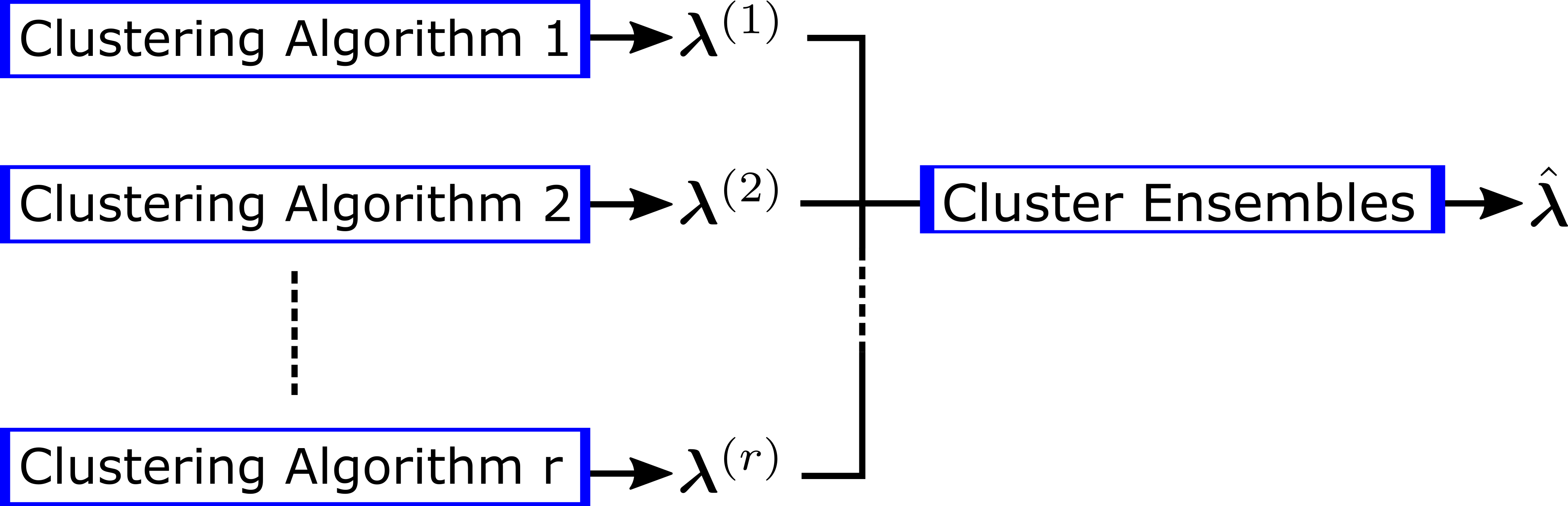
A Python package for cluster ensembles. Cluster ensembles generate a single consensus clustering label by using base labels obtained from multiple clustering algorithms. The consensus clustering label stably achieves a high clustering performance.
This package was originally authored by Takehiro Sano but has since been removed from PyPi. This a cloned version I am maintaining. All original code and functionality is unchanged, it is just maintained, tested, and published from here.
Installation
pip install ensembleclustering
Usage
CE.cluster_ensembles is used as follows.
>> > import numpy as np

>> > import ensembleclustering as CE

>> > label1 = np.array([1, 1, 1, 2, 2, 3, 3])

>> > label2 = np.array([2, 2, 2, 3, 3, 1, 1])

>> > label3 = np.array([4, 4, 2, 2, 3, 3, 3])

>> > label4 = np.array([1, 2, np.nan, 1, 2, np.nan, np.nan])  # `np.nan`: missing value

>> > labels = np.array([label1, label2, label3, label4])

>> > label_ce = CE.cluster_ensembles(labels)

>> > print(label_ce)
[1 1 1 2 2 0 0]
Parameters
-
labels: numpy.ndarrayLabels generated by multiple clustering algorithms such as K-Means.
Note: Assume that the length of each label is the same.
-
nclass: int, default=NoneNumber of classes in a consensus clustering label. If
nclass=None, set the maximum number of classes in each label except missing values. In other words, setnclass=3automatically in the above. -
solver: {'cspa', 'hgpa', 'mcla', 'hbgf', 'nmf', 'all'}, default='hbgf''cspa': Cluster-based Similarity Partitioning Algorithm [1].
'hgpa': HyperGraph Partitioning Algorithm [1].
'mcla': Meta-CLustering Algorithm [1].
'hbgf': Hybrid Bipartite Graph Formulation [2].
'nmf': NMF-based consensus clustering [3].
'all': The consensus clustering label with the largest objective function value [1] is returned among the results of all solvers.
Note: Please use 'hbgf' for large-scale
labels. -
random_state: int, default=NoneUsed for 'hgpa', 'mcla', and 'nmf'. Please pass an integer for reproducible results.
-
verbose: bool, default=FalseWhether to be verbose.

Return
-
label_ce: numpy.ndarrayA consensus clustering label generated by cluster ensembles.
Example
tsano430/egnmf: https://github.com/tsano430/egnmf
Similar Package
GGiecold/Cluster_Ensembles: https://github.com/GGiecold/Cluster_Ensembles
References
[1] A. Strehl and J. Ghosh, "Cluster ensembles -- a knowledge reuse framework for combining multiple partitions," Journal of Machine Learning Research, vol. 3, pp. 583-617, 2002.
[2] X. Z. Fern and C. E. Brodley, "Solving cluster ensemble problems by bipartite graph partitioning," In Proceedings of the Twenty-First International Conference on Machine Learning, p. 36, 2004.
[3] T. Li, C. Ding, and M. I. Jordan, "Solving consensus and semi-supervised clustering problems using nonnegative matrix factorization," In Proceedings of the Seventh IEEE International Conference on Data Mining, pp. 577-582, 2007.
[4] J. Ghosh and A. Acharya, "Cluster ensembles," Wiley Interdisciplinary Reviews: Data Mining and Knowledge Discovery, vol. 1, no. 4, pp. 305-315, 2011.
1 maintainer

Metadata
1 maintainer
Release files for ensembleclustering 1.0.2
For a detailed explanation of source distributions (sdists) and built distributions (wheels), please see the package formats documentation.
Source distribution (sdist)
| File | Size | Uploaded | Provenance | Actions |
|---|---|---|---|---|
| ensembleclustering-1.0.2.tar.gz | 12.5 kB | Without provenance | Details for ensembleclustering-1.0.2.tar.gz |
Built distribution (wheel)
| File | Interpreter | ABI | Platform | Actions Reset |
|---|---|---|---|---|
| ensembleclustering-1.0.2-py3-none-any.whl | Python 3 | none | any | Details for ensembleclustering-1.0.2-py3-none-any.whl |
Total release size: 27.0 kB
Release files / ensembleclustering-1.0.2.tar.gz
| Download URL | ensembleclustering-1.0.2.tar.gz |
|---|---|
| Size | 12.5 kB |
| Tags | Source |
|
SHA-256 checksum How to use checksums |
7019b7636abd84e8d352b47838d055dbb2e330199fd2709465774e69635593c3
|
|
BLAKE2b-256 checksum How to use checksums |
24d5fd5f8bebfd270ae01ffc75db0de690020ef753aa30ef85a925cb9913a972
|
| Upload date | |
|
Uploaded using Trusted Publishing? What is trusted publishing? |
No |
| Uploaded via |
poetry/1.2.2 CPython/3.10.6 Linux/5.15.0-60-generic
|
Release files / ensembleclustering-1.0.2-py3-none-any.whl
| Download URL | ensembleclustering-1.0.2-py3-none-any.whl |
|---|---|
| Size | 14.5 kB |
| Tags | Python 3 |
|
SHA-256 checksum How to use checksums |
574515c8641d002108bd86a167415bbff3ef2643064fa58e7678e434df18fbc0
|
|
BLAKE2b-256 checksum How to use checksums |
5652081ab2a5b8a83534bfada1f6a70aa419fbd851c826a3ef6afef2fef20a92
|
| Upload date | |
|
Uploaded using Trusted Publishing? What is trusted publishing? |
No |
| Uploaded via |
poetry/1.2.2 CPython/3.10.6 Linux/5.15.0-60-generic
|
Security for ensembleclustering 1.0.2
Provenance
Provenance describes where a file came from. On PyPI, provenance is shared via attestations, which provide a verifiable record of the build or publishing details. View details, limitations and caveats.
No provenance found
None of the files in this release were uploaded with provenance metadata.
A note on package security
PyPI is a repository for distributing packages, not a service for auditing them. While third-party security researchers and our staff do their best to detect and remove malicious packages, PyPI cannot guarantee the quality, security or suitability of any given package.
To learn more about protecting yourself from malicious actors, visit our package security documentation.














