
enterprise-claude-kit
The governance and orchestration layer that Fortune 500 teams put between their code and the Claude API.




The Problem
Most enterprise Claude deployments stall — not because of the AI, but because of what's missing above it.
You get an API key. You wire up a chat loop. It works in staging. Then legal asks: "Where are the audit logs?" Compliance asks: "Are we redacting PII before it hits the API?" Finance asks: "How much is the dev team spending per day?" And the rollout team asks: "How do we gate Wave 2 access until Wave 1 hits 80% adoption?"
The Anthropic SDK is not built to answer those questions. enterprise-claude-kit is.
It's the production-grade layer that handles governance, cost control, audit trails, and adoption tracking — so you can focus on the application, not the infrastructure.
Architecture
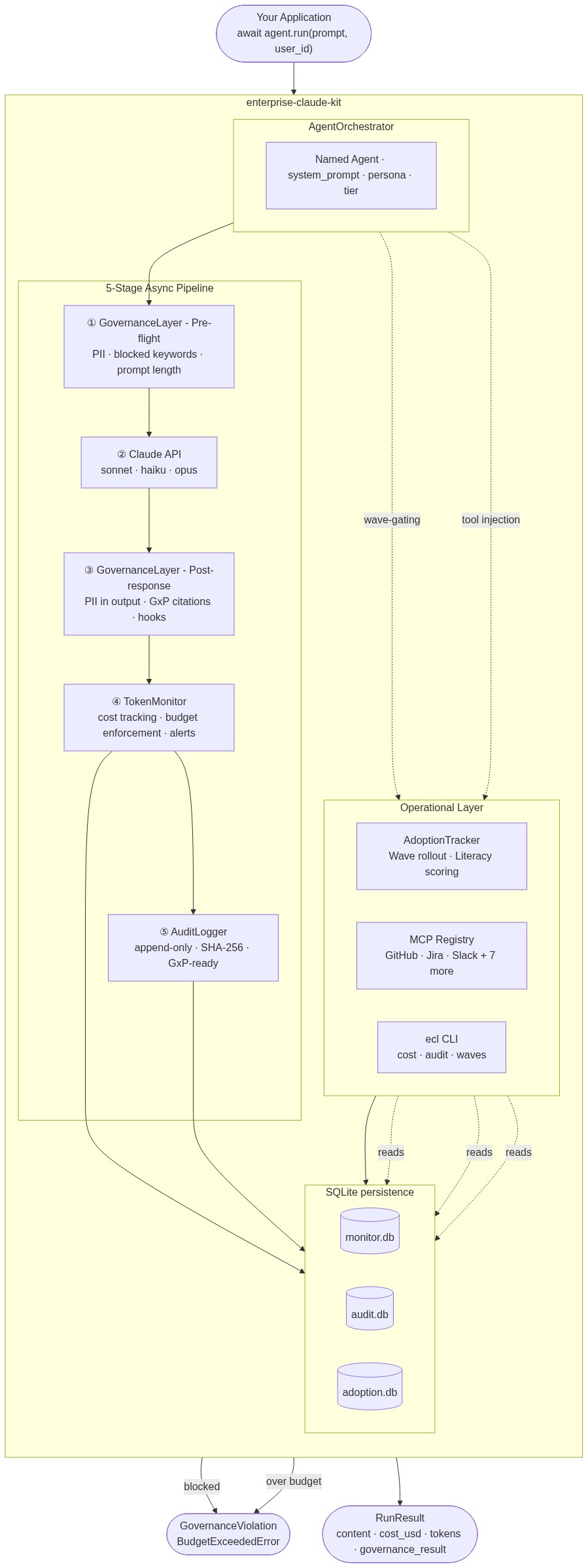
Quick Start
pip install enterprise-claude-kit
cp .env.example .env   # add your ANTHROPIC_API_KEY
import asyncio
from enterprise_claude import AgentOrchestrator, GovernanceLayer, TokenMonitor

governance = GovernanceLayer(pii_filter=True, constitutional_ai=True)
monitor    = TokenMonitor(daily_budget_usd=50.0)

async def main():
    async with AgentOrchestrator(governance=governance, monitor=monitor) as orch:
        agent  = await orch.create_agent(
            name="analyst", system_prompt="You are a concise analyst.", persona="analyst"
        )
        result = await agent.run("Summarise Q3 risks in 3 bullets.", user_id="alice")
        print(result.content)        # the answer
        print(result.cost_usd)       # e.g. 0.000312
        print(result.governance_result.passed)  # True

asyncio.run(main())
Three lines of config. One await. Full governance, cost tracking, and audit trail included.
Modules
🛡️ GovernanceLayer
Every Claude call passes through the governance layer first. Configure it once; it runs everywhere.
from enterprise_claude import GovernanceLayer

governance = GovernanceLayer(
    pii_filter=True,                            # redact emails, SSNs, phone numbers
    blocked_keywords=["classified", "MNPI"],    # hard-stop on sensitive terms
    constitutional_ai=True,                     # self-critique harmful content
    gxp_mode=True,                              # require [SOURCE:] citations (pharma)
    max_prompt_length=50_000,                   # guard against prompt-stuffing
    pre_hooks=[lambda prompt, ctx: log(prompt)],
    post_hooks=[lambda resp, ctx: verify(resp)],
)
GovernanceResult tells you exactly what happened:
result = await agent.run("Who is the patient John Smith?", user_id="alice")

gov = result.governance_result
print(gov.passed)        # False — PII detected
print(gov.pii_detected)  # ["john smith"]
print(gov.flags)         # ["pii_in_prompt"]
print(gov.violations)    # ["pii_blocked"]
Exceptions give you clean programmatic control:
from enterprise_claude import GovernanceViolation, BudgetExceededError

try:
    result = await agent.run(prompt, user_id="alice")
except GovernanceViolation as exc:
    print(exc.violation_type)   # "pii_detected" | "blocked_keyword" | …
except BudgetExceededError as exc:
    print(exc.details)          # {"budget_usd": 50.0, "spent_usd": 50.003}
🤖 AgentOrchestrator
Register named agents with pre-configured system prompts, personas, and tool bindings. Deploy them to your whole org. Change their config in one place.
from enterprise_claude import AgentOrchestrator

async with AgentOrchestrator(governance=governance, monitor=monitor, audit_logger=audit) as orch:

    # Agents are reusable — create once, run many times
    code_reviewer = await orch.create_agent(
        name="Code Reviewer",
        system_prompt="You are a senior engineer performing security-focused code review.",
        persona="engineering",
        tier="default",                              # "default" | "batch" | "gated"
        mcp_connectors=["github", "jira"],           # inject tool definitions
    )

    # Run against any prompt, any user
    result = await code_reviewer.run(diff_text, user_id="bob@acme.com")
    print(f"Review: {result.content}")
    print(f"Cost:   ${result.cost_usd:.6f}  |  Tokens in/out: {result.input_tokens}/{result.output_tokens}")
💰 TokenMonitor
Real-time cost tracking, per-user budgets, and alerting — backed by SQLite so nothing is lost on restart.
from enterprise_claude import TokenMonitor
from datetime import UTC, datetime, timedelta

monitor = TokenMonitor(
    daily_budget_usd=100.0,
    alert_threshold_pct=0.80,   # fire alert at 80 % of budget
    db_path="monitor.db",
)

# Async alert callback — fires when the threshold is crossed
@monitor.on_alert
async def on_budget_alert(status) -> None:
    await slack.post(f"⚠️ Budget at {status.pct_used:.1f}% — ${status.used_usd:.2f} of ${status.budget_usd:.2f} used")

# Query spend for any time window
now     = datetime.now(tz=UTC)
summary = await monitor.get_cost_summary(start_date=now - timedelta(hours=24), end_date=now)

print(f"Total:      ${summary.total_usd:.4f}")
print(f"By model:   {summary.by_model}")    # {"claude-sonnet-4-6": 0.042, …}
print(f"By persona: {summary.by_persona}")  # {"analyst": 0.018, "engineer": 0.024}
print(f"Calls:      {summary.record_count}")

# Check the current budget gauge
budget = await monitor.check_budget()
print(f"{budget.pct_used:.1f}% used — ${budget.remaining_usd:.4f} remaining")
📋 AuditLogger
An immutable, append-only event log with SHA-256 tamper detection. Required for SOC 2, HIPAA, and 21 CFR Part 11 compliance programmes.
from enterprise_claude.audit import AuditLogger, AuditFilter

audit = AuditLogger(db_path="audit.db", gxp_mode=True, retention_days=365)

# Events are written automatically by AgentOrchestrator — no manual logging needed.
# Query them at any time:
page = await audit.query_events(AuditFilter(
    persona="clinical_ops",
    governance_result="pass",
    page=1,
    page_size=50,
))

for event in page["events"]:
    print(f"{event.timestamp}  {event.agent_id}  {event.governance_result}  {event.cost_usd:.6f}")

print(f"Total events: {page['total']}  (page {page['page']} of {page['pages']})")

# Tamper detection — verify every stored SHA-256 checksum
checksums = await audit.verify_checksums()
tampered  = [eid for eid, ok in checksums.items() if not ok]

if tampered:
    raise RuntimeError(f"Audit log tampered — {len(tampered)} event(s) modified: {tampered}")
else:
    print(f"✅ All {len(checksums)} events verified clean")
📈 AdoptionTracker
Wave-based rollout management. Gate Wave 2 access until Wave 1 hits 80%. Track literacy scores. Surface inactive users before your renewal conversation.
from enterprise_claude.adoption_tracker import AdoptionTracker, WaveGateError

tracker = AdoptionTracker(db_path="adoption.db")
await tracker.initialize()

# Define a gated rollout — Wave 2 requires 80 % of Wave 1
wave1 = await tracker.create_wave(name="Architects", target_count=50, order=1)
wave2 = await tracker.create_wave(
    name="Developers", target_count=200, order=2,
    gate_wave_id=wave1.wave_id, gate_threshold_pct=0.80,
)

await tracker.activate_wave(wave1.wave_id)

# Wave 2 is blocked until the gate is met
try:
    await tracker.activate_wave(wave2.wave_id)    # → WaveGateError
except WaveGateError as exc:
    print(exc)   # "Wave 'Developers' requires 'Architects' to reach 80.0% (currently 0.0%)"

# Record activations and call activity
await tracker.record_activation(wave1.wave_id, "alice@acme.com", persona="architect")
await tracker.record_call("alice@acme.com")

# Progress + literacy
progress = await tracker.get_wave_progress(wave1.wave_id)
print(f"Wave 1: {progress.activated}/{progress.target}  ({progress.completion_pct:.0%})")

score = await tracker.get_literacy_score("alice@acme.com")   # 0–100
print(f"Alice's literacy score: {score:.0f}")

# Find users who haven't called the API in 7 days — candidates for re-engagement
inactive = await tracker.get_inactive_users(days=7)
print(f"Inactive: {inactive}")
🔌 MCP Connector Registry
Ten pre-built connector configs for GitHub, Jira, Slack, Confluence, SharePoint, PostgreSQL, ServiceNow, Salesforce, Teams, and the local filesystem — with env-var validation built in.
from enterprise_claude import get_connector, list_connectors, MCPConnectorRegistry

# Fetch a config and check whether env vars are present
github = get_connector("github")
print(github.display_name)          # "GitHub"
print(github.auth_type.value)       # "bearer_token"
print(github.required_env_vars)     # ["GITHUB_TOKEN"]

# List everything available, with env-var readiness flag
for connector in list_connectors():
    status = "✅" if connector["env_configured"] else "❌ missing env vars"
    print(f"{connector['display_name']:<20}  {status}")

# Register a custom connector
registry = MCPConnectorRegistry()
registry.register("my-data-lake", ConnectorConfig(
    name="my-data-lake",
    display_name="Acme Data Lake",
    url="@acme/mcp-server-datalake",
    auth_type=AuthType.OAUTH2,
    required_env_vars=["DATALAKE_CLIENT_ID", "DATALAKE_SECRET"],
    description="Query the Acme internal data lake",
    documentation_url="https://internal.acme.com/data-lake/mcp",
    tags=["data", "analytics"],
))
⌨️ CLI — ecl
A full management CLI ships with the package. No code needed for day-to-day ops.
# Agents
ecl agents list                         # list all registered agents
ecl agents deploy --config agents.yaml  # deploy from YAML spec

# Cost & usage
ecl cost summary --days 7               # spend by model and persona, last 7 days
ecl cost export --format csv --out spend.csv

# Waves
ecl waves list                          # show all waves + progress bars
ecl waves activate <wave-id>            # open a wave

# MCP connectors
ecl connectors list                     # all connectors + env-var status
ecl connectors validate github          # check GITHUB_TOKEN is set

# Audit
ecl audit query --persona clinical_ops --result pass --limit 100
ecl audit export --format csv --out trail.csv
Inspired by Real Enterprise Deployments
This library is modelled on how Anthropic's largest partners deploy Claude at Fortune 500 scale.
The patterns here — wave-gated rollouts, per-user cost envelopes, GxP-mode audit trails, pre/post governance hooks — are drawn from production deployments in financial services, pharmaceuticals, and defence. The specific firms aren't named, but the problems are real:
- A global bank that needed per-trader cost caps before their compliance team would approve Claude access
- A top-10 pharma running clinical-trial summarisation that required 21 CFR Part 11–style audit trails
- A systems integrator rolling Claude to 8,000 engineers in waves, gated on adoption metrics
enterprise-claude-kit is the distillation of those patterns into a single, pip-installable library.
Comparison
| Feature | enterprise-claude-kit | Raw Anthropic SDK | LangChain |
|---|---|---|---|
| PII detection & redaction | ✅ built-in | ❌ DIY | ⚠️ plugin |
| Constitutional AI self-critique | ✅ | ❌ | ❌ |
| GxP / 21 CFR Part 11 mode | ✅ native | ❌ | ❌ |
| Pre/post governance hooks | ✅ | ❌ | ⚠️ chains |
| Per-user daily cost budgets | ✅ SQLite-backed | ❌ | ❌ |
| Budget threshold alerts | ✅ async callbacks | ❌ | ❌ |
| Cost breakdown by model/persona | ✅ | ❌ | ❌ |
| Immutable audit trail | ✅ SHA-256 checksums | ❌ | ❌ |
| Structured audit query/filter | ✅ | ❌ | ❌ |
| Wave-gated rollout management | ✅ | ❌ | ❌ |
| Adoption literacy scoring | ✅ | ❌ | ❌ |
| MCP connector registry (10+) | ✅ | ❌ | ⚠️ tools |
Management CLI (ecl) |
✅ | ❌ | ❌ |
| Fully async, Python 3.11+ | ✅ | ✅ | ⚠️ |
| 100% type-annotated, mypy clean | ✅ | ✅ | ⚠️ |
Examples
The examples/ directory contains three runnable demos — each needs only ANTHROPIC_API_KEY in .env:
| File | What it shows |
|---|---|
basic_governed_agent.py |
Governance + token monitoring + cost table (Rich UI) |
clinical_trial_agent.py |
GxP mode + audit trail + SHA-256 tamper detection |
sdlc_accelerator.py |
Wave rollout simulation — no API key needed |
python examples/basic_governed_agent.py
python examples/clinical_trial_agent.py
python examples/sdlc_accelerator.py    # offline — no API key required
Installation
Minimal (governance + orchestrator only):
pip install enterprise-claude-kit
Full (CLI, YAML deploy, Rich terminal UI):
pip install "enterprise-claude-kit[cli]"
Development:
git clone https://github.com/sairajboddula/enterprise-claude-kit
cd enterprise-claude-kit
pip install -e ".[dev]"
pytest          # 66 tests
mypy enterprise_claude/
ruff check .
Environment variables
cp .env.example .env
# Required
ANTHROPIC_API_KEY=sk-ant-…

# Optional — override defaults
ECL_DEFAULT_MODEL=claude-sonnet-4-6
ECL_DAILY_BUDGET_USD=100.0
ECL_ALERT_THRESHOLD_PCT=0.80
ECL_AUDIT_DB_PATH=audit.db
ECL_MONITOR_DB_PATH=monitor.db
ECL_ADOPTION_DB_PATH=adoption.db
Project Structure
enterprise_claude/
├── governance.py        # GovernanceLayer — the policy engine
├── orchestrator.py      # AgentOrchestrator — agent lifecycle
├── token_monitor.py     # TokenMonitor — cost accounting
├── audit.py             # AuditLogger — immutable event log
├── adoption_tracker.py  # AdoptionTracker — wave rollout
├── mcp_connectors.py    # MCPConnectorRegistry — connector catalogue
└── cli.py               # `ecl` command — management CLI

examples/
├── basic_governed_agent.py     # ← start here
├── clinical_trial_agent.py     # GxP + audit
└── sdlc_accelerator.py         # wave simulation (offline)

tests/                          # 66 pytest tests, all passing
Contributing
Pull requests are welcome. Please:
- Fork and create a feature branch
- Write tests — the project maintains 100% coverage on core paths
- Pass the quality gate:
pytest && mypy enterprise_claude/ && ruff check . - Open a PR — describe the problem you're solving and link any related issues
For significant changes, open an issue first to discuss the design.
Development setup
pip install -e ".[dev]"
pre-commit install   # runs ruff + mypy on every commit
License
MIT — use freely in commercial products.
Built for the engineers who deploy AI in the real world, not just in demos.
⭐ Star this repo if it saves you from rebuilding this layer yourself.
1 maintainer

Download files
Download the file for your platform. If you're not sure which to choose, learn more about installing packages.
Source Distribution
Built Distribution
Filter files by name, interpreter, ABI, and platform.
If you're not sure about the file name format, learn more about wheel file names.
Copy a direct link to the current filters
File details
Details for the file enterprise_claude_kit-0.1.1.tar.gz.
File metadata
- Download URL: enterprise_claude_kit-0.1.1.tar.gz
- Upload date:
- Size: 96.2 kB
- Tags: Source
- Uploaded using Trusted Publishing? Yes
- Uploaded via:
twine/7.0.0 CPython/3.13.14
File hashes
| Algorithm | Hash digest | |
|---|---|---|
| SHA256 |
90796ef4c0ddbcf32f6af798885c6f16fcc483b6855a904bc61fe0d0ce1c6a7a
|
|
| MD5 |
c14133f3e505876d8493eeadec6636a0
|
|
| BLAKE2b-256 |
b8e273880b9432aebfb7451caaed13fb2cd9d474f253ad9e5e2a7012d89e7563
|
Provenance
The following attestation bundles were made for enterprise_claude_kit-0.1.1.tar.gz:
Publisher:
publish.yml on sairajboddula/enterprise-claude-kit
-
Statement:
-
Statement type:
https://in-toto.io/Statement/v1 -
Predicate type:
https://docs.pypi.org/attestations/publish/v1 -
Subject name:
enterprise_claude_kit-0.1.1.tar.gz -
Subject digest:
90796ef4c0ddbcf32f6af798885c6f16fcc483b6855a904bc61fe0d0ce1c6a7a - Sigstore transparency entry: 2816451602
- Sigstore integration time:
-
Permalink:
sairajboddula/enterprise-claude-kit@d4c6b407a9f917845104465e639158dc87106e86 -
Branch / Tag:
refs/tags/v0.1.1 - Owner: https://github.com/sairajboddula
-
Access:
public
-
Token Issuer:
https://token.actions.githubusercontent.com -
Runner Environment:
github-hosted -
Publication workflow:
publish.yml@d4c6b407a9f917845104465e639158dc87106e86 -
Trigger Event:
release
-
Statement type:
File details
Details for the file enterprise_claude_kit-0.1.1-py3-none-any.whl.
File metadata
- Download URL: enterprise_claude_kit-0.1.1-py3-none-any.whl
- Upload date:
- Size: 51.8 kB
- Tags: Python 3
- Uploaded using Trusted Publishing? Yes
- Uploaded via:
twine/7.0.0 CPython/3.13.14
File hashes
| Algorithm | Hash digest | |
|---|---|---|
| SHA256 |
f71eedf85cf41c50b984aeb607abd2b2a961e56540771c9b59528481abf59777
|
|
| MD5 |
c6b001bc2930de5f918ab8231347be26
|
|
| BLAKE2b-256 |
2beb966923a978a56a564137c73b8112705b4234dec55af54926ef6657fdb597
|
Provenance
The following attestation bundles were made for enterprise_claude_kit-0.1.1-py3-none-any.whl:
Publisher:
publish.yml on sairajboddula/enterprise-claude-kit
-
Statement:
-
Statement type:
https://in-toto.io/Statement/v1 -
Predicate type:
https://docs.pypi.org/attestations/publish/v1 -
Subject name:
enterprise_claude_kit-0.1.1-py3-none-any.whl -
Subject digest:
f71eedf85cf41c50b984aeb607abd2b2a961e56540771c9b59528481abf59777 - Sigstore transparency entry: 2816451636
- Sigstore integration time:
-
Permalink:
sairajboddula/enterprise-claude-kit@d4c6b407a9f917845104465e639158dc87106e86 -
Branch / Tag:
refs/tags/v0.1.1 - Owner: https://github.com/sairajboddula
-
Access:
public
-
Token Issuer:
https://token.actions.githubusercontent.com -
Runner Environment:
github-hosted -
Publication workflow:
publish.yml@d4c6b407a9f917845104465e639158dc87106e86 -
Trigger Event:
release
-
Statement type:














