
Entroptics








Find the real structure in noisy multichannel data — how many components it holds, what they are, and how fast they decay and oscillate — without choosing a rank or tuning a threshold.
Give Entroptics any 2-D array: time × sensors, a spectrogram, a radio waterfall, a stack of embeddings. It tells you how many independent components stand above the noise, separates them from the noise exactly, and reads each one's frequency and decay rate. The only setting is the false-alarm rate you are willing to accept (5% by default).
Install
pip install entroptics              # numpy only
pip install "entroptics[torch]"     # + torch tensors and the GPU
Python ≥ 3.10 and numpy ≥ 2.0. From a checkout, pip install -e ".[dev]" adds the test and
figure dependencies.
Why use it
- No knobs. The number of components is decided against the level pure noise of the same shape would reach, at the false-alarm rate you set.
- It finds the right count. On planted components above the noise, it recovers the true number in all 36 cases tested, where Gavish–Donoho, AIC and MDL get 89–95% right (validation, experiment 17).
- Calibrated on noise. On pure noise it reports a component at or below the rate you ask for: Gaussian, Student-t, skewed and count noise, at equal or unequal channel levels (benchmarks).
- Lossless. The signal it keeps plus the residual it returns is your input, to floating-point round-off.
- Frequency and decay together. It reads how fast each component dies away as well as its frequency, between the FFT's bins, across gaps in the record, and next to a much stronger tone (vs the FFT).
- Messy data welcome. Missing cells, dead or stuck channels, channels at very different levels, few samples across many channels.
- Light and fast. numpy only; torch (and a GPU) when you pass a tensor. Streams at O(F²) per frame, with state you can save, resume and splice.
When to reach for it
| you have | you want | call |
|---|---|---|
| a multichannel record | how many real components it holds | Aperture(W).projection().K_signal |
| a noisy record | the signal apart from the noise | Aperture(W).extract() |
| one signal, or a few channels | its frequencies and decay rates | koopman_lift(x, d).modes(), Aperture(W).dynamics().modes() |
| a reference recording | a basis to compress later data with, and an alarm when new structure appears | Aperture(W).basis(), .encode, .drift |
| a live stream | the same reads, updated frame by frame | Aperture(window=...).update(frame) |
| many frames at once | the count for each, in one call (numpy or GPU) | resolved_batch(X) |
Examples
How many components, and the signal apart from the noise
import numpy as np
from entroptics import Aperture

rng = np.random.default_rng(1)
signal = rng.standard_normal((600, 3)) @ rng.standard_normal((3, 40))   # 3 sources over 40 sensors
W = signal + rng.standard_normal((600, 40))                             # plus noise

ap = Aperture(W)
ap.projection().K_signal                    # 3
Aperture(rng.standard_normal((600, 40))).projection().K_signal         # 0 on pure noise

clean, info = ap.extract()                  # clean + info["residual"] == W, to 4e-16
# distance from the true signal: 0.562 for the raw record, 0.184 for clean
Frequencies and decay rates of a single signal
from entroptics import koopman_lift

t = np.arange(1024)
y = np.exp(-0.01 * t) * np.cos(2 * np.pi * 0.0402 * t) + 0.02 * np.random.default_rng(2).standard_normal(1024)
m = koopman_lift(y[:, None], 16).modes()    # modes of the signal's 16-step delay coordinates
# the strongest mode: frequency 0.04022, decay 0.0102 (true 0.0402, 0.010)
Learn a basis once, apply it to later data
rng = np.random.default_rng(1)
mix = np.linalg.qr(rng.standard_normal((40, 3)))[0].T     # 3 hidden sources over 40 channels
gain = np.exp(rng.uniform(-0.5, 0.5, 40))                   # unequal channel noise

def frames(T):
    return (rng.standard_normal((T, 3)) * [6, 4, 3]) @ mix + gain * rng.standard_normal((T, 40))

b = Aperture(frames(600)).basis()   # b.K, b.F == 3, 40
later = frames(600)

A = b.encode(later)                  # (600, 3): three numbers per row instead of forty
resolved, residual = b.split(later)  # resolved + residual == later
b.drift(later).K                     # 0: the basis still spans what arrives
new = np.linalg.qr(rng.standard_normal((40, 1)))[0][:, 0]
b.drift(frames(600) + np.outer(1.5 * rng.standard_normal(600), new)).K   # 1: a new component
Streaming
ap = Aperture(window=512)
for frame in stream:                 # each frame a vector of F channels (numpy or torch)
    ap.update(frame)

ap.rates()                           # the slowest and fastest decay in the stream
s = ap.state()                       # save, and later resume exactly with Aperture.from_state(s)
Every output shown above is what readme_examples.py
prints (output).
Statement of need
Choosing how many components a record holds is the first step of a large class of analyses. It is usually done with a rank or threshold the analyst picks, or with a criterion that needs a known noise level, so a pipeline carries a constant tuned on one instrument and silently wrong on another. Entroptics is for records whose instrument you do not control, or many substrates at once: radio-astronomy waterfalls, spectrograms, sensor panels, embedding stacks. It is measured against the standard selectors (the Gavish–Donoho optimal threshold, Wax–Kailath AIC and MDL) in the validation. For dynamic mode decomposition as such, PyDMD and PyKoopman are more complete.
Know its limits
- Noise correlated across channels or along time (a common-mode drift, 1/f noise) is structure as far as the count is concerned. Remove it, or read a noise reference, first.
- A component has to span channels. A component confined to about
(1 + √(F/T))²channels or fewer is not counted, however strong: two channels when records are long, nine for 64 samples across 256 channels. - Very heavy right tails (lognormal, Pareto noise) exceed the false-alarm rate you set, most on long records.
- A weak component beside a dominant one is counted against the whole record's energy, and can fall under the line.
How it works
Entroptics treats the array as a finite optical aperture. The signal's own entropy sets the resolution it is read at; the count of components is taken against the Tracy–Widom edge — the universal law for the largest eigenvalue of noise — at your false-alarm rate; and the dynamics are read as an operator whose modes carry each component's frequency, decay and power. Every read is a classical result (Wiener–Khinchin, Abbe/Rayleigh, Tracy–Widom, Koopman) specialised to finite data, and the governing lemmas are machine-checked in Lean 4.
Reproducing the numbers
The tests, the validation suite and every benchmark generate their inputs from a fixed seed, with no
download: pytest, python research/validation/run_all.py, and the scripts in
research/benchmarks/. The two FRB figure routines read the public
CHIME/FRB Catalog 1 waterfalls (how to fetch them).
Documentation
- The guide: every read and what it means, the conventions for inputs and missing data, and what the library guarantees.
- Benchmarks: false-alarm rates, the comparison with the FFT, and costs, each from a committed script.
- The paper — Markdown · HTML · PDF: the derivations, and where every constant comes from.
- API reference and the CHANGELOG.
- Validation: what each read recovers against a planted truth.
Getting help
- Questions and bug reports: open an issue at github.com/Agience/entroptics/issues, with the array shape, the backend and the read you called.
- Security issues: email connect@agience.ai.
- Contributions: see CONTRIBUTING.md; participation is governed by the Code of Conduct.
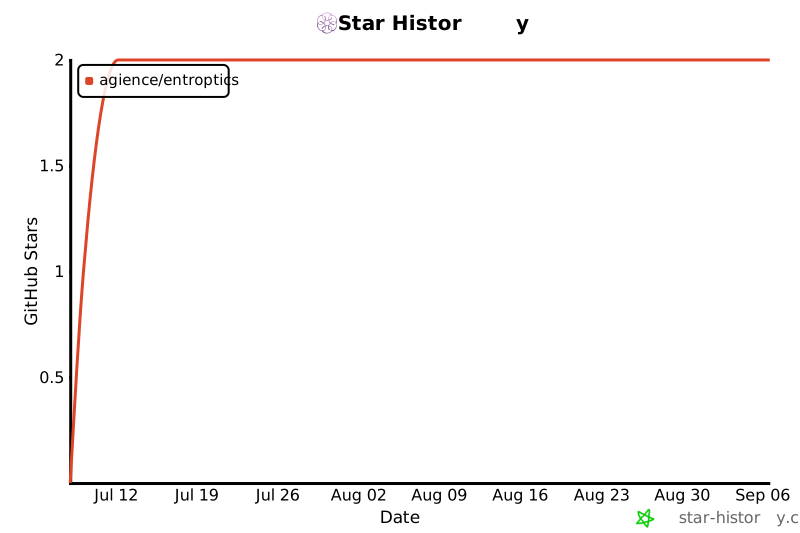
Star history
Licensed under Apache-2.0 — see LICENSE.md,
NOTICE, PATENTS.md
and PLEDGE.md.
Declaration of generative AI use
The author used Anthropic's Claude Opus (versions 4.8 and 5) in the preparation of this work. Its contribution was to write code, and to generate and validate content. The ideas, the construction and the claims are the author's. No other generative AI tool was used. The author reviewed and edited all output and takes full responsibility for the content of this publication.
1 maintainer

Metadata
1 maintainer
Release files for entroptics 0.2.6
For a detailed explanation of source distributions (sdists) and built distributions (wheels), please see the package formats documentation.
Source distribution (sdist)
| File | Size | Uploaded | |
|---|---|---|---|
| entroptics-0.2.6.tar.gz | 233.2 kB | Details |
Built distribution (wheel)
| File | Interpreter | ABI | Platform | Reset |
|---|---|---|---|---|
| entroptics-0.2.6-py3-none-any.whl | Python 3 | none | any | Details |
Total release size: 473.0 kB
Release files / entroptics-0.2.6.tar.gz
| Download URL | entroptics-0.2.6.tar.gz |
|---|---|
| Size | 233.2 kB |
| Tags | Source |
|
SHA-256 checksum How to use checksums |
d296674732cbfa0d9727745635e84c3913effc5784280a3eafe6a43c4dd2fc8b
|
|
BLAKE2b-256 checksum How to use checksums |
811d300e5142211bc63ae142b01d342b5f0b53c6d194065a5b4ba20479093187
|
| Upload date | |
|
Uploaded using Trusted Publishing? What is trusted publishing? |
Yes |
| Uploaded via |
twine/7.0.0 CPython/3.13.14
|
Provenance
Provenance describes where a file came from. On PyPI, provenance is shared via attestations, which provide a verifiable record of the build or publishing details. View details, limitations and caveats.


PyPI Publish Attestation
PyPI verified that this artifact, at this checksum, originated from the publisher listed below.
Signed by GitHub Actions, verified by PyPI on Sep 29, 2026.
Transparency logRelease files / entroptics-0.2.6-py3-none-any.whl
| Download URL | entroptics-0.2.6-py3-none-any.whl |
|---|---|
| Size | 239.7 kB |
| Tags | Python 3 |
|
SHA-256 checksum How to use checksums |
29321b437cf81e167d32c47d10513571d1ebc6152960b1e8a5168f59268f74b6
|
|
BLAKE2b-256 checksum How to use checksums |
9c73e493f595b349ba7ff00cf2cfa92311beecf7bc5d8d1748122ab8fdd03d31
|
| Upload date | |
|
Uploaded using Trusted Publishing? What is trusted publishing? |
Yes |
| Uploaded via |
twine/7.0.0 CPython/3.13.14
|
Provenance
Provenance describes where a file came from. On PyPI, provenance is shared via attestations, which provide a verifiable record of the build or publishing details. View details, limitations and caveats.
PyPI Publish Attestation
PyPI verified that this artifact, at this checksum, originated from the publisher listed below.
Signed by GitHub Actions, verified by PyPI on Sep 29, 2026.
Transparency log













