
envcheck


Keep your .env.example in sync with the environment variables your code actually uses.
New teammate clones the repo, copies .env.example, runs the app — and it crashes on a
KeyError for some variable nobody documented. envcheck catches that before it happens.
It statically scans your Python (it never imports or runs your code) for os.getenv /
os.environ access, compares the result to your example env file, and reports:
- Undocumented vars — used in code but missing from
.env.example(fails CI) - Possibly unused vars — in
.env.examplebut never read by any code
Zero runtime dependencies, Python 3.8+, CI-friendly.
Demo
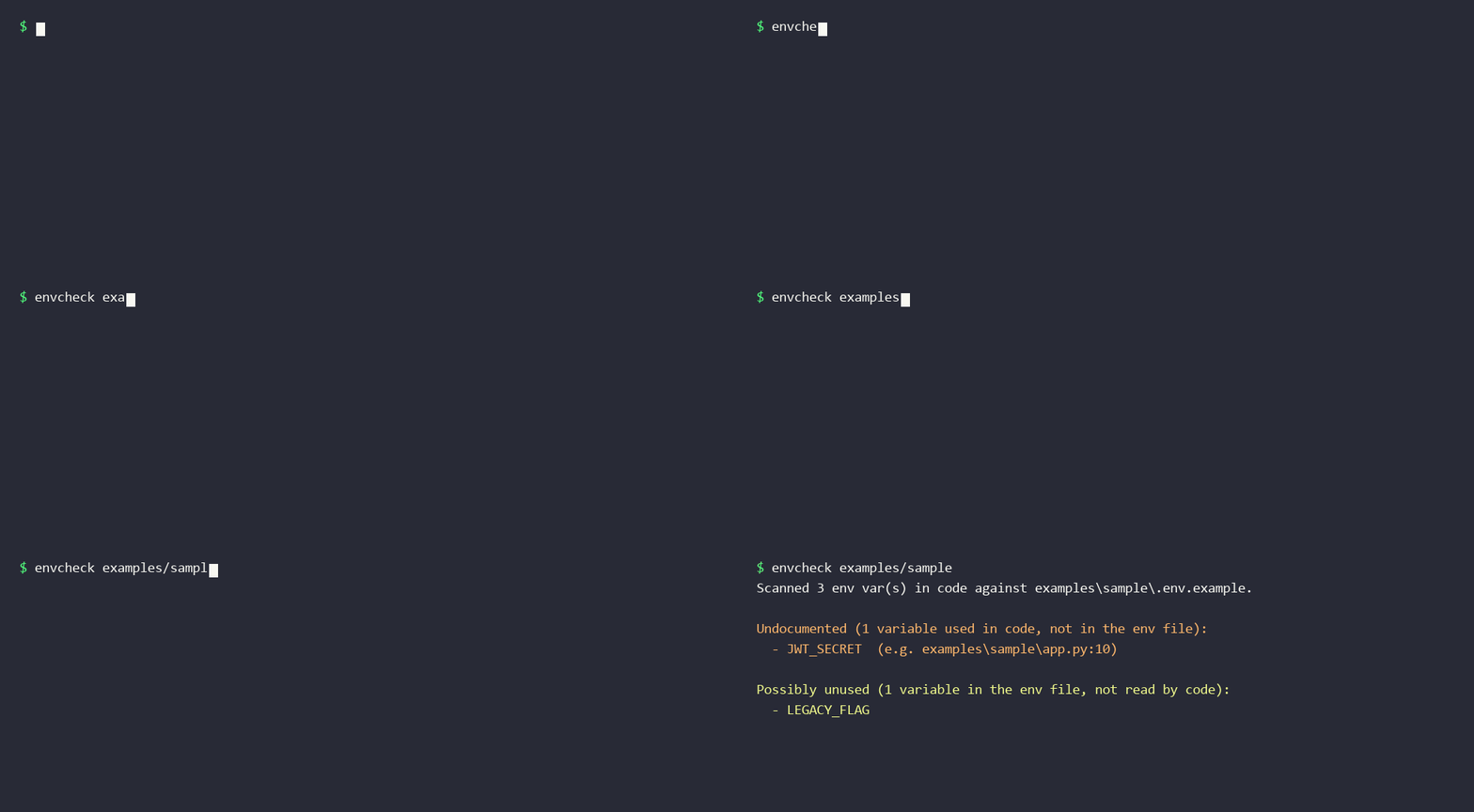
The
examples/sampleproject deliberately drifts from its.env.exampleso you can try it immediately:envcheck examples/sample.
Installation
pip install envcheck-sync
Or run from a checkout without installing:
PYTHONPATH=src python -m envcheck path/to/project
Usage
# Scan the current directory (auto-detects .env.example, .env.sample, ...)
envcheck .

# Point at a specific example file
envcheck . --env-file config/.env.template

# Machine-readable output for tooling
envcheck . --format json
Example
$ envcheck examples/sample
Scanned 3 env var(s) in code against examples/sample/.env.example.

Undocumented (1 variable used in code, not in the env file):
  - JWT_SECRET  (e.g. examples/sample/app.py:9)

Possibly unused (1 variable in the env file, not read by code):
  - LEGACY_FLAG
envcheck exits non-zero when undocumented variables are found, so it drops straight into
CI or a pre-commit hook (use --no-fail to report without failing).
What it detects
Static, literal-key access in these forms:
os.getenv("X")andgetenv("X")os.environ.get("X")andenviron.get("X")os.environ["X"]andenviron["X"]os.environ.setdefault("X", ...)
Dynamic keys (e.g. os.getenv(some_variable)) are intentionally ignored — envcheck only
reports what it can prove statically, so it never produces noisy false positives.
How it works
- Walk the project and parse each
.pyfile with the standard-libraryastmodule. - Collect every literal-key environment-variable access, with its file and line.
- Parse the example env file for declared variable names.
- Diff the two sets and report the gaps.
Development
git clone https://github.com/gazzycodes/envcheck
cd envcheck
PYTHONPATH=src python -m unittest discover -s tests -v
Contributions are welcome — please open an issue or PR.
License
MIT — see LICENSE.
1 maintainer

Metadata
1 maintainer
Release files for envcheck-sync 0.1.0
For a detailed explanation of source distributions (sdists) and built distributions (wheels), please see the package formats documentation.
Source distribution (sdist)
| File | Size | Uploaded | Provenance | |
|---|---|---|---|---|
| envcheck_sync-0.1.0.tar.gz | 51.7 kB | Without provenance | Details |
Built distribution (wheel)
| File | Interpreter | ABI | Platform | Reset |
|---|---|---|---|---|
| envcheck_sync-0.1.0-py3-none-any.whl | Python 3 | none | any | Details |
Total release size: 61.6 kB
Release files / envcheck_sync-0.1.0.tar.gz
| Download URL | envcheck_sync-0.1.0.tar.gz |
|---|---|
| Size | 51.7 kB |
| Tags | Source |
|
SHA-256 checksum How to use checksums |
6db285761077f6e25fe5ac20f6d72b9226e022c7d7e99af104bcdece7800c45f
|
|
BLAKE2b-256 checksum How to use checksums |
5da78113bc2c6c03db9045083799b746cae32a03a6370025fb5f2cfb7bad593b
|
| Upload date | |
|
Uploaded using Trusted Publishing? What is trusted publishing? |
No |
| Uploaded via |
twine/6.2.0 CPython/3.14.3
|
Release files / envcheck_sync-0.1.0-py3-none-any.whl
| Download URL | envcheck_sync-0.1.0-py3-none-any.whl |
|---|---|
| Size | 9.8 kB |
| Tags | Python 3 |
|
SHA-256 checksum How to use checksums |
a84dfd62bee589de0839855ac705439521e7308f5b1f991623aee2900bcacf92
|
|
BLAKE2b-256 checksum How to use checksums |
721299f462302749bcef88bd7fd9bfd96f98f1e66a383fab070e3ec4e7e776ca
|
| Upload date | |
|
Uploaded using Trusted Publishing? What is trusted publishing? |
No |
| Uploaded via |
twine/6.2.0 CPython/3.14.3
|
Security for envcheck-sync 0.1.0
Provenance
Provenance describes where a file came from. On PyPI, provenance is shared via attestations, which provide a verifiable record of the build or publishing details. View details, limitations and caveats.
No provenance found
None of the files in this release were uploaded with provenance metadata.
A note on package security
PyPI is a repository for distributing packages, not a service for auditing them. While third-party security researchers and our staff do their best to detect and remove malicious packages, PyPI cannot guarantee the quality, security or suitability of any given package.
To learn more about protecting yourself from malicious actors, visit our package security documentation.













