
EPHESSOS



EPHESSOS is a NASA Ames Research Center Python library for querying ephemeris data of solar system objects from NASA's JPL Horizons system. It provides an easy interface to query positional and observational data for asteroids, comets, and planets. EPHESSOS allows to provide custom orbital elements to JPL/Horizons and retrieve the ephemerides from their server, and to perform positional queries on the Minor Planet Center database.
Features
- Query JPL Horizons using orbital elements or object designations
- Parse MPC NEA (Near-Earth Asteroid) data files
- Retrieve comprehensive ephemeris data including RA, Dec, distance, and more
- Support for custom time ranges and step sizes
- Integration with Astropy for astronomical calculations
Installation
Install EPHESSOS using pip:
pip install ephessos
Or from source:
git clone https://github.com/Borlaff/EPHESSOS.git
cd EPHESSOS
pip install .
Quick Start
Here's a simple example showing how to query the ephemeris of asteroid (433) Eros:
import ephessos as ep
from astropy.time import Time

# Define time range
mjd_start = Time('2024-01-01T00:00:00', format='isot', scale='utc').mjd
mjd_end = Time('2024-01-15T00:00:00', format='isot', scale='utc').mjd

# Query Horizons for Eros (designation: 00433)
eros_data = ep.core.ephessos(
    designation="00433",
    mjd_start=mjd_start,
    mjd_end=mjd_end,
    step_size="1d",
    verbose=True
)

print(eros_data.head())
This will return a pandas DataFrame containing ephemeris data including:
- Right Ascension (RA) and Declination (Dec) in degrees
- Distance from observer
- Magnitude and other observational quantities
- Modified Julian Date (MJD)
Advanced Usage
Reading MPC Data Files
EPHESSOS can parse MPC-formatted NEA files:
# Read MPC NEA data
nea_table = ep.core.read_mpc_nea_file("path/to/nea.txt")

# Query ephemeris for the first object
first_object = nea_table.iloc[0]
data = ep.core.ephessos(
    designation=first_object["Designation"],
    epoch=first_object["Epoch"],
    eccentricity=first_object["Eccentricity"],
    node=first_object["Node"],
    arg_perihelion=first_object["Arg_Perihelion"],
    inclination=first_object["Inclination"],
    mean_anomaly=first_object["Mean_Anomaly"],
    semimajor_axis=first_object["Semimajor_Axis"],
    mean_motion=first_object["Mean_Motion"],
    mjd_start=mjd_start,
    mjd_end=mjd_end,
    step_size="1d"
)
Cone searches
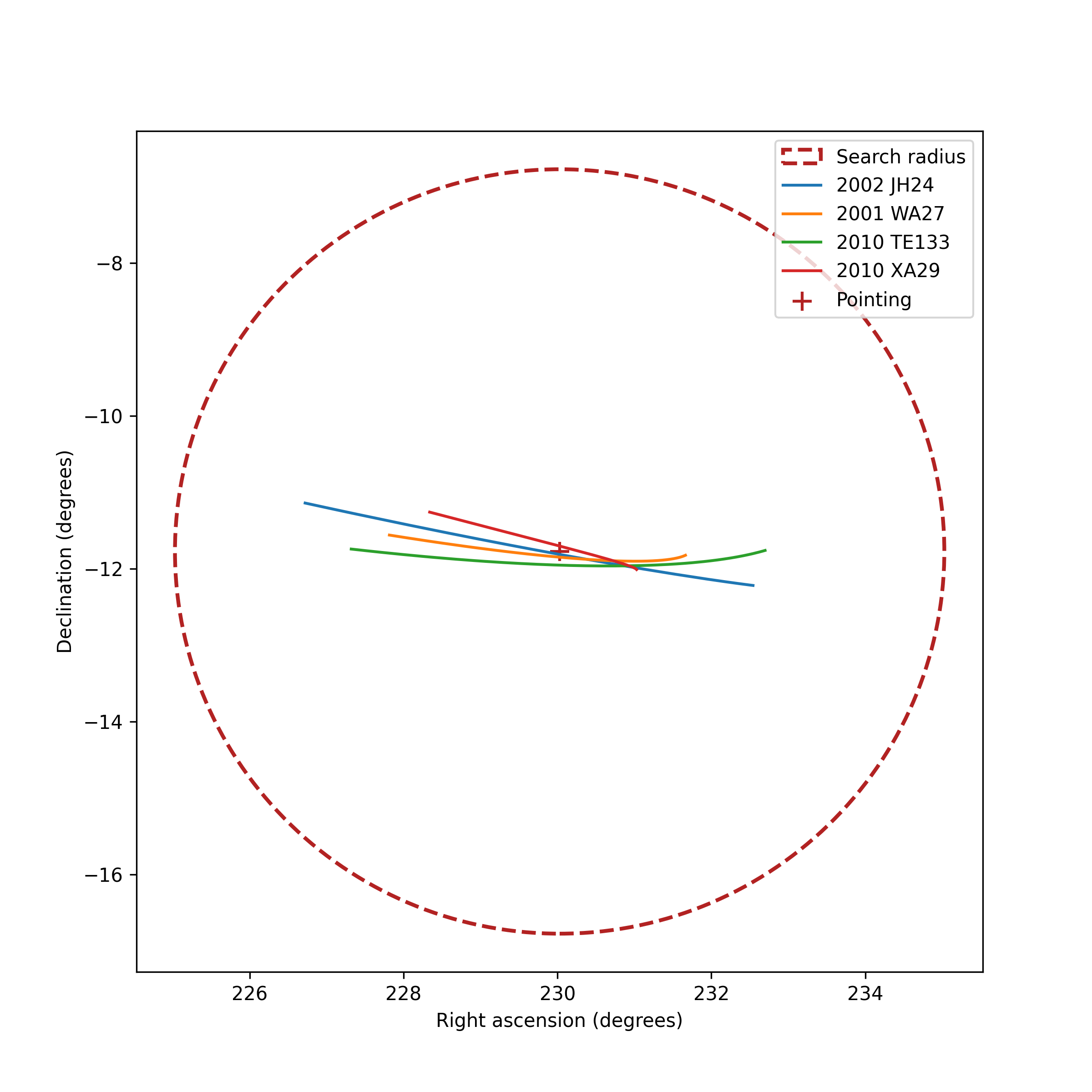
EPHESSOS can search targets in a given area and time, and retrieve the information from the Minor Planet Center. Here is one example of a cone search for Solar System Objects around a certain location of the sky within a given period (one month):
# H2 Cone Search
# This notebook is dedicated to develop the cone_search and detector_search function in EPHESSOS
import ephessos as ep
from astropy.time import Time
import astropy.units as u

# Let's define a location
ra = 230.028
dec = -11.774

# How long are you staring at that location?
now = Time(60000, format="mjd") # Time.now()
mjd = now.mjd #

# Let's find out what asteroids pass around 5 arcminutes of the center
# during a month of observations
start = now - 15*24*60*60*u.s #
end = now + 15*24*60*60*u.s #
search_radius = 5*60 # 5 arcminutes

# ephessos needs Modified Julian Dates as input
mjd_start = start.mjd
mjd_end = end.mjd

cone_search = ep.core.cone_search(ra=ra, dec=dec, mjd=mjd, search_radius=search_radius, observatory=273, verbose=True)
ephessos_df = ep.core.ephessos(sso_search=cone_search, mjd_start=mjd_start, mjd_end=mjd_end, step_size="1h")


# Let's plot the results!
import matplotlib.pyplot as plt
fig, ax = plt.subplots(figsize=(8,8))

circ = plt.Circle((ra,dec), color="firebrick", linewidth=2, linestyle="--", fill=False, facecolor=None, label="Search radius")
ax.add_patch(circ)

for i in range(len(ephessos_df)):
    ax.plot(ephessos_df[i]["RA_deg_ICRF"], ephessos_df[i]["DEC_deg_ICRF"], label=ephessos_df[i]["Designation"].iloc[0])

ax.scatter(ra, dec, marker="+", s=100, color="firebrick", label="Pointing")
ax.set_ylabel("Declination (degrees)")
ax.set_xlabel("Right ascension (degrees)")
ax.legend()
plt.savefig("H2_cone_search.png", dpi=300)
Command Line Interface
EPHESSOS also provides a command-line interface through the ephessos executable, which allows you to query ephemeris data directly from the terminal without writing Python code.
Basic Usage
After installation, you can use the ephessos command to generate ephemeris data. You must provide the orbital elements and time range:
ephessos --designation=433 --epoch=2461000.5 --eccentricity=0.222836 --node=304.27008 --arg_perihelion=178.92978 --inclination=10.82847 --mean_anomaly=310.55432 --semimajor_axis=1.458121 --mean_motion=0.55977529 --mjdstart=58849.0 --mjdend=61042.0 --step_size=1d --output="eros_ephem.csv"
Required Parameters
--designation: Object designation (e.g., "00433" for Eros)--epoch: Julian Date of the osculating elements--eccentricity: Orbital eccentricity--node: Longitude of the ascending node (degrees)--arg_perihelion: Argument of perihelion (degrees)--inclination: Orbital inclination (degrees)--mean_anomaly: Mean anomaly (degrees)--semimajor_axis: Semi-major axis (AU)--mean_motion: Mean motion (degrees/day)--mjdstart: Start time as Modified Julian Date--mjdend: End time as Modified Julian Date
Optional Parameters
--step_size: Time step for ephemeris (default: "1d" for 1 day)- Examples: "1d", "12h", "6h", "1h", "30m"
--output: Output CSV filename (default: "horizons_ephemeris.csv")--verbose: Enable verbose output
The output will be a CSV file containing columns for:
- Date/time information
- Right Ascension and Declination (ICRF)
- Apparent magnitude
- Distance from observer and Sun
- And other ephemeris quantities
Converting Dates to MJD
To convert calendar dates to Modified Julian Dates for use with --mjdstart and --mjdend, you can use online converters or Python:
from astropy.time import Time
t = Time('2024-01-01T00:00:00', format='isot', scale='utc')
print(f"MJD: {t.mjd}")
Contributing
Contributions are welcome! Please see our contributing guidelines for details.
License
EPHESSOS is licensed under the BSD 3-Clause License. See LICENSE for details.
Citation
If you use EPHESSOS in your research, please cite:
Borlaff, A. S., & Dotson, J. (2026). EPHESSOS: Ephemeris for Solar System Objects with JPL/Horizons.
Contact
- Authors: Alejandro S. Borlaff, Jessie Dotson
- Email: a.s.borlaff@nasa.gov, jessie.dotson@nasa.gov
- Repository: https://github.com/Borlaff/EPHESSOS
1 maintainer

Download files
Download the file for your platform. If you're not sure which to choose, learn more about installing packages.
Source Distribution
Built Distribution
Filter files by name, interpreter, ABI, and platform.
If you're not sure about the file name format, learn more about wheel file names.
Copy a direct link to the current filters
File details
Details for the file ephessos-1.1.1.tar.gz.
File metadata
- Download URL: ephessos-1.1.1.tar.gz
- Upload date:
- Size: 18.9 kB
- Tags: Source
- Uploaded using Trusted Publishing? No
- Uploaded via:
twine/6.2.0 CPython/3.12.13
File hashes
| Algorithm | Hash digest | |
|---|---|---|
| SHA256 |
43aa76d9eb9f2ff7bf9100f53c8f8c5d1b22c41eb63f7e750e29078d71dbb652
|
|
| MD5 |
eb0a484e50531d84ba7048a9edbceae7
|
|
| BLAKE2b-256 |
7df2454a911d36fde7b94552098fc8eb7792552b757997a7f10d91852e810c3a
|
File details
Details for the file ephessos-1.1.1-py3-none-any.whl.
File metadata
- Download URL: ephessos-1.1.1-py3-none-any.whl
- Upload date:
- Size: 16.0 kB
- Tags: Python 3
- Uploaded using Trusted Publishing? No
- Uploaded via:
twine/6.2.0 CPython/3.12.13
File hashes
| Algorithm | Hash digest | |
|---|---|---|
| SHA256 |
146d8ba7424182fc8594337af8c44ec000bc2bf40d66043364533f28e4836f4a
|
|
| MD5 |
236f56162465fcef3fc3ab4e6a897249
|
|
| BLAKE2b-256 |
163ca367aaece45d5c7c4fe14f7a9f10721bce14d49be8fdf0b617457f817033
|














