
Ephris
Ephris is a pretrained graph foundation model from Nums AI Inc. for node classification through graph in-context learning. It predicts query-node labels from graph features, edges and labeled context nodes, with no task-specific training.
Apache-2.0 code · Ephris License v1.0 model weights · License & contact
Paper · Quick start · Notebook · Benchmark results · Citation
Installation
Use standard CPython 3.11–3.14 on Linux. Ephris uses PyTorch 2.11.0 and PyTorch Geometric 2.8.0. Install in a virtual environment:
python -m venv .venv
source .venv/bin/activate
python -m pip install ephris
For CPU-only inference, install PyTorch from its CPU index first:
python -m pip install torch==2.11.0 --index-url https://download.pytorch.org/whl/cpu
python -m pip install ephris
Model weights
The first prediction downloads and caches a fixed checkpoint revision from
Hugging Face. No Hugging Face account
or access token is required.
device="auto" selects CUDA when available, otherwise CPU.
See inference details for checkpoint downloads and precision.
Install from source
To use the examples or contribute to the code:
git clone https://github.com/nums-ai/ephris.git
cd ephris
python -m pip install .
The optional environment.lock pins a Python 3.11 / CUDA 13.0
setup. Install it with python -m pip install -r environment.lock before Ephris.
This setup requires a compatible NVIDIA driver.
Quick start
import torch
from ephris import EphrisClassifier

x = torch.tensor([[0.1, 0.2], [0.8, 0.9], [0.2, 0.1], [0.9, 0.8]])
edge_index = torch.tensor([[0, 1, 2, 3], [2, 3, 0, 1]])
context_indices = torch.tensor([0, 1])
query_indices = torch.tensor([2, 3])
context_labels = torch.tensor([0, 1])

model = EphrisClassifier(random_state=42, device="auto")
labels = model.predict(
    x, edge_index,
    context_indices=context_indices, context_labels=context_labels,
)
print(labels[query_indices])
No fit() call is required. Pass the graph and the labels of the context nodes;
query labels are never prediction inputs. predict() returns original class
labels for all nodes, including context nodes, as a CPU tensor [N].
Select query nodes with labels[query_indices].
Class probabilities
Use predict_proba() instead of predict() when probabilities are needed:
probabilities = model.predict_proba(
    x, edge_index,
    context_indices=context_indices, context_labels=context_labels,
)
query_probabilities = probabilities[query_indices]
print(query_probabilities)

# Get labels from these probabilities without running another prediction.
query_labels = model.classes_[query_probabilities.argmax(dim=1)]
print(query_labels)
Inputs can be NumPy arrays or PyTorch tensors. Features have shape [N, F], edges
[2, E], and context indices and labels both [K], paired in the same order.
Only context labels are accepted, with at least two distinct classes. Probabilities
are FP32 CPU tensors of shape [N, C], where C = len(model.classes_).
The sorted classes_ tensor gives the original label for each probability column.
For class alignment in evaluators, see the input contract.
The native head supports ten classes; larger tasks use deterministic error-correcting output codes (ECOC). Edges are unweighted and treated as undirected; reverse edges and missing self-loops are added internally. See the runnable classification example and input contract.
Options
Set these options when constructing EphrisClassifier(...). Prediction loads weights and prepares the graph automatically.
| Parameter | Default | Behavior |
|---|---|---|
checkpoint |
None |
First prediction downloads the pinned Hub checkpoint; an explicit local path bypasses the Hub |
device |
"auto" |
CUDA when available, otherwise CPU; explicit "cpu" and "cuda:0" are supported |
random_state |
42 |
Nonnegative integer seed controlling the ECOC codebook |
Use predict_log_proba() when a calculation needs natural-log probabilities,
such as negative log-likelihood. Ordinary label and probability predictions use
predict() and predict_proba(). CUDA uses BF16 autocast on supported
GPUs; CPU uses FP32. See inference details for label visibility,
checkpoint downloads and reproducibility.
Repeated prediction
Prepare the graph once to reuse loaded weights and prepared state. Compute one result to obtain both probabilities and labels:
model.prepare(
    x, edge_index,
    context_indices=context_indices, context_labels=context_labels,
)
log_probabilities = model.predict_prepared_log_proba()
probabilities = log_probabilities.exp()
labels = model.classes_[log_probabilities.argmax(dim=1)]
print(labels[query_indices])
print(probabilities[query_indices])
Further calls to predict_prepared_log_proba() run inference on the same prepared
graph; they reuse preparation rather than previously computed outputs. Prepare
again when inputs or context labels change. See
prepared prediction.
Notebook
From the source checkout, install the notebook dependencies:
python -m pip install '.[notebook]'
python -m jupyterlab examples/inference_demo.ipynb
The demo compares Ephris with GCN and GAT trained on the same context labels. It runs Cornell, Reed98, Cora and the full 114,127-node CityNetwork Paris graph. Binary tasks use ROC-AUC; multiclass tasks use accuracy. The notebook contains an executed result table and performance chart, with one run per method and graph. GCN/GAT use two layers and 200 training epochs on a seeded 50% context / 50% query split. A CUDA GPU is recommended for the full comparison.
View the saved demo results. GCN/GAT training stays in the notebook; the installed Ephris package is inference-only. Use the same virtual environment's kernel.
Benchmark results
Elo leaderboard
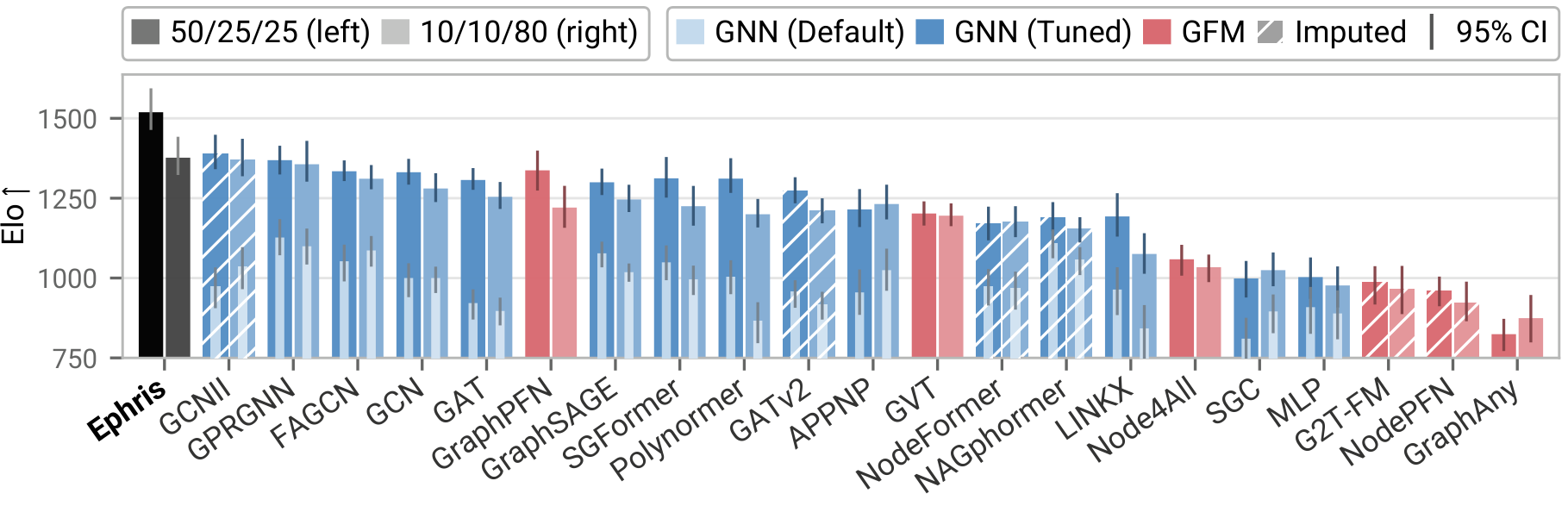
View all leaderboard figures →
Runtime and improvability
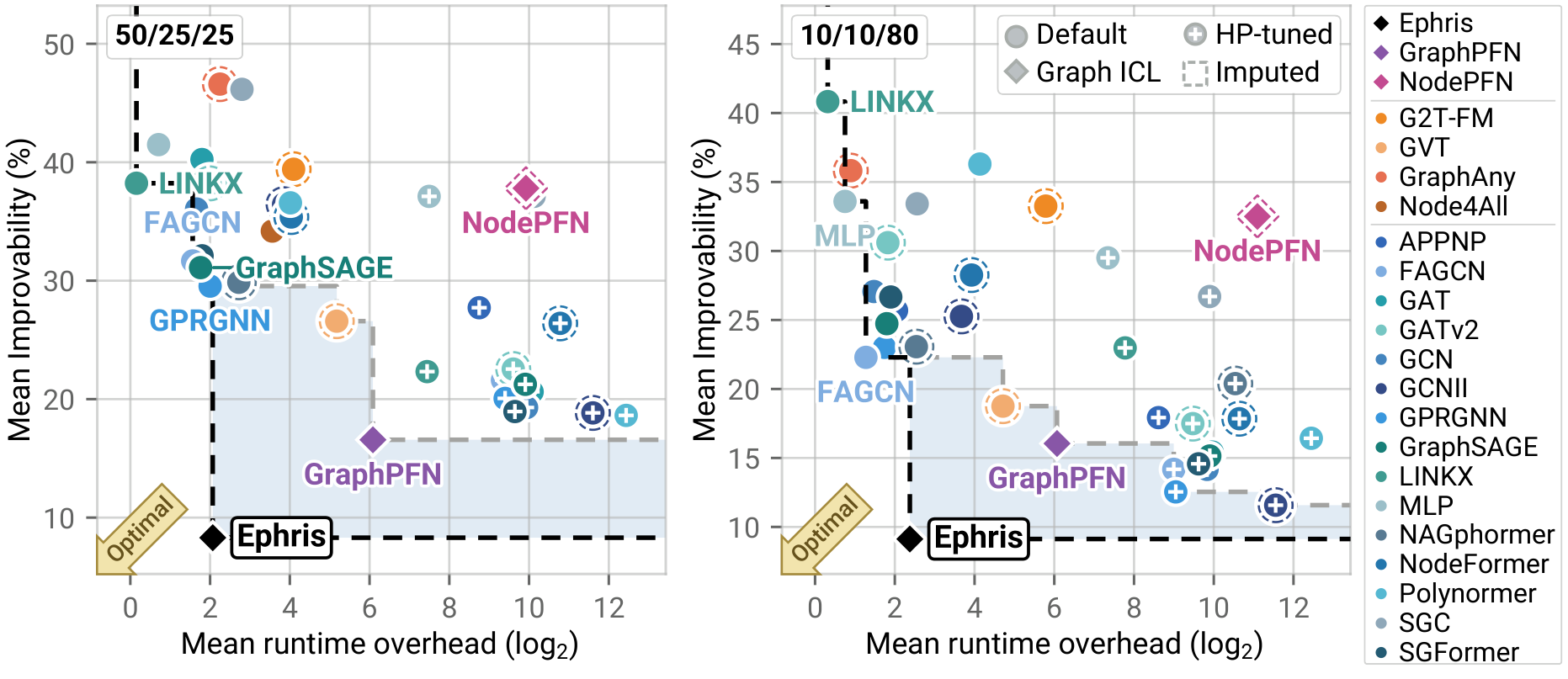
View all runtime–performance figures →
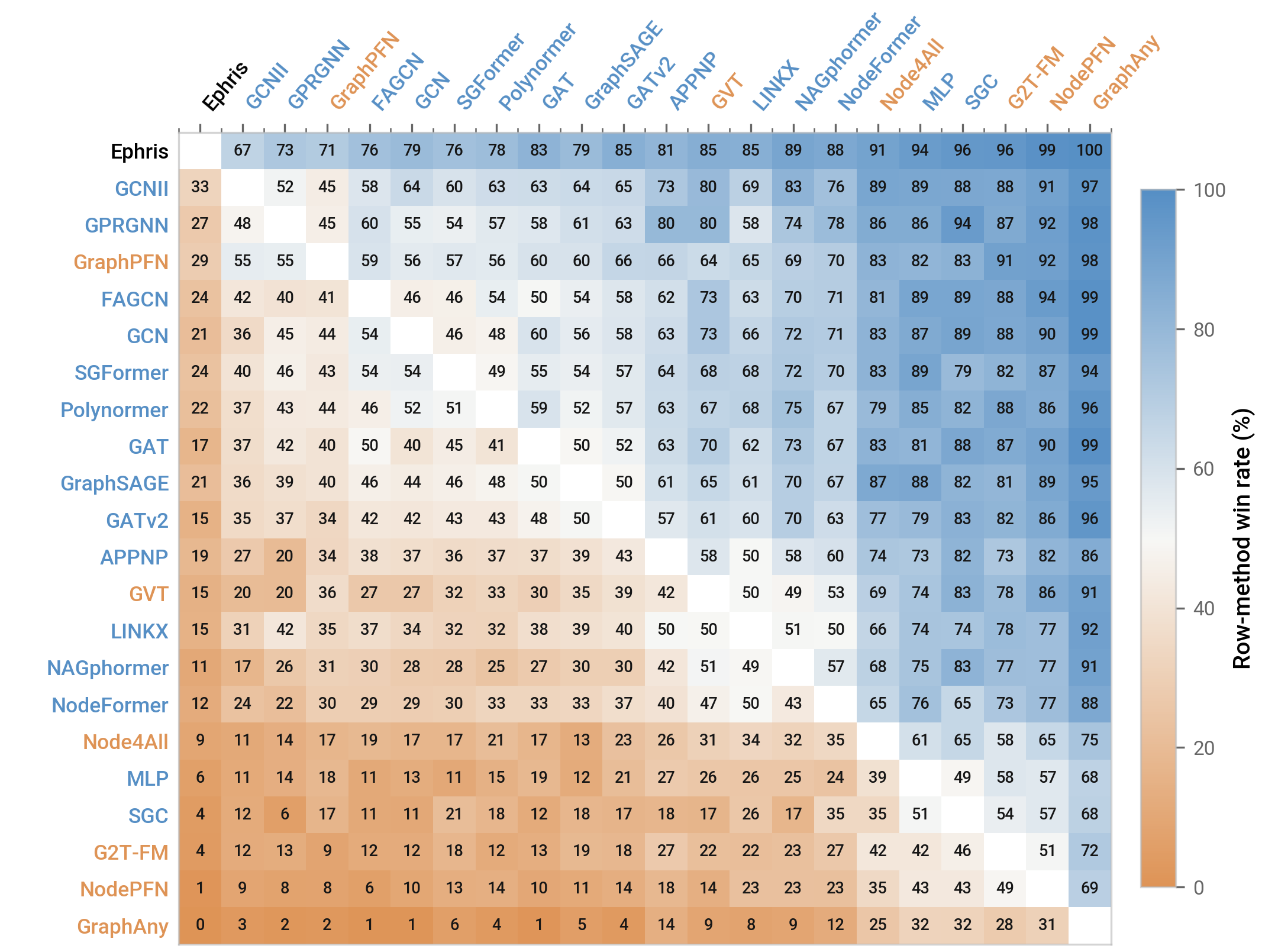
Pairwise win rates · 50/25/25
License & contact
Code is licensed under Apache-2.0; model weights are separately licensed under Ephris License v1.0. Non-commercial research and free research redistribution are permitted under its conditions. Commercial or production use, and hosted/API/SaaS services whether paid or free, require separate licenses. Contact contact@nums.world.
Third-party dependencies and datasets keep their own terms.
Citation
If you use Ephris in research, please cite:
@misc{lee2026messagepassingdoesincontext,
  title={Message Passing Does More with Less for In-Context Learning on Graphs},
  author={Dooho Lee and Jinmo Lee and Minho Jeong and Kijung Shin and Jaemin Yoo},
  year={2026},
  eprint={2609.37057},
  archivePrefix={arXiv},
  primaryClass={cs.LG},
  url={https://arxiv.org/abs/2609.37057},
}
1 maintainer

Metadata
1 maintainer
Release files for ephris 1.0.0
For a detailed explanation of source distributions (sdists) and built distributions (wheels), please see the package formats documentation.
Source distribution (sdist)
| File | Size | Uploaded | |
|---|---|---|---|
| ephris-1.0.0.tar.gz | 2.7 MB | Details |
Built distribution (wheel)
| File | Interpreter | ABI | Platform | Reset |
|---|---|---|---|---|
| ephris-1.0.0-py3-none-any.whl | Python 3 | none | any | Details |
Total release size: 2.7 MB
Release files / ephris-1.0.0.tar.gz
| Download URL | ephris-1.0.0.tar.gz |
|---|---|
| Size | 2.7 MB |
| Tags | Source |
|
SHA-256 checksum How to use checksums |
3deab7671bec42841e17785db13fefd356c925a4b5497505ebbea3d3668409d1
|
|
BLAKE2b-256 checksum How to use checksums |
9c29a344bf48f9d3975376450a9043c65b6c6ea8cc82a9814ae8866cc4704814
|
| Upload date | |
|
Uploaded using Trusted Publishing? What is trusted publishing? |
Yes |
| Uploaded via |
twine/7.0.0 CPython/3.13.14
|
Provenance
Provenance describes where a file came from. On PyPI, provenance is shared via attestations, which provide a verifiable record of the build or publishing details. View details, limitations and caveats.


PyPI Publish Attestation
PyPI verified that this artifact, at this checksum, originated from the publisher listed below.
Signed by GitHub Actions, verified by PyPI on Oct 1, 2026.
Transparency logRelease files / ephris-1.0.0-py3-none-any.whl
| Download URL | ephris-1.0.0-py3-none-any.whl |
|---|---|
| Size | 52.0 kB |
| Tags | Python 3 |
|
SHA-256 checksum How to use checksums |
0b33b447ab7c2f19807b9c3e2e83bb27f94a0ff86e1f95020ebbe446940931ed
|
|
BLAKE2b-256 checksum How to use checksums |
ef3839275d00ea48e19315202329ac89be82322fcf86c2e5bbea9cfdd4469adb
|
| Upload date | |
|
Uploaded using Trusted Publishing? What is trusted publishing? |
Yes |
| Uploaded via |
twine/7.0.0 CPython/3.13.14
|
Provenance
Provenance describes where a file came from. On PyPI, provenance is shared via attestations, which provide a verifiable record of the build or publishing details. View details, limitations and caveats.
PyPI Publish Attestation
PyPI verified that this artifact, at this checksum, originated from the publisher listed below.
Signed by GitHub Actions, verified by PyPI on Oct 1, 2026.
Transparency log













