
This release has been yanked by its maintainers, and will be ignored by installers, except when explicitly specified.
Consider using release 4.10.0 instead.

EPI (Evidence Packaged Infrastructure) — Evidence for AI agents
Record. Seal. Verify offline. The answer is a file.



pip install epi-recorder
epi demo --no-browser    # record → seal → verify (no API key)
60-second path · What a .epi is · CLI · How to use it · Docs · Standards
How it works: ARCHITECTURE.md — packages, integrity model, and where to read next. Docs map: docs/README.md.
When someone asks what your agent did six months ago,
the answer should be a.epifile — not a dashboard login and a shrug.
epi-recorder turns an AI agent's run into evidence a third party can verify. Not a log you have to trust, but a portable, signed artifact that leaves your platform and declares exactly what it captured — verifiable offline with open tooling.
No account and no EPI server: verification is fully offline. When sealing, EPI asks public
RFC 3161 timestamp services for a trusted time (only a hash is sent; switch off with EPI_NOTARIZE=0
or use your own with EPI_TSA_URLS).
Open a sealed .epi offline — epi view run.epi
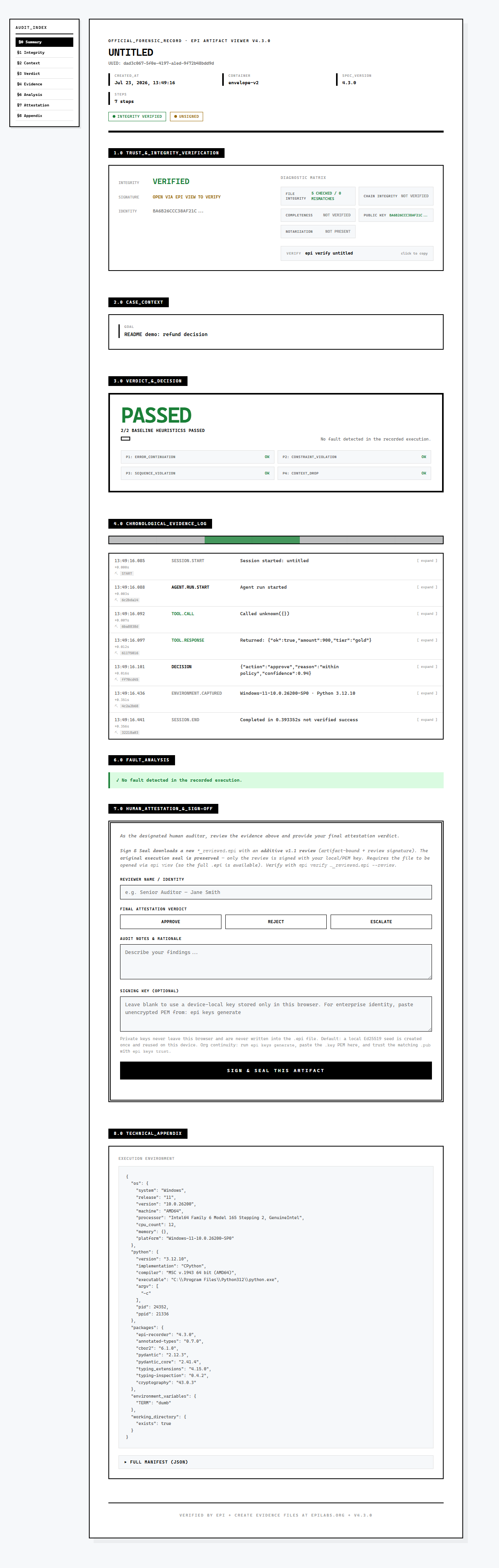
Forensic case view of a sealed run. Sample artifact: docs/assets/readme-demo.epi
60-second path
Works without any LLM API key:
# demo.py
from epi_recorder import record, get_current_session

with record("demo.epi", goal="show the golden path"):
    s = get_current_session()
    s.log("tool.call", tool="lookup", id="A-1")
    s.log("tool.response", tool="lookup", ok=True, balance=250)
    s.log("decision", action="approve", reason="within limit")
python demo.py
epi verify demo.epi
epi-register demo.epi
epi view demo.epi
record("demo.epi") writes epi-recordings/demo.epi: a bare file name goes
into ./epi-recordings/. A path with a folder, such as ./demo.epi or
out/demo.epi, is written exactly there. Run the commands above from the same
folder as demo.py; epi verify demo.epi finds the file in ./epi-recordings/.
Running python demo.py again never replaces earlier evidence: the second run
seals to epi-recordings/demo-2.epi (then demo-3.epi, …) and says so. Set
EPI_OVERWRITE=1 to replace demo.epi in place instead.
$ python demo.py
[EPI] 3 steps → epi-recordings/demo.epi  Signed ✓
| Step | Command | What you get |
|---|---|---|
| Record + seal | python demo.py |
Signed epi-recordings/demo.epi (secrets redacted by default) |
| Verify | epi verify demo.epi |
Integrity + signature checks offline |
| Register | epi-register demo.epi |
Without --service: a local, self-issued SCITT receipt embedded in the .epi (not an independent ledger entry) |
| View | epi view demo.epi |
Self-contained browser viewer (screenshot above) |
Typical first-run verify:
| Check | Result |
|---|---|
| Integrity (SHA-256) | Valid |
| Signature (Ed25519) | Valid |
| Identity | Often LOCAL / UNKNOWN until you pin trust |
| Secrets | Redacted by default (redact=True) |
First-run WARN / LOCAL identity is normal — seal integrity and signature can still pass.
Identity is separate from seal. A customer pins the sender's key, obtained out of band, withepi keys trust <sender-key-file> --name <name>(the sender's.pub,did.jsonor savedepi keys exportline — never the.epiyou are checking) orepi keys trust --from-did did:web:vendor.com --name <name>.
Policy / “did the run break our rules?” is separate again:epi analyze— see docs/POLICY.md.
epi-register is a standalone alias for epi scitt register (same options, same result).
Without --service <url> it creates a LOCAL self-issued receipt signed by your own key, not an
entry in an independent transparency ledger; pass --service for that.
That’s the product. Everything below is optional depth.
With OpenAI
from openai import OpenAI
from epi_recorder import record, wrap_openai

client = wrap_openai(OpenAI())  # needs OPENAI_API_KEY

with record("agent.epi", goal="Answer a user question"):
    client.chat.completions.create(
        model="gpt-4o-mini",
        messages=[{"role": "user", "content": "Hello"}],
    )
python agent.py
epi verify agent.epi
epi view agent.epi
API keys in prompts/headers are redacted automatically before they land in the file.
What a .epi file is
Every .epi uses the Envelope v2 container format — a polyglot HTML+ZIP
binary that opens natively in any browser and can be extracted programmatically.
demo.epi
├── mimetype
├── manifest.json              # Ed25519 signature + SHA-256 file hashes
├── steps.jsonl                # Timeline (hash-linked steps)
├── environment.json           # Runtime snapshot (sensitive env redacted)
├── policy.json                # Sealed rulebook copy (when policy ran)
├── policy_evaluation.json     # Control results (when policy ran)
├── analysis.json              # Fault / policy analysis (when generated at seal)
├── viewer.html                # Offline forensic UI
├── VERIFY.txt                 # Plain-text auditor instructions
└── artifacts/notarization/    # RFC 3161 tokens (when a TSA answered)
| Guarantee | How |
|---|---|
| Integrity | SHA-256 over every sealed member |
| Authenticity | Ed25519 signature on the manifest |
| Chain | Each step’s prev_hash links the timeline |
| Privacy | Default secret redaction (API keys, tokens, common PII patterns: email, phone, card, US SSN). Not names, IBANs, or domain-specific IDs — allowlist fields you must preserve. |
Samples: docs/assets/SAMPLES.md · try docs/assets/readme-demo.epi.
Integrations
| Stack | How |
|---|---|
| OpenAI | wrap_openai(OpenAI()) |
| Anthropic | wrap_anthropic(Anthropic()) |
| LangChain | EpiCallbackHandler(session) inside with record(...) as session |
| LiteLLM | EPICallback |
| pytest | pytest --epi |
| Microsoft AGT | epi import agt <file> |
| TRACE Trust Record | epi export trace <file.epi> — log-import Level 0; see caveats below |
# LangChain (canonical adapter)
from langchain_openai import ChatOpenAI
from epi_recorder import record
from epi_recorder.adapters.langchain import EpiCallbackHandler

with record("run.epi") as session:
    handler = EpiCallbackHandler(session)
    llm = ChatOpenAI(model="gpt-4o-mini", callbacks=[handler])
    llm.invoke("…")
# pytest — attach evidence to failing tests
pytest --epi
pytest --epi writes one .epi per failing test to ./test-evidence/
(--epi-dir DIR to change it, --epi-on-pass to keep passing tests too).
Files are named after the test (test_x.py_test_bad.epi); unlike record(),
a re-run replaces the file for the same test in place.
TRACE export (honest claims)
epi export trace run.epi --out run.trace.json --transcript-uri https://host/run.epi
Signing key order: --key → private key that sealed the .epi → TRACE_PRIVATE_KEY_PEM → ephemeral (warning). allow_embedded_key=True when verifying only proves internal consistency of the record against its own cnf.jwk. It does not prove the record came from a trusted issuer. What we claim: the JSON is self-consistent and bound to the key that signed it (the sealing key when that key is available).
policy.bundle_hash in TRACE is specified as a Cedar policy hash. We hash policy.json (the sealed EPI policy document), not a Cedar bundle. policy.enforcement_mode is "declared" — we did not run a Cedar engine. appraisal.status is "none".
More: docs/FRAMEWORK-INTEGRATIONS-5-MINUTES.md
CLI
| Command | Purpose |
|---|---|
epi demo |
Guided demo: record → seal → verify |
epi verify <file.epi> |
Offline integrity + signature check; customers and auditors run epi verify FILE --policy strict --witness-log received.jsonl (rely on the exit code only with --policy strict; WARN exits 0) |
epi-register <file.epi> |
Alias of epi scitt register: embed a SCITT receipt (local self-issued unless --service <url>) |
epi view <file.epi> |
Open offline viewer (screenshot above) |
epi analyze <file.epi> |
Fault / policy summary from sealed analysis |
epi policy init |
Create epi_policy.json rulebook |
epi run [script.py] |
Record a Python workflow that already emits EPI steps (prompts for a script if omitted) |
epi keys generate / list / trust / revoke / unrevoke |
Signing keys and pinned (trusted) keys; generate and list print fingerprints |
epi enterprise setup / pack |
Org kit + auditor pack |
epi scitt register <file.epi> |
SCITT receipt; --service <url> for an independent transparency service |
epi import agt <path> |
Import Microsoft AGT evidence |
epi export trace <file.epi> |
TRACE v0.2 log-import record (self-consistency, not issuer attestation) |
Policy + fault analyzer guide: docs/POLICY.md
EPI Cloud (share a run with a customer)
Sealed runs stay offline by default. To share one with a customer (a bank reviewer, an auditor), push it to EPI Cloud and send them a trust link they open in a browser — nothing to install on their side.
Install inside a virtual environment, so EPI's libraries stay separate from your other tools:
python -m venv epienv
epienv\Scripts\activate
pip install epi-recorder
epi --version
(source epienv/bin/activate on macOS/Linux. If Windows says epi is
"not on PATH" after install, the program landed in a folder Windows doesn't
search: activate the environment first and install/run in that same window,
or run python -m epi_cli instead of epi.)
Then, in order:
epi cloud login— the terminal shows a short code. Type it at cloud.epilabs.org/auth/device and pick the customer this computer records for. Nothing secret to copy.epi demo— records, seals and uploads a sample run for that customer.- On cloud.epilabs.org, create a share link for the customer and send it
to them. They verify the run in their browser, or offline with
epi verify.
Free plan: 1 customer. A second customer needs an upgrade (Plans page).
Security defaults
- Redaction is on (
redact=True). Keys/tokens/PII become placeholders. - Prefer not using
redact=Falsein production (it warns). - Verification is local — no network required for integrity/signature.
- First-run identity WARN / LOCAL is expected until you trust a key.
- Seal ≠ identity ≠ policy. Verify proves the file; analyze grades the run against rules/heuristics.
Docs
| Topic | Link |
|---|---|
| How to use it (what / where / how) | docs/USER-GUIDE.md |
| Docs map (recorder · Cloud · website) | docs/README.md |
| Bank / auditor briefing | docs/EPI_MASTER_DOCUMENTATION.md |
| What verify means | docs/VERIFICATION_CONTRACT.md |
| Support / SLA | SUPPORT.md |
| Is the file safe to open? | docs/FILE-SAFETY.md |
| Known limitations (read before a security review) | docs/KNOWN_LIMITATIONS.md |
| Architecture | ARCHITECTURE.md |
CLI (epi cloud included) |
docs/CLI.md |
| EPI Cloud | docs/CLOUD.md |
| Website source | docs/WEBSITE.md |
| Auditors guide | docs/AUDITORS-GUIDE.md |
Start at docs/README.md. Do not treat old search hits or forks as current.
Standards & compliance
EPI produces evidence files that help with audit trails. It is not a compliance guarantee and does not provide legal advice. Whether evidence satisfies a specific regulatory threshold is for the auditor or notified body to determine.
| Topic | Docs |
|---|---|
| EU AI Act Annex IV (templates, not a certificate) | docs/ANNEX-IV.md, docs/EU-AI-ACT-EVIDENCE-PREP.md |
| AIUC-1 domains | docs/standards/aiuc-1-evidence.md |
| SCITT | docs/standards/scitt-predicate.md |
epi verify agent.epi --aiuc1 # evidence grouped by AIUC-1 domain (not a certification)
Troubleshooting
| Symptom | Fix |
|---|---|
epi: command not found |
Same venv as pip install, or python -m epi_cli |
| First verify WARN / LOCAL identity | Normal if seal OK — the receiver pins the sender's key from the sender (epi keys trust <sender-key-file> --name <name> or --from-did <did>), never from the file being checked |
Integrity: FAILED |
File changed after seal — re-record |
epi analyze says heuristic only |
Add epi_policy.json via epi policy init, re-run from that folder |
| Share / portal fails | Hosted needs backend; local record/verify never depends on it |
Trust-model note: Integrity checks whether the sealed record was altered since sealing — not that every real-world action was captured.
Project layout (contributors)
Core (actively developed, covered by the release gate):
| Path | Role |
|---|---|
epi_recorder/ |
Python SDK (record, wrappers) |
epi_core/ |
Container, crypto, redaction, verify, fault analyzer |
epi_cli/ |
epi command (including epi cloud) |
epi_gateway/ |
Self-hosted capture/review runtime (epi gateway serve) |
cloud/ |
EPI Cloud Worker (cloud.epilabs.org) |
web_viewer/ |
Canonical browser UI (source for epi view and the embedded viewer) |
epi_viewer_static/ |
Browser crypto baked into every sealed file at pack time |
pytest_epi/ |
Pytest plugin |
website/ |
Public site source of truth (epilabs.org) |
scripts/ |
Build, sync, release and verification helper scripts |
docs/ |
Start at docs/README.md |
tests/ |
191 test_*.py files, including the test_core_loop_golden.py regression path |
Experimental (frozen — works as documented, bug fixes allowed, no new features until a paying user asks; not on the critical path):
| Path | Note |
|---|---|
epi_mcp/ |
ChatGPT/Claude connector (hosted HTTP still on Render) |
verify_portal/ |
Legacy hosted share/verify API. Login is EPI Cloud, not this service. |
epi_recorder/integrations/trace_exporter.py |
TRACE export |
epi_recorder/integrations/agt* |
Microsoft AGT import/export |
epi_guardrails/ |
Guardrails |
| remote SCITT service | Local SCITT receipt is core; the hosted service is not |
Website edits: only under website/. npm run build copies it to site/ for Cloudflare Pages; python scripts/sync_website.py mirrors it to verify_portal/static/ and epi-official/. Details: docs/WEBSITE.md, ARCHITECTURE.md.
License
MIT — see LICENSE.
Site: epilabs.org · Issues: GitHub Issues
1 maintainer

Metadata
1 maintainer
Release files for epi-recorder 4.6.3
For a detailed explanation of source distributions (sdists) and built distributions (wheels), please see the package formats documentation.
Source distribution (sdist)
| File | Size | Uploaded | Provenance | Actions |
|---|---|---|---|---|
| epi_recorder-4.6.3.tar.gz | 1.4 MB | Without provenance | Details for epi_recorder-4.6.3.tar.gz |
Built distribution (wheel)
| File | Interpreter | ABI | Platform | Actions Reset |
|---|---|---|---|---|
| epi_recorder-4.6.3-py3-none-any.whl | Python 3 | none | any | Details for epi_recorder-4.6.3-py3-none-any.whl |
Total release size: 2.2 MB
Release files / epi_recorder-4.6.3.tar.gz
| Download URL | epi_recorder-4.6.3.tar.gz |
|---|---|
| Size | 1.4 MB |
| Tags | Source |
|
SHA-256 checksum How to use checksums |
9280d872b1934aacc45edcba445dd7c22405ad62a3daeeace316664e699474a2
|
|
BLAKE2b-256 checksum How to use checksums |
2628a8c9c09ce53dfddd85dcbe8cdc7547d2f6d43eba73f61a11a0da576f6665
|
| Upload date | |
|
Uploaded using Trusted Publishing? What is trusted publishing? |
No |
| Uploaded via |
twine/7.0.0 CPython/3.12.10
|
Release files / epi_recorder-4.6.3-py3-none-any.whl
| Download URL | epi_recorder-4.6.3-py3-none-any.whl |
|---|---|
| Size | 891.4 kB |
| Tags | Python 3 |
|
SHA-256 checksum How to use checksums |
b73e30d06d7444bae07232d9714d207146fffb49a154b717ccbbb7187b9519e2
|
|
BLAKE2b-256 checksum How to use checksums |
2cd516b6addd466cc8a440f64a393955fccfa70087c803a4762aa99b59bf9f4b
|
| Upload date | |
|
Uploaded using Trusted Publishing? What is trusted publishing? |
No |
| Uploaded via |
twine/7.0.0 CPython/3.12.10
|
Security for epi-recorder 4.6.3
Provenance
Provenance describes where a file came from. On PyPI, provenance is shared via attestations, which provide a verifiable record of the build or publishing details. View details, limitations and caveats.
No provenance found
None of the files in this release were uploaded with provenance metadata.
A note on package security
PyPI is a repository for distributing packages, not a service for auditing them. While third-party security researchers and our staff do their best to detect and remove malicious packages, PyPI cannot guarantee the quality, security or suitability of any given package.
To learn more about protecting yourself from malicious actors, visit our package security documentation.














