
epmux
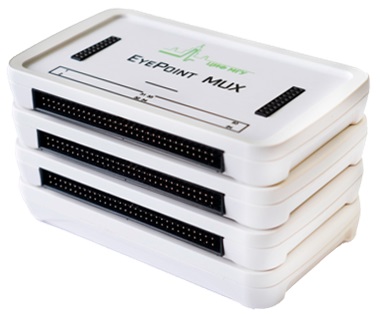
This is a python binding for epmux cross-platform library for Multiplexer EyePoint MUX.
Installation
pip install epmux
Minimal example
For more information on API functions please consult documentation (see section "More information").
from epmux import EpmuxDeviceHandle

module_type = {
    0: "placeholder",  # No module present
    1: "A",            # Module of type A (connects to line A only)
    2: "AB"            # Module of type AB (connects to both line A and B)
}

# Set correct device URI here
# Format for Windows: com:\\.\COM1
# Format for Linux: /dev/ttyACM1
# Format for MacOS: com:///dev/tty.usbmodem000001721
device_uri = r'com:\\.\COM433'

# Open device
try:
    device = EpmuxDeviceHandle(device_uri)
    print("Device opened")
    print("Read device information... ", end="")
    device_info = device.get_identity_information()
    print("Done")
    print("  -- Device information --")
    print("  Product: {} {}".format(bytes(device_info.manufacturer).decode("utf-8"),
                                    bytes(device_info.product_name).decode("utf-8")))
    print("  Hardware version: {}.{}.{}".format(device_info.hardware_major,
                                                device_info.hardware_minor,
                                                device_info.hardware_bugfix))
    print("  Serial number: {}".format(device_info.serial_number))
    print("  Firmware version: {}.{}.{}".format(device_info.firmware_major,
                                                device_info.firmware_minor,
                                                device_info.firmware_bugfix))
except RuntimeError:
    print("Cannot open device {}.".format(device_uri))
    print("Please check URI and try again.")
    exit()

# Get module chain structure (number of modules and their types)
chain = device.get_chain_structure()
print("Device chain length: {}".format(chain.chain_length))
print("Device chain structure: ", end="")
print(*("{}".format(module_type[chain.chain_structure[k]])
        for k in range(chain.chain_length)), sep=", ")

# Set active output channel
print("Set active output channel to: module 1, line A, channel 1")
active_channel_a = device.get_channel_for_line_a()
active_channel_a.module_number = 1   # Module chain position
active_channel_a.channel_number = 1  # Channel number within the module
device.set_channel_for_line_a(active_channel_a)

print("Turn off all channels of all modules")
device.all_channels_off()

# Close device
device.close_device()
print("Device closed")
More information
For documentation, software, examples of using the API and bindings for Python and C#, you can visit our website:
- English version: https://eyepoint.physlab.ru/en/product/EyePoint_MUX_M/
- Russian version: https://eyepoint.physlab.ru/ru/product/EyePoint_MUX_M/.
1 maintainer

Metadata
1 maintainer
Release files for epmux 1.0.0
For a detailed explanation of source distributions (sdists) and built distributions (wheels), please see the package formats documentation.
Source distribution (sdist)
| File | Size | Uploaded | Provenance | Actions |
|---|---|---|---|---|
| epmux-1.0.0.tar.gz | 3.2 MB | Without provenance | Details for epmux-1.0.0.tar.gz |
Built distribution (wheel)
| File | Interpreter | ABI | Platform | Actions Reset |
|---|---|---|---|---|
| epmux-1.0.0-py3-none-any.whl | Python 3 | none | any | Details for epmux-1.0.0-py3-none-any.whl |
Total release size: 6.4 MB
Release files / epmux-1.0.0.tar.gz
| Download URL | epmux-1.0.0.tar.gz |
|---|---|
| Size | 3.2 MB |
| Tags | Source |
|
SHA-256 checksum How to use checksums |
39ab62523156e2d9b05e13a9b2de83cc7815156c25e94937475a96ed01435726
|
|
BLAKE2b-256 checksum How to use checksums |
1341689c3ab404c4eb324c532f869ca8b1d20652b449527dffe0d661f23a3495
|
| Upload date | |
|
Uploaded using Trusted Publishing? What is trusted publishing? |
No |
| Uploaded via |
twine/3.8.0 pkginfo/1.9.2 readme-renderer/34.0 requests/2.27.1 requests-toolbelt/0.10.1 urllib3/1.26.18 tqdm/4.64.1 importlib-metadata/4.2.0 keyring/23.4.1 rfc3986/1.5.0 colorama/0.4.5 CPython/3.6.8
|
Release files / epmux-1.0.0-py3-none-any.whl
| Download URL | epmux-1.0.0-py3-none-any.whl |
|---|---|
| Size | 3.2 MB |
| Tags | Python 3 |
|
SHA-256 checksum How to use checksums |
30e8b300f4eadc025ffcc698afd070df28ce5268bfbcf321ad4615cdfdd933aa
|
|
BLAKE2b-256 checksum How to use checksums |
1d7d084a7eed05850d8bd16a1fa95dff2dbd00a1691a9c6481df08599a060e21
|
| Upload date | |
|
Uploaded using Trusted Publishing? What is trusted publishing? |
No |
| Uploaded via |
twine/3.8.0 pkginfo/1.9.2 readme-renderer/34.0 requests/2.27.1 requests-toolbelt/0.10.1 urllib3/1.26.18 tqdm/4.64.1 importlib-metadata/4.2.0 keyring/23.4.1 rfc3986/1.5.0 colorama/0.4.5 CPython/3.6.8
|
Security for epmux 1.0.0
Provenance
Provenance describes where a file came from. On PyPI, provenance is shared via attestations, which provide a verifiable record of the build or publishing details. View details, limitations and caveats.
No provenance found
None of the files in this release were uploaded with provenance metadata.
A note on package security
PyPI is a repository for distributing packages, not a service for auditing them. While third-party security researchers and our staff do their best to detect and remove malicious packages, PyPI cannot guarantee the quality, security or suitability of any given package.
To learn more about protecting yourself from malicious actors, visit our package security documentation.













