
erdalchemy is an interactive ERD visualizer for SQLAlchemy 2.0 models. Point it at your DeclarativeBase and get a diagram, no manual configuration.
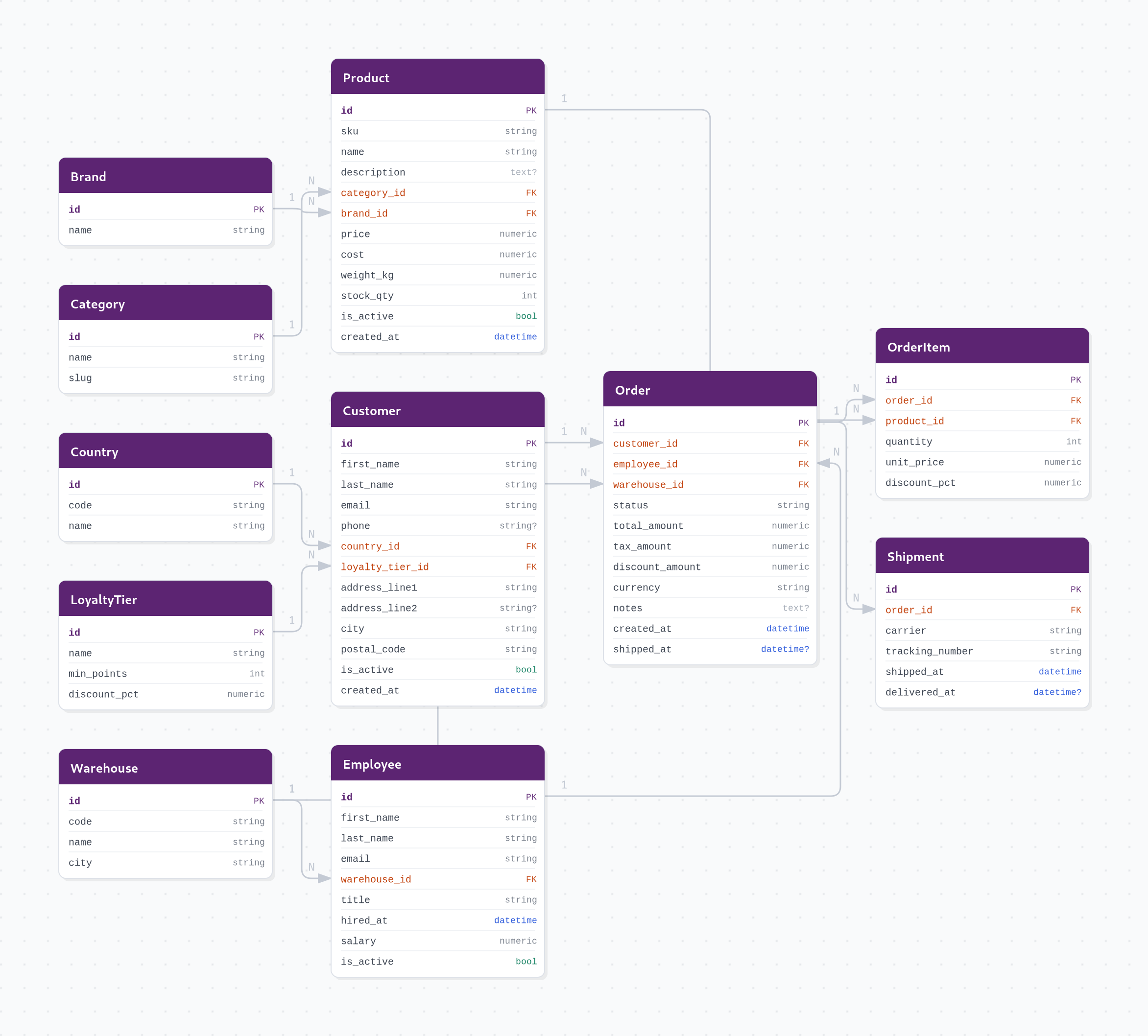
- Drag-and-drop interactive HTML, with hover highlighting
- Three layouts: hierarchical layered (default), force-directed, and star
- Orthogonal edge routing that follows foreign keys without cutting across cards
- Regex filtering to focus large schemas (include/exclude tables and columns)
- Export to HTML, SVG, PNG, and PDF
- Built-in themes and per-table color overrides
- Multi-schema support with cross-schema FKs
- Zero dependencies beyond SQLAlchemy
Install
pip install erdalchemy
PNG and PDF export need an optional dependency:
pip install "erdalchemy[all]"
Quick start
from sqlalchemy_erd import generate_erd
from myapp.models import Base

generate_erd(Base, output="erd.html")
Or from the command line:
sqlalchemy-erd myapp.models:Base --format svg --output erd.svg
Layouts
| Layout | When to use |
|---|---|
layered (default) |
General purpose. Ranks tables into columns by FK direction; cards never overlap. Best for large or wide schemas. |
force |
Small, highly-connected graphs where an organic shape reads better. |
star |
Star/snowflake and ETL schemas, or many disconnected tables. |
generate_erd(Base, output="erd.html", layout="layered")
Documentation
Full reference (every CLI flag, the Python API, themes, layout tuning, card sizing, and supported column types) lives in docs/reference.md.
Examples
See examples/ for ready-to-run schemas:
showcase/- 12 tables across four FK levels (the preview above)blog/- blog schema (User, Post, Comment)ecommerce/- 1:N chainsuniversity/- N:N via association tableshr/- 1:1 and 1:Nmulti_schema/- cross-schema FKs
Acknowledgments
Inspired by eralchemy2 (originally eralchemy), which pioneered generating ER diagrams from SQLAlchemy models. erdalchemy reimagines the idea with a self-contained, interactive, dependency-free renderer.
License
MIT
1 maintainer

Metadata
1 maintainer
Release files for erdalchemy 0.6.0
For a detailed explanation of source distributions (sdists) and built distributions (wheels), please see the package formats documentation.
Source distribution (sdist)
| File | Size | Uploaded | Provenance | Actions |
|---|---|---|---|---|
| erdalchemy-0.6.0.tar.gz | 1.1 MB | Without provenance | Details for erdalchemy-0.6.0.tar.gz |
Built distribution (wheel)
| File | Interpreter | ABI | Platform | Actions Reset |
|---|---|---|---|---|
| erdalchemy-0.6.0-py3-none-any.whl | Python 3 | none | any | Details for erdalchemy-0.6.0-py3-none-any.whl |
Total release size: 1.1 MB
Release files / erdalchemy-0.6.0.tar.gz
| Download URL | erdalchemy-0.6.0.tar.gz |
|---|---|
| Size | 1.1 MB |
| Tags | Source |
|
SHA-256 checksum How to use checksums |
019d266402b9bc423e18c1e519f9c6a47d80d13ee1bceb1832fe2409e3fd930c
|
|
BLAKE2b-256 checksum How to use checksums |
df60563e8ab08193418d9f382611dc8c4b531cecd8f061fd574fa5b4cf1f5de7
|
| Upload date | |
|
Uploaded using Trusted Publishing? What is trusted publishing? |
No |
| Uploaded via |
twine/7.0.0 CPython/3.14.6
|
Release files / erdalchemy-0.6.0-py3-none-any.whl
| Download URL | erdalchemy-0.6.0-py3-none-any.whl |
|---|---|
| Size | 36.5 kB |
| Tags | Python 3 |
|
SHA-256 checksum How to use checksums |
c216973b5673babb9e3f3a2c57fc921330d5b62be87d1641fb7ed754f663f4ce
|
|
BLAKE2b-256 checksum How to use checksums |
001f951f7d7c2843a497bafe8842a253f49bc45a6c66ae7d032337ce37232914
|
| Upload date | |
|
Uploaded using Trusted Publishing? What is trusted publishing? |
No |
| Uploaded via |
twine/7.0.0 CPython/3.14.6
|
Security for erdalchemy 0.6.0
Provenance
Provenance describes where a file came from. On PyPI, provenance is shared via attestations, which provide a verifiable record of the build or publishing details. View details, limitations and caveats.
No provenance found
None of the files in this release were uploaded with provenance metadata.
A note on package security
PyPI is a repository for distributing packages, not a service for auditing them. While third-party security researchers and our staff do their best to detect and remove malicious packages, PyPI cannot guarantee the quality, security or suitability of any given package.
To learn more about protecting yourself from malicious actors, visit our package security documentation.














