
errlore
Memory for AI agents that learns from failures.
Stop the second mistake, not just the first.
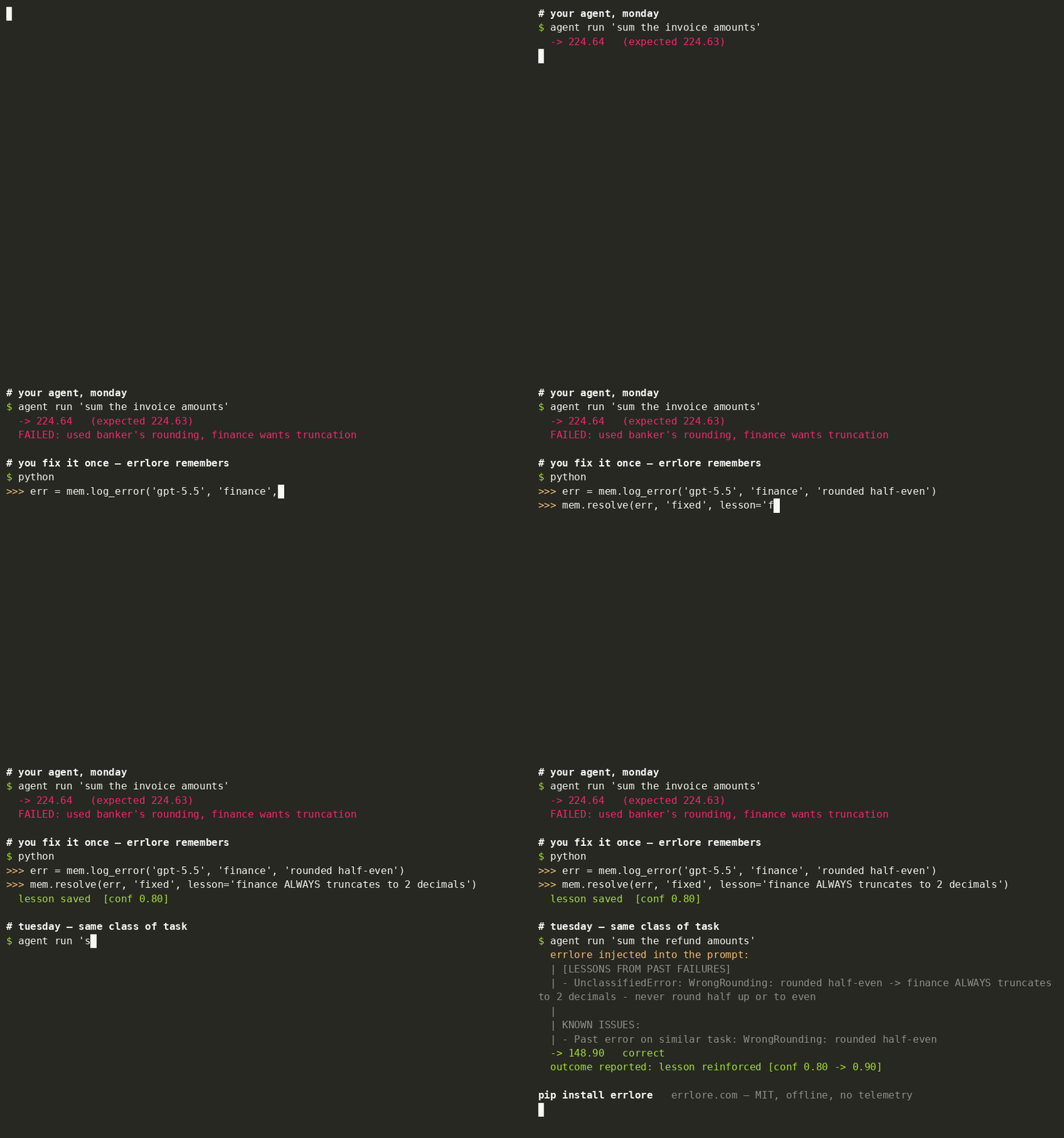


Extracted from a 324K LOC production multi-LLM orchestration system, keeping the one part that demonstrably worked: the error-memory loop that made agents stop repeating mistakes.
Your agent keeps making the same mistakes. errlore fixes that:
- Lessons -- every resolved failure becomes a lesson; relevant lessons are injected into the prompt for similar future tasks.
- Known issues -- per-model weakness tracking ("gpt-5.6 keeps hallucinating dates in extraction tasks") injected as warnings.
- Trust (experimental) -- Bayesian per-model, per-domain trust weights: a starting point for which model to pick per job, based on observed outcomes. Needs a spread of real outcomes to separate models; shipped, but not yet proven on production traffic.
- Closed loop -- errlore tracks whether an injected lesson actually helped and reinforces or decays it automatically.
- Harm gate -- injecting lessons also breaks some previously-passing tasks (we measured 12–15%). errlore tracks each lesson's failures separately and withholds one from injection once a Beta-Binomial bar says its harm rate is credibly too high — so a bad lesson can't keep hurting you. A static conventions file can't do this.
- Warning tier (validator-less surfaces) -- no oracle? Run the prompt twice and
pass both to
check_consistency: disagreement flags "likely wrong" at ~86% precision. Honestly one-sided — a stable result is explicitly not verification. Cheap wrong-answer detector, never a correctness guarantee. - Shadow mode (validator-equipped surfaces) -- verify a lesson before it graduates.
A counterfactual run (never the user's output) re-tests baseline vs injected against
your validator; two Beta posteriors decide
promote/hold/quarantine. Lessons that clear the bar graduate into your prompt/docs with an evidence trail. See docs/SHADOW_MODE_SPEC.md.
Embedded, file-based (JSONL), no server, no database, no API keys required. Works fully offline. Your data never leaves your machine.
Who it's for
errlore isn't memory for everything — it's memory for failures. It shines wherever an agent repeats the same class of mistake:
- Coding agents (Claude Code, Cursor, SWE agents) that keep re-introducing the same bug or forgetting a project convention across sessions.
- Extraction pipelines (PDFs, invoices, contracts) that hallucinate the same date format, rounding rule, or schema field every week.
- Any repeated-failure workflow where a fix should stick the first time, not be re-discovered on every run.
It fixes what the model doesn't know (a convention, a gotcha), not what it can't do — see the benchmark below.
Quickstart (< 5 minutes)
pip install errlore
from errlore import AgentMemory

mem = AgentMemory("./agent_memory")

# 1. Agent failed -- record it
err_id = mem.log_error("gpt-5.6", "extraction", error="hallucinated dates")

# 2. You fixed it -- extract a lesson
mem.resolve(err_id, "Added date format validation",
            lesson="For date extraction, demand ISO-8601 and verify against source")

# 3. Next similar task -- lessons + known issues injected automatically
inj = mem.inject_for("extract dates from contract", model="gpt-5.6",
                      task_type="extraction")
prompt = f"Your task: extract dates\n{inj.text}"
print(prompt)

# 4. Close the loop -- did the lesson help?
mem.report_outcome(inj, success=True)

# 5. Check stats
print(mem.stats())
# {'errors_total': 1, 'errors_resolved': 1, 'errors_unresolved': 0,
#  'lessons_total': 1, 'lessons_applied': 1, 'pending_injections': 0,
#  'trust': {'gpt-5.6': 0.5522...}}
No API keys needed. errlore itself never calls any LLM -- it manages local JSONL files and does text matching. LLM calls are yours to make (or not).
Does it actually reduce errors?
For the class of errors memory can fix — yes, and here's the honest version.
Paired A/B (benchmarks/bench_error_reduction.py): the same model
(claude-haiku-4-5) runs 96 tasks twice, with and without errlore injection.
Deterministic validators, no LLM judges; raw outputs committed in
benchmarks/results/error_reduction/ so
you can recompute every number.
| arm | failures | fail rate |
|---|---|---|
| A: plain | 63/96 | 65.6% |
| B: with errlore | 20/96 | 20.8% |
Exact McNemar over all 96 pairs: p = 1.8e-09 (49 pairs fixed, 6 broken). Split by error class:
- Knowledge-gap errors (workspace conventions: date formats, ID normalization, rounding rules, CSV column order): 46/48 -> 0/48. The model can't know a convention it was never told, so arm A fails almost by construction; the result shows errlore captures the fix once and re-supplies it on the next similar task, end to end. That store-and-inject loop is the claim — not that memory teaches skills.
- Capability-gap errors (letter counting, string reversal): 17/48 -> 20/48 -- errlore did not help and slightly hurt. Memory fixes what the model doesn't know, not what it can't do.
Reproduced across 5 independent runs (two on the default seed 5 days apart, plus three fresh RNG seeds — different task instances). Every run: overall reduction 66.7–69.8%, exact McNemar p between 8.4e-12 and 1.8e-9, knowledge-gap reduction 95–100%, capability-gap −12% to 0% (no help). Cross-model: the same grid on gemma-4-31b (a different model family) lands at 70.0% reduction (66.7% → 20.0%, p = 2.6e-13), knowledge-gap 83%, capability-gap −20% — same effect, same honest boundary. Task-generality: two fresh realistic-convention families (an arbitrary internal status enum and a non-standard git branch convention) go 100% → 0% on both models. Full table + per-run reports: benchmarks/results/REPRODUCIBILITY_2026-07-11.md.
Caveats, up front: temperature 0 still leaves LLM output slightly non-deterministic, so exact fine-grained counts vary run to run — the large knowledge-gap effect is robust across all five runs; the capability-gap delta stays within noise. The knowledge-gap task families use conventions the model demonstrably can't guess, which is the point — but it means the headline is "the loop works," not "90% fewer errors everywhere."
Reproduce: python benchmarks/bench_error_reduction.py --backend anthropic
(needs an Anthropic API key; task families and validators ship in the repo).
How it works
errlore runs three reinforcement loops around your agent:
1. Lesson loop
Agent fails  -->  log_error()  -->  resolve() + lesson
                                        |
Agent runs   <--  inject_for() <--------+
     |
     +--> report_outcome(success=True)  -->  lesson confidence +0.1
     +--> report_outcome(success=False) -->  lesson confidence -0.1
Lessons with high confidence surface first. Unused lessons decay over time.
2. Known-issue loop
Per-model, per-task-type error tracking. When a model has failed on a task
type before, inject_for adds a warning block to the prompt. Separate from
lessons: lessons are solutions, known issues are warnings.
3. Trust loop (experimental)
Bayesian per-model weights with adaptive learning rate, cold-start blending,
entropy enforcement, and temporal decay. After enough observations, call
mem.best_model("code_generation") to pick the model that historically
performs best on that domain.
Status: experimental. The engine is tested and works, but discrimination between models only emerges from a spread of real outcomes over time — feed it a stream that is mostly successes and every model converges near the cap. Treat
best_model()as a hint to validate, not a proven router yet. The lesson + known-issue loops above are the proven core (see the A/B benchmark).
Semantic retrieval (optional)
By default, errlore finds relevant lessons via word overlap (zero dependencies). For higher recall on paraphrased queries, enable embedding search:
pip install errlore[embeddings] # installs fastembed + numpy
mem = AgentMemory("./agent_memory", embeddings=True)
The embedding model (~120 MB ONNX) is downloaded once on first use, then runs locally with no further network calls. The core (word-overlap) stays fully offline and dependency-free.
Benchmark (adversarial paraphrasing)
Tested on 40 lessons with adversarially paraphrased queries
(benchmarks/bench_retrieval.py):
| Metric | word-overlap | embeddings |
|---|---|---|
| recall@1 | 0.000 | 0.375 |
| recall@3 | 0.000 | 0.575 |
| recall@5 | 0.000 | 0.675 |
| MRR | 0.000 | 0.488 |
The gold set is intentionally adversarial (queries share few literal words with the lesson text), which is why word-overlap scores zero. On natural queries with shared vocabulary, word-overlap works fine.
Integrations
errlore is framework-agnostic. It produces a text block; you put it in the system prompt.
Claude Code — one command wires up failure-memory across sessions:
errlore init claude-code # or: --project for this repo only
Failed Bash commands become lessons; every new session is briefed on past pitfalls. See examples/claude-code/.
| Provider | Example |
|---|---|
| Claude Code | examples/claude-code/ — hooks, errlore init claude-code |
| Open WebUI | integrations/openwebui/ — memory Filter + feedback Action |
| OpenAI | examples/openai_agent.py |
| Anthropic | examples/anthropic_agent.py |
| LangChain | examples/langchain_agent.py |
The SDK examples run offline with python examples/<name>.py (mock responses,
no API keys). Set use_api=True to call real models.
CLI
pip install errlore also installs an errlore command:
errlore init claude-code   # install Claude Code hooks + settings
errlore stats              # memory stats for a data dir (--data-dir)
errlore lessons            # list stored lessons
errlore --version
API overview
The main entry point is AgentMemory. All other classes are internal --
you only need them for advanced use.
| Method / Property | Description |
|---|---|
log_error(model, task_type, error) |
Record an error. Returns error ID. |
resolve(err_id, resolution, lesson) |
Mark error fixed, extract a lesson. |
inject_for(task, model) |
Build prompt injection (lessons + warnings). |
report_outcome(inj, success) |
Close the loop: reinforce lessons, update trust. |
add_lesson(pattern, solution) |
Add a lesson directly (sanitized). |
lessons(limit) |
List all lessons (sorted by confidence). |
quarantined_lessons() |
Lessons the harm gate withholds from injection. |
check_consistency(outputs) |
Warning tier: flag likely-wrong via re-run disagreement. |
enqueue_counterfactual(inj, baseline) |
Shadow mode: queue a lesson's counterfactual trial. |
report_counterfactual_outcome(cf_id, base_ok, inj_ok) |
Close a shadow trial; update graduation. |
graduation_status(lesson_id) |
promote / hold / quarantine from shadow evidence. |
graduated_lessons() |
Lessons verified ready to bake into a permanent surface. |
best_model(domain) |
Model with the highest trust weight (experimental). |
model_penalty(model, task_type) |
Error-history penalty [0, 1]. |
pending_injections() |
Injections not yet reported. |
stats() |
Aggregate counts + trust weights. |
.trust |
Access the underlying TrustEngine (or None). |
Supporting classes (advanced)
| Class | Purpose |
|---|---|
LessonStore |
Low-level lesson CRUD + search. |
TrustEngine |
Bayesian trust weights with persistence. |
FeedbackSignal |
Typed quality signal for trust updates. |
Injection |
Dataclass returned by inject_for. |
Data & privacy
- All data is stored in local JSONL files in the directory you specify.
- Nothing is sent to any server. errlore itself makes zero network calls.
- Works fully offline -- no API keys, no accounts, no telemetry.
- Files:
errors.jsonl,lessons.jsonl,injections.jsonl,counterfactuals.jsonl(shadow mode),trust.json,model_accuracy.jsonl. - Sidecar files (auto-managed):
*.idx(byte-offset index),*.lock(filelock),vectors.npy(embedding vectors),vector_meta.json(embedding metadata),trust.json(trust engine state).
Security
A lesson is trusted prompt content by design — it is injected into your prompts and reaches the model. So:
- Do not ingest lessons from untrusted sources without review. Treat lesson capture like a code review, not like user input. A malicious lesson is a prompt-injection vector — and this is the real control, not the sanitizer.
- What the sanitizer does (and does not) do. Both the lesson pattern and
solution pass
sanitize_lesson_textat the injection boundary: it strips raw-JSON/code-fence noise and control characters (ANSI/NUL), caps length, NFKC-normalizes (homoglyph/full-width/zero-width tricks fold to ASCII), and redacts the "ignore all previous instructions" override family — tuned to catch the obvious payloads without touching legitimate lessons that merely mention instructions or prompts. The injected block is also explicitly framed as reference data, not instructions. All of that is defense-in-depth, not a complete injection defense — a determined author can phrase an override no pattern list catches. Don't rely on it to make untrusted lessons safe; review is the real control. - You control what becomes a lesson (
resolve(..., lesson=...)/add_lesson(...)); nothing is auto-promoted from raw model output.
Privacy mode
Error descriptions come from tool output (stderr, command lines), which can
carry credentials, emails, and addresses. With privacy mode on, every text
field is scrubbed before it reaches disk — so secrets never land in
errors.jsonl/lessons.jsonl, and therefore can never be re-injected into a
later prompt:
mem = AgentMemory(
    "./data",
    privacy_mode=True,
    redact_patterns=[r"CUST-\d{6}"],   # optional extra regexes -> [REDACTED]
)
Defaults redact emails, IPv4 addresses, Bearer tokens, password=... /
api_key: ... pairs, and well-known key prefixes (sk-…, ghp_…,
github_pat_…, AKIA…, xox…) — precision over recall, so hashes and IDs a
lesson needs stay readable. For the Claude Code hooks, set
ERRLORE_PRIVACY_MODE=1 in the environment.
Report security issues to the address in SECURITY.md.
Scale & limits (honest)
errlore is built for one process, thousands of lessons — a single agent or a coding-agent session, not a high-throughput fleet. Know the edges:
injections.jsonlself-compacts (since 0.3.2): once the ledger passes a size threshold, the heavyissuedrecord of every closed handle is dropped, keeping only its tinyreportedmarker and any pending injections — soreport_outcome's full scan stays bounded. If you don't need the reinforcement loop, you can ignorereport_outcomeand the file stays small.- Single-process by default. The lesson/error stores use cross-process file
locks and are safe to share, but the trust engine and the optional vector
index are not cross-process safe — two processes writing
trust.json/vectors.npyconcurrently can clobber each other (last-writer-wins). Run one writer, or give each process its owndata_dir. Multi-agent shared memory is on the roadmap. - Embeddings index rebuild is O(n²) over many adds — building a fresh index over a large existing lesson store is slow the first time (then incremental).
- Concurrency is tested across threads and across real OS processes (lost-update and at-most-once-report suites) for the lesson/error/injection stores; the trust engine and vector index remain single-writer as above.
None of these bite at the scale errlore targets today; they're stated so you can decide, not discover.
Roadmap
- Log compaction for injections journal
- Async API (
alog_error,ainject_for, etc.) - Multi-agent shared memory (multiple agents, one lesson store)
- Lesson clustering and auto-summarization
- Dashboard / CLI for browsing lessons and trust weights
- Export/import for lesson sharing between projects
License
MIT
1 maintainer

Download files
Download the file for your platform. If you're not sure which to choose, learn more about installing packages.
Source Distribution
Built Distribution
Filter files by name, interpreter, ABI, and platform.
If you're not sure about the file name format, learn more about wheel file names.
Copy a direct link to the current filters
File details
Details for the file errlore-0.4.0.tar.gz.
File metadata
- Download URL: errlore-0.4.0.tar.gz
- Upload date:
- Size: 285.0 kB
- Tags: Source
- Uploaded using Trusted Publishing? No
- Uploaded via:
twine/6.1.0 CPython/3.13.12
File hashes
| Algorithm | Hash digest | |
|---|---|---|
| SHA256 |
8cbd12a149cd8ad5661ff381f8e4601e97d638cdf815f200f6174761c8e0bea8
|
|
| MD5 |
5fcc17b65d1e02d49d7e076e10a46183
|
|
| BLAKE2b-256 |
f6a0dafa9240de38eaaa56a8b4a21fe695e4d8dc7cf27a686a195b3a2db3ee56
|
File details
Details for the file errlore-0.4.0-py3-none-any.whl.
File metadata
- Download URL: errlore-0.4.0-py3-none-any.whl
- Upload date:
- Size: 77.1 kB
- Tags: Python 3
- Uploaded using Trusted Publishing? No
- Uploaded via:
twine/6.1.0 CPython/3.13.12
File hashes
| Algorithm | Hash digest | |
|---|---|---|
| SHA256 |
626c1239f24ee0b74688baf56723796d6ac5097414e90f4b356bc6338e3d4c02
|
|
| MD5 |
eea14b98d946b927f413a0290e556ee1
|
|
| BLAKE2b-256 |
7086f243a9f09e97fd6518bdc78f042a2aa5f415e3393b1149ca7551970f93a4
|














