
Echo State Networks for Federated Learning: reservoirs, topologies and federated strategies

Project description
esnfed — a federated reservoir computing toolkit
esnfed is a small, dependency-light Python library for training Echo State
Networks (reservoir computing) in a federated setting — where several
parties jointly train a model without sharing their raw data. It accompanies the
Final Degree Project Ensemble of Recurrent Networks for Federated Learning
(ETSINF, Universitat Politècnica de València).
The core library depends only on NumPy and NetworkX.
Why this and not ReservoirPy? ReservoirPy is the mature, full-featured library for building and tuning reservoir computing models, and
esnfeddoes not try to replace it.esnfedfocuses on the part ReservoirPy does not cover: federating reservoir models across parties. You can design a reservoir in ReservoirPy and federate it here in one line (see Interoperability below).
Gallery
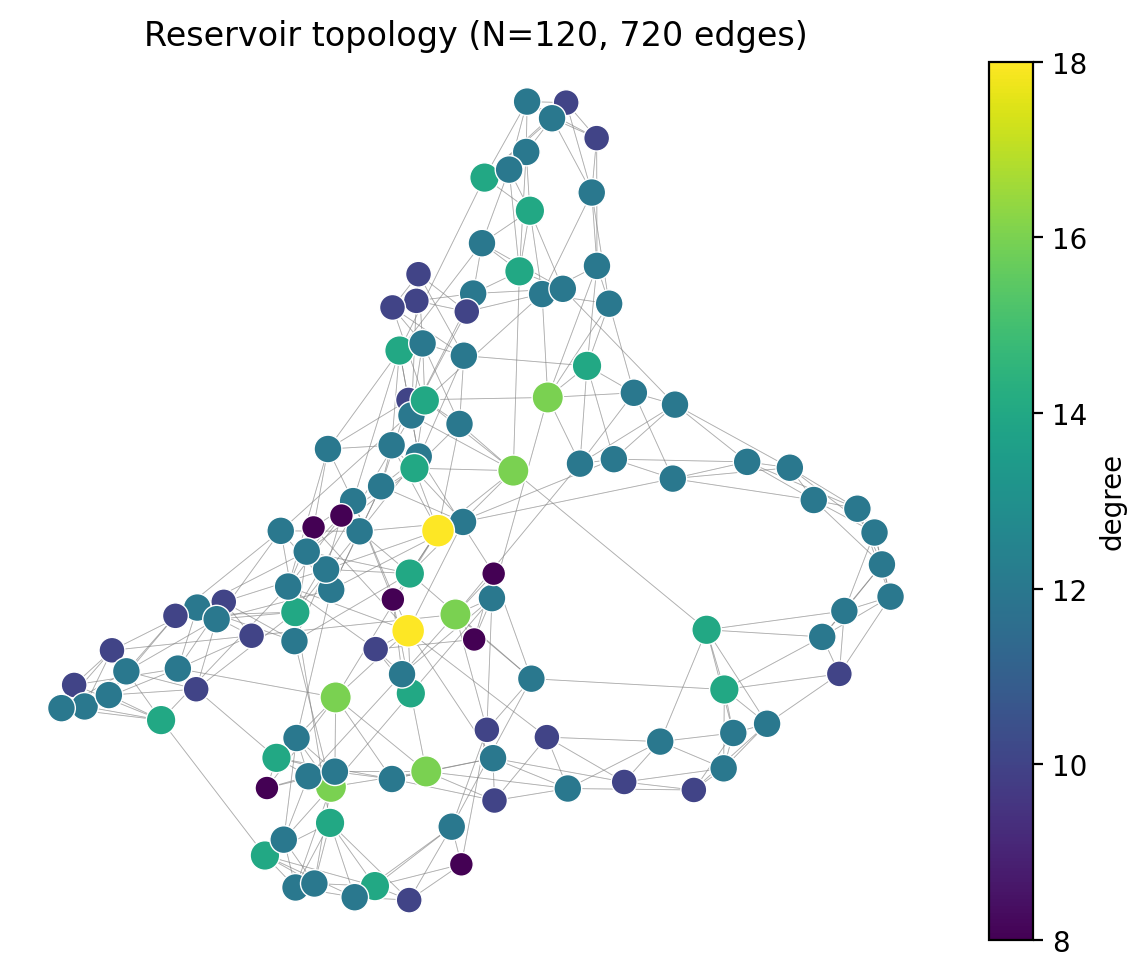
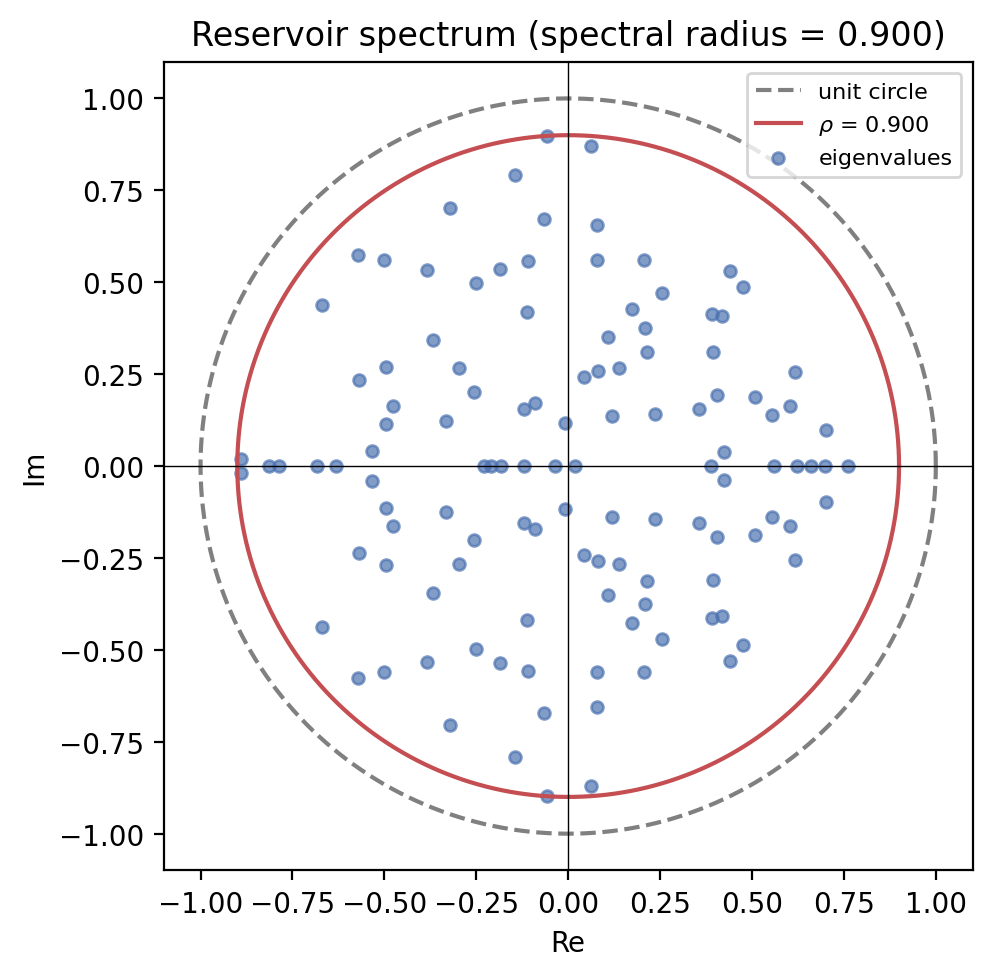
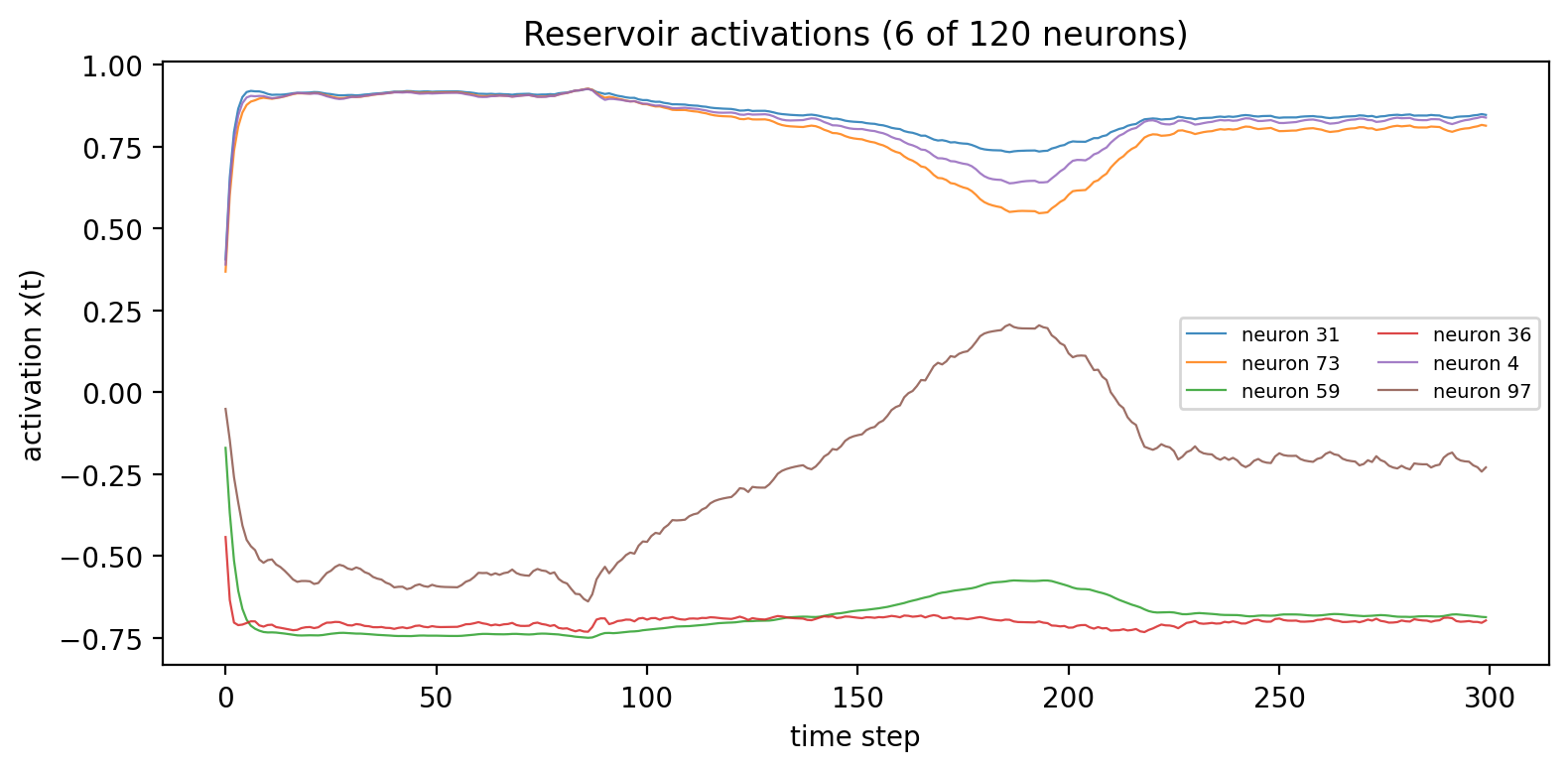
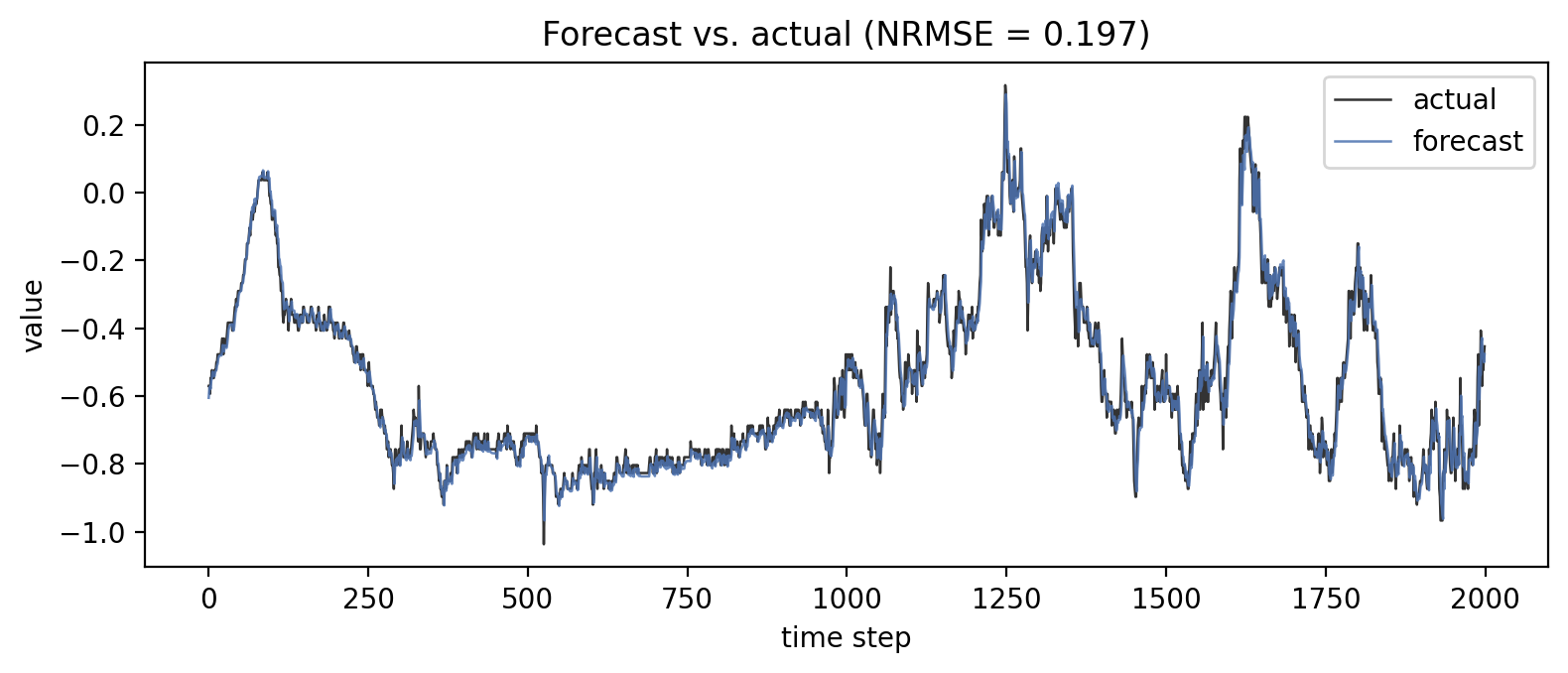
All four plots below are produced by esnfed.viz (see Visualising your ESN).
| Reservoir topology | Eigenvalue spectrum |
|---|---|
 |
 |
| Reservoir activations | Forecast vs. actual |
 |
 |
Features
- Echo State Network with leaky-integrator neurons and a closed-form ridge
readout (
EchoStateNetwork); a deep / hierarchical stack (DeepEchoStateNetwork); heterogeneous leaking rates and mixed activations. - Federated strategies:
federated_ridge— exact federated training for a shared reservoir (clients exchange only ridge sufficient statistics; provably equal to pooled training, in one communication round);fedavg— iterative FedAvg on the readout;ensemble_predict— prediction ensemble for heterogeneous reservoirs;structural_alignment— interpolate reservoirs toward a shared structure.
- Privacy & continual learning — all on the same sufficient statistics:
federated_ridge_dp—(ε, δ)-differential privacy (analytic Gaussian mechanism);federated_ridge_secure— secure aggregation (additive masking; the server only sees the sum);StreamingRidge/RLSReadout— incremental / online ridge for streaming and continual federated learning.
- Sequence classification (
classification) with the same exact federated aggregation (e.g. speaker ID, activity recognition). - Reservoir topologies: Erdős–Rényi, small-world, scale-free, ring.
- Data: synthetic benchmarks (NARMA-10, Mackey-Glass, Lorenz); real series — a
bundled counterparty-risk series (the TED spread) and FRED loaders (
load_fred, multivariateload_fred_matrix); and UCI sequence-classification benchmarks (load_japanese_vowels,load_har). - Interoperability: adapters for ReservoirPy reservoirs and an example integration with the Flower federated-learning framework.
Installation
pip install esnfed                  # core (numpy + networkx)
pip install "esnfed[viz]"           # + plotly/matplotlib/seaborn plots
pip install "esnfed[experiments]"   # + matplotlib/pandas/scipy/scikit-learn
pip install "esnfed[reservoirpy]"   # + ReservoirPy interop
pip install "esnfed[flower]"        # + Flower integration
Quick start
Federated counterparty-risk forecasting (real data)
Several institutions jointly forecast the TED spread (a classic gauge of interbank/counterparty credit risk) without sharing their data. Exact federated ridge equals pooled training in a single round:
from esnfed import datasets, federated, topologies, metrics

u, y = datasets.load_ted_spread()                 # bundled real series (FRED)
u_tr, y_tr, u_te, y_te = datasets.split(u, y, 0.7)
parts = datasets.partition_iid(u_tr, y_tr, n_clients=8)   # 8 "institutions"

W = topologies.random_reservoir(200, density=0.1, rng=0)
esn_kw = dict(spectral_radius=0.9, leaking_rate=0.5, washout=100, ridge=1e-6)
clients, ref = federated.make_shared_clients(W, parts, input_seed=0, esn_kwargs=esn_kw)

W_out = federated.federated_ridge(clients, ref)   # one round, exact, private
Z_test = ref.harvest(u_te)[ref.washout:]
print("federated NRMSE:", metrics.nrmse(y_te[ref.washout:], Z_test @ W_out))
Need another series? datasets.load_fred("BAMLH0A0HYM2") pulls a high-yield
credit spread from FRED; datasets.from_array(my_series) or
datasets.load_csv("my.csv") turn any series into a forecasting task.
Train a single ESN
import numpy as np
from esnfed import EchoStateNetwork, datasets, topologies, metrics

u, y = datasets.narma10(3000, rng=0)
u_tr, y_tr, u_te, y_te = datasets.split(u, y)
W = topologies.random_reservoir(200, density=0.1, rng=0)
esn = EchoStateNetwork(1, 1, W, spectral_radius=0.9, washout=100).fit(u_tr, y_tr)
print("NRMSE:", metrics.nrmse(y_te[100:], esn.predict(u_te)[100:]))
Differential privacy & secure aggregation
Harden the federated exchange — the same (A, B) statistics, now with a formal
privacy guarantee, or hidden from the server:
from esnfed import federated
from esnfed.privacy import PrivacyConfig

# (ε, δ)-differentially private readout (clip + analytic Gaussian mechanism)
cfg = PrivacyConfig(epsilon=1.0, delta=1e-5, clip_state=5.0, clip_target=1.0)
W_dp = federated.federated_ridge_dp(clients, ref, cfg)

# secure aggregation: the server only ever sees the masked sum of clients
W_secure = federated.federated_ridge_secure(clients, ref, seed=0)
Interoperability
ReservoirPy — design there, federate here
from reservoirpy.nodes import Reservoir
from esnfed import interop, datasets, federated

res = Reservoir(200, sr=0.9, lr=0.5, input_dim=1)   # design/tune in ReservoirPy
esn = interop.to_esn(res, n_inputs=1)               # -> esnfed EchoStateNetwork
W = interop.reservoir_matrix(res)                   # ... then federate it
Flower — a real FL framework
examples/flower_federated_ridge.py shows the exact federated-ridge scheme as a
Flower NumPyClient + custom Strategy: each client's fit returns its ridge
sufficient statistics and the server sums them and solves once. The Flower-routed
result is identical to federated_ridge to numerical precision.
Visualising your ESN
The optional esnfed.viz module (pip install "esnfed[viz]") provides four
plots. The default backend is Plotly (interactive); pass
backend="matplotlib" or backend="seaborn" for static figures. Each function
returns the native figure object.
from esnfed import EchoStateNetwork, topologies, viz

W = topologies.small_world_reservoir(100, k=6, p=0.1, rng=0)
esn = EchoStateNetwork(1, 1, W, spectral_radius=0.9).fit(u_tr, y_tr)

viz.plot_reservoir(esn).show()           # connectivity graph (degree-coloured)
viz.plot_spectrum(esn).show()            # eigenvalues + unit circle + ρ
viz.plot_states(esn, u_te).show()        # reservoir activations over time
viz.plot_forecast(y_te, esn.predict(u_te), washout=100).show()
viz.save(viz.plot_spectrum(esn), "spectrum.html")   # or .png (needs kaleido)
| Function | Shows |
|---|---|
plot_reservoir |
reservoir connectivity as a network graph |
plot_spectrum |
eigenvalues in the complex plane (echo state property) |
plot_states |
a sample of reservoir activations over time |
plot_forecast |
predicted vs. actual with NRMSE |
Modules
| Module | Contents |
|---|---|
esnfed.esn |
EchoStateNetwork, ridge helpers |
esnfed.deep |
DeepEchoStateNetwork (stacked reservoirs) |
esnfed.topologies |
reservoir generators + graph_metrics |
esnfed.datasets |
NARMA-10, Mackey-Glass, Lorenz; from_array, load_csv, load_ted_spread, load_fred, load_fred_matrix, load_japanese_vowels, load_har |
esnfed.metrics |
nrmse, rmse, mse, r2_score |
esnfed.federated |
Client, federated_ridge, fedavg, ensemble_predict, structural_alignment, federated_ridge_dp, federated_ridge_secure |
esnfed.privacy |
differential privacy (dp_statistics, gaussian_sigma) + secure aggregation (secure_sum) |
esnfed.streaming |
StreamingRidge, RLSReadout (incremental / online ridge) |
esnfed.classification |
sequence classification + exact federated / ensemble variants |
esnfed.interop |
ReservoirPy adapters (to_esn, reservoir_matrix) |
esnfed.viz |
plot_reservoir, plot_spectrum, plot_states, plot_forecast |
esnfed.llm_orchestration |
experimental FedResPrompt (reservoir soft-prompt control of a frozen LLM) |
Reproducing the research experiments
pip install -e ".[experiments,reservoirpy,flower,viz]"
python -m pytest                    # 92 tests
python experiments/run_all.py       # synthetic-benchmark figures and tables
python experiments/exp6_finance.py  # federated counterparty-risk (TED spread)
Data attribution
The bundled TED spread is sourced from the Federal Reserve Bank of St. Louis
(FRED, series TEDRATE) and is used for demonstration under FRED's terms.
Citation
@thesis{benites2026esnfed,
  author = {Benites Aldaz, Dairon Andres},
  title  = {Ensemble of Recurrent Networks for Federated Learning},
  school = {Universitat Politecnica de Valencia (ETSINF)},
  year   = {2026},
  type   = {Bachelor's thesis},
}
License
MIT — see LICENSE.
Release history Release notifications | RSS feed


Download files
Download the file for your platform. If you're not sure which to choose, learn more about installing packages.
Source Distribution
Built Distribution
Filter files by name, interpreter, ABI, and platform.
If you're not sure about the file name format, learn more about wheel file names.
Copy a direct link to the current filters
File details
Details for the file esnfed-1.6.1.tar.gz.
File metadata
- Download URL: esnfed-1.6.1.tar.gz
- Upload date:
- Size: 83.3 kB
- Tags: Source
- Uploaded using Trusted Publishing? No
- Uploaded via: twine/6.2.0 CPython/3.13.12
File hashes
| Algorithm | Hash digest | |
|---|---|---|
| SHA256 |
3e07f41fac44f3ccb2a63126cc49c89e7a8372cd27d8e5f2143e9f68b3216b7d
|
|
| MD5 |
615c9197ed077ac5bb77f8c3df86a83e
|
|
| BLAKE2b-256 |
d9afdf77e8828e893e71b754665336a50faedc9f8e4b2f04af189c7323ed2d7f
|
File details
Details for the file esnfed-1.6.1-py3-none-any.whl.
File metadata
- Download URL: esnfed-1.6.1-py3-none-any.whl
- Upload date:
- Size: 75.8 kB
- Tags: Python 3
- Uploaded using Trusted Publishing? No
- Uploaded via: twine/6.2.0 CPython/3.13.12
File hashes
| Algorithm | Hash digest | |
|---|---|---|
| SHA256 |
ae6fd5cc1ebbc11175d125d6ce8b1061dd75029ab5a89bb4e766427b992432d9
|
|
| MD5 |
c2ac7bd8de63344e6013c53664231ec1
|
|
| BLAKE2b-256 |
fa2d39c0d7de583e2d31f3a9533ae832ce9688e4b390957e7ee489caef4af88a
|






