

Rendered from a live ETABS 23 session: every member, deflection and D/C ratio is real. MP4
etabs-mcp
Your AI agent, inside ETABS.
An agentic Model Context Protocol server for CSI ETABS v22+. Claude Code, Codex, Factory Droid, Cursor and any other MCP client can model, load, analyse, design and inspect structures the way an engineer does, through the official ETABS API, with every call checked against the real signatures.





Quick start · Tools · How it works · Testing · Configuration
Why
ETABS has a huge automation API: 143 interfaces, 1,293 reachable methods, 58 enums. It's also full of
ref arrays, status codes and silent quirks. Agents should be designing buildings, not wrestling with COM marshalling.
etabs-mcp gives agents two layers:
| 71 curated tools | Engineer-shaped workflows: etabs_generate_building, etabs_define_seismic_load, etabs_code_checks, etabs_run_analysis, etabs_get_results, etabs_run_design, etabs_render_view, etabs_find_objects, etabs_edit_table, and more. |
| The entire API | etabs_search_api → etabs_describe_api → etabs_call_api. Every ETABS method is callable with plain JSON, validated against the live signature of the ETABS version you run. |
Highlights
|
Full coverage, zero guesswork |
Sees like an engineer |
The Interactive Database |
|
Safe by design |
Version-adaptive |
Built for agents |
Quick start
Requirements: Windows · ETABS 22 or newer (licensed) · Python 3.10+ · the .NET 8 Desktop Runtime (installed with ETABS 22+).
Install from PyPI:
pip install etabs-mcp
Or run it without installing, using uv:
uvx etabs-mcp --list-installs
Claude Desktop, one click: download etabs-mcp-<version>-py3XX.mcpb for your Python version from the
latest release and open it. Claude Desktop installs
the extension with every dependency bundled.
Check that it finds ETABS:
etabs-mcp --list-installs
Connect your agent
Claude Code
claude mcp add etabs -- etabs-mcp
Analyses can take minutes on big models; raise the tool timeout with MCP_TOOL_TIMEOUT=600000.
OpenAI Codex
~/.codex/config.toml
[mcp_servers.etabs]
command = "etabs-mcp"
tool_timeout_sec = 600
Factory Droid · Cursor · Claude Desktop · Windsurf · any MCP client
{
  "mcpServers": {
    "etabs": {
      "command": "etabs-mcp",
      "env": { "ETABS_MCP_CONNECT_MODE": "auto" }
    }
  }
}
HTTP (remote agents, multiple clients)
etabs-mcp --transport streamable-http --port 8765
Then just ask:
"Model a 2-storey steel frame, 2×1 bays of 6 m × 5 m, W14X90 columns, W18X35 beams, 200 mm slab. Apply 1.5 kPa SDL and 3 kPa live, run the analysis, report T₁, wind drift and the worst steel D/C ratio, and show me the 3D view."
The server connects on its own: it attaches to a running ETABS, or launches one.
71 tools
| Area | Tools |
|---|---|
| Session | etabs_list_installations · etabs_connect · etabs_status · etabs_disconnect |
| Model & file | etabs_model_overview · etabs_new_model · etabs_open_model · etabs_save_model · etabs_set_units · etabs_get_stories · etabs_set_stories |
| Geometry | etabs_add_frames · etabs_add_areas · etabs_add_points · etabs_list_objects · etabs_delete_objects · etabs_set_restraints · etabs_assign_section · etabs_select |
| Properties | etabs_list_properties · etabs_define_material · etabs_define_frame_section · etabs_define_area_section |
| Loads | etabs_define_load_patterns · etabs_assign_loads · etabs_define_combinations · etabs_list_load_definitions |
| Lateral system | etabs_define_seismic_load (ASCE 7-16 ELF) · etabs_define_wind_load (ASCE 7-16/7-22, other codes via fields) · etabs_define_response_spectrum · etabs_set_mass_source · etabs_assign_diaphragm · etabs_set_modal_case |
| Generate | etabs_generate_building: grids, stories, steel moment/braced or concrete frame/wall systems, slabs, supports, diaphragm and gravity loads in one call |
| Analysis & design | etabs_run_analysis · etabs_analysis_status · etabs_unlock_model · etabs_get_results · etabs_run_design · etabs_get_design_summary · etabs_design_codes |
| Concrete & walls | etabs_get_concrete_design (beams, columns, joints) · etabs_run_shear_wall_design · etabs_get_wall_design (piers, spandrels) · etabs_get_slab_design (strips, punching) |
| Code checks | etabs_code_checks (drift, torsional/soft-story/weight irregularity, modal mass, RS vs ELF) · etabs_scale_response_spectrum |
| Background jobs | etabs_job_status · etabs_job_wait: analysis and design with background=true never hit client timeouts |
| Database tables | etabs_list_tables · etabs_get_table · etabs_edit_table |
| See & query | etabs_render_view · etabs_find_objects · etabs_screenshot · etabs_show_window · etabs_refresh_view |
| Track & undo | etabs_what_changed · etabs_checkpoint · etabs_list_checkpoints · etabs_restore_checkpoint |
| Export & report | etabs_export_model (full .e2k text, paged) · etabs_design_report (Markdown) · etabs_assign_label (groups, piers, spandrels) |
| Menus & dialogs | etabs_menu (browse and run ETABS menu commands the API lacks) · etabs_dialogs |
| Instances | etabs_instances: drive several ETABS at once (etabs_connect(instance=...)), switch, remove |
| Entire API | etabs_search_api · etabs_describe_api · etabs_call_api · etabs_call_api_batch |
Plus resources (etabs://api/interfaces, etabs://api/interface/{name}, etabs://api/enum/{name},
etabs://server/info) and a prompt (etabs_build_and_check) that walks an agent through the full workflow.
Example: anything the curated tools don't cover
// 1. find it
etabs_search_api({ "query": "frame releases" })
// → SapModel.FrameObj.SetReleases(Name, ref II[], ref JJ[], ref StartValue[], ref EndValue[], ItemType)

// 2. call it: plain JSON, validated and converted to the exact .NET types
etabs_call_api({
  "path": "FrameObj.SetReleases",
  "args": { "Name": "13", "II": [false,false,false,false,false,true],
            "JJ": [false,false,false,false,false,true],
            "StartValue": [0,0,0,0,0,0], "EndValue": [0,0,0,0,0,0] }
})
// → { "ok": true, "ret": 0, "outputs": { ... } }
What the agent sees
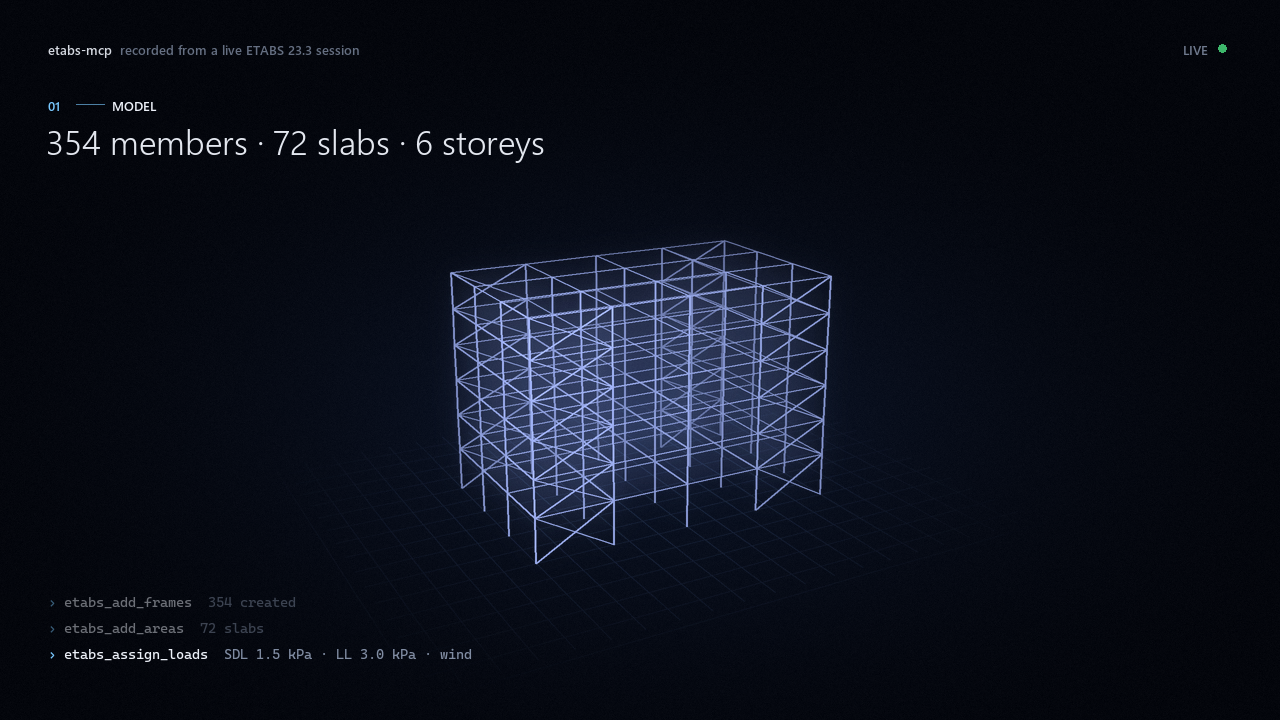
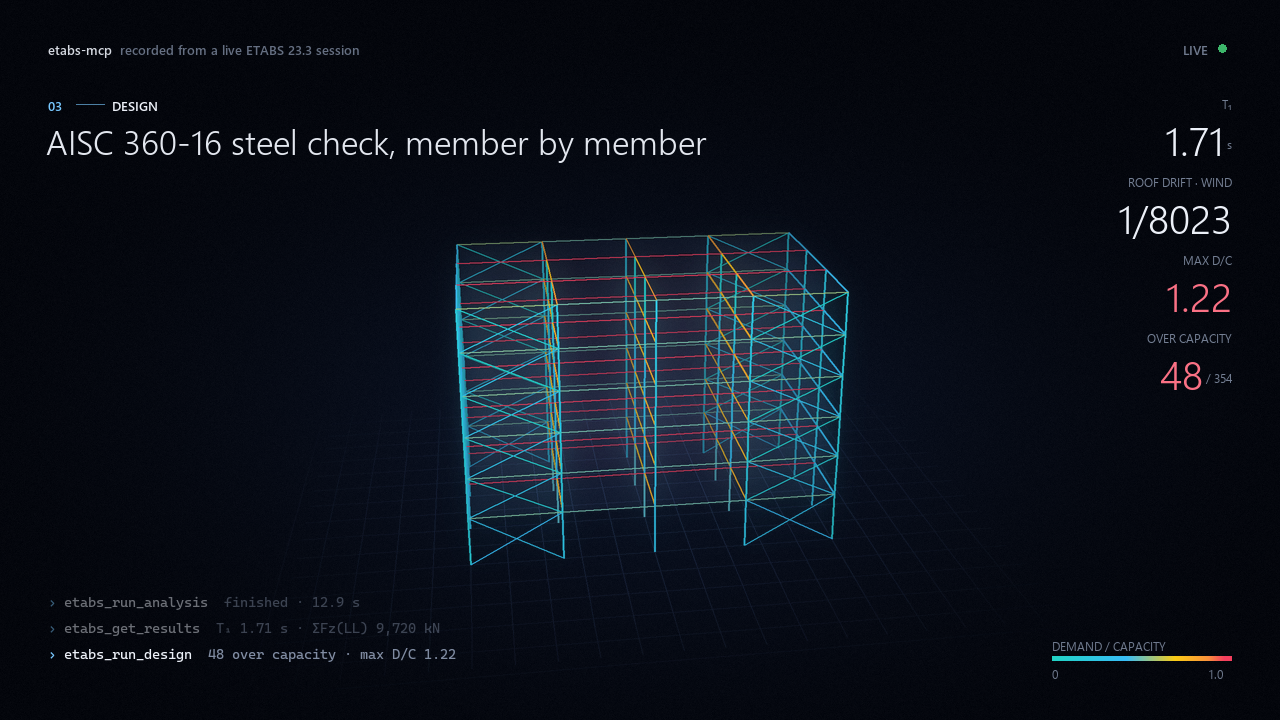
The film above is cut from one recorded session. An agent built a 6-storey, 4×3-bay braced steel building
through etabs-mcp, analysed it, ran the AISC 360-16 check, found 48 overstressed girders, upsized them,
and re-ran everything until no member was over capacity.
 |
 |
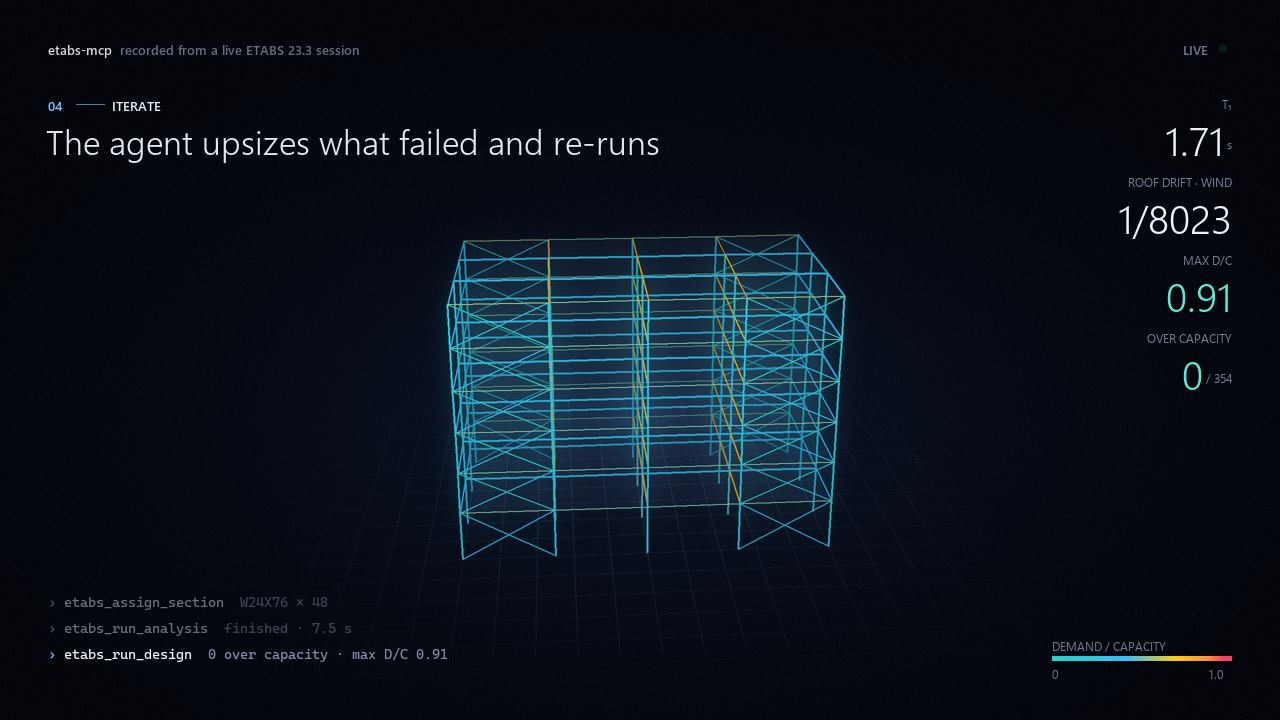 |
| Model · 354 members, 72 slabs, 30 tool calls | Design · 48 over capacity, max D/C 1.22 | Iterate · W24X76 × 48 → 0 over capacity, max D/C 0.91 |
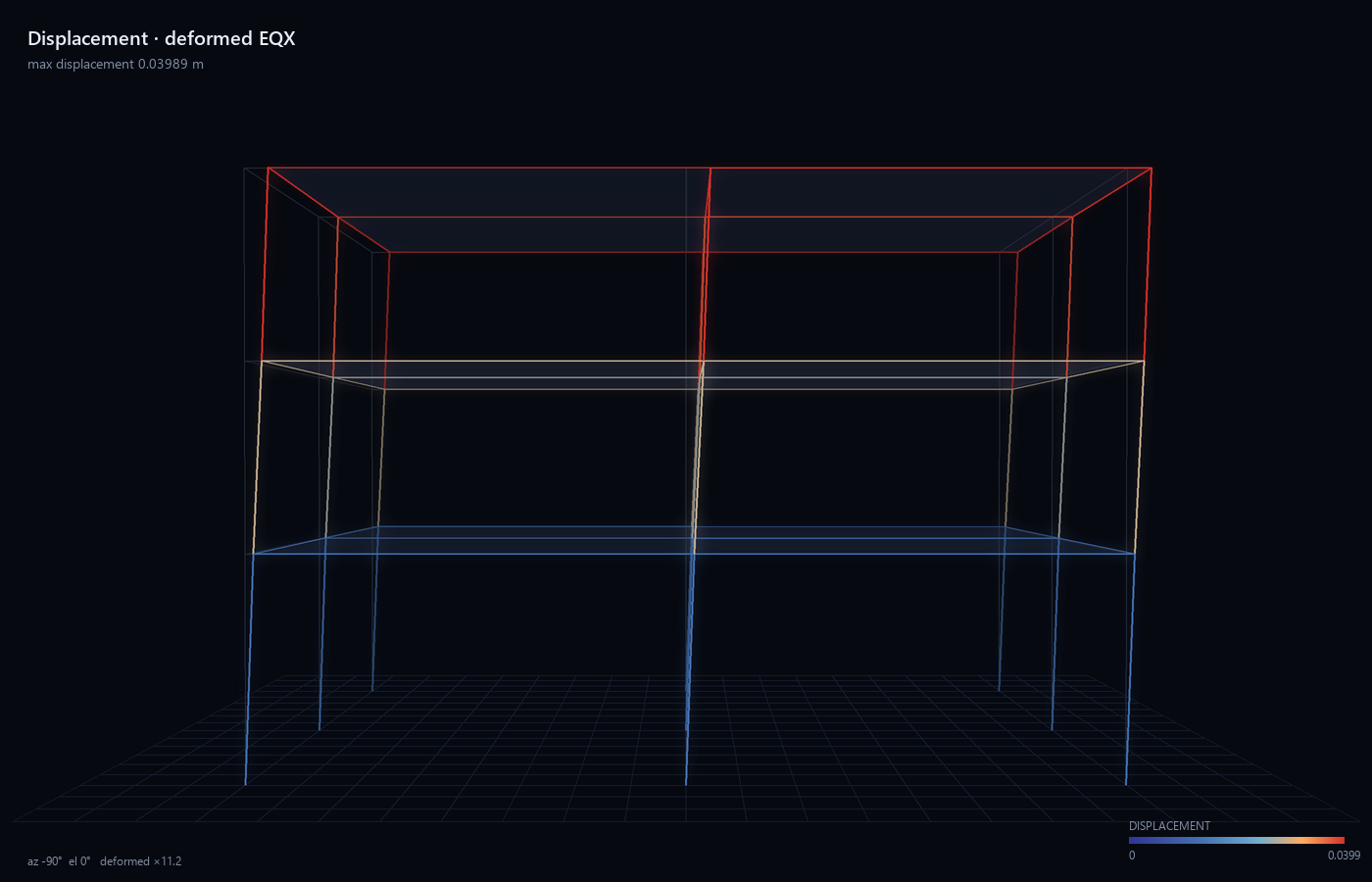
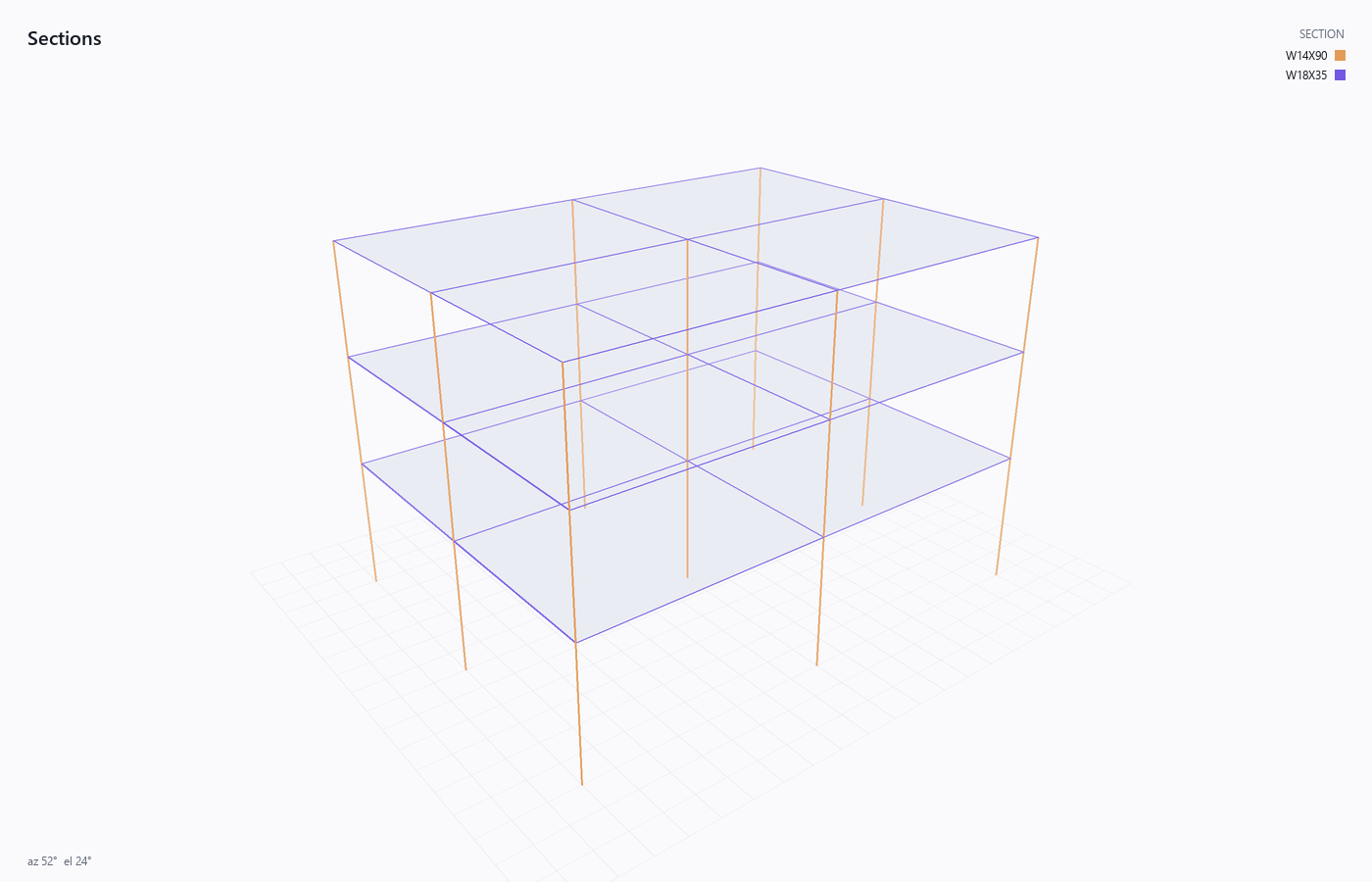
etabs_render_view
The agent's own view of the model, drawn from its data. It works with ETABS hidden, never takes focus, and shows what the ETABS API cannot switch the GUI to.
 |
 |
 |
color_by="design_ratio" |
deformed_case="EQX", color_by="displacement" |
color_by="section", theme="light" |
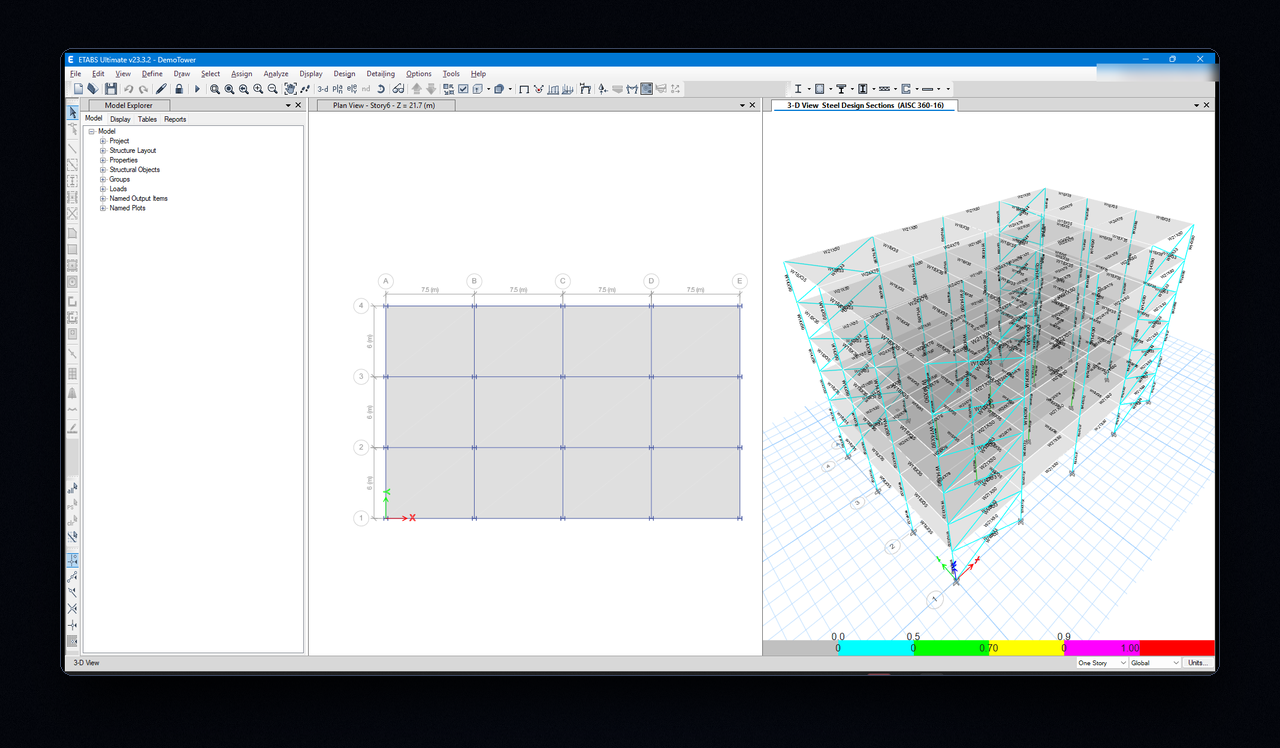
The same model in ETABS itself, captured by the agent with etabs_screenshot.
How it works
flowchart LR
    A["AI agent<br/>Claude Code · Codex · Droid · Cursor"] -- "MCP (stdio / HTTP)" --> S

    subgraph S["etabs-mcp"]
        direction TB
        T["71 curated tools<br/>+ generic dispatcher"] --> P["Policy<br/>read-only · confirm · blocked"]
        P --> C["Coercion<br/>JSON → typed args, ByRef placeholders"]
        C --> K["API catalog<br/>live reflection of ETABSv1.dll"]
        K --> W["Single STA worker thread"]
    end

    W -- "pythonnet / CoreCLR<br/>MethodInfo.Invoke" --> D["ETABSv1.dll<br/>(the installed version)"]
    D -- "COM, cross-process" --> E["ETABS.exe"]
    E -. "screen capture" .-> A
Reverse-engineering the API, not ETABS. This server stays on the official, documented OAPI and never patches or decompiles the ETABS engine. Its API surface was mapped from the shipped interop assembly:
- REA static metadata analysis of
ETABSv1.dll: 365 types, 3,275 method defs, 14,752 parameters. - A reflection dumper (
tools/ApiDump) emits every public interface, signature, ByRef flag, default and enum intoetabs_api_spec.json. - Cross-check: reflection and raw metadata agree exactly (e.g.
cFrameObj+cAnalysisResults+cDatabaseTables= 136 methods + 1 property accessor = REA's 137). - At runtime the server re-reflects the loaded DLL, so validation always matches the ETABS you run.
Engineering details that make it "just work":
- Typed marshalling. pythonnet boxes Python
intasPyIntinsideobject[], which reflection rejects forInt32. Every argument is routed through a one-element typed array andArray.Copy, so ETABS gets realInt32/Double/enum boxes and ByRef arrays. - One thread. ETABS and COM proxies aren't thread-safe; every call is serialised on a single worker.
- Lost connections (ETABS closed or crashed) are detected from HRESULTs and reported with a reconnect hint.
- ETABS quirks handled:
- Library imports that ETABS silently renames (
W14X90→W14X90-1) are detected and renamed back. - After table edits, ETABS reports the model file as the temporary
.$et; saving is mapped back to.EDB. - Unitless result columns (drift ratios, mass ratios) are turned into numbers, while IDs like
Label: "1"stay strings. - GPU-drawn viewports are blank to
PrintWindow, so screenshots come from the composed screen and focus is handed back afterwards.
- Library imports that ETABS silently renames (
Tested against real ETABS
Offline (CI): 58 tests. Every curated tool runs through FastMCP against a fake backend that resolves and
coerces every call against the real ETABSv1.dll catalog. A wrong method or parameter name fails exactly as it
would in ETABS.
Live end-to-end: tests/live/test_live_e2e.py starts the server as a real
MCP subprocess, launches ETABS 23.3.2, and runs 42 tool calls with 0 failures in ~42 s:
| Step | Verified |
|---|---|
| Model | 2 storeys, 26 frames (library W-shapes), 4 slabs, 6 fixed supports |
| Loads | SDL / LL / wind patterns, area + line + joint loads, 2 combos + AISC defaults |
| Analysis | all cases finished in 9.8 s; model locks |
| Base reactions | LL ΣFz = 360 kN = 3 kPa × 120 m², exact; SDL matches slab + line-load hand calc |
| Modal / drift | T₁ = 0.398 s · max wind drift 1/1846 |
| Design | 26 steel members (AISC 360-16), max D/C 0.35, 0 failing |
| Generic API | releases set and read back, a 9-call batch, status-code failures, validation and confirm errors |
| Tables | read 26 section assignments, edit one through the Interactive Database, verify through the API |
| Lifecycle | unlock, save (.EDB), screenshot, clean ETABS shutdown |
Live v0.2 suite: tests/live/test_live_v2.py drives every new tool against
ETABS on a 3-storey, 63-member model:
| Step | Verified |
|---|---|
| Units | "3.5 m", "4200 mm", "500 mm" inputs land as the right values |
| Find & label | 27 columns, 12 beams on Story2, 18 beams ≥ 7.5 m (selected), group round-trip |
| Lateral | ASCE 7-16 seismic (X, X±E), auto wind, ASCE 7-16 spectrum + RS case, mass source, diaphragm on 12 slabs, 9 modes |
| Change tracking | a hand edit and an added beam are both reported; the checkpoint restores the model |
| Background jobs | analysis returns at once; other calls get busy; job_wait returns the result |
| Results | EQX, WX and RSX base shears; X-only seismic gives exactly zero FY |
| Seeing | design-ratio, deformed, section and plan renders; AISC 341 design errors flagged, never shown as safe |
| Export & report | .e2k sections, Markdown report with reactions, modes, drifts and design |
Live v0.3 suite: tests/live/test_live_v3.py:
| Step | Verified |
|---|---|
| Generator | 4-storey concrete shear-wall building on a non-uniform grid (8/6/8 m); steel braced building in kip-ft |
| Hand check | steel building LL ΣFz = 0.05 ksf × 90 ft × 50 ft × 3 floors, exact |
| Code checks | drift (Cd-amplified), torsion, soft story, weight, modal mass (12 modes), RS vs ELF |
| RS scaling | response spectrum scaled to 100% of ELF, re-analysed, ratio 1.00 verified |
| Concrete & walls | ACI 318-19 beams, all 48 columns, joints; shear walls designed through the menu, pier results read back |
Showcase run (tools/record_demo_data.py): a 6-storey braced steel building,
354 members and 72 slabs. LL ΣFz = 9,720 kN (= 3 kPa × 30 m × 18 m × 6 floors, exact), wind ΣFx = 432 kN
(= 18 kN × 24 joints, exact), T₁ = 1.71 s. The redesign loop took max D/C from 1.22 to 0.91.
pip install -e ".[dev]"
pytest                                   # offline suite
ETABS_MCP_ARTIFACTS=docs/live pytest tests/live --live -s   # drives your local ETABS
Configuration
| Env var / flag | Default | Meaning |
|---|---|---|
ETABS_MCP_CONNECT_MODE / --connect-mode |
auto |
attach to a running ETABS, start a new one, or auto (attach if one is open, else start) |
ETABS_MCP_VERSION / --etabs-version |
newest | ETABS major version to use, e.g. 22 |
ETABS_MCP_INSTALL_DIR / --install-dir |
auto | ETABS program folder |
ETABS_MCP_VISIBLE / --hidden |
visible | Show the ETABS window when launching |
ETABS_MCP_READ_ONLY / --read-only |
off | Refuse every call that changes the model |
ETABS_MCP_ALLOW_DESTRUCTIVE / --allow-destructive |
off | Skip confirm=true for destructive calls (CI / unattended use) |
ETABS_MCP_RUNTIME |
coreclr |
.NET host for pythonnet (netfx as a fallback) |
ETABS_MCP_MAX_ARRAY_ITEMS |
2000 | Cap on array lengths returned by etabs_call_api |
ETABS_MCP_MAX_TABLE_ROWS |
500 | Default page size for tables and results |
ETABS_MCP_AUDIT_LOG / --audit-log |
off | Append every model-changing call (time, instance, call, arguments, result) to a JSON-lines file |
ETABS_MCP_TOKEN / --token |
none | Bearer token for --transport streamable-http/sse; required to listen beyond localhost |
Publishing (maintainers)
Tagging vX.Y.Z runs release.yml, which tests, builds the wheel, sdist and
.mcpb bundles, and publishes the GitHub release. PyPI and the MCP Registry use tokenless trusted publishing:
add a trusted publisher on pypi.org (this repo, workflow release.yml, environment pypi), then set the
repository variable PUBLISH_PYPI=true. Later tags publish to PyPI and list the server in the MCP Registry.
Version support
| ETABS | Status |
|---|---|
| 23.x | ✅ Verified live (23.3.2) |
| 22.x | ✅ Supported: same .NET 8 API; the catalog is reflected from your installed DLL |
| 24+ | ✅ Expected to work: new methods appear automatically through live reflection |
| ≤ 21 | ❌ Not supported (.NET Framework era API) |
Safety model
| Level | Examples | Behaviour |
|---|---|---|
| read | Get*, Count*, tables, results |
always allowed |
| write | Set*, Add*, analysis, design |
blocked in read-only mode |
| destructive | Delete*, new/open model, unlock (deletes results), close ETABS |
needs confirm=true |
| blocked | InternalExec, plugin hooks, active-object switching |
never callable |
Menu commands run through etabs_menu need confirm=true as well, and over HTTP every request must carry the
bearer token.
Project layout
src/etabs_mcp/
  server.py        FastMCP assembly: tools, resources, prompt, agent instructions
  session.py       connection lifecycle + single worker thread + generic call()
  dotnet.py        pythonnet host, live reflection, typed marshalling, connection-loss detection
  catalog.py       API catalog: path resolution, search, describe
  coerce.py        JSON → signature-typed values, results → JSON
  policy.py        read / write / destructive / blocked classification
  discovery.py     ETABS installs and running instances
  screenshot.py    window capture
  render.py        offscreen model renderer (etabs_render_view)
  units.py         unit-aware lengths ("6 m", "20 ft", "250 mm")
  gui.py           ETABS menu commands through Windows UI Automation
  http.py          HTTP transports with bearer-token auth
  tools/           curated tools (connection, model, generator, geometry, properties, loads, lateral,
                   analysis, concrete, checks, tables, view, insight, api)
mcpb/              Claude Desktop extension manifest    server.json   MCP Registry entry
  data/etabs_api_spec.json   reflected API of ETABSv1.dll
tools/ApiDump                .NET reflection dumper that produced the API spec
tools/record_demo_data.py    drives the MCP tools against live ETABS and records the showcase data
tools/render_hero.py         renders the README film and stills from that data
tools/build_mcpb.py          builds the Claude Desktop extensions
tests/             offline suite + live end-to-end test
Troubleshooting
install_not_found: runetabs-mcp --list-installs; setETABS_MCP_INSTALL_DIRif ETABS lives somewhere unusual.- Attaching does nothing: wait until ETABS has finished starting and close any modal dialogs; or pass
pidtoetabs_connect. - Edits fail after analysis: the model is locked.
etabs_unlock_model(confirm=true)deletes results and unlocks it. - Long analyses time out in the client: raise the client's MCP tool timeout (see Connect your agent).
- Switching ETABS major versions: restart the server; one process hosts one
ETABSv1.dll.
Apache-2.0 © Moha2005269 · ETABS is a trademark of Computers and Structures, Inc. This project is independent and not affiliated with or endorsed by CSI.
1 maintainer

Metadata
1 maintainer
Release files for etabs-mcp 0.3.2
For a detailed explanation of source distributions (sdists) and built distributions (wheels), please see the package formats documentation.
Source distribution (sdist)
| File | Size | Uploaded | |
|---|---|---|---|
| etabs_mcp-0.3.2.tar.gz | 183.0 kB | Details |
Built distribution (wheel)
| File | Interpreter | ABI | Platform | Reset |
|---|---|---|---|---|
| etabs_mcp-0.3.2-py3-none-any.whl | Python 3 | none | any | Details |
Total release size: 348.4 kB
Release files / etabs_mcp-0.3.2.tar.gz
| Download URL | etabs_mcp-0.3.2.tar.gz |
|---|---|
| Size | 183.0 kB |
| Tags | Source |
|
SHA-256 checksum How to use checksums |
a830ed841625938b56c718e58bb44e273db1d62b59381487486779087aff9bd1
|
|
BLAKE2b-256 checksum How to use checksums |
9215d2b59edb0269520ecf7f2b2fffe6d35f0449ff1c002f382dc494f22c587c
|
| Upload date | |
|
Uploaded using Trusted Publishing? What is trusted publishing? |
Yes |
| Uploaded via |
twine/7.0.0 CPython/3.13.14
|
Provenance
Provenance describes where a file came from. On PyPI, provenance is shared via attestations, which provide a verifiable record of the build or publishing details. View details, limitations and caveats.


PyPI Publish Attestation
PyPI verified that this artifact, at this checksum, originated from the publisher listed below.
Signed by GitHub Actions, verified by PyPI on Oct 18, 2026.
Transparency logRelease files / etabs_mcp-0.3.2-py3-none-any.whl
| Download URL | etabs_mcp-0.3.2-py3-none-any.whl |
|---|---|
| Size | 165.5 kB |
| Tags | Python 3 |
|
SHA-256 checksum How to use checksums |
7bf6b050b2e4979a0dcc7de093c936aee0c7816cbee3ef7328a4105c0b94cc03
|
|
BLAKE2b-256 checksum How to use checksums |
4299e6e2a1c60594b8af2d9eb0b134ddfce1767d3c8615430476a47561ffd966
|
| Upload date | |
|
Uploaded using Trusted Publishing? What is trusted publishing? |
Yes |
| Uploaded via |
twine/7.0.0 CPython/3.13.14
|
Provenance
Provenance describes where a file came from. On PyPI, provenance is shared via attestations, which provide a verifiable record of the build or publishing details. View details, limitations and caveats.
PyPI Publish Attestation
PyPI verified that this artifact, at this checksum, originated from the publisher listed below.
Signed by GitHub Actions, verified by PyPI on Oct 18, 2026.
Transparency log













