

Verify what your repository says against what it actually contains.
Local-first evidence validation for AI-assisted repositories.
Evagix checks documentation, commands, agent instructions, generated context, and repository claims against local evidence before developers, CI pipelines, or coding agents act on that information.





Local-first · Evidence-backed · Agent-aware · CI-friendly · JSON / SARIF outputs · Zero runtime dependencies
Quick start · Why Evagix? · What it validates · Commands · Docs · Security
Quick start
Install Evagix from PyPI:
python -m pip install evagix
For an isolated CLI installation:
pipx install evagix
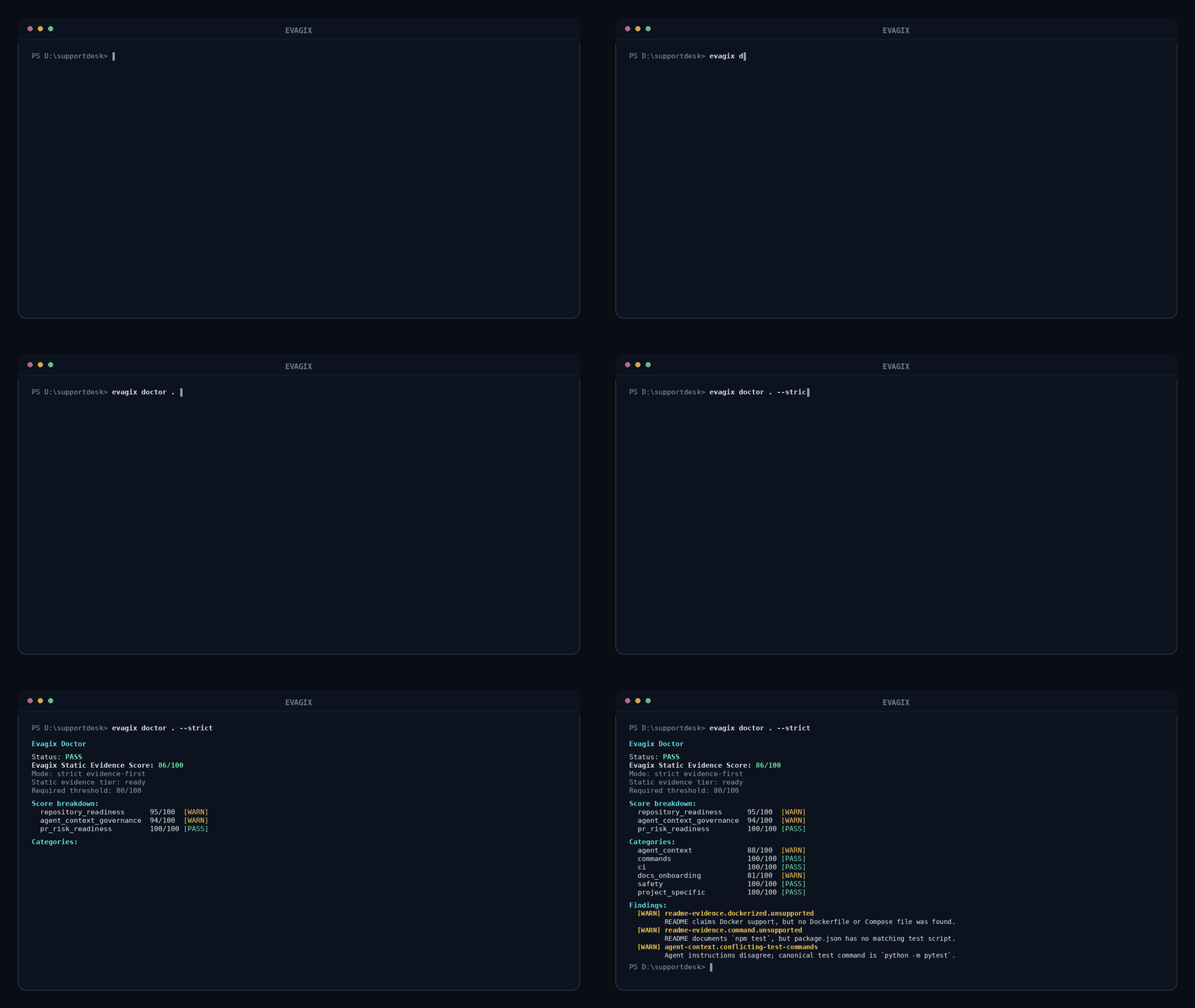
Run a repository readiness check:
evagix doctor .
Example output:
Evagix Doctor

Status: PASS
Evagix Static Evidence Score: 100/100
Static evidence tier: clear
Required threshold: 80/100

Score breakdown:
  repository_readiness      100/100  [PASS]
  agent_context_governance  100/100  [PASS]
  pr_risk_readiness         100/100  [PASS]

Categories:
  agent_context     100/100  [PASS]
  commands          100/100  [PASS]
  ci                100/100  [PASS]
  docs_onboarding   100/100  [PASS]
  safety            100/100  [PASS]
  project_specific  100/100  [PASS]

Findings:
  [PASS ] No issues found.
Results depend on the repository being inspected.
For a broader local review:
evagix doctor .
evagix readme-audit .
evagix eval-context . --strict
evagix check .
The shorter evgx alias is also available:
evgx doctor .
Evagix supports Python 3.11, 3.12, 3.13, and 3.14 through its release CI matrix.
Evagix provides conservative local evidence checks for repository claims, documented commands, agent-facing context, and generated context.
Why Evagix?
Modern repositories contain more than source code.
README files document setup and capabilities. CI files describe automation. AGENTS.md and other agent-facing files tell coding tools how to work with the repository. Generated context summarizes repository state for humans and AI systems.
Those sources can drift away from the repository they describe.
README says: npm test
package.json has no matching test script
README claims Docker support
no Dockerfile or Compose file exists
AGENTS.md documents one test command
evagix.toml declares another
A developer or coding agent can then follow instructions that look authoritative but no longer match the repository.
Evagix checks those instructions and claims against repository-local evidence before they are trusted.
Repository instructions are treated as evidence-backed artifacts, not trusted prose.
Evagix is intentionally focused. It complements tests, CI, code review, static application security testing (SAST), secret scanning, and dependency auditing rather than replacing them.
What Evagix validates
Evagix collects local repository evidence and evaluates several related surfaces.
| Area | What Evagix checks | Example |
|---|---|---|
| README claims | Claims about tests, CI, Docker, packaging, deployment, typing, monitoring, and related capabilities | Docker support is documented, but no Dockerfile or Compose file exists |
| Commands | Install, test, lint, typecheck, build, evaluation, smoke, and application-run commands | npm test is documented, but no matching package script exists |
| Agent context | AGENTS.md, supported context files, canonical commands, conflicts, and unsafe guidance |
AGENTS.md and evagix.toml define different test commands |
| Generated context | Missing, stale, unmanaged, modified, truncated, or invalid generated targets | Managed context no longer matches current repository evidence |
| Safety signals | Dangerous shell guidance, credential-bearing commands, environment exposure, and context-poisoning patterns | Agent instructions encourage risky access to local environment files |
| Repository evidence | Languages, tests, migrations, tooling, workflows, infrastructure markers, and related signals | A documented capability has weak or missing supporting evidence |
| CI and PR context | Workflow evidence and advisory changed-file risk signals | CI is claimed without matching workflow evidence |
Findings are designed to explain:
- what was detected;
- what evidence supports the result;
- why it matters;
- and whether it should be fixed, reviewed, or deliberately waived.
See the complete rule reference.
How it works
flowchart LR
    A["Claims & guidance<br/>README · docs · agent context"]
    B["Repository signals<br/>manifests · config · workflows · structure"]
    C["Evidence collection<br/>repository-local"]
    D["CLAIMS ↔ EVIDENCE<br/>VALIDATION"]
    E["Rule evaluation"]
    F["Findings"]
    G["CLI · JSON · SARIF · CI"]

    A --> C
    B --> C
    C --> D
    D --> E
    E --> F
    F --> G
Evagix collects repository-local signals from documentation, configuration, manifests, workflows, command definitions, and agent-facing context. It validates documented claims and guidance against the available evidence, then applies deterministic rules and repository policy to produce findings for local review, CI, and automation.
Evagix performs static repository inspection.
By default, it does not:
- execute project test, lint, build, or application commands;
- install project dependencies;
- call model APIs;
- upload repository contents.
Static markers are evidence signals, not proof of high-impact claims such as secure or production-ready.
When evidence is incomplete, Evagix reports that uncertainty instead of manufacturing confidence.
Commands
Most users only need a small part of the CLI.
| Goal | Command |
|---|---|
| Repository readiness | evagix doctor . |
| README evidence audit | evagix readme-audit . |
| Agent-context evaluation | evagix eval-context . |
| Generated-context verification | evagix check . |
| Repository governance audit | evagix audit . |
| Generate context | evagix compile . |
| Preview synchronization | evagix sync . --plan |
| PR risk signals | evagix pr-risk . --base main |
| Explain a finding | evagix explain <finding-code> |
| Export a report | evagix report . |
Advanced commands
| Goal | Command |
|---|---|
| Baseline snapshot | evagix baseline . |
| Baseline diff | evagix diff . |
| Scoped checks | evagix scoped . |
For the complete command inventory, flags, advanced workflows, and exit-code semantics, see docs/commands.md.
Strict gates
Evagix can start in reporting mode and later enforce explicit repository policy.
evagix doctor . --strict --fail-under 80
evagix readme-audit . --strict --fail-on unsupported
evagix eval-context . --strict --fail-on high
--strict enables stricter evaluation. It does not replace command-specific failure policy.
Thresholds such as --fail-under and selectors such as --fail-on determine when a configured gate fails.
This allows teams to inspect a repository first and introduce enforcement only after the expected policy is clear.
CI
A conservative CI gate can run:
python -m evagix check .
python -m evagix doctor . --strict --fail-under 80
python -m evagix readme-audit . --strict --fail-on unsupported
python -m evagix eval-context . --strict --fail-on high
Evagix can also generate a downstream GitHub Actions workflow:
evagix init-ci . --fail-under 85
For gradual adoption:
- run Evagix in reporting mode;
- review the findings;
- define the expected repository policy;
- add strict thresholds where enforcement is appropriate.
pr-risk is advisory. It does not replace repository validation, tests, CI, dependency auditing, or human review.
Pre-commit
Evagix provides hooks for downstream repositories:
repos:
  - repo: https://github.com/tarekmasryo/Evagix
    rev: v0.1.2
    hooks:
      - id: evagix-check
      - id: evagix-doctor
Configuration
Repository policy lives in evagix.toml.
[policy]
fail_on_stale = true
fail_under = 80

[commands]
test = "python -m pytest"
lint = "python -m ruff check ."
typecheck = "python -m mypy evagix"
Configuration can define:
- canonical repository commands;
- generated targets;
- policy thresholds;
- repository-specific validation behavior.
Evagix validates configuration before trusting it.
Invalid keys, empty commands, unsafe target paths, literal command credentials, and high-risk shell commands are rejected at the relevant boundary.
README examples can be excluded from claim analysis so example text is not automatically treated as a real repository claim.
Intentional policy waivers remain visible in results and do not become supporting evidence.
Outputs
Evagix supports human-readable and machine-readable output for local review, CI, and automation.
evagix doctor . --format json
evagix readme-audit . --format json
evagix eval-context . --format json
evagix report . --format sarif --output evagix.sarif --force
| Format | Typical use |
|---|---|
| Text | Local inspection |
| JSON | CI and automation |
| Markdown | Human-readable reports |
| SARIF | Code-scanning style integrations where supported |
Stable machine-readable contracts are documented in docs/schemas.md.
JSON output is not automatically a stable public contract. Stable outputs are the schema-backed formats documented by Evagix.
Evidence-sensitive reads are bounded. Truncated, unreadable, or invalid UTF-8 input is reported as incomplete instead of being treated as clean evidence.
Generated context
Evagix can generate opt-in agent-facing context derived from repository evidence.
Neutral Evagix-managed targets include:
.evagix/context.md
.evagix/context.json
Integrity state is stored separately in:
.evagix/integrity.json
Generated context includes ownership and repository fingerprint information.
This allows evagix check to distinguish:
- repository changes that make generated context stale;
- manual modification of Evagix-managed context;
- cases where both conditions are present.
Tool-specific exports are opt-in and are generated only when explicitly requested or configured.
Compatibility with a tool-specific target format does not imply affiliation, endorsement, or sponsorship.
Conservative behavior
Evagix intentionally avoids turning missing evidence into confidence.
- External or missing agent context remains unscored instead of receiving a positive structural score.
- Incomplete README reads do not become clean
100/100results. - Invalid UTF-8 and unreadable evidence are surfaced instead of silently ignored.
- Generated-context freshness and integrity are evaluated independently.
- Unsafe repository-internal symlink traversal is rejected.
- Policy waivers remain visible and do not create supporting evidence.
- Static repository markers are not treated as proof of broad claims such as
secureorproduction-ready.
The goal is not to maximize scores. The goal is to keep conclusions proportional to the evidence available.
Exact rule semantics are documented in the rule reference.
Installation
PyPI
python -m pip install evagix
For an isolated CLI installation:
pipx install evagix
Upgrade
With pip:
python -m pip install --upgrade evagix
With pipx:
pipx upgrade evagix
From source
git clone https://github.com/tarekmasryo/Evagix.git
cd Evagix
python -m pip install -e ".[dev]"
Verify the installation:
evagix --version
evgx --version
Supported environments
Evagix targets Python 3.11, 3.12, 3.13, and 3.14 through its release CI matrix.
It has zero runtime dependencies.
Repository scans do not require model APIs or network access.
Evagix can inspect repositories containing different languages and ecosystems, but it is not a deep language- or framework-specific analyzer.
New Python versions are considered supported after they enter the release matrix.
Scope
Evagix has a deliberately narrow responsibility:
Check whether repository-facing claims, instructions, commands, and managed context are supported by the local evidence available to developers and coding agents.
It complements existing engineering and security tooling.
Evagix is not:
- a test runner;
- a CI replacement;
- a semantic code analyzer;
- a full security scanner;
- a secret scanner;
- a dependency vulnerability auditor;
- a release approval system.
These boundaries are intentional. Evagix validates repository evidence and context; it does not attempt to prove the runtime correctness or security of an entire software system.
Documentation
| Document | Purpose |
|---|---|
| Commands | CLI workflows, flags, exit behavior, and advanced commands |
| Configuration | Repository policy and configuration |
| Rules | Rule overview |
| Rule reference | Complete rule semantics |
| Architecture | Architecture boundaries and extension rules |
| Schemas | Machine-readable contracts |
| Contributing | Development and contribution workflow |
| Changelog | Release history and notable changes |
| Security | Security policy and vulnerability reporting |
For bugs, feature requests, or unexpected behavior, use GitHub Issues.
Development
Install the development dependencies:
python -m pip install -e ".[dev]"
Run the local quality gates:
python -m compileall -q evagix tests scripts
python -m ruff check .
python -m ruff format --check .
python -m mypy evagix
python -m pytest --cov=evagix --cov-branch --cov-report=term-missing --cov-fail-under=80
Evagix also validates itself through its own repository checks.
See CONTRIBUTING.md before contributing and docs/architecture.md before making architectural changes.
Security
Evagix is designed to inspect repository evidence conservatively and avoid unnecessary access to known secret-bearing file types.
It does not intentionally read .env files or private-key formats as ordinary repository evidence.
Command safety, path handling, sensitive-data redaction, and generated-context integrity are treated as explicit validation boundaries.
For vulnerability reporting and the full security policy, see SECURITY.md.
License
Evagix is licensed under the Apache License 2.0.
1 maintainer

Metadata
1 maintainer
Release files for evagix 0.1.2
For a detailed explanation of source distributions (sdists) and built distributions (wheels), please see the package formats documentation.
Source distribution (sdist)
| File | Size | Uploaded | |
|---|---|---|---|
| evagix-0.1.2.tar.gz | 212.1 kB | Details |
Built distribution (wheel)
| File | Interpreter | ABI | Platform | Reset |
|---|---|---|---|---|
| evagix-0.1.2-py3-none-any.whl | Python 3 | none | any | Details |
Total release size: 487.5 kB
Release files / evagix-0.1.2.tar.gz
| Download URL | evagix-0.1.2.tar.gz |
|---|---|
| Size | 212.1 kB |
| Tags | Source |
|
SHA-256 checksum How to use checksums |
9d7d4ccc6c4ec1045d6f32f50f219ecd6c8e4ad5b552ca1b84f56ca026bca21a
|
|
BLAKE2b-256 checksum How to use checksums |
2e7f19a9deaa8dee88c496be5cfb9c7fbca0ac668169041466cd40cb981bdbb5
|
| Upload date | |
|
Uploaded using Trusted Publishing? What is trusted publishing? |
Yes |
| Uploaded via |
twine/7.0.0 CPython/3.13.14
|
Provenance
Provenance describes where a file came from. On PyPI, provenance is shared via attestations, which provide a verifiable record of the build or publishing details. View details, limitations and caveats.


PyPI Publish Attestation
PyPI verified that this artifact, at this checksum, originated from the publisher listed below.
Signed by GitHub Actions, verified by PyPI on Sep 27, 2026.
Transparency logRelease files / evagix-0.1.2-py3-none-any.whl
| Download URL | evagix-0.1.2-py3-none-any.whl |
|---|---|
| Size | 275.4 kB |
| Tags | Python 3 |
|
SHA-256 checksum How to use checksums |
7455e51ca6d7e53a414adc7df4d77d528de0cce6699860325ae7e902478aeb13
|
|
BLAKE2b-256 checksum How to use checksums |
86ee10239b4ae4ade717d2554ade07fbe0d15ac505e09ab349b55e7ddba6a191
|
| Upload date | |
|
Uploaded using Trusted Publishing? What is trusted publishing? |
Yes |
| Uploaded via |
twine/7.0.0 CPython/3.13.14
|
Provenance
Provenance describes where a file came from. On PyPI, provenance is shared via attestations, which provide a verifiable record of the build or publishing details. View details, limitations and caveats.
PyPI Publish Attestation
PyPI verified that this artifact, at this checksum, originated from the publisher listed below.
Signed by GitHub Actions, verified by PyPI on Sep 27, 2026.
Transparency log













