
Audit an LLM eval set the way you would audit an exam: what it can measure, what is dead weight, and which items are broken.
Verified details
These details have been verified by PyPIProject links
GitHub Statistics
Maintainers

Project description
evalint
Audit an LLM eval set the way you would audit an exam.
Every eval framework runs your test cases. None of them ask whether the test cases are any good.
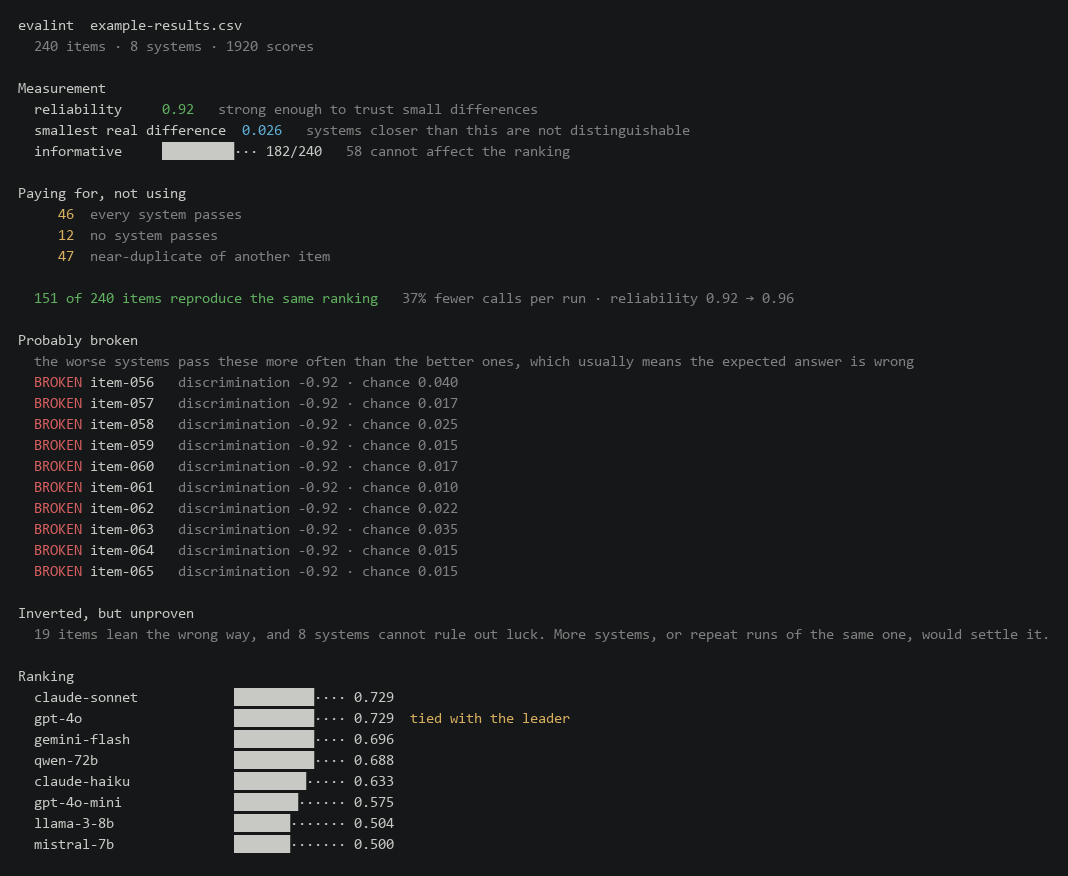
So you get a leaderboard: claude-sonnet 0.729, gpt-4o 0.729. Two numbers,
three decimal places, and no way to know whether that gap means anything, how
many of those 240 items could have told you anything in the first place, or
which of them are scored against an answer that is simply wrong.
evalint reads the results you already have and answers those questions.
Nothing to instrument, nothing to install alongside it, no API key, no model. It reads a CSV, a JSONL, a promptfoo dump or an OpenAI evals log, and it has zero runtime dependencies.
Install
pip install evalint
evalint results.csv
Python 3.9+. The only requirement is that the file compares at least two systems — two models, two prompt versions, or the same model run twice. Every statistic here is about telling systems apart, so one column is not a smaller version of the answer; it is no answer, and the tool says so instead of printing something.
What it tells you
Whether the leaderboard means anything
Reliability (KR-20 / Cronbach's alpha) is the fraction of the spread between your systems that is signal rather than noise. It is what licenses a sentence like "A beat B", and almost nobody computes it for an eval set.
From that comes the smallest real difference — systems closer together
than this are not distinguishable by your set, however many decimal places
the leaderboard prints. In the example above that threshold is 0.026, which
is why the top two are reported as tied rather than as first and second.
What you are paying for and not using
An item that every system passes, or that none do, contributes an identical constant to every system's total. It is arithmetically incapable of changing the ranking — while still costing an API call on every run, forever.
The example set has 240 items. 58 of them cannot affect the answer, and 151 reproduce the ranking exactly: 37% fewer calls per run, same result.
Which items are broken
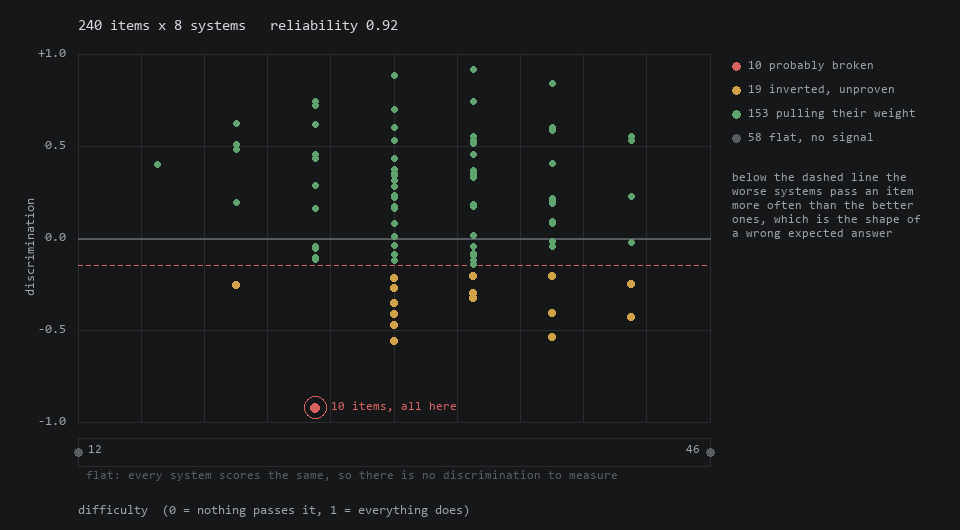
Each dot is one eval item, placed by how hard it is and by how well it agrees with everything else in the set.
The vertical axis is discrimination: the correlation between an item's score and the system's score on every other item. A good item is passed more often by the systems that do better overall — it sits above the line.
An item below the line is passed more often by the systems that do worse. There is no version of "a hard question" that behaves that way. In practice it means the expected answer is wrong, and the systems that "pass" it are the ones that answer badly enough to match.
The example has ten of those, planted deliberately, and evalint names all
ten and nothing else.
Reading your own results
Formats are detected by shape, not by filename, because everything in this
space writes .json and none of it is labelled.
| What you have | What to run |
|---|---|
A CSV: item_id, system, score |
evalint results.csv |
| A wide CSV: one column per model | evalint results.csv |
| JSONL records | evalint results.jsonl |
promptfoo's --output JSON |
evalint promptfoo.json |
| OpenAI evals logs (one run each) | evalint gpt-4o.jsonl claude.jsonl |
| One file per model | evalint *.csv |
Scores may be 1/0, true/false, PASS/FAIL, or a float in [0, 1]
from a rubric or a judge model. Fractional scores keep their resolution:
rounding them at the door would make every statistic coarser than your data
actually is.
Several files are merged on the item id. If the same system appears in two of
them, evalint decides what that means by whether the cells collide — the
same item scored twice is two separate runs and becomes two columns; disjoint
items are one run split across files and stay one column.
In CI
evalint results.csv --fail-under 0.8
Exit 2 means the eval set has a problem; exit 1 means the audit itself
failed. Distinct, so a pipeline can tell them apart.
evalint results.csv --json | jq '.summary.reliability'
What it will not claim
This section exists because the failure that matters is not "missed a problem". It is naming an item that turns out to be fine — a reader who opens two flagged items, finds nothing wrong and stops believing the rest has been made worse off than if the tool had said nothing.
A negative correlation alone is not evidence. With a handful of systems, an ordinary item that the weaker ones happened to get right looks exactly like one whose answer key is wrong. Measured on five systems: genuinely broken items land near −0.60, and innocent ones reach −0.71. The two populations overlap completely, so no threshold can separate them.
What separates them is more columns, not a better cutoff. So every accusation
runs a seeded permutation test — the item's scores are shuffled against
the systems' overall scores, and the reported chance is how often a result
this negative comes out of pure luck. Items that clear it are listed as
BROKEN. Items that look inverted but cannot clear it get their own section
that says so:
19 items lean the wrong way, and 8 systems cannot rule out luck. More systems, or repeat runs of the same one, would settle it.
With three systems, nothing can be proven. There are only six possible orderings, so the smallest achievable p-value is about 1/6. That is the correct answer rather than a limitation to route around, and the report says it instead of guessing.
Reliability is not reported when it would be meaningless. Fewer than three systems, or no spread between them at all, and you get the reason rather than a number. A reliability figure computed on two systems is arithmetic without information, and it would be the most quotable wrong number in the report.
A missing score is not a zero. Cells are stored sparsely, and every statistic states what it was computed over. Treating "not run" as "failed" is the single most misleading thing this tool could do.
Duplicate detection is textual. It uses character shingles and MinHash — no embedding model, no API key, no GPU — so it finds copy-pasted-and-edited items, which is what eval duplicates almost always are. Two items that mean the same thing in completely different words are not detected. That needs semantics, and the README saying so is enforced by a test.
The reduction is verified, not assumed. Every layer of it recomputes the ranking on what would be left, and rolls back with a note if the ranking moves:
47 near-duplicates were left in place: removing them changed the ranking, so they are not interchangeable despite the similar wording
That check was written after an early version reported "96% fewer calls" next to a leaderboard that had quietly reversed.
How it works
Classical test theory, which has been the standard toolkit in educational measurement for about a century, pointed at eval sets instead of school exams. Three quantities do the work:
- Difficulty — the mean score on an item. Zero variance means it cannot affect the ranking.
- Discrimination — the corrected item-total correlation. Corrected means the item is removed from the total it is compared against; leaving it in correlates the item with itself and flatters short sets most.
- Reliability — KR-20 over the items, and from it the standard error of measurement.
Duplicate detection is character 5-shingles → 64-permutation MinHash → banded LSH for candidate pairs → an exact Jaccard check on every candidate. The exact check is what keeps the output trustworthy; below a few hundred items it skips the signatures entirely, because exhaustive comparison is faster and cannot miss anything.
All of it is standard library. No numpy, no scipy, no pandas.
Why this exists
There is a lot of tooling for running evals — promptfoo, OpenAI evals, deepeval, Inspect, LangSmith — and it is good. There is very little for asking whether the eval set itself is sound, which is strange, because the same question about school exams has a century-old answer and a name.
The nearest things are dataset-quality advice in eval framework docs (which is prescriptive rather than something you can run) and academic work on benchmark contamination and saturation (which is about public benchmarks, not the 200-row CSV your team actually ships against). Neither will tell you that item 57 is scored against a wrong answer.
Full output
The figure at the top of this page, as text:
evalint  example-results.csv
  240 items · 8 systems · 1920 scores

Measurement
  reliability     0.92   strong enough to trust small differences
  smallest real difference  0.026   systems closer than this are not distinguishable
  informative     █████████··· 182/240   58 cannot affect the ranking

Paying for, not using
     46  every system passes
     12  no system passes
     47  near-duplicate of another item

  151 of 240 items reproduce the same ranking   37% fewer calls per run · reliability 0.92 → 0.96

Probably broken
  the worse systems pass these more often than the better ones, which usually means the expected answer is wrong
  BROKEN item-056   discrimination -0.92 · chance 0.040
  BROKEN item-057   discrimination -0.92 · chance 0.017
  BROKEN item-058   discrimination -0.92 · chance 0.025
  BROKEN item-059   discrimination -0.92 · chance 0.015
  BROKEN item-060   discrimination -0.92 · chance 0.017
  BROKEN item-061   discrimination -0.92 · chance 0.010
  BROKEN item-062   discrimination -0.92 · chance 0.022
  BROKEN item-063   discrimination -0.92 · chance 0.035
  BROKEN item-064   discrimination -0.92 · chance 0.015
  BROKEN item-065   discrimination -0.92 · chance 0.015

Inverted, but unproven
  19 items lean the wrong way, and 8 systems cannot rule out luck. More systems, or repeat runs of the same one, would settle it.

Ranking
  claude-sonnet            ██████████···· 0.729
  gpt-4o                   ██████████···· 0.729  tied with the leader
  gemini-flash             ██████████···· 0.696
  qwen-72b                 ██████████···· 0.688
  claude-haiku             █████████····· 0.633
  gpt-4o-mini              ████████······ 0.575
  llama-3-8b               ███████······· 0.504
  mistral-7b               ███████······· 0.500
Command line
usage: evalint [-h] [--format {auto,csv,jsonl,matrix,promptfoo,openai-evals}]
               [--similarity N] [--no-duplicates] [--no-reduce]
               [--fail-under N] [--save-reduced FILE] [--json]
               [--color {auto,always,never}] [--ascii] [--version]
               FILE [FILE ...]

Audit an LLM eval set. Reports what it can actually measure, which items are dead weight, which look broken, and how many you could drop without changing the answer.

positional arguments:
  FILE                  eval results to audit; several files are merged on the
                        item id

options:
  -h, --help            show this help message and exit
  --format {auto,csv,jsonl,matrix,promptfoo,openai-evals}
                        input shape (default: detected from the file)
  --similarity N        how alike two items must be to count as duplicates
                        (0-1, default: 0.8)
  --no-duplicates       skip duplicate detection
  --no-reduce           skip working out which items could be dropped
  --fail-under N        exit 2 if reliability is below N (a useful CI gate is
                        0.8)
  --save-reduced FILE   write the reduced set's item ids, one per line
  --json                machine-readable output
  --color {auto,always,never}
                        colour output (default: auto; NO_COLOR is honoured)
  --ascii               avoid non-ASCII characters
  --version             show program's version number and exit

Examples:
  evalint results.csv
  evalint promptfoo-output.json
  evalint results.jsonl --json
  evalint results.csv --fail-under 0.8
  evalint gpt-4o.jsonl claude.jsonl llama.jsonl

There must be at least two systems to compare: two models, two
prompt versions, or the same model run twice. Formats that log
one run per file -- OpenAI evals, one CSV per model -- are given
as several files, and are merged on the item id.
Development
git clone https://github.com/CAOShurong/evalint
cd evalint
python -m pip install -e ".[dev]"
python -m pytest
The example set, the figures and the numbers quoted above are all generated by running the tool:
python docs/make_example.py     # regenerate the example results
python docs/build_docs.py       # regenerate README.md and its figures
CI runs python docs/build_docs.py --check, so the documentation cannot
drift away from the code without a build going red.
Licence
MIT
Project details
Verified details
These details have been verified by PyPIProject links
GitHub Statistics
Maintainers
Release history Release notifications | RSS feed

Download files
Download the file for your platform. If you're not sure which to choose, learn more about installing packages.
Source Distribution
Built Distribution
Filter files by name, interpreter, ABI, and platform.
If you're not sure about the file name format, learn more about wheel file names.
Copy a direct link to the current filters
File details
Details for the file evalint-0.1.0.tar.gz.
File metadata
- Download URL: evalint-0.1.0.tar.gz
- Upload date:
- Size: 184.5 kB
- Tags: Source
- Uploaded using Trusted Publishing? Yes
- Uploaded via: twine/7.0.0 CPython/3.13.14
File hashes
| Algorithm | Hash digest | |
|---|---|---|
| SHA256 |
74ae283a4011902c16f45fd74b0e13a684cf656e7bc1b19a8e431c2924122a58
|
|
| MD5 |
f33c87ced4feeda7d0d411eb868cf1db
|
|
| BLAKE2b-256 |
f22eaf222bbbb2858a4bf797aef2af6db2fb9210f64335e04b1667906a5ed084
|
Provenance
The following attestation bundles were made for evalint-0.1.0.tar.gz:
Publisher:
release.yml on CAOShurong/evalint
-
Statement:
-
Statement type:
https://in-toto.io/Statement/v1 -
Predicate type:
https://docs.pypi.org/attestations/publish/v1 -
Subject name:
evalint-0.1.0.tar.gz -
Subject digest:
74ae283a4011902c16f45fd74b0e13a684cf656e7bc1b19a8e431c2924122a58 - Sigstore transparency entry: 2334677569
- Sigstore integration time:
-
Permalink:
CAOShurong/evalint@0528287a371e4defbe0714b72ecd20af05f5c09c -
Branch / Tag:
refs/tags/v0.1.0 - Owner: https://github.com/CAOShurong
-
Access:
public
-
Token Issuer:
https://token.actions.githubusercontent.com -
Runner Environment:
github-hosted -
Publication workflow:
release.yml@0528287a371e4defbe0714b72ecd20af05f5c09c -
Trigger Event:
push
-
Statement type:
File details
Details for the file evalint-0.1.0-py3-none-any.whl.
File metadata
- Download URL: evalint-0.1.0-py3-none-any.whl
- Upload date:
- Size: 36.6 kB
- Tags: Python 3
- Uploaded using Trusted Publishing? Yes
- Uploaded via: twine/7.0.0 CPython/3.13.14
File hashes
| Algorithm | Hash digest | |
|---|---|---|
| SHA256 |
67684f610e37417d32383a5c8388f4d210548ff0a5d3fae55aeb812fa91c6a27
|
|
| MD5 |
d069779039bf479afab77196d1a5fa3c
|
|
| BLAKE2b-256 |
4e2047568c203147bb8a9c66bd8e734479e4b61416073a5acc27abe6580b727a
|
Provenance
The following attestation bundles were made for evalint-0.1.0-py3-none-any.whl:
Publisher:
release.yml on CAOShurong/evalint
-
Statement:
-
Statement type:
https://in-toto.io/Statement/v1 -
Predicate type:
https://docs.pypi.org/attestations/publish/v1 -
Subject name:
evalint-0.1.0-py3-none-any.whl -
Subject digest:
67684f610e37417d32383a5c8388f4d210548ff0a5d3fae55aeb812fa91c6a27 - Sigstore transparency entry: 2334677575
- Sigstore integration time:
-
Permalink:
CAOShurong/evalint@0528287a371e4defbe0714b72ecd20af05f5c09c -
Branch / Tag:
refs/tags/v0.1.0 - Owner: https://github.com/CAOShurong
-
Access:
public
-
Token Issuer:
https://token.actions.githubusercontent.com -
Runner Environment:
github-hosted -
Publication workflow:
release.yml@0528287a371e4defbe0714b72ecd20af05f5c09c -
Trigger Event:
push
-
Statement type:






