
evalX
pytest for AI behavior. Grade LLM apps with golden datasets, code checks + an LLM judge, track every run locally, and gate CI on every single case.


Install · Quickstart · Features · Check types · CLI reference · Dashboard · Milestones
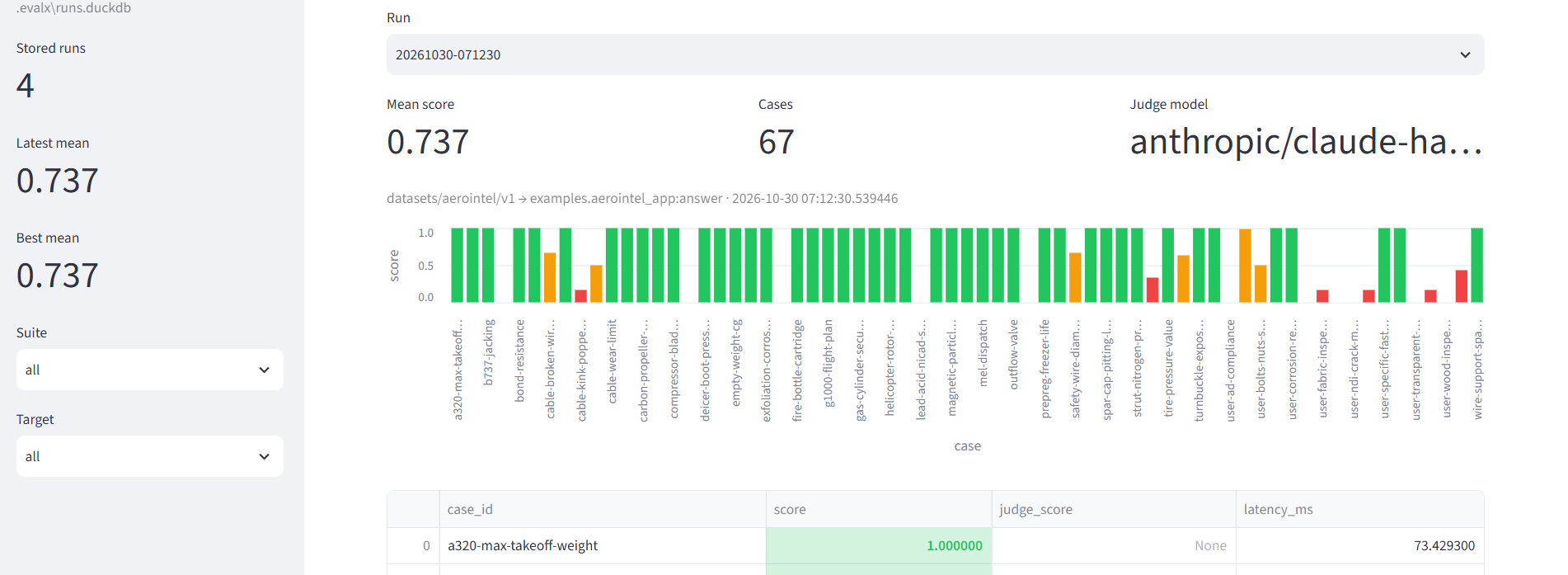
evalX grading a real system: the AeroIntel dogfood run — 67 cases, mean 0.737.
Local-first by design. Every run lives in a single DuckDB file inside your repo — no account, no cloud, no telemetry. Your eval history sits next to your code, and the whole loop works offline with a local judge model. promptfoo is a platform; evalX is the 10-minute, local-first regression catcher for Python LLM apps.
Features
- Golden datasets in YAML — hand-written cases with weighted code checks
(
exact_match,contains,not_contains,regex,numeric,max_length,json_schema) and optional LLM-judge rubrics. - LLM-as-judge with bias guards — answers scored alone (no position bias), an anti-fluff system prompt (no verbosity bias), verdicts validated as Pydantic JSON (retry once, then raise — never an invented score).
- Any text-in → text-out target — a Python function via
module:attr, a hosted service via a small adapter, or any OpenAI-compatible endpoint (Ollama, vLLM, LM Studio, LiteLLM proxies, …) via the generic adapter. - Local run store — every run saved to one DuckDB file in your repo; compare any two runs case-by-case.
- Quality vs cost — judge tokens and dollar cost are tracked per case
and per run (priced by LiteLLM, retries included);
evalx compareshows latency and cost changes next to the score deltas. - Per-case regression gate — pin a trusted run as a baseline; CI fails if any single case drops past your threshold, even when the mean improves. A guard refuses baselines from a different dataset.
- Errors can't hide — a crashing case is recorded with its error and
scored 0.0, runs carry error/skipped counts, an infra gate
(
--max-error-rate) fails CI on outage fraction before the score gates, and a run with errors is refused as a baseline. - Streamlit dashboard — run history with trends, per-case drill-down (question, answer, per-check scores, judge reasoning), and run compare.
- CI-ready — exit-code gates for mean score, per-case regression, and error rate; the included GitHub Actions workflow runs lint, tests, and an eval gate on every push.
Proof it works
evalX has graded two real systems (plus its own deterministic demo):
| Target | Suite | Result |
|---|---|---|
| AeroIntel — local aviation-maintenance RAG | 67 cases (35 answerable, 32 must-refuse), judged by Claude Haiku 5.5 | mean 0.737; refusals 31/32; one case rescued by the judge (code 0.00 → judge 1.00) |
Ollama qwen3:4b-instruct (local) |
6 general cases via the generic adapter | mean 0.833, total cost $0 |
| Demo app (deterministic, deliberately mediocre) | 6 cases | 0.500 by design — the CI gate's calibration fixture |
243 tests (including end-to-end), ruff clean, CI green on every push.
Install
pip install evalx-gate
The package is evalx-gate on PyPI (an unrelated project owns the evalx
name there); the command is evalx and the import is import evalx.
Point --target at a module:function in your project, run from your
project's folder. Python 3.11+.
Quickstart
From a clone of this repo (the demo dataset and app live here):
pip install -e .
evalx run --suite datasets/demo/v1 --target examples.demo_app:answer
The demo target is deliberately naive: it aces easy questions, gets partial credit on medium ones, and hallucinates on adversarial cases. Watch the harness catch all of it — mean score 0.500 over 6 cases.
Gate a run in CI:
evalx run --suite datasets/demo/v1 --target examples.demo_app:answer --fail-under 0.8
# exits 1: mean 0.500 < gate 0.8
Speed up a big suite by running cases concurrently:
evalx run --suite datasets/aerointel/v1 --target examples.aerointel_app:answer --workers 8
Results keep dataset order and score exactly as a sequential run would. Keep
--workers within your target's rate limit (the AeroIntel adapter retries
HTTP 429 with Retry-After).
LLM answers vary between identical calls. Measure how much with --repeats:
evalx run --suite datasets/aerointel/v1 --target examples.aerointel_app:answer \
  --repeats 3 --workers 4
Each case is asked 3 times; its score is the mean and a spread column
(max − min across attempts) shows how noisy it is. Cases that move more than
the regression threshold between identical attempts are listed as noisy, and
a REGRESSED line on such a case is marked (noisy: … may be model noise) —
the gate still fails, but you can see whether to trust it. The stored answer
and checks are from the lowest-scoring attempt, the one worth debugging.
How it works
One command runs the whole pipeline — load the exam, ask your app, grade every answer, remember the run:
flowchart LR
    subgraph S1["📥 PHASE 1 · SETUP"]
        direction TB
        CLI(["⚡ evalx run — you type the command"])
        PARSE["cli.py — flags → arguments; judge built only if asked"]
        LOAD["datasets.py — YAML → TestCases, Pydantic-validated"]
        RESOLVE["adapters.py — module:attr → real function"]
        CLI --> PARSE
        PARSE --> LOAD
        PARSE --> RESOLVE
    end
    subgraph S2["🔁 PHASE 2 · THE LOOP — repeats per case"]
        direction TB
        ASK["Ask the app — answer = answer_fn(question), timed"]
        CODE["Code checks — scorers.py: exact · contains · regex"]
        RUBRIC{"rubric?"}
        LLM["LLM judge — judge.py → LiteLLM, JSON verdict validated"]
        SKIP["judge skipped"]
        BLEND["Blend by weight — _combine_score"]
        CASE["CaseResult — score · latency · reason"]
        ASK --> CODE
        ASK --> RUBRIC
        RUBRIC -->|yes| LLM
        RUBRIC -->|no| SKIP
        CODE --> BLEND
        LLM --> BLEND
        SKIP --> BLEND
        BLEND --> CASE
        CASE -.->|"↺ next case"| ASK
    end
    subgraph S3["📤 PHASE 3 · REPORT + MEMORY"]
        direction TB
        MEAN["RunResult — mean of all case scores"]
        SAVE[("store.py — DuckDB .evalx/runs.duckdb")]
        TABLE["Report — Rich table; gate → exit 0 / 1"]
        CMP["evalx compare — latest-1 vs latest, per-case deltas"]
        MEAN --> SAVE
        MEAN --> TABLE
        SAVE -.-> CMP
    end
    LOAD --> ASK
    RESOLVE --> ASK
    CASE --> MEAN

    classDef input fill:#16283f,stroke:#3b82f6,stroke-width:2px,color:#e6e9f0;
    classDef exec fill:#14301f,stroke:#22c55e,stroke-width:2px,color:#e6e9f0;
    classDef score fill:#2a2145,stroke:#a78bfa,stroke-width:2px,color:#e6e9f0;
    classDef judge fill:#3a2a10,stroke:#f59e0b,stroke-width:2px,color:#e6e9f0;
    classDef out fill:#12303d,stroke:#38bdf8,stroke-width:2px,color:#e6e9f0;
    class CLI,PARSE,LOAD,RESOLVE input;
    class ASK,CASE exec;
    class CODE,BLEND,SKIP score;
    class RUBRIC,LLM judge;
    class MEAN,SAVE,TABLE,CMP out;
Check types
Each case lists weighted checks; a case's code score is their weighted mean. Checks are validated when the dataset loads, so a typo fails fast instead of silently scoring 0.
| Type | Passes when | expected |
|---|---|---|
exact_match |
the answer equals the text (surrounding whitespace ignored) | text |
contains |
the text appears in the answer (case-insensitive) | text |
not_contains |
the text does not appear — a banned phrase, a hallucinated name, a leaked secret | text |
regex |
the pattern matches anywhere in the answer | Python regex |
numeric |
any number in the answer is within tolerance (default 0) of the value; reads 1,200, -3, .5, 40psi |
number |
max_length |
the answer has at most this many characters | positive integer |
json_schema |
the answer is JSON that validates against the schema (one Markdown code fence allowed) | JSON Schema, as a YAML mapping |
- id: torque-json
  question: "Give the torque for an AN3 bolt as JSON."
  checks:
    - type: json_schema
      expected:
        type: object
        required: [part, torque_in_lb]
        properties: {torque_in_lb: {type: number}}
    - {type: numeric, expected: 25, tolerance: 3}
    - {type: not_contains, expected: "ft-lb"}   # wrong unit
    - {type: max_length, expected: 200, weight: 0.5}
CLI reference
| Command | What it does | Key options |
|---|---|---|
evalx run |
Run a suite against a target, print the per-case table, save the run | --suite, --target, --judge-model, --judge-temperature, --fail-under, --baseline, --fail-on-regression (default 0.2), --max-error-rate (default 0.0), --workers (default 1), --repeats (default 1), --report FORMAT:PATH (repeatable), --no-save |
evalx runs |
List stored runs, newest first, with mean, error/skipped counts, judge cost, wall time and workers | — |
evalx compare A B |
Per-case score, latency and judge-cost deltas plus whole-run wall time between two runs (refs: full id, unique prefix, latest, latest-N) |
— |
evalx baseline pin REF |
Pin a stored run as a named baseline (--name, default stable) |
--allow-errors (required if the run contains error cases) |
evalx baseline list |
List pinned baselines | — |
evalx dashboard |
Launch the Streamlit dashboard | --port (default 8501) |
evalx version |
Print the version | — |
What's here
evalx/schemas.py— Pydantic models:TestCase,Check,JudgeSpec,CaseResult,RunResultevalx/datasets.py— load + validate golden datasets from YAMLevalx/scorers.py— deterministic scorers:exact_match,contains,not_contains,regex,numeric,max_length,json_schemaevalx/judge.py— LLM-as-judge via LiteLLM with built-in bias guards: answers scored alone (no position bias), anti-fluff system prompt (no verbosity bias), JSON verdicts validated with Pydantic (retry once, then raise instead of inventing a score), temperature optional — some models (e.g. claude-haiku-5-5) reject a forced temperature, so the parameter is omitted unless you set itevalx/adapters.py— resolvemodule:attrtargets to question → answer callablesevalx/runner.py— run every case, combine code checks + judge by weight; a failing case is recorded with its error, never aborts the runevalx/store.py— DuckDB run store: save runs, list them, resolvelatest/latest-N/ id-prefix references, compare two runs per case, pin and check baselinesevalx/cli.py— the Typer CLI above (Rich tables, exit-code gates)evalx/dashboard.py— Streamlit dashboard: run history, per-run detail, run-over-run compare.github/workflows/ci.yml— CI on every push: lint, tests, and the demo suite gated at--fail-under 0.4datasets/demo/v1/cases.yaml— 6 hand-written golden cases (2 with rubrics)datasets/aerointel/v1/cases.yaml— 67 cases converted from AeroIntel's golden setdatasets/general/v1/cases.yaml— 6 general-knowledge cases for bare LLMsexamples/demo_app.py— deliberately mediocre demo targetexamples/aerointel_app.py— HTTP adapter for AeroIntel (token auth, 429 retry withRetry-After)examples/openai_compatible_app.py— generic adapter for any OpenAI-compatible endpoint (Ollama by default)
Judge usage
export ANTHROPIC_API_KEY=...   # or the key for your judge provider
evalx run --suite datasets/demo/v1 --target examples.demo_app:answer \
  --judge-model anthropic/claude-haiku-5-5
Only cases with a judge: rubric invoke the judge; the rest use code checks.
Two judged cases on Haiku cost a fraction of a cent. Cases with a rubric and no checks are skipped when you run without
--judge-model (listed in the output, left out of the mean) rather than
scored 0.
A case never aborts the run: if your target or the judge raises, that case records the error (shown in the CLI and the dashboard drill-down) and scores 0.0, so a crashing app can't slip past the gate.
Run store & comparison
Every evalx run is saved to .evalx/runs.duckdb (override with EVALX_STORE):
evalx run --suite datasets/demo/v1 --target examples.demo_app:answer
# Run saved: 20261019-143022

evalx runs                 # list stored runs, newest first
evalx compare latest-1 latest   # per-case delta table + mean change
Run references accept a full id, a unique prefix, latest, or latest-N.
--no-save skips storing a throwaway run. The runs list shows each run's
error and skipped counts (– for runs stored before those were tracked).
Judged runs also record what the judge consumed: tokens and cost per case
(retries included), totalled per run. evalx run prints the total, and
evalx compare adds per-case latency and judge cost plus a summary, for
example:
Mean: 0.500 -> 0.750 (+0.250) | 2 improved, 0 regressed, 4 unchanged
Latency (mean per case): 1200 -> 800 ms (-33%)
Judge cost: $0.0020 -> $0.0016 (-20%)
Wall time (whole run): 7.4s -> 5.1s (-31%) | workers 1 -> 1
Every run also records its wall-clock time and --workers. Compare prints
them on a Wall time (whole run) line and notes when the two runs used
different worker counts: per-case latency includes queueing at the target,
so a parallel run can show higher latency per case and still finish sooner.
Cost comes from LiteLLM's price table. For a model it has no price for (a
local or custom endpoint), tokens are still recorded and cost shows as –,
never as a misleading $0.
Baselines & the regression gate (M5)
A mean-score gate can pass while one case craters. Pin a run you trust as a baseline, and every later run is also graded case-by-case against it:
evalx baseline pin 20261030-071230 --name aerointel   # bookmark a stored run
evalx baseline list                                   # see your bookmarks

evalx run --suite datasets/aerointel/v1 --target examples.aerointel_app:answer \
  --baseline aerointel                                # fail if any case drops > 0.2
A case fails the gate only when its score drops by more than the threshold
(--fail-on-regression, default 0.2 — a drop of exactly 0.2 still passes).
Cases added or removed since the baseline are reported as warnings, never
failures: a changed dataset is not a regression.
A baseline is only meaningful against the same dataset — the comparison matches on case ids. If a run and its baseline share no cases at all, the gate refuses with an error instead of passing a comparison that never happened; if the baseline came from a differently-named suite, the shared cases are still compared, with a warning. Baselines live in the local run store, so a CI gate needs a store that contains the pin.
A run with error cases (the target or judge raised) is refused as a
baseline unless you pass --allow-errors: a baseline built on an outage
would hide every later regression. To keep an outage from passing as a
quality drop in the first place, evalx run --max-error-rate (default 0.0)
adds an infra gate that fails the run on its fraction of errored cases,
reported before the score gates.
Reports for CI
evalx run --report FORMAT:PATH writes the run out for other tools, and can
be given several times:
evalx run --suite datasets/demo/v1 --target examples.demo_app:answer --fail-under 0.4 \
  --report junit:reports/evalx.xml \
  --report markdown:"$GITHUB_STEP_SUMMARY" \
  --report json:reports/evalx.json
| Format | Use it for | What's in it |
|---|---|---|
junit |
test-report views (GitHub Actions reporters, GitLab, Jenkins) | one <testcase> per case: <error> if it errored, <failure> if it regressed past the baseline or scored below --fail-under; score, judge reason, question and answer in system-out |
markdown |
a job summary or a PR comment | pass/fail per gate, judge cost, wall time, the cases needing attention (worst first) and a collapsible table of all cases |
json |
anything else | the full run plus every gate verdict, regressions and judge usage |
Reports are written even when a gate fails, so CI can show why it failed. This repo's own CI writes the Markdown report to the workflow summary page.
Dashboard
evalx dashboard # http://localhost:8501 (add --port N if busy)
Three tabs over your stored runs: Runs (history table with error counts
and a mean-score trend line), Run detail (per-case scores for one run),
and Compare (pick a baseline and a challenger — per-case deltas with
▲/▼ markers). Needs the dashboard extra:
pip install "evalx-gate[dashboard]" (or pip install -e ".[dev]" in a clone).
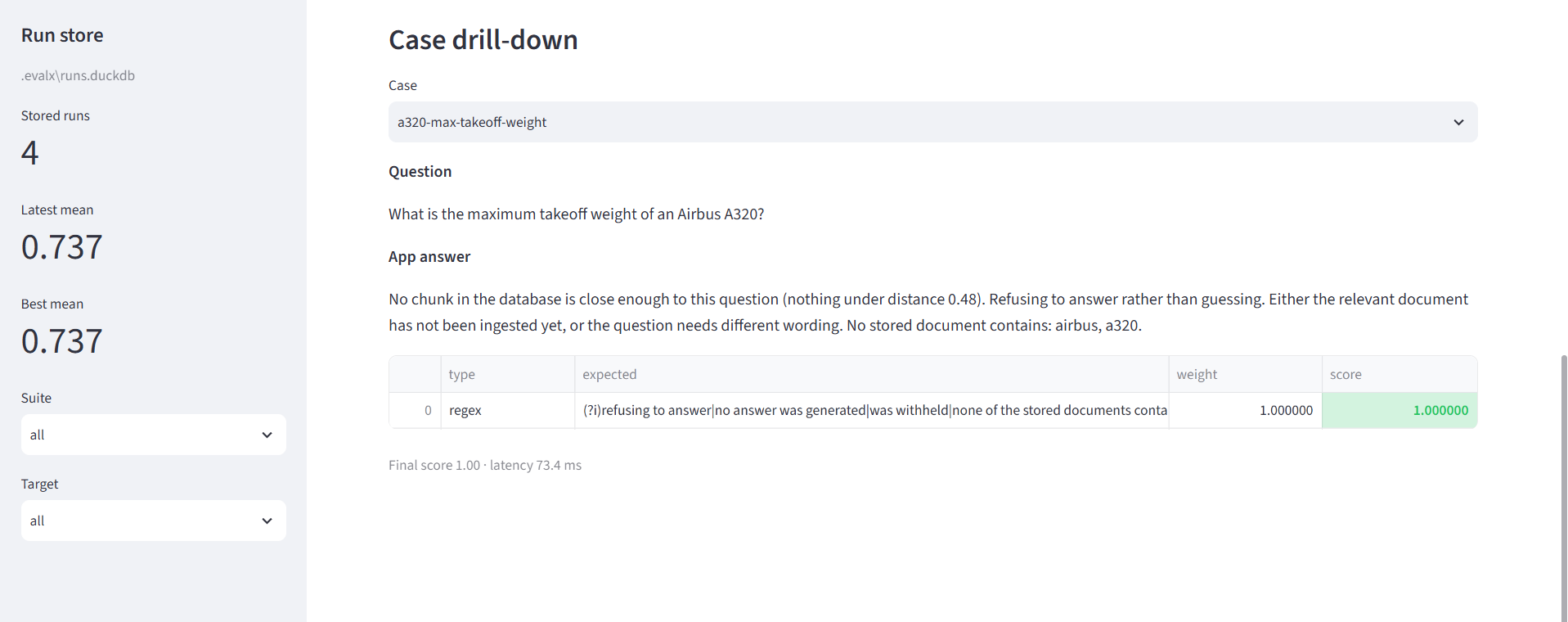
Case drill-down — the stored question, the app's actual answer (here a refusal, returned verbatim by the adapter), and the per-check scores behind the final grade. The run-detail view of the same run is the screenshot at the top of this README.
Configuration
| Variable | Used by | Purpose |
|---|---|---|
EVALX_STORE |
run store | Path of the DuckDB run-store file (default .evalx/runs.duckdb) |
ANTHROPIC_API_KEY (or your provider's key) |
LLM judge | API key for the --judge-model provider, via LiteLLM |
AEROINTEL_URL |
AeroIntel adapter | Base URL (default http://127.0.0.1:8000) |
AEROINTEL_CLIENT_ID / AEROINTEL_CLIENT_SECRET |
AeroIntel adapter | Token-auth credentials for AeroIntel's /auth/token |
OPENAI_COMPAT_BASE_URL |
generic adapter | Endpoint base URL (default http://localhost:11434/v1 — Ollama) |
OPENAI_COMPAT_MODEL |
generic adapter | Model name — required, no default |
OPENAI_COMPAT_API_KEY |
generic adapter | Optional bearer key for hosted endpoints |
OPENAI_COMPAT_SYSTEM_PROMPT |
generic adapter | Optional system prompt (handy for prompt A/B runs) |
OPENAI_COMPAT_TEMPERATURE |
generic adapter | Optional temperature; omitted unless set |
Development
pip install -e ".[dev,e2e]"           # pytest, ruff, streamlit, pandas, playwright
python -m playwright install chromium # browser for the dashboard E2E test
python -m pytest                      # 243 tests
ruff check .
tests/e2e/ tests evalX end to end the way a user runs it: a real evalx
process grades the OpenAI-compatible adapter against a local fake LLM server
(real HTTP, real LiteLLM judge calls, real DuckDB store, real exit codes),
and the dashboard is rendered in headless Chromium. No API key needed; the
dashboard test skips if Playwright isn't installed. One opt-in check hits a
real judge model: ANTHROPIC_API_KEY=... python -m pytest -m live.
CI (.github/workflows/ci.yml) runs the same lint + tests on every push and
pull request, then gates the deterministic demo suite at
--fail-under 0.4 (its designed mean is 0.500, so the gate verifies the
grading itself).
Releasing
The version lives in one place, evalx/__init__.py. To release:
- Bump
__version__and add a## [x.y.z]section toCHANGELOG.md(a test fails if the section is missing). - Merge to
main, then tag it:git tag vX.Y.Z && git push origin vX.Y.Z.
.github/workflows/release.yml then checks the tag matches the version,
runs lint and tests, builds and twine checks the package, publishes it to
PyPI through trusted publishing (no API token), and creates a GitHub release
with that version's changelog notes.
Milestones
-
M1 — core harness: YAML golden datasets, code scorers (exact / contains / regex), runner, CLI with a mean-score gate.
-
M2 — LLM-as-judge: rubric scoring through LiteLLM with bias guards — Pydantic-validated JSON verdicts, retry once, never an invented score.
-
M3 — run store & compare: every run saved to a local DuckDB file; per-case deltas between any two runs.
-
M4 — dashboard + CI: Streamlit dashboard over the stored runs (history, case drill-down, compare); GitHub Actions runs lint, tests, and the eval gate on every push.
-
M5 — baselines & regression gate: pin a run and fail when any single case drops past a threshold, even if the mean improved — with a guard against baselines from a different dataset. See "Baselines & the regression gate" above.
-
Dogfooding: evalX graded AeroIntel, a local aviation-maintenance RAG, on a 67-case dataset built from its own golden set (35 answerable + 32 must-refuse): mean 0.737 with an LLM judge, with 31 of 32 must-refuse questions refused correctly. Dataset in
datasets/aerointel/v1, adapter inexamples/aerointel_app.py, screenshots in the Dashboard section above. -
Concurrent runs:
evalx run --workers Ngrades N cases at once on a thread pool, with results in dataset order — identical to a sequential run. -
Quality vs cost: judge tokens and cost per case and per run, with latency and cost deltas next to score deltas in
evalx compareand the dashboard. -
Repeat runs:
--repeats Nscores every case N times — mean score, per-case spread, noisy cases flagged in the run and on regressions. -
More check types:
not_contains,numeric(with tolerance),max_lengthandjson_schema, all validated at dataset load. -
Reports for CI:
--report junit|markdown|json:PATH, written even when a gate fails; CI posts the Markdown report to its summary page. -
0.2.0 on PyPI as
evalx-gate, released from a version tag by GitHub Actions with trusted publishing. See the CHANGELOG.
Roadmap
- 0.3 — semantic similarity and HTML export: a
semanticcheck type scored with embeddings through LiteLLM (no torch), andevalx export --htmlfor a self-contained report to share. - 0.4 — RAG faithfulness: targets can return their retrieved context; judge modes for faithfulness (is every claim supported?) and context relevance (did retrieval find the right chunk?).
- 0.5 — multi-turn conversations: cases with several turns and checks per turn, for chatbots and agents.
License
MIT — see LICENSE.
1 maintainer

Metadata
1 maintainer
Release files for evalx-gate 0.2.0
For a detailed explanation of source distributions (sdists) and built distributions (wheels), please see the package formats documentation.
Source distribution (sdist)
| File | Size | Uploaded | Provenance | Actions |
|---|---|---|---|---|
| evalx_gate-0.2.0.tar.gz | 80.5 kB | With provenance | Details for evalx_gate-0.2.0.tar.gz |
Built distribution (wheel)
| File | Interpreter | ABI | Platform | Actions Reset |
|---|---|---|---|---|
| evalx_gate-0.2.0-py3-none-any.whl | Python 3 | none | any | Details for evalx_gate-0.2.0-py3-none-any.whl |
Total release size: 122.3 kB
Release files / evalx_gate-0.2.0.tar.gz
| Download URL | evalx_gate-0.2.0.tar.gz |
|---|---|
| Size | 80.5 kB |
| Tags | Source |
|
SHA-256 checksum How to use checksums |
11238ee4ca8a0a04b3c2f7a34fb7318bf06803b69913d230861a4806c2fc1740
|
|
BLAKE2b-256 checksum How to use checksums |
2237cefee0135f72e4e0232659a514a1fdebfdb2358c775113073b83d896c8ee
|
| Upload date | |
|
Uploaded using Trusted Publishing? What is trusted publishing? |
Yes |
| Uploaded via |
twine/7.0.0 CPython/3.13.16
|
Provenance
Provenance describes where a file came from. On PyPI, provenance is shared via attestations, which provide a verifiable record of the build or publishing details. View details, limitations and caveats.


PyPI Publish Attestation
PyPI verified that this artifact, at this checksum, originated from the publisher listed below.
Signed by GitHub Actions, verified by PyPI on Nov 4, 2026.
Transparency logRelease files / evalx_gate-0.2.0-py3-none-any.whl
| Download URL | evalx_gate-0.2.0-py3-none-any.whl |
|---|---|
| Size | 41.8 kB |
| Tags | Python 3 |
|
SHA-256 checksum How to use checksums |
a14b2432de202818e91f5bcad35fdb9cd69bc45a4d53c298f1ecc48db97d02fb
|
|
BLAKE2b-256 checksum How to use checksums |
bc6d342a8423e6b00054886d03530dcc586d41048e70f5ea0a74db2cc9e58c75
|
| Upload date | |
|
Uploaded using Trusted Publishing? What is trusted publishing? |
Yes |
| Uploaded via |
twine/7.0.0 CPython/3.13.16
|
Provenance
Provenance describes where a file came from. On PyPI, provenance is shared via attestations, which provide a verifiable record of the build or publishing details. View details, limitations and caveats.
PyPI Publish Attestation
PyPI verified that this artifact, at this checksum, originated from the publisher listed below.
Signed by GitHub Actions, verified by PyPI on Nov 4, 2026.
Transparency logSecurity for evalx-gate 0.2.0
Provenance
Provenance describes where a file came from. On PyPI, provenance is shared via attestations, which provide a verifiable record of the build or publishing details. View details, limitations and caveats.
Full provenance
Both files in this release have been uploaded with provenance metadata.
Attestation for evalx_gate-0.2.0.tar.gz
PyPI Publish Attestation
PyPI verified that this artifact, at this checksum, originated from the publisher listed below.
Signed by GitHub Actions, verified by PyPI on Nov 4, 2026.
Transparency logA note on package security
PyPI is a repository for distributing packages, not a service for auditing them. While third-party security researchers and our staff do their best to detect and remove malicious packages, PyPI cannot guarantee the quality, security or suitability of any given package.
To learn more about protecting yourself from malicious actors, visit our package security documentation.














