
Evarness
The governed agent harness for small local models. Local by default. Deterministic where it can be. Governed before action. Learns in the open.






Evarness runs an agent loop (classify, plan, act with tools, curate the answer) on models that fit on a laptop, through Ollama, LM Studio or any OpenAI-compatible server. Every model call and every tool call passes through a governance kernel you cannot unplug. A turn that can be answered exactly is answered with no model at all. The harness measures its own routing and tool use and proposes changes with evidence; it applies none of them until you say so. Everything outside the loop and the kernel is a plugin on a small, stable SDK.
The proof is the email assistant that ships with it: a private inbox assistant that reads, sorts and labels your mail on a local model, writes nothing until you approve it, and leaves an audit row for every call. The email assistant is not the product. It is the first proof that the harness works.
Documentation: https://evarness-ai.github.io/evarness/. Say it "ev-AR-ness".
Why I built it
I started Evarness as a private experiment: a personal assistant that runs on my own machines, on small local models, and helps with real work without sending my mail to someone else's cloud. As I added tools, routing, memory and email, the model turned out to be the smaller problem. A bigger model did not give me reliable tool calls, a local model did not give me permission boundaries, a system prompt was not a security boundary, and I did not want "self-learning" to mean the system quietly rewriting itself. Those became the harness's responsibilities, and Evarness is the result. Models provide cognition. Deterministic paths provide reliability. Plugins provide capability. Learning provides adaptation. Governance provides authority.
Try it in three minutes
You need uv or pipx (install notes). On Windows, one script sets everything up in Docker Desktop; see the Windows guide.
uv tool install "evarness[email]"   # or: pipx install "evarness[email]"
evarness doctor                     # can Evarness run here, and what to fix
evarness email demo                 # a synthetic mailbox, a scripted model, no network
The demo needs no account, no credentials and no model server. It fetches a 200-message
synthetic mailbox, sorts it, previews and writes labels, prints a first digest, and ends with
what it did, audit rows included. The demo keeps its own home, ~/.evarness-demo, and never
touches yours. Export that home's proof bundle, ledger and session logs both, and verify it
offline:
evarness governance proof-bundle export --db ~/.evarness-demo/governance/audit.db \
    --session-logs ~/.evarness-demo/logs --out bundle.json
evarness governance proof-bundle verify bundle.json   # exit 0 verified, 1 a violation

For your own mail you need Ollama and 8 GB of RAM for the
lite model set, 16 GB for standard. Connect an account, let evarness doctor --fix pull
the models your machine fits, then run evarness email setup; it asks before any write.
Connect your mailbox
has the provider notes, and setup gotchas
the known snags.
How it works
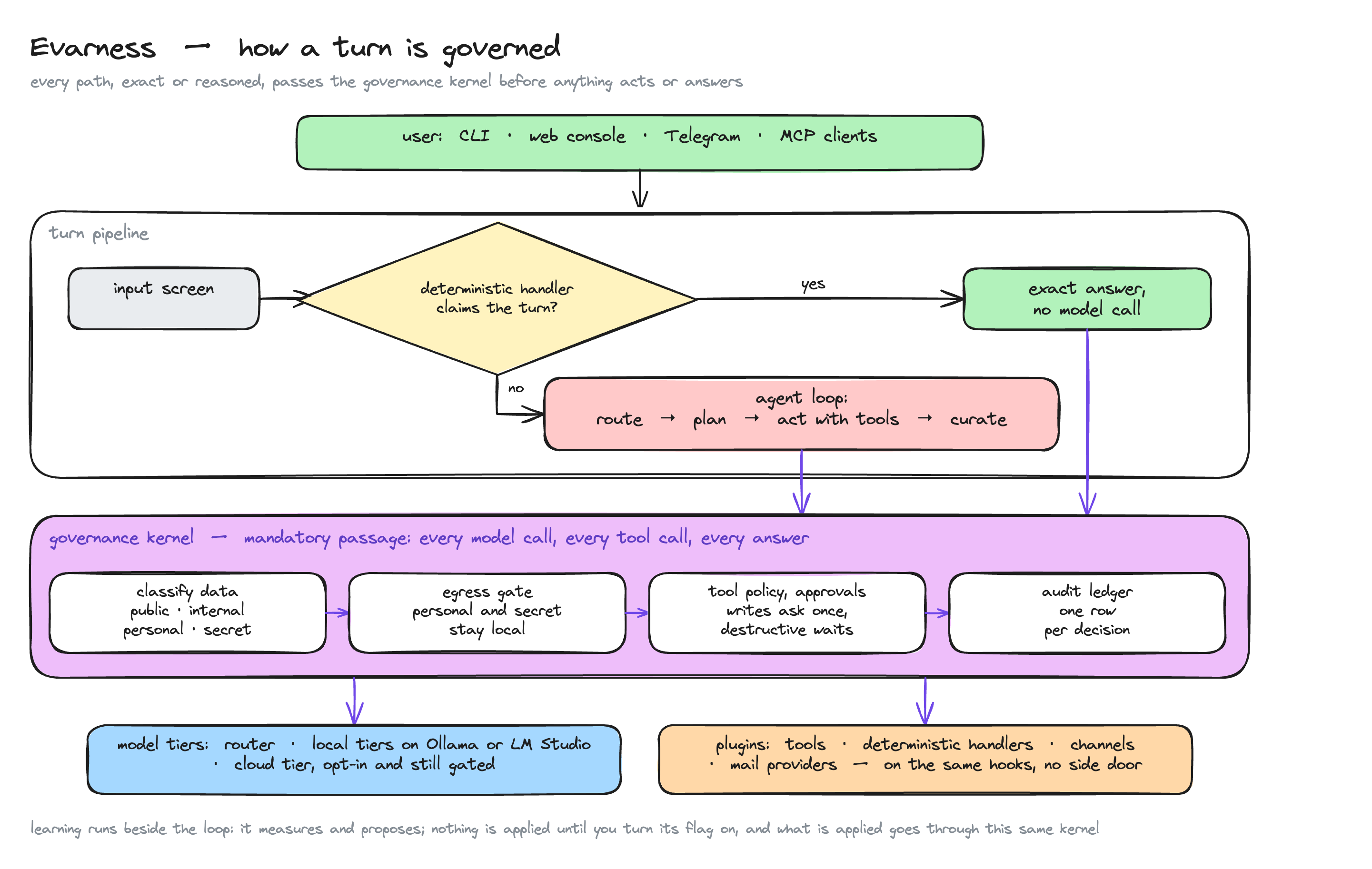
The kernel is a passage, not a filter: it runs at
nine fixed hook points
in every turn, and plugins cannot add, remove or reorder them. The stage-by-stage view is in
Architecture; the editable
source of the drawing is
docs/architecture/how-a-turn-is-governed.excalidraw.
Three things a bigger model would not give you
Deterministic where it can be. On one grounded action, a 7B model called the right tool
25% of the time and a 35B model 0%; a deterministic handler did it 100% of the time
(the measurement).
A plugin can claim the turns it can answer exactly, and those answers pass the same
model-free guards and leave an audit row marked deterministic.
Governed before action. Data is classified before it moves; personal and secret data stays on local models even when a cloud tier is on. Secrets reach tools as vault handles, never as prompt text. Writes ask once; destructive actions wait for your approval, per call. The proof bundle checks three invariants offline: no personal data to a cloud model, no mailbox write without an approval, every call and answer audited. The demo's bundle exercises the first two; the third is observed from chat sessions, which a scripted demo does not record.
Learns in the open. Four scheduled jobs read the signals real turns leave behind (intent confidence, tool failures, your corrections, task outcomes), propose experiments, recommend a start tier per intent, and write recurring successes as quarantined skill proposals. Each is recorded, none is applied, until you turn its flag on; the lifecycle is measure, propose, review, promote. The jobs, the signals and every flag are in Learning.
See every decision
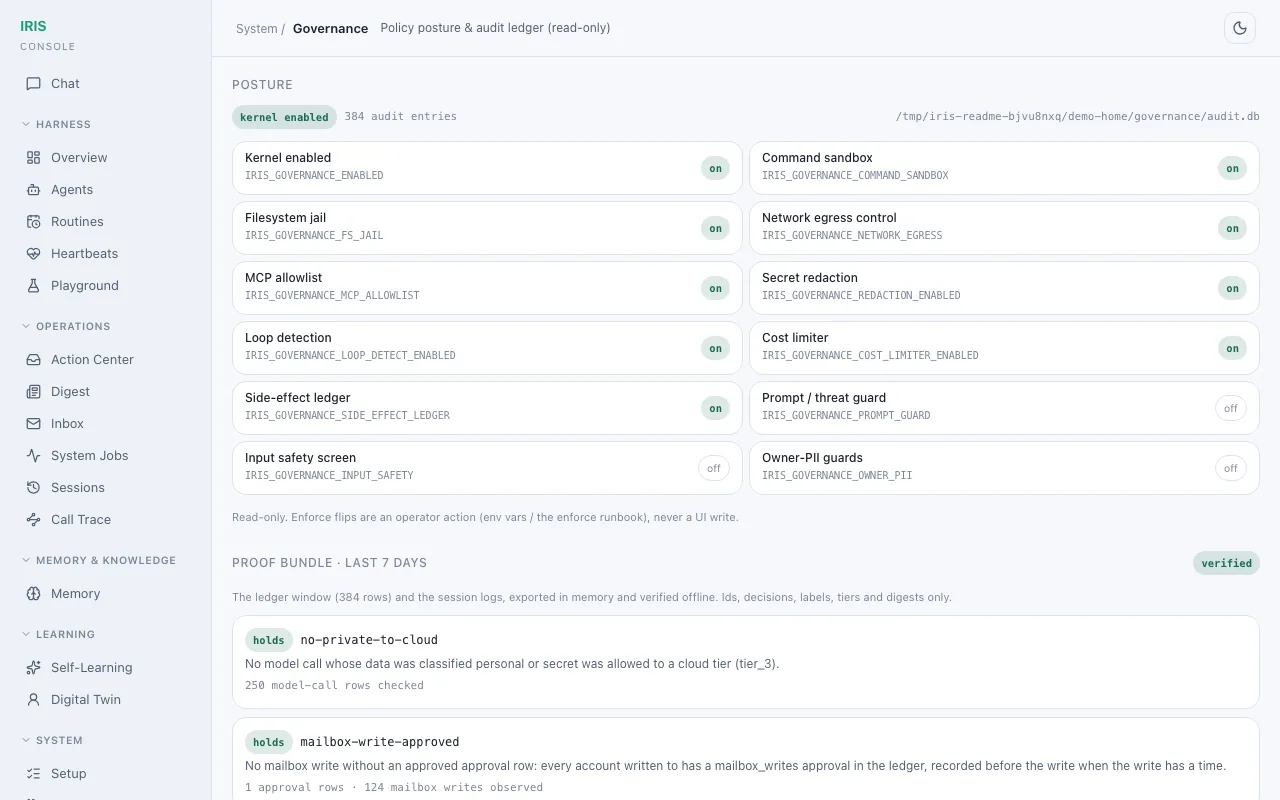
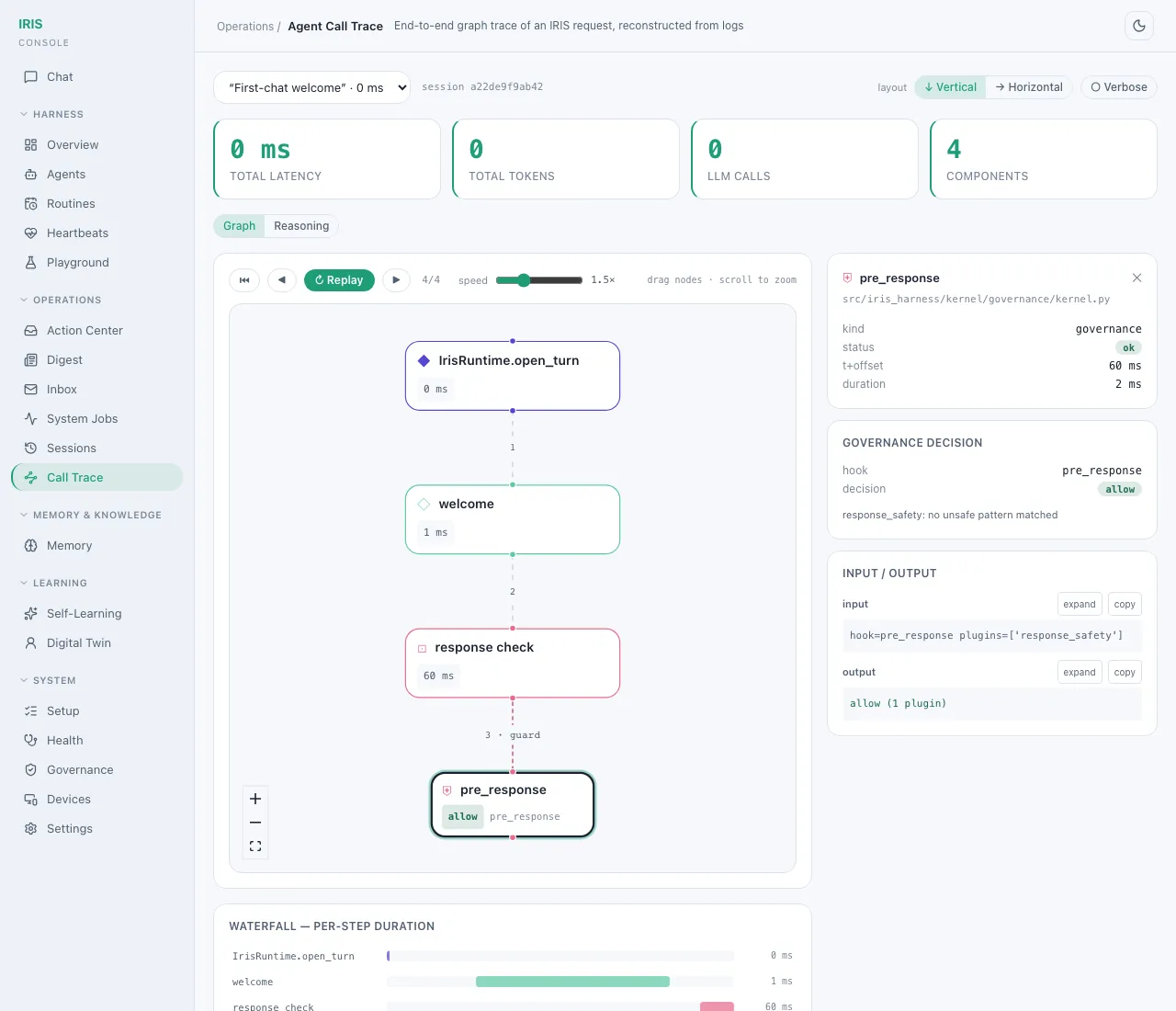
The web console shows the ledger. Governance has the kernel's posture and the proof bundle's
invariants, checked against the audit rows; Call trace has each turn as a graph, with the
governance decision at every hook. Both are from evarness email demo:
Build on it
A plugin is a package with a manifest.yaml and a setup(api). It can answer a turn with a
deterministic handler, add tools to the governed pool, run on a schedule and deliver to a
channel, extend the console and the API, feed memory and search, and reach out through the
governed HTTP client. Everything it registers lands on the same hooks the core uses.
evarness plugins new weather-now --kind tool   # or channel, mail-provider, research-provider, skill
cd weather-now && pip install -e ".[test]" && pytest
evarness.testing runs your plugin inside a real governed Evarness on a scripted model and
lets you assert on the audit ledger. Nine runnable examples, each tested in CI, are in
examples/; what a plugin may
import, and the deprecation rule that protects it, is the
stable API. Plugins can also
arrive as MCP servers, signed and verified before launch.
Where it is today (0.2.0)
- Learning proposes, it does not apply. Priors, crystallized skills and experiment variants are recorded and quarantined; each has a documented flag to turn application on.
- Brief and digest slots run their skill tools in-process: a redaction pass, but no per-call hook, approval check or audit row. Tracked in #199, help wanted.
- MCP launch signing defaults to shadow: every call is verified and the verdict is on
the ledger rows; nothing is blocked until you set
enforce. - The audit ledger is append-only, not tamper-evident. The hash chain is designed and deferred (#231).
- Outlook and Microsoft 365 are not supported over IMAP. iCloud, Fastmail, Yahoo and Gmail are. A provider over the Graph API is the first project on the help-wanted list.
- The MCP bridge is experimental and off by default. Known gaps in #111 to #114.
- Docker with the bundled CPU-only Ollama needs more than 8 GB for the 7B model, and
the lite set has not been tried inside Docker. Native Ollama with
make up-hostworks. - Evarness has one maintainer. Response times follow from that; contributions are how it changes.
Evarness runs on macOS (Apple Silicon) and Linux; on Windows, use Docker Desktop or WSL2. It collects no telemetry. It is pre-1.0: the stable API changes only after a deprecation cycle, and everything else may change in any release. Until 0.2.0 the project was called IRIS; the old package, environment variable and directory names keep working for one release and warn once (see the changelog). To run the scheduled jobs and the console as a service, see Run with Docker.
Contributing
Outside review is the contribution this project needs most. Run the demo from a clean machine and report friction. Try to find a path around the governance kernel; what counts is in SECURITY.md, which also says how to report it privately. Build a plugin outside this repository and say where the SDK gets in your way. Run it on hardware the maintainer does not have. Tell us which abstraction does not belong in the core. A well-reasoned challenge to an architectural decision is a contribution too; the reasons behind the design are in the decision log.
git clone https://github.com/evarness-ai/evarness.git && cd evarness
poetry install --with dev --extras email
poetry run evarness email demo           # the whole stack from source: no account, no model server
scripts/ci_local.sh --fast               # ruff, black, mypy, import contracts, the tests for what changed
CONTRIBUTING.md has the governance rules every change keeps, the DCO sign-off, the stable-tier rule and where help is wanted. Read the code of conduct. Coding agents: AGENTS.md. Questions and ideas go to Discussions; bugs to Issues. Changes are listed in CHANGELOG.md.
License
Apache License 2.0; see LICENSE. Evarness is, and will remain, Apache-2.0.
1 maintainer

Metadata
1 maintainer
Release files for evarness 0.2.2
For a detailed explanation of source distributions (sdists) and built distributions (wheels), please see the package formats documentation.
Source distribution (sdist)
| File | Size | Uploaded | Provenance | |
|---|---|---|---|---|
| evarness-0.2.2.tar.gz | 2.7 MB | Without provenance | Details |
Built distribution (wheel)
| File | Interpreter | ABI | Platform | Reset |
|---|---|---|---|---|
| evarness-0.2.2-py3-none-any.whl | Python 3 | none | any | Details |
Total release size: 5.9 MB
Release files / evarness-0.2.2.tar.gz
| Download URL | evarness-0.2.2.tar.gz |
|---|---|
| Size | 2.7 MB |
| Tags | Source |
|
SHA-256 checksum How to use checksums |
373e9a71ea9964c077019a9a98b7bd0f6fb7377006ea9f4dd7c9608aa2e92129
|
|
BLAKE2b-256 checksum How to use checksums |
7eddaf257589b795c3950dbe746e3be5635982b51036ecca0da38fd9ef2d9b7b
|
| Upload date | |
|
Uploaded using Trusted Publishing? What is trusted publishing? |
No |
| Uploaded via |
twine/6.2.0 CPython/3.14.0
|
Release files / evarness-0.2.2-py3-none-any.whl
| Download URL | evarness-0.2.2-py3-none-any.whl |
|---|---|
| Size | 3.2 MB |
| Tags | Python 3 |
|
SHA-256 checksum How to use checksums |
54222f800aa255154857e577c2d9bc76f63bb263f12aa66e6d68a4f12c6a2797
|
|
BLAKE2b-256 checksum How to use checksums |
f27c0ab3a1aa6ac0aad126b21d8b34a348d1aa19a15ca77e9db7484b60302443
|
| Upload date | |
|
Uploaded using Trusted Publishing? What is trusted publishing? |
No |
| Uploaded via |
twine/6.2.0 CPython/3.14.0
|
Security for evarness 0.2.2
Provenance
Provenance describes where a file came from. On PyPI, provenance is shared via attestations, which provide a verifiable record of the build or publishing details. View details, limitations and caveats.
No provenance found
None of the files in this release were uploaded with provenance metadata.
A note on package security
PyPI is a repository for distributing packages, not a service for auditing them. While third-party security researchers and our staff do their best to detect and remove malicious packages, PyPI cannot guarantee the quality, security or suitability of any given package.














