

Interpretable, composable embeddings for sequences of discrete events.




event2vec.com · Paper · Changelog · Issues
What it is
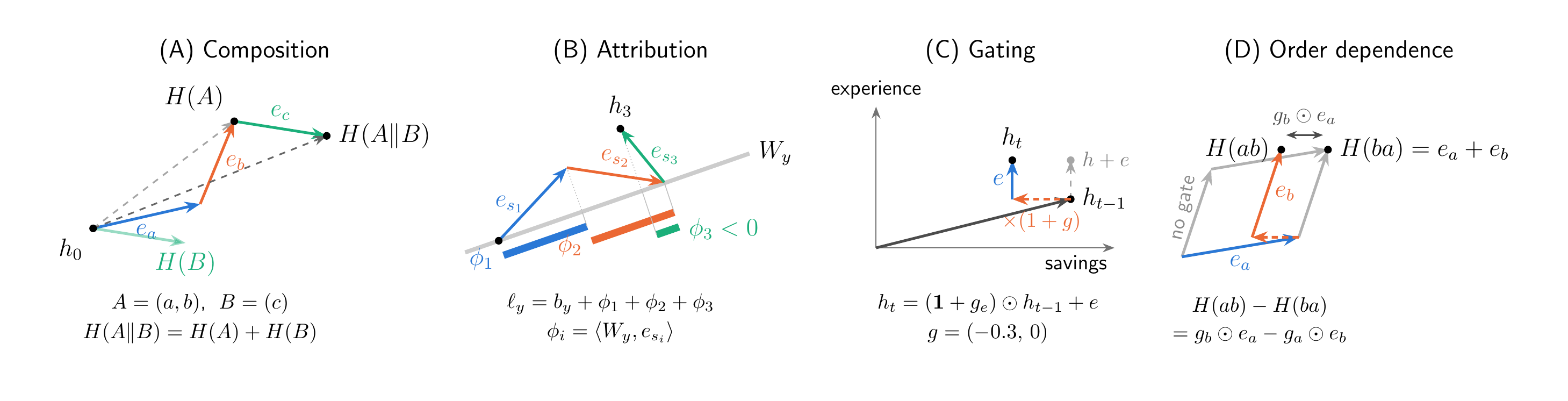
Event2Vector learns one vector per event type and represents a whole sequence as the composition of its events. In the default Euclidean geometry that composition is a plain sum, so a sequence's embedding is exactly the sum of its events' vectors. This makes the representation interpretable by construction:
- Decomposition: every coordinate of a sequence is attributable to the events in it.
- Composition: sub-sequences combine by vector arithmetic.
- Counterfactuals: removing an event from a sequence is one subtraction.
Other geometries (hyperbolic, spherical, rotation, Heisenberg, affine, product) keep this compositional structure while capturing hierarchy, cycles or order. All of them sit behind one scikit-learn-style estimator.
Installation
pip install event2vector
From source:
git clone https://github.com/sulcantonin/event2vec_public.git
cd event2vec_public
pip install .
Requires Python 3.9+ and PyTorch 1.13+.
Quickstart
Sequences are lists of integer event ids (0 … num_event_types - 1) and can have
different lengths.
import numpy as np
from event2vector import Event2Vec

vocab = ["start", "login", "search", "buy", "logout"]
sequences = [[0, 1, 2, 3, 4], [0, 1, 2, 2, 4], [0, 2, 3, 4], [0, 1, 4]] * 50

model = Event2Vec(
    num_event_types=len(vocab),
    embedding_dim=8,
    geometry="euclidean",
    pad_sequences=True,   # vectorized batches of variable-length sequences
    num_epochs=20,
    random_state=0,
)
model.fit(sequences)

embeddings = model.transform(sequences)          # (n_sequences, 8)

# A sequence is exactly the sum of its event vectors:
event_vectors = model.model.embedding.weight.detach().cpu().numpy()
assert np.allclose(embeddings[0], event_vectors[sequences[0]].sum(axis=0), atol=1e-5)

# gensim-style nearest events to an event or a whole sequence
print(model.most_similar(positive=3, topn=2))           # [(event_id, similarity), ...]
print(model.most_similar(positive=[[0, 1, 2]], topn=2))
How it works
A sequence is read one event at a time. The state starts at the identity and each
event updates it, h_t = h_{t-1} ⊕ e_t, where ⊕ is the geometry's composition
(vector addition in the Euclidean case). Training minimizes three terms at every
step:
| term | weight | what it enforces |
|---|---|---|
| next-event prediction | 1 | a linear decoder predicts event t+1 from h_t (cross-entropy) |
| reconstruction | lambda_reconstruction |
the step e_t can be recovered from h_{t-1} and h_t, so the update stays invertible |
| consistency | lambda_consistency |
two dropout passes over the same step agree |
There is no attention and no hidden nonlinearity in the state update, which is what keeps every embedding a readable composition of its events. See the paper for details.
Geometries
Choose the composition with geometry=. Every geometry uses the same estimator
and a generic left-cancellation reconstruction loss.
geometry |
update | best for |
|---|---|---|
euclidean |
vector addition | order-invariant bag of events, exact decomposition |
hyperbolic |
Möbius addition (curvature curvature > 0) |
hierarchical, tree-like structure |
stereographic |
κ-gyroaddition (signed kappa) |
one curvature dial: kappa < 0 hyperbolic, 0 Euclidean, > 0 spherical |
spherical |
κ-gyroaddition (kappa > 0) |
cyclic / periodic structure |
rotation |
left SO(n) product |
non-commutative orientation (order matters) |
heisenberg |
Heisenberg group product | order-dependent signed (Lévy) area |
affine |
x ↦ exp(M_e) x + v_e on the left |
events that act on the history (shrink, stretch, rotate it), not only add to it |
product |
per-factor update | two structure types at once, e.g. hyperbolic × spherical |
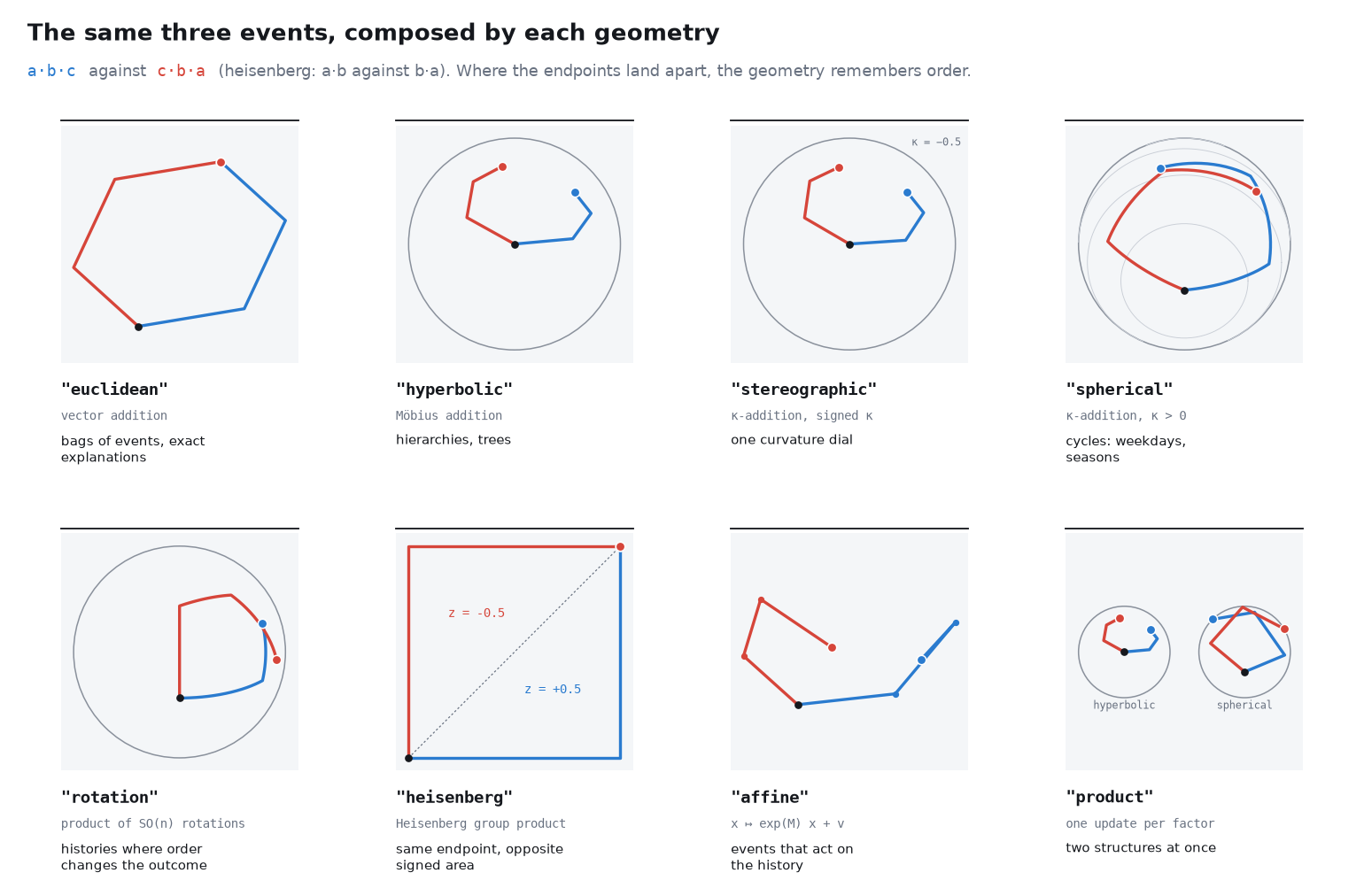
The same three events composed by each geometry, in order a·b·c (blue) and c·b·a
(red). The Euclidean sum ends in the same place either way; where the endpoints
separate, the geometry remembers order. Drawn by the library's own model classes
with python images/make_readme_figures.py.
Event2Vec(num_event_types=len(vocab), geometry="hyperbolic", curvature=1.0)
Event2Vec(num_event_types=len(vocab), geometry="stereographic", kappa=-1.0)
Event2Vec(num_event_types=len(vocab), geometry="rotation", rotation_n=3)
Event2Vec(num_event_types=len(vocab), geometry="product", product_kappas=(-1.0, 1.0))
Hyperbolic embeddings live in the Poincaré ball; use the matching operations on them:
from event2vector import HyperbolicUtils

hyp = Event2Vec(num_event_types=len(vocab), geometry="hyperbolic", curvature=1.0,
                pad_sequences=True, num_epochs=20).fit(sequences)
z = hyp.transform(sequences, as_numpy=False)
combined = HyperbolicUtils.mobius_add(z[0:1], z[1:2], hyp.curvature)
distance = HyperbolicUtils.poincare_dist_sq(z[0:1], z[1:2], hyp.curvature).sqrt()
Affine geometry
In the additive geometries an event always pushes the state the same way. With
geometry="affine" each event is an invertible affine map x ↦ exp(M_e) x + v_e,
so the same event contributes differently depending on what came before, while
the model remains a group:
- with every
M_e = 0(the initialization) the result is exactly the Euclidean sum, so training starts from the additive model; - every step is invertible, and the reconstruction loss recovers it exactly;
- any sub-sequence composes into a single affine map, so its effect on any
history is one
A x + v.
The state is the whole map [vec(A), b]; the point to plot is b, the image of the
origin. The singular values of a sub-sequence's A measure how strongly it
overrides what came before: 1 passes the history through, values below 1
erase it along that direction.
aff = Event2Vec(num_event_types=len(vocab), geometry="affine", embedding_dim=2,
                pad_sequences=True, num_epochs=20).fit(sequences)

states = aff.transform(sequences, as_numpy=False)   # [vec(A), b] per sequence
points = aff.model.point(states)                    # (n_sequences, 2), ready to plot

A, v = aff.model.compose([1, 2, 3])                 # one map for a sub-sequence
print(aff.model.override_strength([1, 2, 3]))       # its singular values
affine_readout="full" lets the decoder read A as well as b, and
affine_max_log_scale bounds how strongly a single event can stretch or shrink
the state.
API reference
Event2Vec parameters
| parameter | default | meaning |
|---|---|---|
num_event_types |
required | size of the event vocabulary |
embedding_dim |
64 |
dimension of the event vectors (the plotted point for affine) |
geometry |
"euclidean" |
see Geometries |
curvature |
1.0 |
curvature c > 0 for hyperbolic |
kappa |
None |
signed curvature for stereographic / spherical |
rotation_n |
3 |
n of SO(n) for rotation |
heisenberg_m |
1 |
the state is the (2m+1)-dimensional Heisenberg group |
affine_readout |
"point" |
"point" or "full": what the decoder reads for affine |
affine_max_log_scale |
None |
bound on how much one event can stretch the affine state |
product_kappas |
(-1.0, 1.0) |
one curvature per factor for product |
dropout_p |
0.2 |
dropout on each step's increment |
max_norm |
10.0 |
norm clipping of the Euclidean state |
lambda_reconstruction |
0.2 |
weight of the reconstruction loss |
lambda_consistency |
0.2 |
weight of the consistency loss |
learning_rate |
1e-3 |
AdamW learning rate |
batch_size |
32 |
sequences per batch |
num_epochs |
50 |
training epochs |
pad_sequences |
False |
vectorized padded batches (much faster on large corpora) |
use_gpu / device |
True / None |
automatic CUDA / MPS / CPU choice, or an explicit device |
random_state |
None |
seed for reproducible runs |
deterministic |
False |
request deterministic kernels |
riemannian |
False |
Riemannian Adam for hyperbolic (needs geoopt) |
Methods
| method | returns |
|---|---|
fit(sequences, epochs=None, verbose=False) |
the fitted estimator; per-epoch losses in training_loss_ |
transform(sequences, as_numpy=True) |
one state per sequence (NumPy array or tensor) |
fit_transform(sequences, ...) |
fit, then transform on the same sequences |
most_similar(positive, negative=None, topn=10) |
nearest event ids to events or whole sequences, with similarities |
The underlying PyTorch module is model.model (event vectors in
model.model.embedding.weight).
Devices
By default the estimator uses CUDA, then Apple MPS, then the CPU. On Apple
Silicon the rotation and affine geometries default to the CPU, because MPS has
no matrix_exp kernel and the CPU is faster for them; pass device="mps" to
override. Use use_gpu=False to force the CPU, or device="cuda:0" to pick a
device.
Datasets, metrics and baselines
The package ships domains with exact ground truth for the additive structure,
so interpretability can be measured rather than only visualized. Datasets live in
event2vector.datasets and return a uniform record (sequences,
processed_sequences, vocab, labels, graph):
make_decay(): radioactive decay chains; each event is an exact(ΔZ, ΔN), so additivity coincides with conservation laws (metric:operator_recovery).make_group(name): Cayley-graph walks on abelian and non-abelian groups; the additive endpoint provably equals the abelianization (metric:abelianization_gap).make_lifepath(),load_brown(): a controlled synthetic workbench and real part-of-speech sequences.load_gdelt(),load_sec_8k(),load_synthea(), …: real-world event streams (each needs a public data download; see the loader's docstring).
Metrics are in event2vector.metrics, a seeded evaluation harness in
event2vector.eval, and GRU / LSTM / Transformer / Word2Vec baselines in
event2vector.baselines.
Examples
A minimal end-to-end run (loss, embeddings, nearest events):
python3 examples/minimal_example.py
Part-of-speech sequences from the Brown corpus (the scripts need a few extra packages: NLTK for the corpus, t-SNE and Word2Vec for the comparison plots):
pip install "event2vector[viz,manifold,nlp]" nltk
python3 -m examples.prepare_brown_data
python3 -m examples.train_brown_data
python3 -m examples.visualize_brown_corpus
Applications:
Development
pip install -e . pytest
pytest tests/ -q
Changes are listed in CHANGELOG.md. Bug reports and questions are welcome in the issue tracker.
Citation
If you use Event2Vector, please cite the paper, published in the Proceedings of Machine Learning Research (vol. 282, NeurIPS Workshops on Symmetry and Geometry in Neural Representations):
@InProceedings{pmlr-v282-sulc26a,
  title     = {Event2Vec: A Geometric Approach to Learning Composable Representations of Event Sequences},
  author    = {Sulc, Antonin},
  booktitle = {Proceedings of the 4th (2025) and 3rd (2024) NeurIPS Workshops on Symmetry and Geometry in Neural Representations},
  pages     = {492--512},
  year      = {2026},
  editor    = {Acosta, Francisco and Azeglio, Simone and Tolooshams, Bahareh and van de Geijn, Chase and Shewmake, Christian and Sanborn, Sophia and Miolane, Nina},
  volume    = {282},
  series    = {Proceedings of Machine Learning Research},
  publisher = {PMLR},
  url       = {https://proceedings.mlr.press/v282/sulc26a.html}
}
A preprint is on arXiv:2509.12188.
To cite the software itself, use its Zenodo DOI
10.5281/zenodo.23399003, which always
resolves to the latest version (each release also has its own DOI). GitHub's
"Cite this repository" button reads the same metadata from CITATION.cff.
License
MIT. See the license badge above.
1 maintainer

Metadata
1 maintainer
Release files for event2vector 0.4.1
For a detailed explanation of source distributions (sdists) and built distributions (wheels), please see the package formats documentation.
Source distribution (sdist)
| File | Size | Uploaded | Provenance | |
|---|---|---|---|---|
| event2vector-0.4.1.tar.gz | 60.8 kB | Without provenance | Details |
Built distribution (wheel)
| File | Interpreter | ABI | Platform | Reset |
|---|---|---|---|---|
| event2vector-0.4.1-py3-none-any.whl | Python 3 | none | any | Details |
Total release size: 118.0 kB
Release files / event2vector-0.4.1.tar.gz
| Download URL | event2vector-0.4.1.tar.gz |
|---|---|
| Size | 60.8 kB |
| Tags | Source |
|
SHA-256 checksum How to use checksums |
cf2f130c5c5e13c5d023053c0e8d6937709174ce4bc40686eb51d831159a952c
|
|
BLAKE2b-256 checksum How to use checksums |
10c8e85033a503c40245976125c20c31e731150f6a5a5b647a26eb2387b50b5e
|
| Upload date | |
|
Uploaded using Trusted Publishing? What is trusted publishing? |
No |
| Uploaded via |
twine/7.0.0 CPython/3.12.14
|
Release files / event2vector-0.4.1-py3-none-any.whl
| Download URL | event2vector-0.4.1-py3-none-any.whl |
|---|---|
| Size | 57.2 kB |
| Tags | Python 3 |
|
SHA-256 checksum How to use checksums |
b1aeea3da7c90a7833abc2a155ef6c050b7b4019ed9f2c62f876042bfdd53601
|
|
BLAKE2b-256 checksum How to use checksums |
343d92a6b85920855e700ab09301c48fb98d4bfcf4ed4ab99384be60e05f3855
|
| Upload date | |
|
Uploaded using Trusted Publishing? What is trusted publishing? |
No |
| Uploaded via |
twine/7.0.0 CPython/3.12.14
|
Security for event2vector 0.4.1
Provenance
Provenance describes where a file came from. On PyPI, provenance is shared via attestations, which provide a verifiable record of the build or publishing details. View details, limitations and caveats.
No provenance found
None of the files in this release were uploaded with provenance metadata.
A note on package security
PyPI is a repository for distributing packages, not a service for auditing them. While third-party security researchers and our staff do their best to detect and remove malicious packages, PyPI cannot guarantee the quality, security or suitability of any given package.














