
When Attention Collapses
Code for the NeurIPS 2026 paper
When Attention Collapses: Residual Evidence Modeling for Compositional Inference
Niklas Houba. NeurIPS 2026. arXiv:2605.02323
Slot attention is effective at grouping tokens into objects, but it can struggle with additive
mixtures (audio, overlapping spectra, gravitational-wave data), where several sources contribute to
the same token: one strong source tends to capture several slots while the weaker ones are never
picked up. We call this slot
collapse. Evidence depletion is a small change to slot attention that counters it: slots are
processed one after another, each token keeps a scalar evidence e ∈ [ε, 1] that shrinks as slots
attend to it, and a γ log e term in the attention logits pushes later slots toward tokens that
have not been explained yet.
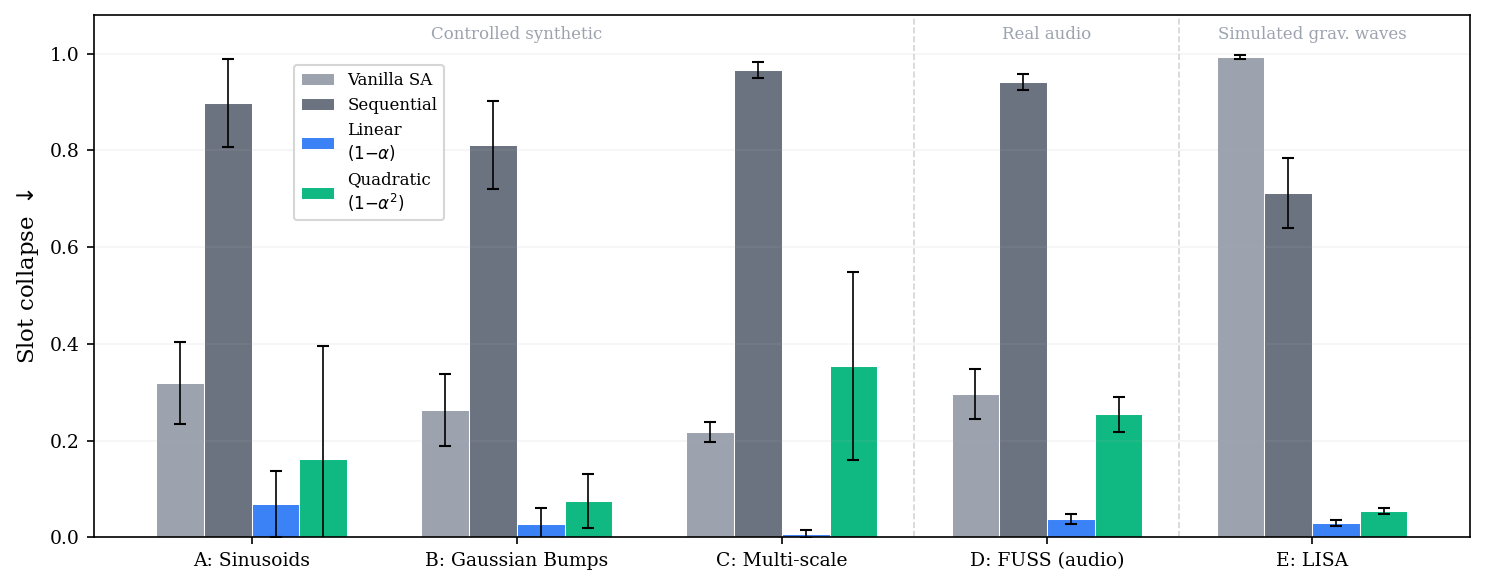
Fig. 1 of the paper: slot collapse (lower is better) for vanilla, sequential, and linear
and quadratic evidence-depletion attention. Peak overlap, except LISA (cosine overlap). This
repository covers the synthetic and FUSS groups.
This repository provides the evidence-depletion module, the baselines from the paper, and reproduction scripts for the synthetic and FUSS experiments. The LISA experiments use a separate simulation and training pipeline, described in Appendix A of the paper.
Installation
To use the module in your own code:
pip install evidence-depletion
To run the experiments, clone the repository and install it in editable mode:
git clone https://github.com/nhouba/when-attention-collapses.git
cd when-attention-collapses
python -m venv .venv && source .venv/bin/activate
pip install -e ".[plot]"        # or ".[dev,plot]" for tests and linting
This needs Python 3.10 or newer, PyTorch ≥ 2.1, NumPy and SciPy. requirements.txt has the exact
versions we tested with; those pins need Python 3.12 or newer, so on 3.10/3.11 just use
pip install -e .. Everything runs on a CPU. The synthetic models are small enough that they train
faster on a single CPU core than on a GPU; for the FUSS experiments a GPU is recommended.
Using the module
import torch
from evidence_depletion import EvidenceDepletionSlotAttention

attn = EvidenceDepletionSlotAttention(
    n_slots=5,
    d_model=64,
    n_iter=3,  # refinement iterations per slot
    gamma=3.0,  # weight of the log-evidence bias
    tau=0.3,  # attention temperature
    depletion="linear",  # "linear", "quadratic", "cubic" or "binary"
)
tokens = torch.randn(8, 16, 64)  # [batch, tokens, dim], e.g. encoder output
out = attn(tokens)
out.slots  # [B, S, D]
out.attn  # [B, S, L], each slot's attention over tokens
out.evidence  # list of S+1 tensors [B, L], evidence before and after each slot
In training mode the slot order is shuffled; in eval() mode slots run in a fixed order. slots
and attn are indexed by slot, evidence by processing step. Since the slot order carries no
meaning, train with a permutation-invariant loss. Hungarian matching is the usual choice (the paper's
LISA model uses it). The synthetic and FUSS benchmarks instead match sources to the top-K slots
greedily, both in the training loss and in the evaluation.
The default depletion="quadratic" is the form written in Eq. 6 and Algorithm 1 of the paper and
used for the LISA experiments, so the module matches the paper's reference formulation. For new
problems we recommend starting with "linear", which gave the lowest collapse on the synthetic and
FUSS benchmarks (App. J).
build_model(method, ...) builds the full model used in the benchmarks (tokenizer, slot attention,
parameter and existence heads) for every method in the paper: vanilla, sequential,
evidence_{linear,quadratic,cubic,binary}, dataspace_*, mesh, sa_sh, sparsemax, entmax15,
coverage, coverage_loss, stickbreaking and dspn.
examples/quickstart.py trains vanilla, sequential and evidence-depletion attention for a few
epochs on sinusoid mixtures and prints the collapse on held-out data. It runs in under a minute on
a laptop:
python examples/quickstart.py
Practical considerations
- The method helps when one source dominates. With equal or nearly equal amplitudes (ratio ≤ 1.5) it is not reliably better than vanilla slot attention (App. I).
- The temperature matters more than
gamma. Withtau = 0.3, collapse stayed low forgammain {1, 3, 10};tau = 1.0washes out the bias, andtau = 0.1is unstable unlessgammais large (App. E, sinusoids). - Slots run sequentially, so the critical path is O(S·I) instead of O(I). At S = 5 that was about 4× slower than vanilla attention on a GH200 (App. I).
Reproducing the paper
Run everything from the repository root. The script defaults are the paper settings (200 epochs,
5,000 training and 1,000 test mixtures). Results are appended to a JSON file in the output
directory, and runs that are already there are skipped; pass --no-resume to rerun them.
We don't ship trained models. A synthetic model takes a few minutes to train on a CPU and a FUSS
model about an hour on a GPU, and the per-seed numbers behind the paper are in results/paper/.
To check your setup, run
bash scripts/reproduce/quick_check.sh
It trains on sinusoids with a reduced budget (40 epochs, 3 seeds) and takes 5–7 minutes on a laptop CPU. Our run gave a peak overlap of 0.38 for vanilla and 0.15 for evidence depletion. Exact values depend on hardware and PyTorch version, so the script only checks that evidence depletion is below half of vanilla.
The full reproduction is split by paper artifact. GPU-hours are for one NVIDIA GH200 running jobs one after another. The synthetic runs are so small that a GPU spends most of its time on kernel launches (20–30 min per 200-epoch run, against 3–6 min on one CPU core), so running many CPU jobs in parallel is the fastest option.
| Paper artifact | Script | GH200 GPU-h (serial) |
|---|---|---|
| Fig. 1 and Table 1 (synthetic), App. F, App. G, data-space variants | scripts/reproduce/fig1_table1_synthetic.sh |
~52 |
| Table 2: alternative mechanisms and matching pursuit | scripts/reproduce/table2_alternatives.sh |
~50 |
| App. E: sensitivity to γ and τ | scripts/reproduce/app_e_sensitivity.sh |
~13 |
| App. H: loss-based baselines | scripts/reproduce/app_h_loss_baselines.sh |
~38 |
| App. I: amplitude ratio, slot and token counts, slot order, latency | scripts/reproduce/app_i_stress.sh |
~87 |
| FUSS: Table 1 and Table 8 columns, Table 13, App. J | scripts/reproduce/fuss.sh |
~25 |
| All of the above | scripts/reproduce/all.sh |
~265 |
docs/reproduce.md gives the command behind every number in the paper, how seeds are aggregated
(mean ± population std), the expected values, and the few places where the released code and the
reported numbers differ. scripts/make_tables.py turns finished runs into the paper's tables:
python scripts/make_tables.py results/runs
For FUSS, bash experiments/download_fuss.sh downloads the dataset (Zenodo record 3743844,
CC BY 4.0) to data/fuss/ssdata, which is the default --fuss-dir of experiments/fuss.py.
Results
The core comparison from Table 1: peak overlap (Definition 1), mean ± std over 5 seeds, lower is
better. Numbering follows the camera-ready version of the paper; the FUSS column differs slightly
from arXiv v1 (see docs/reproduce.md, Sec. 15).
| Method | Sinusoids | Gaussians | Multi-scale | FUSS |
|---|---|---|---|---|
| Vanilla slot attention | 0.32 ± 0.09 | 0.26 ± 0.07 | 0.22 ± 0.02 | 0.30 ± 0.05 |
| Sequential slot attention | 0.90 ± 0.09 | 0.81 ± 0.09 | 0.97 ± 0.02 | 0.94 ± 0.02 |
| Evidence depletion (linear) | 0.07 ± 0.07 | 0.03 ± 0.03 | 0.01 ± 0.01 | 0.04 ± 0.01 |
Comparisons with the alternative attention mechanisms and the loss-based baselines are in Table 2
and Appendix H of the paper and in docs/reproduce.md; results/paper/ has all reported numbers.
Peak overlap measures how attention is allocated rather than how accurately sources are recovered.
The paper also evaluates parameter recovery and, on FUSS, source separation (App. J); the scripts
for these are listed in docs/reproduce.md.
Layout
src/evidence_depletion/
  attention.py      evidence-depletion slot attention
  baselines.py      vanilla, sequential and the alternative mechanisms
  models.py         tokenizers, heads, build_model
  metrics.py        collapse metrics and parameter recovery
  training.py       training and evaluation loops
  separation.py     attention-to-mask readout and SI-SDR (App. J)
  data/             synthetic generators and the FUSS loader
experiments/        command-line scripts for each experiment (App. D checks in app_d/)
scripts/            reproduction scripts and table generation
results/paper/      the paper's numbers, per seed where available
examples/           quickstart
tests/
Tests
pip install -e ".[dev,plot]"
pytest
This takes about a minute on a CPU. The tests cover output shapes for every method, the evidence
staying in [ε, 1] and never increasing (Proposition 2), each depletion form, permutation
equivariance over tokens, and a one-epoch run of every experiment script. There are also 133 tests
that compare this code against the original research code and check that both give bit-identical
results (for every method except SA-SH, which we reimplemented). They need the research code,
which is not distributed, and are skipped unless ED_REFERENCE_CODE points to it.
Citation
@inproceedings{houba2026attention,
  title         = {When Attention Collapses: Residual Evidence Modeling for Compositional Inference},
  author        = {Houba, Niklas},
  booktitle     = {Advances in Neural Information Processing Systems},
  year          = {2026},
  eprint        = {2605.02323},
  archivePrefix = {arXiv}
}
License
MIT, see LICENSE. FUSS is distributed by its authors under CC BY 4.0.
This work was funded by the Gravitational Physics Professorship at ETH Zurich.
1 maintainer

Metadata
1 maintainer
Release files for evidence-depletion 1.0.0
For a detailed explanation of source distributions (sdists) and built distributions (wheels), please see the package formats documentation.
Source distribution (sdist)
| File | Size | Uploaded | |
|---|---|---|---|
| evidence_depletion-1.0.0.tar.gz | 49.5 kB | Details |
Built distribution (wheel)
| File | Interpreter | ABI | Platform | Reset |
|---|---|---|---|---|
| evidence_depletion-1.0.0-py3-none-any.whl | Python 3 | none | any | Details |
Total release size: 89.7 kB
Release files / evidence_depletion-1.0.0.tar.gz
| Download URL | evidence_depletion-1.0.0.tar.gz |
|---|---|
| Size | 49.5 kB |
| Tags | Source |
|
SHA-256 checksum How to use checksums |
3a4f7559570a4b9ad2a94a85821ee7058b924fe76d29f29be819a8f9467dbf69
|
|
BLAKE2b-256 checksum How to use checksums |
9be350480a0d9258e4ac8c8e0d55ba02e46d11782872d8355bf5dd582e23ff85
|
| Upload date | |
|
Uploaded using Trusted Publishing? What is trusted publishing? |
Yes |
| Uploaded via |
twine/7.0.0 CPython/3.13.14
|
Provenance
Provenance describes where a file came from. On PyPI, provenance is shared via attestations, which provide a verifiable record of the build or publishing details. View details, limitations and caveats.


PyPI Publish Attestation
PyPI verified that this artifact, at this checksum, originated from the publisher listed below.
Signed by GitHub Actions, verified by PyPI on Oct 16, 2026.
Transparency logRelease files / evidence_depletion-1.0.0-py3-none-any.whl
| Download URL | evidence_depletion-1.0.0-py3-none-any.whl |
|---|---|
| Size | 40.2 kB |
| Tags | Python 3 |
|
SHA-256 checksum How to use checksums |
201b2fbd484c96d35938a96e6e0d0690c66a9c5719dc34496d9e5daf68a00131
|
|
BLAKE2b-256 checksum How to use checksums |
a5f3ff8939e8325c90a1f4fdc0bf88ea89074e3c72fcf86bfb4678f46d2012a1
|
| Upload date | |
|
Uploaded using Trusted Publishing? What is trusted publishing? |
Yes |
| Uploaded via |
twine/7.0.0 CPython/3.13.14
|
Provenance
Provenance describes where a file came from. On PyPI, provenance is shared via attestations, which provide a verifiable record of the build or publishing details. View details, limitations and caveats.
PyPI Publish Attestation
PyPI verified that this artifact, at this checksum, originated from the publisher listed below.
Signed by GitHub Actions, verified by PyPI on Oct 16, 2026.
Transparency log












