

Ex-Fuzzy
🚀 A modern, explainable fuzzy logic library for Python







🎯 Overview
Ex-Fuzzy is a comprehensive Python library for explainable artificial intelligence through fuzzy logic programming. Built with a focus on accessibility and visualization, it enables researchers and practitioners to create interpretable machine learning models using fuzzy association rules.
Why Ex-Fuzzy?
- 🔍 Explainable AI: Create interpretable models that humans can understand. Support for classification and regression problems.
- 📊 Rich Visualizations: Beautiful plots and graphs for fuzzy sets and rules.
- 🛠️ Scikit-learn Compatible: Familiar API for machine learning practitioners.
- 🚀 High Performance: Optimized algorithms with optional GPU support using Evox (https://github.com/EMI-Group/evox).
✨ Features
Explainable Rule-Based Learning
- Fuzzy Association Rules: For both classification and regression problems with genetic fine-tuning.
- FERL Rule Trees: Greedy fuzzy rule learning with native belief, plausibility, ignorance, and set-valued predictions.
- Out-of-the-box Results: Complete compatibility with scikit-learn, minimal to none fuzzy knowledge required to obtain good results.
- Complete Complexity Control: Number of rules, rule length, linguistic variables, etc. can be specified by the user with strong and soft constrains.
- Statistical Analysis of Results: Confidence intervals for all rule quality metrics, repeated experiments for rule robustness.
- Conformal Predictions Supported Out-of-the-box: Use Rule classifiers with conformal guarantees to obtain more reliable classification/regression.
Complete Rule Base Visualization and Validation
- Comprehensive Plots: Visualize fuzzy sets and rules.
- Robustness Metrics: Compute validation of rules, ensure linguistic meaning of fuzzy partitions, robustness metrics for rules and space partitions, reproducible experiments, etc.
Advanced Learning Routines
- Multiple Backend Support: Choose between PyMoo (CPU) and EvoX (GPU-accelerated) backends for evolutionary optimization.
- Genetic Algorithms: Rule base optimization supports fine-tuning of different hyperparameters, like tournament size, crossover rate, etc.
- GPU Genetic Acceleration: EvoX backend with PyTorch provides significant speedups for large datasets and complex rule bases.
- Extensible Architecture: Easy to extend with custom components.
Complete Fuzzy Logic Systems Support
- Multiple Fuzzy Set Types: Classic, Interval-Valued Type-2, and General Type-2 fuzzy sets
- Linguistic Variables: Automatic generation with quantile-based optimization.
🚀 Quick Start
Installation
Install Ex-Fuzzy using pip:
# Basic installation (CPU only, PyMoo backend)
pip install ex-fuzzy

# With GPU support (EvoX backend with PyTorch)
pip install "ex-fuzzy[evox]"
Basic Usage
from ex_fuzzy import BaseFuzzyRulesClassifier
from sklearn.datasets import load_iris
from sklearn.model_selection import train_test_split

# Load data
X, y = load_iris(return_X_y=True)
X_train, X_test, y_train, y_test = train_test_split(X, y, test_size=0.3, random_state=42)

# Create and train fuzzy classifier
classifier = BaseFuzzyRulesClassifier(
    nRules=15,
    nAnts=4,
    backend="pymoo"  # or "evox" for GPU acceleration
)

# Train the model
classifier.fit(X_train, y_train)

# Make predictions
predictions = classifier.predict(X_test)

# Evaluate and visualize fuzzy partitions
from ex_fuzzy.eval_tools import eval_fuzzy_model
eval_fuzzy_model(classifier, X_train, y_train, X_test, y_test,
                plot_partitions=True)
FERL Evidential Classification
FERL learns a fuzzy rule tree and derives Dempster--Shafer evidence directly
from rule firing strengths. It is implemented natively in Ex-Fuzzy and needs no
separate fuzzy-tree package.
from ex_fuzzy import FERL

ferl = FERL(max_rules=15, random_state=0)
ferl.fit(X_train, y_train)

predictions = ferl.predict(X_test)
betp, belief, plausibility, ignorance = ferl.predict_credal(X_test)
prediction_sets = ferl.predict_set(X_test)
ferl.print_tree()
Use split_mode="learned" for data-driven soft split locations or
partition="mdlp" for supervised trapezoidal partitions. Native FERL sets are
calibration-free evidential outputs; use ConformalFuzzyClassifier when a
finite-sample marginal coverage guarantee is required.
For higher accuracy with the same evidential outputs, DeepFERL grows a deep
tree of learned, Gini-placed soft splits and votes over its leaves.
Regression Usage
BaseFuzzyRulesRegressor learns interpretable Type-1 rules for continuous
targets. It supports crisp Takagi-Sugeno consequents and fuzzy Mamdani
consequents.
from ex_fuzzy import BaseFuzzyRulesRegressor
from sklearn.datasets import make_regression
from sklearn.model_selection import train_test_split

X, y = make_regression(n_samples=500, n_features=5, noise=5.0, random_state=0)
X_train, X_test, y_train, y_test = train_test_split(
    X, y, test_size=0.25, random_state=0
)

regressor = BaseFuzzyRulesRegressor(
    nRules=20,
    nAnts=3,
    consequent_type="crisp",  # use "fuzzy" for Mamdani consequents
    backend="pymoo",
)
regressor.fit(X_train, y_train, n_gen=50, pop_size=50)

predictions = regressor.predict(X_test)
print(f"Test R2: {regressor.score(X_test, y_test):.3f}")
regressor.print_rules()
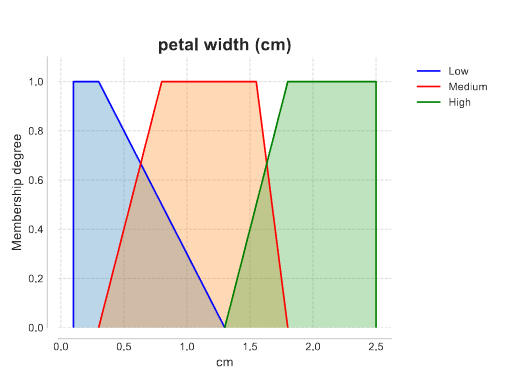
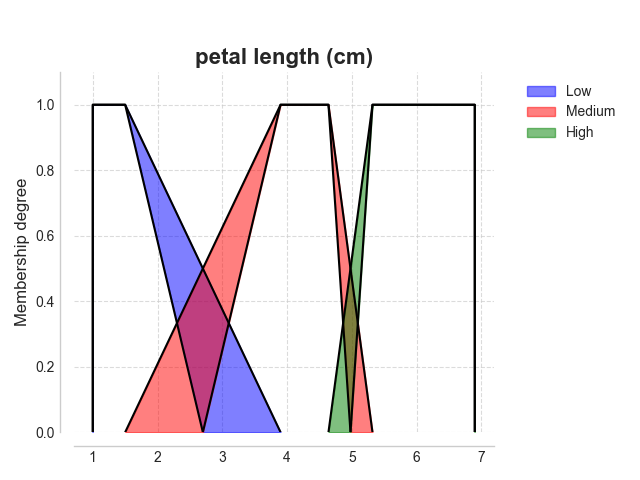
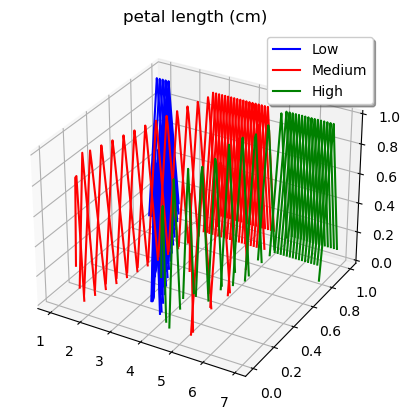
📊 Visualizations
Ex-Fuzzy provides beautiful visualizations to understand your fuzzy models:
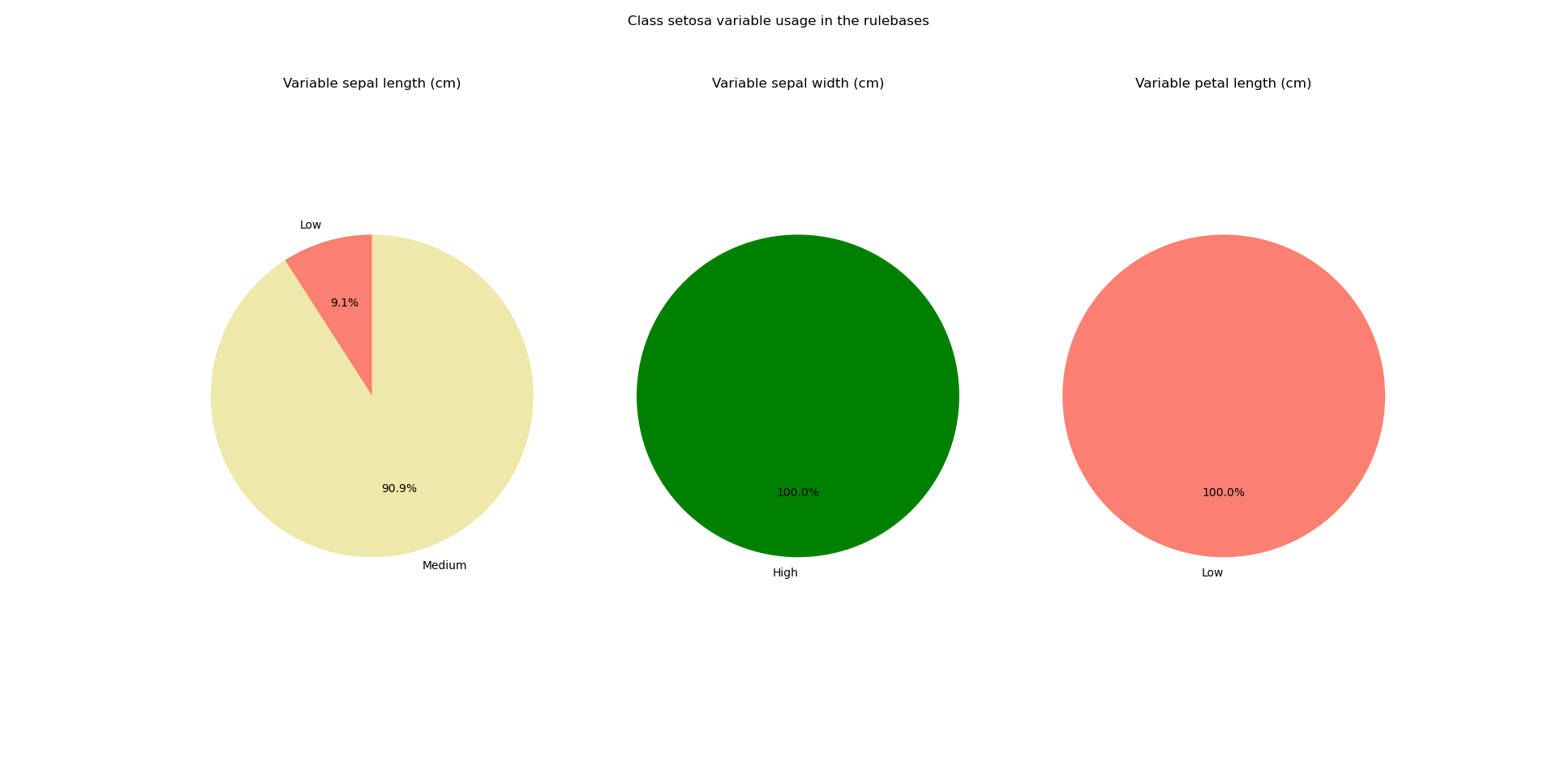
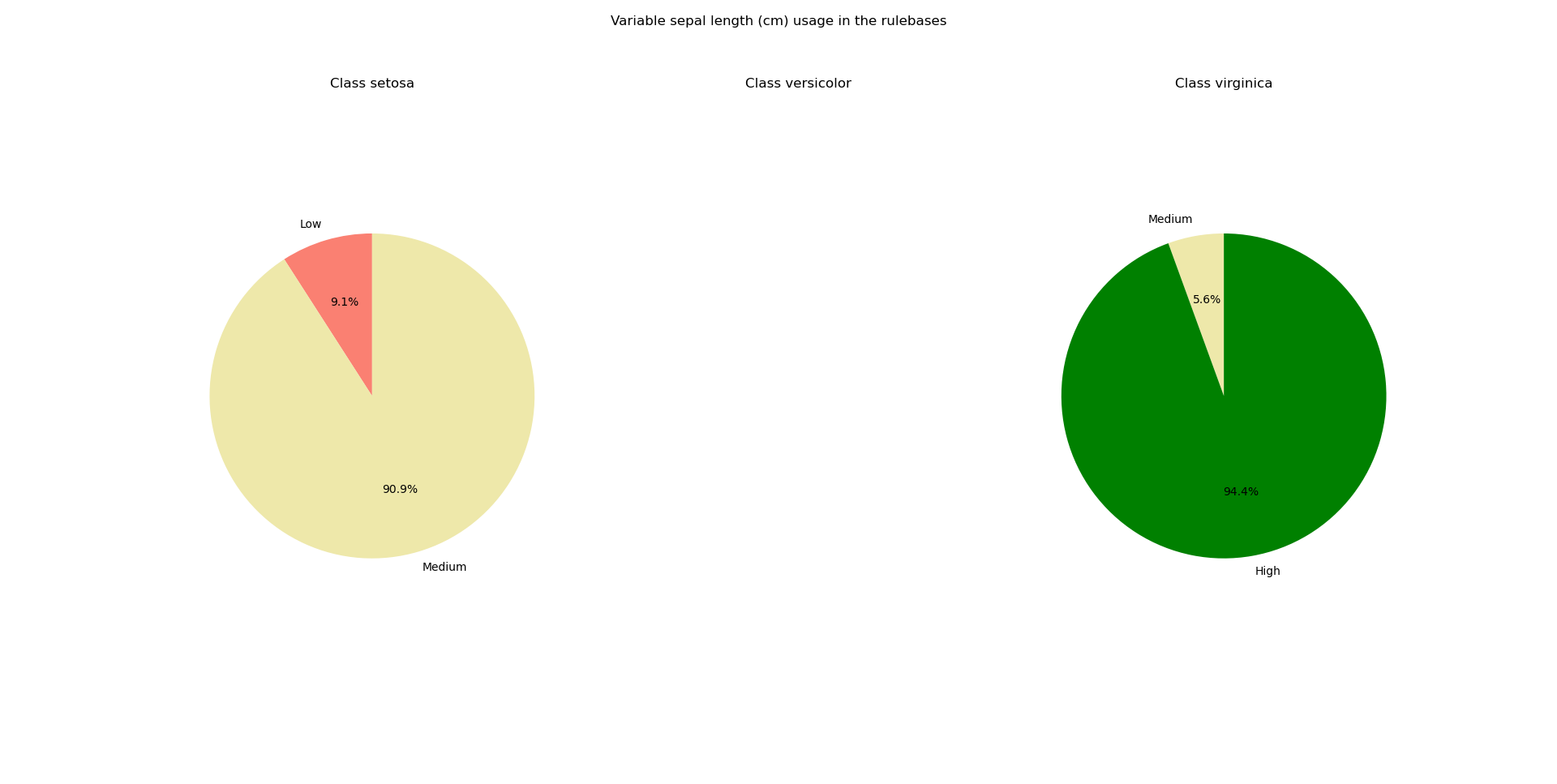
📈 Statistical Analysis
Monitor pattern stability and variable usage across multiple runs:
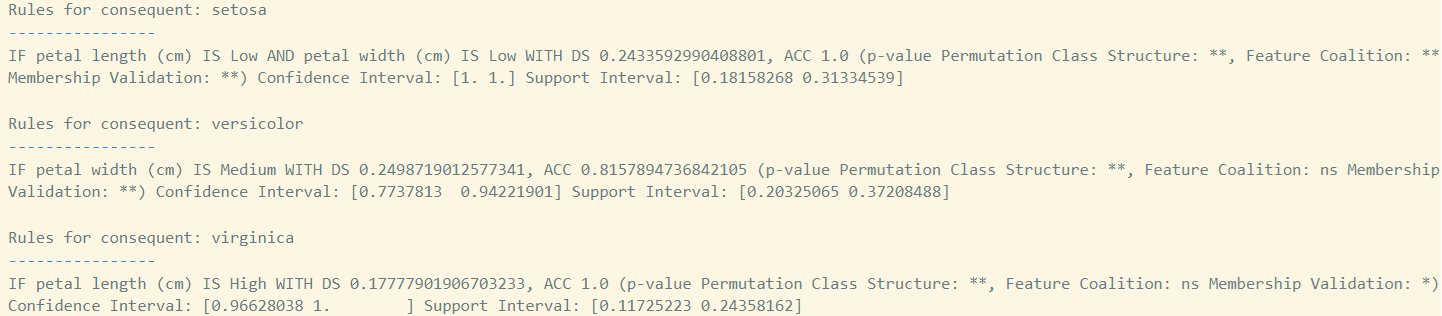
🎯 Bootstrap Confidence Intervals
Obtain statistical confidence intervals for your metrics:
⚡ Performance
Accuracy and model size on 67 KEEL datasets

Ex-Fuzzy 2.0 vs Ex-Fuzzy 3.0 training speed

Our implementation is getting more efficient! This experiment crosses 1,000 / 10,000 / 100,000 samples with 10 / 50 / 200 features, for both fixed and optimized partitions. All of them using CPU backend.
EvoX GPU acceleration
A three-seed benchmark compared identical EvoX CPU and CUDA searches on 100,000 samples and 200 features (Type-1, 20 rules, 4 antecedents, population 40 and 5 generations):

Backend Comparison
Ex-Fuzzy supports two evolutionary optimization backends:
| Backend | Hardware | Best For |
|---|---|---|
| PyMoo | CPU | Classification/regression on small datasets, checkpoint support |
| EvoX | GPU/CPU | Batched classification/regression on large datasets |
When to Use Each Backend
Use PyMoo when:
- Working with small to medium datasets
- Running on CPU-only environments
- Need checkpoint/resume functionality
- Memory is limited
Use EvoX when:
- Have GPU available (CUDA recommended)
- Working with large datasets (>10,000 samples)
- No checkpointing (Evox does not support checkpointing yet)
Both backends automatically batch operations to fit available memory and large datasets are processed in chunks to prevent out-of-memory errors.
🛠️ Examples
🔬 Interactive Jupyter Notebooks
Try our hands-on examples in Google Colab:
| Topic | Description | Colab Link |
|---|---|---|
| Basic Classification | Introduction to fuzzy classification |  |
| Custom Loss Functions | Advanced optimization techniques | |
| Rule File Loading | Working with text-based rule files | |
| Advanced Rules | Using pre-computed rule populations | |
| Temporal Fuzzy Sets | Time-aware fuzzy reasoning | |
| Rule Mining | Automatic rule discovery | |
| Fuzzy Regression | Interpretable continuous prediction | 📓 Notebook |
| EvoX Backend | GPU-accelerated training with EvoX | 🐍 Script |
| Conformal Learning | Set-valued predictions with calibrated coverage | 📓 Notebook |
| FERL | Evidential fuzzy rule-tree classification | 🐍 Script |
Real Applications
- Ex-Fuzzy in fNIRS data: https://github.com/jjcato9/ex_fuzzy_fnirs_demo
💻 Code Examples
📊 Fuzzy Partition Visualization
# Plot fuzzy variable partitions
classifier.plot_fuzzy_variables()
🚀 GPU-Accelerated Training (EvoX Backend)
from ex_fuzzy import BaseFuzzyRulesClassifier, BaseFuzzyRulesRegressor

# Create classifier with EvoX backend for GPU acceleration
classifier = BaseFuzzyRulesClassifier(
    nRules=30,
    nAnts=4,
    backend='evox',  # Use GPU-accelerated EvoX backend
    verbose=True
)

# Train with GPU acceleration
classifier.fit(X_train, y_train,
              n_gen=50,
              pop_size=100)

# Early stopping is enabled by default:
# patience=10, min_delta=1e-4

# Regression uses the same EvoX backend. Both crisp and fuzzy
# consequents are evaluated in memory-aware PyTorch batches.
regressor = BaseFuzzyRulesRegressor(
    nRules=30,
    nAnts=4,
    consequent_type="crisp",
    backend="evox",
)
regressor.fit(X_reg_train, y_reg_train, n_gen=50, pop_size=100)

# CUDA is selected automatically when available; otherwise EvoX uses CPU.
print(regressor.optimization_device_)  # "cuda" or "cpu"
print(regressor.gpu_accelerated_)      # True only when CUDA was used
🧪 Bootstrap Analysis
from ex_fuzzy.bootstrapping_test import generate_bootstrap_samples

# Generate bootstrap samples
bootstrap_samples = generate_bootstrap_samples(X_train, y_train, n_samples=100)

# Evaluate model stability
bootstrap_results = []
for X_boot, y_boot in bootstrap_samples:
    classifier_boot = BaseFuzzyRulesClassifier(nRules=10)
    classifier_boot.fit(X_boot, y_boot)
    accuracy = classifier_boot.score(X_test, y_test)
    bootstrap_results.append(accuracy)

print(f"Bootstrap confidence interval: {np.percentile(bootstrap_results, [2.5, 97.5])}")
📚 Documentation
- 📖 User Guide: Comprehensive tutorials and examples
- 🔧 API Reference: Detailed function and class documentation
- 🚀 Quick Start Guide: Get up and running fast
- 📊 Examples Gallery: Real-world use cases
🛡️ Requirements
Core Dependencies
- Python >= 3.7
- NumPy >= 1.19.0
- Pandas >= 1.2.0
- Matplotlib >= 3.3.0
- PyMOO >= 0.6.0
Optional Dependencies
- EvoX >= 1.3.0 (for GPU-accelerated evolutionary optimization)
- PyTorch >= 2.6.0 (required by EvoX)
- Scikit-learn >= 0.24.0 (for compatibility examples)
🤝 Contributing
We welcome contributions from the community! Here's how you can help:
Bug Reports
Found a bug? Please open an issue with:
- Clear description of the problem
- Steps to reproduce
- Expected vs actual behavior
- System information
Feature Requests
Have an idea? Submit a feature request with:
- Clear use case description
- Proposed API design
- Implementation considerations
💻 Code Contributions
- Fork the repository
- Create a feature branch:
git checkout -b feature-name - Make your changes with tests
- Run the test suite:
pytest tests/ -v - Submit a pull request
🧪 Running Tests
# Install test dependencies
pip install pytest pytest-cov

# Run all tests
pytest tests/ -v

# Run tests with coverage report
pytest tests/ --cov=ex_fuzzy --cov-report=html

# Run specific test file
pytest tests/test_fuzzy_sets_comprehensive.py -v
📄 License
This project is licensed under the AGPL v3 License - see the LICENSE file for details.
📑 Citation
If you use Ex-Fuzzy in your research, please cite our paper:
@article{fumanalex2024,
  title = {Ex-Fuzzy: A library for symbolic explainable AI through fuzzy logic programming},
  journal = {Neurocomputing},
  pages = {128048},
  year = {2024},
  issn = {0925-2312},
  doi = {10.1016/j.neucom.2024.128048},
  url = {https://www.sciencedirect.com/science/article/pii/S0925231224008191},
  author = {Javier Fumanal-Idocin and Javier Andreu-Perez}
}
👥 Main Authors
- Javier Fumanal-Idocin - Lead Developer
- Javier Andreu-Perez - Development manager & Licensing officer
🌟 Acknowledgments
- Special thanks to all contributors
- This research has been supported by EU Horizon Europe under the Marie Skłodowska-Curie COFUND grant No 101081327 YUFE4Postdocs.
⭐ Star us on GitHub if you find Ex-Fuzzy useful!

1 maintainer

Metadata
1 maintainer
Release files for ex-fuzzy 3.1.0
For a detailed explanation of source distributions (sdists) and built distributions (wheels), please see the package formats documentation.
Source distribution (sdist)
| File | Size | Uploaded | |
|---|---|---|---|
| ex_fuzzy-3.1.0.tar.gz | 339.7 kB | Details |
Built distribution (wheel)
| File | Interpreter | ABI | Platform | Reset |
|---|---|---|---|---|
| ex_fuzzy-3.1.0-py3-none-any.whl | Python 3 | none | any | Details |
Total release size: 568.2 kB
Release files / ex_fuzzy-3.1.0.tar.gz
| Download URL | ex_fuzzy-3.1.0.tar.gz |
|---|---|
| Size | 339.7 kB |
| Tags | Source |
|
SHA-256 checksum How to use checksums |
6e91b94114758f5fa2b7966bd905d036c3bd8633c5e2b49d6ce7dddbc5c2ce89
|
|
BLAKE2b-256 checksum How to use checksums |
db3cc118a499ea2c82913c287f7328c757fb09e29c3c5fe19b19d288dd512f7d
|
| Upload date | |
|
Uploaded using Trusted Publishing? What is trusted publishing? |
No |
| Uploaded via |
twine/7.0.0 CPython/3.12.3
|
Release files / ex_fuzzy-3.1.0-py3-none-any.whl
| Download URL | ex_fuzzy-3.1.0-py3-none-any.whl |
|---|---|
| Size | 228.5 kB |
| Tags | Python 3 |
|
SHA-256 checksum How to use checksums |
4ccccbdc73f43ab49475976ed3e614bd39dac8408019ccfc5dde4c8f6f7586d9
|
|
BLAKE2b-256 checksum How to use checksums |
06737212a5304cd0b581c667da4219602fb4d5694dbb6564bf74e7570be11fdf
|
| Upload date | |
|
Uploaded using Trusted Publishing? What is trusted publishing? |
No |
| Uploaded via |
twine/7.0.0 CPython/3.12.3
|














