


What is Exoma?
Exoma is a library that supports problem solving by AI agents through context management, exploration, tool use, work delegation, and evidence gathering.
It starts from the idea that how well an AI solves a problem is not decided by the model alone, but also by how information is provided, how work is organized, and how the results of an investigation are evaluated.
A person who hands a problem to an AI should not have to prescribe every step, or steer it toward a conclusion they already had in mind. The person sets the goal, the initial context, and the constraints; the AI then uses the capabilities and resources available to it to investigate the problem, weigh the possibilities, and reach a solution grounded in evidence.
Exoma supports that process as an external system that organizes the flow of context, work, and information between an AI agent and the resources it uses.
Core philosophy
People define the problem, not the answer to be found.
An AI is not only expected to produce the answer a person asked for. It also needs room to check assumptions, weigh alternatives, find what was not yet known, and reach a conclusion that may differ from what whoever assigned the task expected.
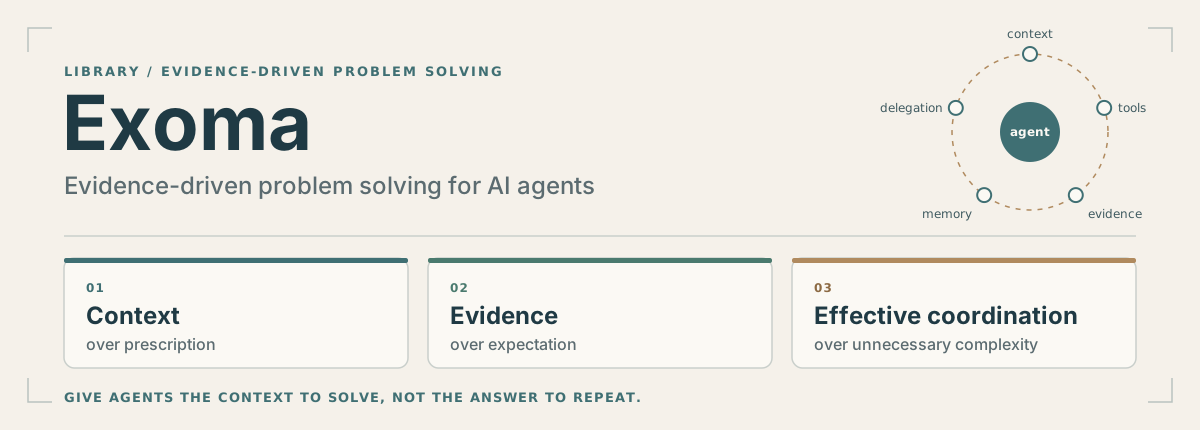
Exoma focuses on three principles:
- Context over prescription. Provide the relevant context and resources so the AI can investigate the problem, rather than over-specifying the steps and conclusions it must follow.
- Evidence over expectation. Favor problem solving grounded in evidence and evaluation, not in confirming a person's assumptions.
- Effective coordination over unnecessary complexity. Organize agents, tools, and compute by what the task needs, without assuming that more agents or more process always produce better quality.
These principles are a design direction to be realized and evaluated through the implementation, not a guarantee that any AI agent will always be objective or correct.
How Exoma works
Technically, Exoma is a supporting layer around an AI agent. Depending on the need and the implementation, it can manage context retrieval, delegate exploration to another agent, gather evidence from external sources, retain relevant information, and control the flow of execution.
The AI agent still does the semantic reasoning and makes the decisions its role calls for. Exoma organizes the processes and resources that support that work. The aim is not to replace the model or to make the whole process fully automatic; it is to let the AI complete a task more effectively without a person directing every step or conclusion.
The current implementation targets coding agents, with Claude Code as the primary agent.
It is installed as a Python package (pip install exoma) with a CLI (exoma), and separates
work that needs broad repository inspection from work that needs the primary agent's
reasoning and implementation context. A coding agent on a mature repository spends much of
its effort locating modules, tracing call sites, and reading conventions before it changes
anything; Exoma moves that inspection into a separate execution context and returns
structured evidence: a digest, file:line anchors, and a reference to the full evidence on
disk.
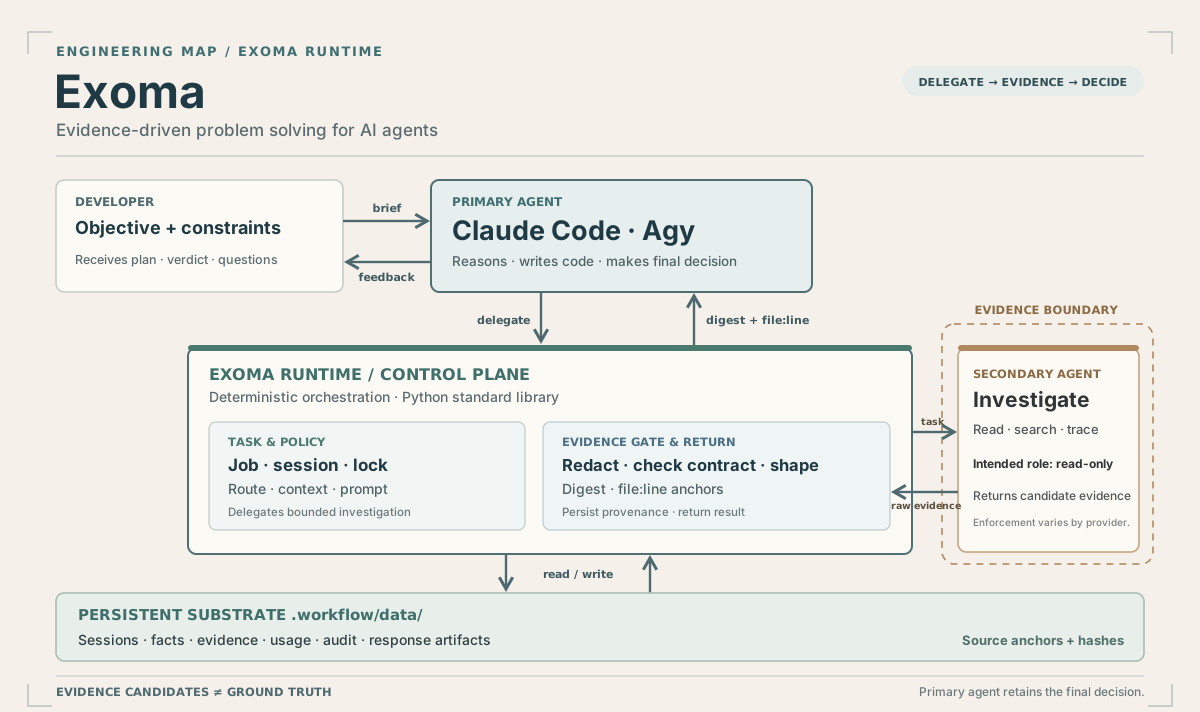
The primary agent reasons and writes the code; the developer answers open questions and approves implementation. "Read-only" is the secondary agent's role, and how strictly it is enforced depends on the provider (see Security). Text version, full verified flow, side paths, and storage: docs/architecture.
Delegated results are treated as evidence candidates, not truth. Every delegated call
returns the same envelope; digest appears when the secondary agent's summary parses, and
evidence_ref on the explore/plan/analyze evidence path:
{ "ok": true, "content": "...", "meta": {}, "digest": {}, "evidence_ref": {} }
The primary agent decides what the evidence means and whether to act on it. A secondary agent can be incomplete or wrong even when its output looks plausible.
Core responsibilities
| Role | Who | Responsibility |
|---|---|---|
| Primary agent | Claude Code (the integration target) | Reasoning, decisions, code changes, and final review |
| Workflow runtime | The exoma package, Python standard library only |
Routing, sessions and locks, policy, prompt building, redaction, evidence contracts, digests, persistence, recovery |
| Secondary agent | opencode, codex, or agy |
Repository exploration, analysis, planning, and verification evidence |
The design keeps code-writing with the primary agent. The secondary agent's role is read-only; the degree to which each provider enforces that differs, and the runtime states it rather than assuming it. See Security.
The principle: let the model do the semantic reasoning, and let deterministic software enforce state, contracts, policy, provenance, and execution control.
Relationship to agent-workflow
agent-workflow is the implementation and research foundation Exoma grew from. It explores separating repository exploration from the primary agent's reasoning and implementation context, and how delegation, evidence management, and runtime control affect the outcome of the work. That research, including its hypotheses and experiments, stays in agent-workflow.
This first release of Exoma repackages that runtime as a library: the same commands, contracts and workspace, installed and upgraded like any other Python tool. Exoma is meant to grow into a broader library identity, developed from mechanisms that have been tested and needs that have been measured.
The name
Exoma is a distinctive name for the project. Conceptually, it is inspired by the idea of cognitive resources and processes that reach beyond the individual, including discussions of extrasomatic resources and the Extended Mind Thesis.
That inspiration reflects the view that problem solving can be supported by the interplay of an AI model, context, tools, memory, and external systems. It does not assume that tools or external components literally have minds, nor that an AI becomes smarter simply by using more resources.
Vision
Exoma sets out to explore how external systems can help AI agents solve problems more effectively: with the right context, a directed investigation, traceable evidence, and a compute cost proportionate to its benefit.
Its value is not measured by how many agents it uses or how complex its architecture is, but by how far it actually helps an AI solve problems with better quality and conclusions that can be accounted for.
Give agents the context to solve, not the answer to repeat.
When it is useful
The idea behind the design: on a large codebase, keeping exploration out of the primary agent's context should leave it more room to reason. That is a design premise, not a measured result; Exoma does not claim a benchmark.
Typical requests (translated, names removed):
| Situation | What was asked | Command |
|---|---|---|
| A feature in an unfamiliar area | "Explore the cash-advance input feature: map its files and code, the permissions it uses, and any explicit or special rules." | explore |
| A feature end to end | "Map the project-template feature: a template is created, applied to a project, and then…" | explore |
| A question about a mechanism | "When the audit delta runs, are the commits it checks based on the anchor hash of the last audited commit?" | analyze |
| Reviewing work in progress | "Analyze the changes made in my worktree on this project." | analyze |
| Merging two features | "Make a plan to merge this meetings page with the meetings feature on the Notes page." | plan |
| A cost or speed problem | "Each step uses many tokens and is slow; plan how to lower token use without reducing detection quality." | plan |
| After an implementation | /.verify, straight after /.execute -y |
verify |
| A UI change | "Test it end to end in the browser, several rounds over every category area that changed." | verify-browser |
| Before a commit | /.sweep |
sweep |
It is less attractive when the change is already localized, the relevant file is known, or you need an instant answer: a delegated call takes from under a minute to several minutes, because the secondary agent actually reads the code. The team guide covers choosing per task and how to phrase requests.
Quick start
uv tool install exoma            # or: pip install exoma
exoma install                    # dry run: read what it will change in ~/.claude
exoma install --apply
Then, in a project, run /.init in Claude Code (or exoma init --work-dir .), and /.doctor.
A project that already has a .workflow/ from agent-workflow is taken over by /.upgrade.
Details, modes and undo: installation guide.
Ask in natural language; the primary agent routes it:
you:          where is the authentication logic in this project?
Claude Code:  [INTENT] explore — location question
              (runs bash .workflow/run.sh explore '...')
Or call the runtime directly:
bash .workflow/run.sh explore 'find the authentication entry point' '<SESSION_ID>'
The generated runner refuses a delegated call without a session id: without one, concurrent sessions would share an identifier and overwrite each other's state.
| Command | Type | Purpose |
|---|---|---|
init / upgrade |
local | Enable the runtime in a project / refresh it after the tool is updated |
doctor |
local | Readiness check; writes a report |
sweep |
local | Scan the working tree for changes |
clean |
local | Prune jobs, stale facts, and old sessions |
explore |
delegated | Code map, entry points, ownership |
analyze |
delegated | Causal analysis; no code changes |
plan |
delegated | Evidence-backed implementation steps |
verify |
delegated | Verdict on completed work, with evidence — produced by the secondary agent, not an independent check |
verify-browser |
delegated | Verify a running app in a real browser: the secondary agent drafts the scenario and reviews the evidence; a runtime player drives Playwright |
promote-validate → promote-verify → promote-write |
local | Turn verified evidence into a Git-tracked knowledge document |
Implementation itself (/.execute in Claude Code) is a primary-agent skill, not a delegated
command; it opens and closes a runtime execution (plan-record, execute-begin,
execute-end) whose scope a hook enforces for Edit/Write. Asynchronous job commands and the remaining local commands are in the
full reference.
Setup problems and their fixes: installation guide.
Security
What each secondary-agent provider can read and change: docs/security.md.
Documentation
Documentation is layered: the team guide says how and when, and the reference says exactly what the runtime does — see docs/.
| Document | Contents |
|---|---|
| docs/installation.md | Requirements, install, per-project setup, updating, uninstalling |
| docs/security.md | What each secondary-agent provider is allowed to read and change |
| docs/team-guide | For developers: getting started, when to use it, task framing, examples, troubleshooting |
| docs/architecture | Verified request flow, components, and storage |
| docs/reference.md | Complete technical reference: configuration, jobs, fact store, evidence reuse, verify modes, sessions, tests, CI |
| docs/runtime-contracts.md | Which .workflow/config.json keys the runtime obeys, and which it cannot enforce |
| docs/limitations.md | Known limitations |
| docs/evaluation/metrics.md | How every figure exoma report prints is computed |
| CHANGELOG.md / RELEASE.md | Release history and procedure |
ci.yml runs the version stamp, manifest, stdlib-only gate, and test suites, plus a clean install of the built wheel, on every push on Linux and Windows, spending no provider quota; publish.yml publishes a release tag to PyPI; e2e-full.yml is manual because it calls a real secondary agent.
Limitations
Exoma adds an execution layer, and with it additional latency, additional provider calls and compute, new failure modes, provider-specific security limits, and maintenance complexity. It is not preferable for every task. Full list: docs/limitations.md.
License
Apache License 2.0 — see LICENSE for the authoritative text.
Use, modification, and distribution are permitted, including commercially, provided the copyright notice and licence are retained and modified files are marked as changed. The licence includes an express patent grant that terminates for any party initiating patent litigation over the work. The software is provided without warranty of any kind. This summary is not legal advice.
Copyright 2026 dammar01
1 maintainer

Metadata
1 maintainer
Release files for exoma 0.2.0
For a detailed explanation of source distributions (sdists) and built distributions (wheels), please see the package formats documentation.
Source distribution (sdist)
| File | Size | Uploaded | Provenance | |
|---|---|---|---|---|
| exoma-0.2.0.tar.gz | 652.4 kB | With provenance | Details |
Built distribution (wheel)
| File | Interpreter | ABI | Platform | Reset |
|---|---|---|---|---|
| exoma-0.2.0-py3-none-any.whl | Python 3 | none | any | Details |
Total release size: 1.4 MB
Release files / exoma-0.2.0.tar.gz
| Download URL | exoma-0.2.0.tar.gz |
|---|---|
| Size | 652.4 kB |
| Tags | Source |
|
SHA-256 checksum How to use checksums |
11cad4218bbed32cefa7ee8631f9f7b5bda4003471966db5603e2ce5723903fa
|
|
BLAKE2b-256 checksum How to use checksums |
88bc6fa8a7bd7b7f584f7866d9b4f7ef2723292f61993d288dab1e9c66a63032
|
| Upload date | |
|
Uploaded using Trusted Publishing? What is trusted publishing? |
Yes |
| Uploaded via |
twine/7.0.0 CPython/3.13.16
|
Provenance
Provenance describes where a file came from. On PyPI, provenance is shared via attestations, which provide a verifiable record of the build or publishing details. View details, limitations and caveats.


PyPI Publish Attestation
PyPI verified that this artifact, at this checksum, originated from the publisher listed below.
Signed by GitHub Actions, verified by PyPI on Oct 26, 2026.
Transparency logRelease files / exoma-0.2.0-py3-none-any.whl
| Download URL | exoma-0.2.0-py3-none-any.whl |
|---|---|
| Size | 750.0 kB |
| Tags | Python 3 |
|
SHA-256 checksum How to use checksums |
cb50619b291b2f48edfcf4124022aa8c553c84900a39ace1dfa8bf62d79a795b
|
|
BLAKE2b-256 checksum How to use checksums |
11a98919a64e0cdd59d2b2aced7260655182b6dc1fac7352d89b45d410c0ceb6
|
| Upload date | |
|
Uploaded using Trusted Publishing? What is trusted publishing? |
Yes |
| Uploaded via |
twine/7.0.0 CPython/3.13.16
|
Provenance
Provenance describes where a file came from. On PyPI, provenance is shared via attestations, which provide a verifiable record of the build or publishing details. View details, limitations and caveats.
PyPI Publish Attestation
PyPI verified that this artifact, at this checksum, originated from the publisher listed below.
Signed by GitHub Actions, verified by PyPI on Oct 26, 2026.
Transparency logSecurity for exoma 0.2.0
Provenance
Provenance describes where a file came from. On PyPI, provenance is shared via attestations, which provide a verifiable record of the build or publishing details. View details, limitations and caveats.
Full provenance
All 2 files in this release have been uploaded with provenance metadata.
Attestation for exoma-0.2.0.tar.gz
PyPI Publish Attestation
PyPI verified that this artifact, at this checksum, originated from the publisher listed below.
Signed by GitHub Actions, verified by PyPI on Oct 26, 2026.
Transparency logA note on package security
PyPI is a repository for distributing packages, not a service for auditing them. While third-party security researchers and our staff do their best to detect and remove malicious packages, PyPI cannot guarantee the quality, security or suitability of any given package.
To learn more about protecting yourself from malicious actors, visit our package security documentation.














