
The plumbing every local AI experiment rebuilds, built once. athome is one SDK, CLI, and skill set for the machinery every experiment repo grows anyway — content-keyed caching, sidecar workers, record/replay LLM caching, launchd scheduling, detached overnight runs, and resumable progress.



Get started
uv add experiment-at-home
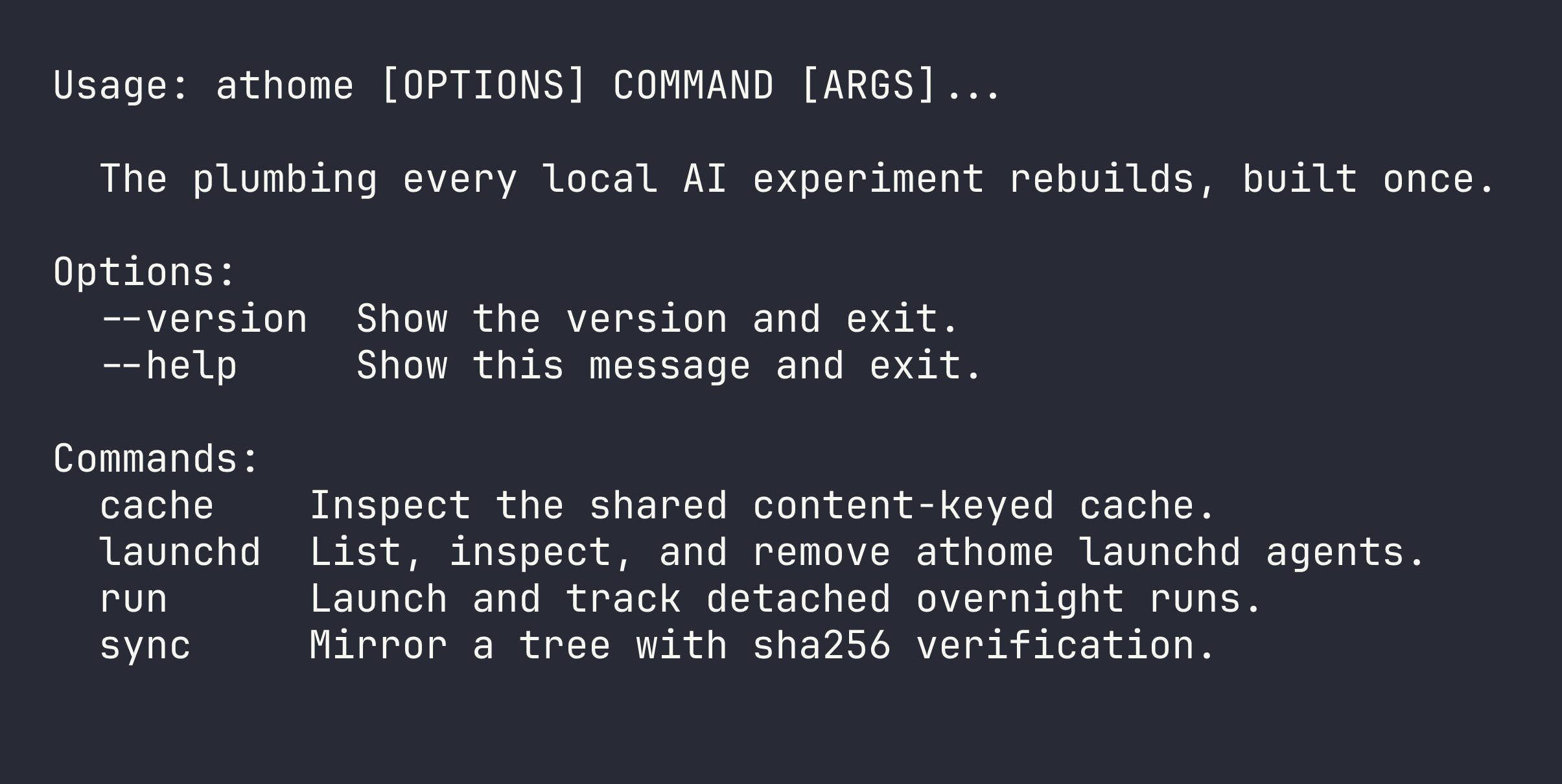
uv run athome --help
Driving with an agent? Paste this:
Add experiment-at-home (uv add experiment-at-home) and wrap my most expensive
pipeline step in its @cached decorator, namespaced after this project.
Docs: https://yasyf.github.io/experiment-at-home/
Claude Code plugin (the athome skills)
/plugin marketplace add yasyf/experiment-at-home
/plugin install athome@experiment-at-home
Use cases
Stop re-paying for the same expensive artifact every rerun
A pipeline rerun that re-derives every intermediate burns minutes (or API
dollars) to reproduce bytes you already had. Wrap the step; the cache is
content-keyed under ~/.athome/cache, shared across every repo on the machine:
from athome import cached


@cached(ns="ingest", version=1)
async def parsed_pages(pdf_digest: str) -> list[str]:
    # the expensive part: OCR, chunking, whatever your pipeline re-derives
    ...
The second call with the same arguments returns from disk. Invalidation is one
edit: bump version=2 and the old entries are never read again.
Send tonight's sweep off before you close the laptop
An overnight script tied to a terminal dies with the terminal, and nohup
leaves you grepping for whether it finished. Detach it with a name:
uv run athome run --detach --name sweep -- uv run python sweep.py
The run gets its own log under ~/.athome/logs/runs/, and a completion
sentinel records the exit code. In the morning, uv run athome run wait sweep
returns instantly with that exit code — 0 or the failure you need to chase.
Move a corpus without wondering if it all arrived
rsync reports transfer success, not tree integrity — and macOS salts remote
copies with ._* AppleDouble droppings. Mirror with verification:
uv run athome sync ~/corpora/traces backup-host:corpora/traces --move
Every file is sha256-verified against the source before --move deletes
anything; a mismatch repairs and re-verifies, and an unverifiable tree blocks
deletion outright.
More in the docs
- Record/replay LLM caching — replay yesterday's API responses in today's tests, byte-for-byte — llmcache
- Sidecar workers — call GIL-bound engines from free-threaded Python over a version-handshaked pipe — workers
- launchd agents — declarative Calendar/Interval/KeepAlive schedules, no plist authoring — launchd
- Resumable progress — JSONL work-sets where crashed units retry and finished ones skip — progress
- One config file — every knob in
~/.athome/config.toml, every module a pydantic-settings section — config
Read the docs for the full guide.
Status: alpha — the primitives above are shipped and tested (including on free-threaded Python 3.14); MLX serving recipes, OCR engines, batch LLM lanes, and the autoresearch harness land in 0.2–0.3.
Licensed under PolyForm-Noncommercial-1.0.0.
1 maintainer

Metadata
1 maintainer
Release files for experiment-at-home 0.10.0
For a detailed explanation of source distributions (sdists) and built distributions (wheels), please see the package formats documentation.
Source distribution (sdist)
| File | Size | Uploaded | Provenance | |
|---|---|---|---|---|
| experiment_at_home-0.10.0.tar.gz | 205.4 kB | With provenance | Details |
Built distribution (wheel)
| File | Interpreter | ABI | Platform | Reset |
|---|---|---|---|---|
| experiment_at_home-0.10.0-py3-none-any.whl | Python 3 | none | any | Details |
Total release size: 458.4 kB
Release files / experiment_at_home-0.10.0.tar.gz
| Download URL | experiment_at_home-0.10.0.tar.gz |
|---|---|
| Size | 205.4 kB |
| Tags | Source |
|
SHA-256 checksum How to use checksums |
4b0f7e6867899ea363596eef4bf50d7c80b057dd2c49a76bb93deee850744584
|
|
BLAKE2b-256 checksum How to use checksums |
0beb61bc14b30ccd331af36f29aca4b71be5d6f85e66914095e8274881ccc5f2
|
| Upload date | |
|
Uploaded using Trusted Publishing? What is trusted publishing? |
Yes |
| Uploaded via |
twine/6.1.0 CPython/3.13.14
|
Provenance
Provenance describes where a file came from. On PyPI, provenance is shared via attestations, which provide a verifiable record of the build or publishing details. View details, limitations and caveats.


PyPI Publish Attestation
PyPI verified that this artifact, at this checksum, originated from the publisher listed below.
Signed by GitHub Actions, verified by PyPI on Jul 19, 2026.
Transparency logRelease files / experiment_at_home-0.10.0-py3-none-any.whl
| Download URL | experiment_at_home-0.10.0-py3-none-any.whl |
|---|---|
| Size | 252.9 kB |
| Tags | Python 3 |
|
SHA-256 checksum How to use checksums |
0868afc5d100482485528bbb78d776ca1851fc473a796cfd1bb2e675551b64a1
|
|
BLAKE2b-256 checksum How to use checksums |
8cb359af7099765d599957268139af87e21a1238b5b33acafbaf3cd7d89e5302
|
| Upload date | |
|
Uploaded using Trusted Publishing? What is trusted publishing? |
Yes |
| Uploaded via |
twine/6.1.0 CPython/3.13.14
|
Provenance
Provenance describes where a file came from. On PyPI, provenance is shared via attestations, which provide a verifiable record of the build or publishing details. View details, limitations and caveats.
PyPI Publish Attestation
PyPI verified that this artifact, at this checksum, originated from the publisher listed below.
Signed by GitHub Actions, verified by PyPI on Jul 19, 2026.
Transparency logSecurity for experiment-at-home 0.10.0
Provenance
Provenance describes where a file came from. On PyPI, provenance is shared via attestations, which provide a verifiable record of the build or publishing details. View details, limitations and caveats.
Full provenance
All 2 files in this release have been uploaded with provenance metadata.
Attestation for experiment_at_home-0.10.0.tar.gz
PyPI Publish Attestation
PyPI verified that this artifact, at this checksum, originated from the publisher listed below.
Signed by GitHub Actions, verified by PyPI on Jul 19, 2026.
Transparency logA note on package security
PyPI is a repository for distributing packages, not a service for auditing them. While third-party security researchers and our staff do their best to detect and remove malicious packages, PyPI cannot guarantee the quality, security or suitability of any given package.














