
experiment-toolkit
Small, well-tested utilities for online controlled experiments.




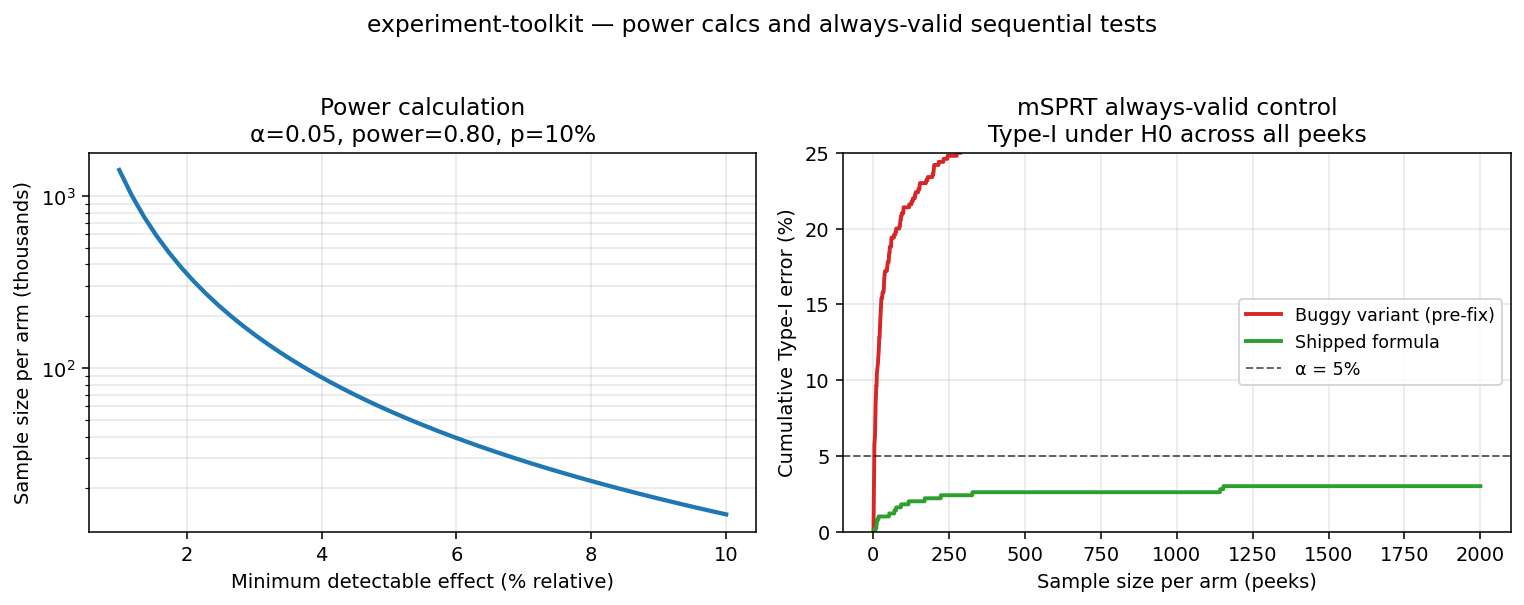
A compact Python package covering the calculations that come up in everyday experimentation work: sample sizing, variance reduction, sequential tests, ratio-metric variance, staggered DiD, sensitivity analysis for observational designs, A/B metrics scored by an LLM judge, and honest lift estimates for creatives picked by a bandit. The implementations follow standard results from the experimentation and causal-inference literature (referenced in the docstrings and below).
Intended audience: analysts, data scientists, and experimentation platform engineers who want a small, inspectable reference implementation rather than a framework.
Modules
| Module | Purpose |
|---|---|
sample_size |
Per-arm sample size and MDE, CUPED-aware (rho keyword) |
cuped |
Deng et al. (2013) CUPED variance reduction |
ratio |
Delta-method variance for ratio metrics (revenue per session, etc.) |
sequential |
mSPRT always-valid p-values, with optional CUPED compounding |
cs_did |
Callaway & Sant'Anna (2021) staggered DiD, robust to heterogeneous cohort effects |
sensitivity |
E-value (VanderWeele & Ding) and Rosenbaum bounds |
llm_judge |
LLM-judge-scored A/B metrics: naive bias/power vs. PPI++ correction with a small human-labeled sample |
offline_eval |
Offline LLM evals vs online A/B: mix shift, judge bias and online-only costs, with reweighting and PPI++ fixes |
ppi_covariates |
PPI++ plus a pre-treatment covariate (CUPED-style): closed-form label budgets and when the covariate stops helping |
judge_drift |
A judge that changes mid-test, flagged or silent: which analyses stay valid, why front-loaded human labels don't, and which drift monitors (judge scores, label agreement, a re-judged canary set) can detect it |
bandit_eval |
Lift of a creative a bandit picked from many generated variants: winner's curse, time confounding, and off-policy (IPS / SNIPS / DR) estimates from logged propensities |
judge_audit |
Real-data audit of an LLM judge against expert humans (MT-Bench): win-rate bias, error that depends on which model humans preferred, and PPI++ checked against a known answer |
The public API is typed (the package ships a py.typed marker) and unit-tested, and the key methods cite their source in the module docstrings.
Install
pip install experiment-toolkit
Or from source:
pip install git+https://github.com/wavde/experiment-toolkit.git
Quick start
from experiment_toolkit import sample_size_for_mde, apply_cuped, msprt_pvalue

# Per-arm sample size to detect a 2% lift at sd = 1.0
n = sample_size_for_mde(mde=0.02, std_dev=1.0, alpha=0.05, power=0.80)
# ~39,000 per arm

# CUPED adjustment with a pre-experiment covariate
y_adj = apply_cuped(y, pre_period_y)

# Always-valid p-value, safe to peek
p = msprt_pvalue(delta_hat=0.015, sigma=1.0, n_per_arm=5000, tau=0.05)
CLI
The CLI exposes sample-size and mde. The other modules are library-only.
experiment-toolkit sample-size --mde 0.02 --sd 1.0
# Required per-arm sample size: 39,244

experiment-toolkit mde --n 10000 --sd 1.0
# Detectable effect (MDE): 0.0396
LLM-as-judge simulation
Can you ship on an A/B test whose primary metric is scored by an LLM judge? llm_judge simulates binary true quality plus a judge with per-arm error rates, then compares three analyses: the naive judge-only analysis, human labels only, and PPI++ (judge scores corrected with a small human-labeled sample drawn within each arm). There are no model API calls, and the ground truth is known by construction.
pip install -e ".[dev]"
python scripts/llm_judge_sim.py
The script uses a fixed seed and writes docs/llm_judge_results.md and docs/llm_judge.png. Every simulated number appears next to its closed-form value. When judge noise is the same in both arms, it shrinks the effect by Youden's J and costs power. When the noise differs between arms, the naive test's false-positive rate grows with sample size. Calibration labels have to be drawn within each arm: a single shared or offline calibration cancels out of the difference.
Write-up, with the decision rule: LLM-as-judge is a noisy metric: what it does to A/B power and bias.
from experiment_toolkit import JudgeConfusion, simulate_judged_experiment, analyze_judged_experiment

judge = JudgeConfusion(sensitivity=0.85, specificity=0.85)
lenient = JudgeConfusion(sensitivity=0.85, specificity=0.80)  # judge favours treatment
t, c = simulate_judged_experiment(5000, p_control=0.6, effect=0.0, judge_control=judge,
                                  judge_treatment=lenient, n_labeled_per_arm=500, seed=0)
res = analyze_judged_experiment(t, c)  # {"naive", "human_only", "ppi"}
Offline evals vs online A/B
When can an offline LLM eval win be trusted to predict the online result? offline_eval simulates an eval set whose prompt mix differs from live traffic, a judge whose errors can differ between the baseline and candidate outputs, and online-only costs such as latency. It compares the raw offline judge score, the score reweighted to the traffic mix, judge-plus-human-labels PPI++ reweighted to the mix, and the online A/B result. There are no model API calls.
python scripts/offline_online_sim.py
The script uses a fixed seed and writes docs/offline_online_results.md and docs/offline_online.png.
What the results show:
- Reweighting to the traffic mix fixes mix shift.
- Human labels fix judge bias.
- No offline correction can see an online-only cost.
- Each correction costs offline power, so an offline win is best used to choose what to test online, not to skip the online test.
Write-up, with the decision rule: An offline eval win is evidence about the eval set.
PPI++ with a pre-treatment covariate
How much does a pre-treatment covariate, such as a query difficulty bucket or a user's prior-period outcome, cut the human-label budget of PPI++? ppi_covariates generalises PPI++ to several control variates (the judge score and the covariate). It provides the closed-form variance Var(Y)/n · (1 − R² · N/(N+n)), label budgets for a target power, and a simulator to check them.
python scripts/ppi_covariates_sim.py
The script uses a fixed seed and writes docs/ppi_covariates_results.md and docs/ppi_covariates.png.
The covariate's gain depends on how much it adds beyond the judge. It is largest when the judge is weak, small when the judge is strong, and capped when labels are a large share of each arm.
Write-up, with the decision rule: A covariate stacks on the judge, but a better judge beats both.
Judge drift mid-test
What happens to a judge-scored A/B test when the judge model is upgraded partway through? judge_drift simulates an upgrade that switches both arms to a new judge at the same time, and compares five analyses: the judge score pooled over the test, the judge score before the upgrade only, and three PPI++ variants that differ in when human labels are drawn.
python scripts/judge_drift_sim.py
The script uses a fixed seed and writes docs/judge_drift_results.md and docs/judge_drift.png.
- An upgrade that changes both arms' judged rates equally is harmless under the null.
- An upgrade that is more lenient on one arm's outputs biases the pooled judge score.
- It also biases PPI++ if all the human labels were collected before the upgrade.
- PPI++ with labels spread across the test, or stratified by judge version, stays unbiased.
Write-up, with the decision rule: Upgrading the judge mid-test is safe only if your labels know about it.
Silent judge drift
A hosted judge can change under the same model name, so the analysis has no version flag to stratify on. SilentDrift changes the judge from an unknown day, as a step or a gradual ramp, on one or both arms. It can also shift true quality with no judge change, which a drift monitor should not flag. The simulation compares the judge-only readout with PPI++ using launch-week labels or labels drawn at random from the whole test. It also runs three cheap monitors (first_alarm): judge pass rate on the control arm, judge pass rate on each arm, and the judge's agreement with human labels split by the human label.
python scripts/silent_drift_sim.py
The script uses a fixed seed and writes docs/silent_drift_results.md and docs/silent_drift.png.
- PPI++ with labels drawn at random from the whole test stays valid under every drift tested, without knowing when or whether the judge changed. The labels can be drawn at the end from logged outputs.
- Launch-week labels and the judge-only readout are biased when drift hits one arm more than the other.
- A score monitor on the control arm can't see drift that only affects treatment. Score monitors on both arms also fire when true quality changes and the judge doesn't.
- Agreement split by the human label separates judge drift from quality change, but needs thousands of labels per arm to detect a realistic drift.
Write-up, with the decision rule: When the judge drifts silently, random labels protect the readout and monitors only tell you where to look.
Canary-set drift monitor
A canary set is a fixed set of stored outputs that the production judge re-scores every day. Their true quality can't change, so a shift in their scores can only come from the judge. simulate_canary re-judges stored outputs under a SilentDrift, with a repeatability setting for how often the judge repeats its verdict on the same output. canary_alarm compares each output's recent verdicts with its own early ones. The simulation runs it on the same scenarios as the silent-drift simulation, next to the score and agreement monitors.
python scripts/canary_drift_sim.py
The script uses a fixed seed and writes docs/canary_drift_results.md and docs/canary_drift.png.
- With 400 stored outputs per arm and no human labels, the canary caught treatment-only drift about as often and as fast as a score monitor on both arms, and caught gradual drift more often.
- Unlike the score monitors, it stayed quiet when true quality fell and the judge didn't change.
- A canary built only from control outputs missed drift that affected only treatment outputs. The canary has to contain outputs from every arm.
- Closed forms give the canary size for a target detection probability (
canary_items_for_power).
Write-up, with the decision rule: A canary set catches a drifting judge without blaming real quality changes.
Generated creatives picked by a bandit
Generative tools make it cheap to test 20 or 50 creative variants at once, and a bandit moves traffic toward whichever is ahead. How far is the leader's reported lift from its true lift, and which estimate from the logged decisions can be trusted? bandit_eval provides off-policy estimators that use the logged allocation probabilities (IPS, self-normalised IPS, doubly robust), the naive dashboard comparison, and a minimal batched Thompson-sampling log generator with known ground truth. It evaluates bandit logs; it is not a bandit framework.
python scripts/bandit_eval_sim.py
The script uses a fixed seed and writes docs/bandit_eval_results.md and docs/bandit_eval.png. The full run takes about 33 minutes on a laptop CPU; --smoke takes seconds.
Two biases are at work, and they need different fixes:
- Time confounding. A variant that wins traffic late is measured on late traffic. With click rates drifting ±20% over the test and no variant better than control, the leader's raw lift averages +12.6% and every replication claims a win. IPS, SNIPS and DR with the logged propensities remove this part.
- Winner's curse. The leader was chosen because its estimate was high. IPS on the same log still overstates it: by +4.6 pp with 20 null variants (about 22% false wins at a nominal 2.5%), and DR on the same log by +8.0 pp with 50. When variant lifts are spread around zero (SD 4%) and clicks drift, the leader's true lift is +5.7% while the same-log IPS estimate is +7.7% and the raw lift +16.3%.
What the simulation shows about the fixes:
- Splitting the log after the fact doesn't work. The bandit allocated traffic using both halves, so the held-out half is biased (here downward) and the variant it picks is worse.
- Data the bandit never learned from does. A 20% evaluation slice that the bandit serves but never updates on, and a 50k-per-arm confirmation A/B, are both unbiased with 94–96% coverage. The slice barely hurts the pick, but its SE is 2.3–2.8× the confirmation test's at a similar impression count, because most of its traffic went to variants that lost.
Decision rule: let the bandit choose, but quote the lift only from impressions it didn't learn from. Run a short confirmation A/B when the number feeds a ship or forecast decision. If no extra time is available, reserve an evaluation slice from day one and log propensities with a floor, and treat it as a check on direction and rough size. Never report the leader's raw lift, and don't treat IPS on the same log as a fix for the winner's curse.
from experiment_toolkit.bandit_eval import ope_lift

# One row per impression: arm shown (0 = control), click, logged probability of that arm.
# Rows from the evaluation slice only, for the leader chosen on the other rows.
res = ope_lift(arms[slice_], clicks[slice_], propensity[slice_], target=leader, control=0)
res.estimate, res.ci()
Where this breaks: with two to five variants the same-log overstatement is under 2 pp, so the extra machinery buys little. A thin propensity floor (≤1% of variant traffic) drops the slice's coverage to 0.91–0.93. Lifts are held constant over time; if generated creatives have a novelty effect that fades, no estimate from the test window measures the post-launch lift, and only a later confirmation test does.
Write-up: Classic case studies, reread in 2026.
Real-data judge audit (MT-Bench)
Every LLM-judge simulation above assumes a judge whose errors can depend on which arm produced the output. judge_audit checks that on real data: the public MT-Bench human judgments (Zheng et al., 2023, CC BY 4.0), where expert humans and GPT-4 judged the same pairwise comparisons of six models. Each pair of models is read as a side-by-side test, with the stronger model as treatment.
pip install -e ".[dev,data]"
python scripts/judge_audit_mtbench.py
The data (about 1.4 MB) are downloaded on first run from a pinned revision, checked against SHA-256 hashes and cached in data/mt_bench/; they aren't committed. The script uses a fixed seed and writes docs/judge_audit_results.md and docs/judge_audit.png. CI smoke-runs it on synthetic data with the same schema.
- GPT-4's win rate for the stronger model was above the experts' in all 15 pairs, by up to +0.185, on the same items.
- When experts preferred the stronger model, GPT-4 agreed 82% of the time; when they preferred the weaker one, 22%. The judge's error depends on the arm.
- In a known-answer check that resamples the real verdicts, with 200 human labels per pair, PPI++ kept 93–96% coverage. The judge alone covered the truth in at most 0.5% of replications in 13 of 15 pairs, and at most 44% in the other two.
- The real judge correlates with humans far less than the simulated judges assumed (0.14–0.56 against 0.69), so PPI++ saved only 2–28% of labels.
Write-up, with the decision rule: A real LLM judge favours the winner: auditing GPT-4 against expert humans.
Out of scope
Not in this package: a bandit framework (bandit_eval only evaluates logged bandit traffic; its simulator is a minimal test fixture), a Bayesian posterior sampler, a full experimentation platform, assignment or exposure logging, multiple-comparison correction beyond what the sequential tests provide. Those belong in separate layers.
Development
pip install -e ".[dev]"
pytest
ruff check .
References
- Deng, Xu, Kohavi, Walker (2013). CUPED.
- Deng, Knoblich, Lu (2018). Delta method in metric analytics.
- Johari, Pekelis, Walsh (2015). Always-valid inference.
- Callaway & Sant'Anna (2021). Difference-in-differences with multiple time periods.
- VanderWeele & Ding (2017). Sensitivity analysis in observational research.
- Kohavi, Tang, Xu (2020). Trustworthy Online Controlled Experiments.
- Angelopoulos, Bates, Fannjiang, Jordan, Zrnic (2023). Prediction-powered inference.
- Angelopoulos, Duchi, Zrnic (2023). PPI++: Efficient prediction-powered inference.
- Chaganty, Mussmann, Liang (2018). The price of debiasing automatic metrics in natural language evaluation.
- Dudík, Langford, Li (2011). Doubly robust policy evaluation and learning.
- Swaminathan & Joachims (2015). The self-normalized estimator for counterfactual learning.
- Nie, Tian, Taylor, Zou (2018). Why adaptively collected data have negative bias and how to correct for it.
- Hadad, Hirshberg, Zhan, Wager, Athey (2021). Confidence intervals for policy evaluation in adaptive experiments.
- Andrews, Kitagawa, McCloskey (2024). Inference on winners.
License
MIT. See LICENSE.
1 maintainer

Metadata
1 maintainer
Release files for experiment-toolkit 0.3.0
For a detailed explanation of source distributions (sdists) and built distributions (wheels), please see the package formats documentation.
Source distribution (sdist)
| File | Size | Uploaded | Provenance | Actions |
|---|---|---|---|---|
| experiment_toolkit-0.3.0.tar.gz | 1.1 MB | With provenance | Details for experiment_toolkit-0.3.0.tar.gz |
Built distribution (wheel)
| File | Interpreter | ABI | Platform | Actions Reset |
|---|---|---|---|---|
| experiment_toolkit-0.3.0-py3-none-any.whl | Python 3 | none | any | Details for experiment_toolkit-0.3.0-py3-none-any.whl |
Total release size: 1.1 MB
Release files / experiment_toolkit-0.3.0.tar.gz
| Download URL | experiment_toolkit-0.3.0.tar.gz |
|---|---|
| Size | 1.1 MB |
| Tags | Source |
|
SHA-256 checksum How to use checksums |
d550bab8362be3fe121216f428c9892b8da840ca617eb2fa1affc18315a3f182
|
|
BLAKE2b-256 checksum How to use checksums |
493ccee8823fc1081f6ed6a5faa4137539f6fbedcf9e16699d4c6e61cdb29611
|
| Upload date | |
|
Uploaded using Trusted Publishing? What is trusted publishing? |
Yes |
| Uploaded via |
twine/7.0.0 CPython/3.13.16
|
Provenance
Provenance describes where a file came from. On PyPI, provenance is shared via attestations, which provide a verifiable record of the build or publishing details. View details, limitations and caveats.


PyPI Publish Attestation
PyPI verified that this artifact, at this checksum, originated from the publisher listed below.
Signed by GitHub Actions, verified by PyPI on Nov 28, 2026.
Transparency logRelease files / experiment_toolkit-0.3.0-py3-none-any.whl
| Download URL | experiment_toolkit-0.3.0-py3-none-any.whl |
|---|---|
| Size | 54.9 kB |
| Tags | Python 3 |
|
SHA-256 checksum How to use checksums |
71a858eeb0d947e6d2ce7c418620f71b2d872606e17aa8234447b96f2bf69c2d
|
|
BLAKE2b-256 checksum How to use checksums |
c191969a42a850f8a3c5b5e3c2daae6e02d76bab7dbc8451fff3cd0d19e46071
|
| Upload date | |
|
Uploaded using Trusted Publishing? What is trusted publishing? |
Yes |
| Uploaded via |
twine/7.0.0 CPython/3.13.16
|
Provenance
Provenance describes where a file came from. On PyPI, provenance is shared via attestations, which provide a verifiable record of the build or publishing details. View details, limitations and caveats.
PyPI Publish Attestation
PyPI verified that this artifact, at this checksum, originated from the publisher listed below.
Signed by GitHub Actions, verified by PyPI on Nov 28, 2026.
Transparency logSecurity for experiment-toolkit 0.3.0
Provenance
Provenance describes where a file came from. On PyPI, provenance is shared via attestations, which provide a verifiable record of the build or publishing details. View details, limitations and caveats.
Full provenance
Both files in this release have been uploaded with provenance metadata.
Attestation for experiment_toolkit-0.3.0.tar.gz
PyPI Publish Attestation
PyPI verified that this artifact, at this checksum, originated from the publisher listed below.
Signed by GitHub Actions, verified by PyPI on Nov 28, 2026.
Transparency logA note on package security
PyPI is a repository for distributing packages, not a service for auditing them. While third-party security researchers and our staff do their best to detect and remove malicious packages, PyPI cannot guarantee the quality, security or suitability of any given package.
To learn more about protecting yourself from malicious actors, visit our package security documentation.

















