





A token heatmap is a claim about a model, and most heatmaps are never tested.
explainkit computes word-level attributions for any text classifier hiding
behind a predict_proba-style callable, then makes those attributions earn
their keep: it selects the tokens that carry 95% of the corpus importance,
steers an LLM annotator toward them, swaps them out to see whether the verdict
survives, and scores the whole chain for faithfulness, plausibility and
cross-method agreement. Explain, select, steer, replace, verify: the
pipeline behind a set of published studies on transparent text classification
(citations at the bottom), packaged.
The demo in one table
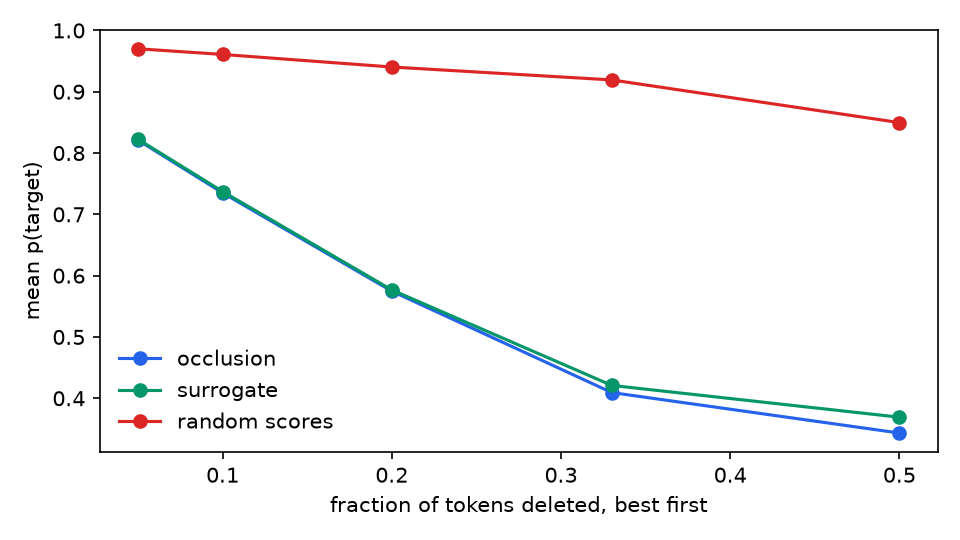
Three attributions of the same classifier (occlusion, a LIME-style surrogate and a permuted-scores baseline), each made to prove itself on a corpus whose ground-truth rationales are known by construction:
| attribution | AOPC | comp@3 | suff@3 | rationale F1@3 | top-3 jaccard vs occlusion | flip rate @3 |
|---|---|---|---|---|---|---|
| occlusion | 0.40 | 0.49 | -0.02 | 0.77 | 1.00 | 1.00 |
| surrogate | 0.39 | 0.49 | -0.02 | 0.77 | 0.90 | 1.00 |
| random scores | 0.04 | 0.03 | 0.24 | 0.20 | 0.20 | 0.20 |
AOPC and comp@3 are the probability drops after deleting top-ranked words (higher = more faithful). suff@3 is the drop when only the top 3 remain (near zero = the evidence suffices). Rationale F1@3 compares top tokens against the implanted signal words. The flip rate replaces each hostile-predicted text's top 3 words with civil counterparts and counts changed verdicts. The row to sit with is the last one: random and informed scores describe the same classifier, but acting on the informed ones flips essentially every verdict while acting on random ones barely moves it. An attribution you cannot act on was never evidence.
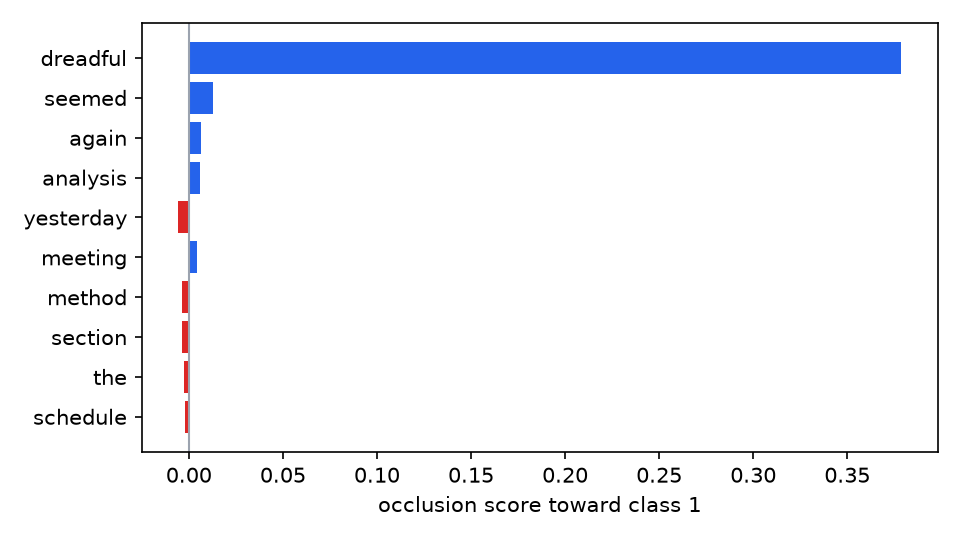
make demo regenerates the full report and the figures
from fixed seeds. CI rebuilds them from pinned dependencies and fails if a
committed number differs from what the code produces.
Install
pip install explainkit
Python 3.11+. Runtime dependencies: numpy, pydantic, matplotlib. The core methods (occlusion, surrogate) need nothing else. Heavier backends are extras:
| extra | adds | enables |
|---|---|---|
[shap] |
shap | method="shap" |
[lime] |
lime | method="lime" |
[transformers] |
transformers, torch | explainkit.hf pipeline wrapper |
[all] |
all of the above | everything |
Quickstart
from explainkit import Explainer, token_importance, select_tokens, highlight
from explainkit.replace import synonym_strategy, robustness_probe

explainer = Explainer(model.predict_proba)          # any (texts) -> (n, classes)

e = explainer.explain("your draft was useless and the meeting felt hopeless")
print(e.tokens, e.scores)                           # word-level attribution

importances = token_importance(explanations, y_true)   # corpus-level SI / IR
vocabulary = select_tokens(importances, threshold=0.95)

prompt = highlight(text, [t.token for t in vocabulary])  # **bold** the evidence

report = robustness_probe(explainer, texts,
                          synonym_strategy({"useless": "helpful"}), top_k=3)
print(report.flip_rate)                             # do the attributions act?
With a Hugging Face model:
from explainkit.hf import pipeline_predict_fn      # pip install "explainkit[transformers]"

explainer = Explainer(pipeline_predict_fn("distilbert-base-uncased-finetuned-sst-2-english"))
e = explainer.explain("a quietly devastating film", method="shap")
What it does
| module | the question it answers | needs |
|---|---|---|
explain |
which words pushed this prediction? (occlusion, surrogate, shap, lime) | core |
select |
which tokens carry the corpus? correctness-gated SI, IR, cumulative cut at T_c | core |
steer |
how do I point an LLM annotator at them? highlighting, virtual-annotator voting | core |
replace |
do the attributions transfer to action? strategies + robustness probes | core |
faithfulness |
does the model actually depend on them? comprehensiveness, sufficiency, AOPC | core |
plausibility |
do they match human rationales? token F1, IOU | core |
agreement |
do two methods tell one story? rank correlation, top-k overlap | core |
viz |
can I look at it? HTML heatmaps, attribution and selection figures | core |
How the numbers are defended
- Occlusion must recover the coefficient signs of a known linear model, by test. The surrogate must recover its ranking.
- Spearman and Kendall are computed in plain numpy and cross-checked against scipy to 1e-10 in the test suite. The library depends on scipy for neither.
- The demo corpus implants its rationales, so selection and plausibility are checked against planted ground truth, not eyeballed.
- Every README number is regenerated by CI from pinned dependencies and diffed against the committed report.
Design notes
- Words, not subwords. Attribution, selection and replacement happen at the word level, the level humans read. A model's subword vocabulary stays its own business: perturbed texts reach the model as raw strings. Subword-to-word pooling for transformer-native scores is on the roadmap.
- Spans, not string replacement. Every perturbation splices validated
character spans (the
Explanationmodel rejects spans that do not read back as their token), so editing "art" can never corrupt "party". - Ranks across methods, never magnitudes. SHAP values are additive contributions, while occlusion scores are probability drops. The agreement module compares rankings and top-k sets only, and the selection module normalizes within a corpus.
- Deterministic to the digit. Every sampled method takes a seed, and the demo's model is closed-form counting, so its numbers cannot wobble across platforms.
Limitations
- Occlusion costs n+2 model calls per text (batched into one) and reads near-independent token effects. Strongly interacting features deserve the sampling methods.
- Deletion-based faithfulness metrics evaluate the model off-distribution. That caveat is known across the field, and stated here rather than hidden.
- The demo corpus is synthetic by design (real moderation data cannot ship with ground-truth rationales), so treat its numbers as a validation harness, not a benchmark.
- Word-level only. Occlusion, the surrogate and the shap backend all build their variants by splicing the same word spans, so they see the same texts. The lime backend perturbs a whitespace-joined rendering of the tokens, so its variants are not byte-identical to the others.
Roadmap
Subword-to-word attribution pooling, a POS-matched replacement strategy in
core, bootstrap confidence intervals on corpus metrics, an
integrated-gradients backend, and a report CLI over stored explanation JSONL.
Related work
SHAP, LIME and the ERASER faithfulness metrics are the foundations this package operationalizes end-to-end. Sister package: judgekit, bias probes for LLM judges, each with a bootstrap confidence interval.
Citing
This package operationalizes methods developed across:
@article{mohammadi2024explainable,
  title   = {A Transparent Pipeline for Identifying Sexism in Social Media: Combining Explainability with Model Prediction},
  author  = {Mohammadi, Hadi and Giachanou, Anastasia and Bagheri, Robert A.},
  journal = {Applied Sciences},
  volume  = {14},
  number  = {19},
  pages   = {8620},
  year    = {2024},
  doi     = {10.3390/app14198620}
}

@inproceedings{mohammadi2025reliability,
  title     = {Assessing the Reliability of LLMs Annotations in the Context of Demographic Bias and Model Explanation},
  author    = {Mohammadi, Hadi and Shahedi, Tina and Mosteiro, Pablo and Poesio, Massimo and Bagheri, Robert A. and Giachanou, Anastasia},
  booktitle = {Proceedings of the 6th Workshop on Gender Bias in Natural Language Processing (GeBNLP)},
  year      = {2025},
  doi       = {10.18653/v1/2025.gebnlp-1.9}
}

@article{mohammadi2025token,
  title         = {Explainability-Based Token Replacement on LLM-Generated Text},
  author        = {Mohammadi, Hadi and Giachanou, Anastasia and Oberski, Daniel L. and Bagheri, Robert A.},
  year          = {2025},
  journal       = {arXiv preprint},
  eprint        = {2506.04050},
  archivePrefix = {arXiv}
}

@article{mohammadi2025xnlp,
  title         = {Explainability in Practice: A Survey of Explainable NLP Across Various Domains},
  author        = {Mohammadi, Hadi and Bagheri, Robert A. and Giachanou, Anastasia and Oberski, Daniel L.},
  year          = {2025},
  journal       = {arXiv preprint},
  eprint        = {2502.00837},
  archivePrefix = {arXiv}
}
License
MIT.
1 maintainer

Metadata
1 maintainer
Release files for explainkit 0.2.0
For a detailed explanation of source distributions (sdists) and built distributions (wheels), please see the package formats documentation.
Source distribution (sdist)
| File | Size | Uploaded | Provenance | Actions |
|---|---|---|---|---|
| explainkit-0.2.0.tar.gz | 44.0 kB | With provenance | Details for explainkit-0.2.0.tar.gz |
Built distribution (wheel)
| File | Interpreter | ABI | Platform | Actions Reset |
|---|---|---|---|---|
| explainkit-0.2.0-py3-none-any.whl | Python 3 | none | any | Details for explainkit-0.2.0-py3-none-any.whl |
Total release size: 81.5 kB
Release files / explainkit-0.2.0.tar.gz
| Download URL | explainkit-0.2.0.tar.gz |
|---|---|
| Size | 44.0 kB |
| Tags | Source |
|
SHA-256 checksum How to use checksums |
60ee7dc191187e3586356e5cde6786bc8f7b79643dfcdb9b18d32042dbf6af36
|
|
BLAKE2b-256 checksum How to use checksums |
02351abbc3c4751e7d0ce6e43eeaae34606647e67193f266371cd21e3196d5dd
|
| Upload date | |
|
Uploaded using Trusted Publishing? What is trusted publishing? |
Yes |
| Uploaded via |
twine/7.0.0 CPython/3.13.16
|
Provenance
Provenance describes where a file came from. On PyPI, provenance is shared via attestations, which provide a verifiable record of the build or publishing details. View details, limitations and caveats.


PyPI Publish Attestation
PyPI verified that this artifact, at this checksum, originated from the publisher listed below.
Signed by GitHub Actions, verified by PyPI on Oct 24, 2026.
Transparency logRelease files / explainkit-0.2.0-py3-none-any.whl
| Download URL | explainkit-0.2.0-py3-none-any.whl |
|---|---|
| Size | 37.5 kB |
| Tags | Python 3 |
|
SHA-256 checksum How to use checksums |
bcf3afce4138bcec09b5cf3eb2a999f2daf8911cd0a46261a6e223887ece2ea9
|
|
BLAKE2b-256 checksum How to use checksums |
89862c12cc18b09bc050aa8c291d1dce38f1907faa6888b0f54fa271635c874e
|
| Upload date | |
|
Uploaded using Trusted Publishing? What is trusted publishing? |
Yes |
| Uploaded via |
twine/7.0.0 CPython/3.13.16
|
Provenance
Provenance describes where a file came from. On PyPI, provenance is shared via attestations, which provide a verifiable record of the build or publishing details. View details, limitations and caveats.
PyPI Publish Attestation
PyPI verified that this artifact, at this checksum, originated from the publisher listed below.
Signed by GitHub Actions, verified by PyPI on Oct 24, 2026.
Transparency logSecurity for explainkit 0.2.0
Provenance
Provenance describes where a file came from. On PyPI, provenance is shared via attestations, which provide a verifiable record of the build or publishing details. View details, limitations and caveats.
Full provenance
Both files in this release have been uploaded with provenance metadata.
Attestation for explainkit-0.2.0.tar.gz
PyPI Publish Attestation
PyPI verified that this artifact, at this checksum, originated from the publisher listed below.
Signed by GitHub Actions, verified by PyPI on Oct 24, 2026.
Transparency logA note on package security
PyPI is a repository for distributing packages, not a service for auditing them. While third-party security researchers and our staff do their best to detect and remove malicious packages, PyPI cannot guarantee the quality, security or suitability of any given package.
To learn more about protecting yourself from malicious actors, visit our package security documentation.













