
Extra-P, automated performance modeling for HPC applications
Verified details
These details have been verified by PyPIProject links
GitHub Statistics
Maintainers


Project description
Extra-P
Automated performance modeling for HPC applications








Extra-P uses measurements of various performance metrics at different execution configurations as input to generate performance models of code regions (including their calling context) as a function of the execution parameters. All it takes to search for scalability issues even in full-blown codes is to run a manageable number of small-scale performance experiments, launch Extra-P, and compare the asymptotic or extrapolated performance of the worst instances to the expectations.
Extra-P generates not only a list of potential scalability bugs but also human-readable models for all performance metrics available such as floating-point operations or bytes sent by MPI calls that can be further analyzed and compared to identify the root causes of scalability issues.
The following video on the Laboratory for Parallel Programming @ TUDa YouTube channel provides a quick introduction to Extra-P.
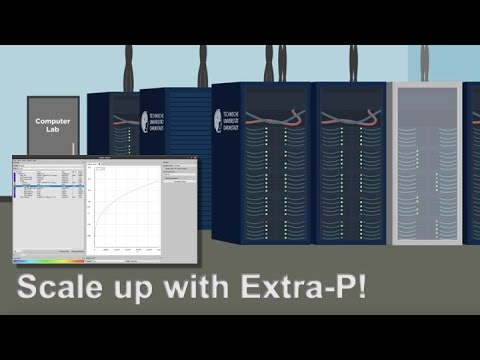
Extra-P is developed by TU Darmstadt – in collaboration with ETH Zurich.
For questions regarding Extra-P, please send a message to extra-p-support@lists.parallel.informatik.tu-darmstadt.de.
Table of Contents
Requirements
- Python 3.10 or higher
- numpy
- pycubexr
- marshmallow
- packaging
- tqdm
- kaitaistruct
- protobuf
- itanium_demangler
- sympy
- typing-extensions
- sklearn
- PySide6 (for GUI)
- matplotlib (for GUI)
- pyvista (for GUI)
- pyvistaqt (for GUI)
- pyobjc-framework-Cocoa (only for GUI on macOS)
Installation
Use the following command to install Extra-P and all required packages via pip.
python -m pip install extrap --upgrade
The --upgrade forces the installation of a new version if a previous version is already installed.
Usage
Extra-P can be used in two ways, either using the command-line interface or the graphical user interface. More information about the usage of Extra-P with both interfaces can be found in the quick start guide.
Note
Extra-P is designed for weak-scaling, therefore, directly modeling of strong-scaling behaviour is not supported. Instead of modeling the runtime of your strong-scaling experiment, you can model the resource consumption, i.e., the runtime times the number of processors. Extra-P automatically offers this conversion, if it detects that strong-scaling data was loaded. If you are loading files that contain per-thread/per-rank data you should select the scaling-type upfront to run the conversion already during the import.
Graphical user interface
The graphical user interface can be started by executing the extrap-gui command.
Command line interface
The command line interface is available under the extrap command:
extrap OPTIONS (--cube | --text | --talpas | --json | --extra-p-3 | --experiment) FILEPATH
You can use different input formats as shown in the examples below:
- Text files:
extrap --text test/data/text/one_parameter_1.txt - JSON files:
extrap --json test/data/json/input_1.JSON - Talpas files:
extrap --talpas test/data/talpas/talpas_1.txt - Create model and save it to text file at the given
path:
extrap --out test.txt --text test/data/text/one_parameter_1.txt
You can find an overview about all command line options under docs/command-line-options.md.
License
BSD 3-Clause "New" or "Revised" License
Citation
Please cite Extra-P in your publications if it helps your research:
Alexandru Calotoiu, Marcin Copik, Fabian Czappa, Alexander Geiß, Gustavo Morais, Marcus Ritter, Sergei Shudler, Torsten Hoefler, Felix Wolf: Extra-P – Empirical Performance Modeling Made Easy. Frontiers in High Performance Computing, 3–2025, 2026. 10.3389/fhpcp.2025.1714042
@Article{calotoiu_extra-p_2026,
  author          = {Calotoiu, Alexandru and Copik, Marcin and Czappa, Fabian and Geiß, Alexander and Morais, Gustavo and Ritter, Marcus and Shudler, Sergei and Hoefler, Torsten and Wolf, Felix},
  title           = {Extra-{P} – {Empirical} {Performance} {Modeling} {Made} {Easy}},
  journal         = {Frontiers in High Performance Computing},
  year            = {2026},
  volume          = {3–2025},
  issn            = {2813–7337},
  doi             = {10.3389/fhpcp.2025.1714042}
}
Selected Publications
-
Alexandru Calotoiu, Torsten Hoefler, Marius Poke, Felix Wolf: Using automated performance modeling to find scalability bugs in complex codes. In Proc. of the International Conference on High Performance Computing, Networking, Storage and Analysis (SC '13), ACM, 2013. DOI
-
Alexandru Calotoiu, David Beckingsale, Christopher W. Earl, Torsten Hoefler, Ian Karlin, Martin Schulz, Felix Wolf: Fast Multi-Parameter Performance Modeling. In Proc. of the 2016 IEEE International Conference on Cluster Computing ( CLUSTER), Taipei, Taiwan, pages 172–181, IEEE, September 2016. PDF
-
Marcus Ritter, Alexandru Calotoiu, Sebastian Rinke, Thorsten Reimann, Torsten Hoefler, Felix Wolf: Learning Cost-Effective Sampling Strategies for Empirical Performance Modeling. In Proc. of the 34th IEEE International Parallel and Distributed Processing Symposium (IPDPS), New Orleans, LA, USA, pages 884–895, IEEE, May 2020. PDF
-
Marcus Ritter, Alexander Geiß, Johannes Wehrstein, Alexandru Calotoiu, Thorsten Reimann, Torsten Hoefler, Felix Wolf: Noise-Resilient Empirical Performance Modeling with Deep Neural Networks. In Proc. of the 35th IEEE International Parallel and Distributed Processing Symposium (IPDPS), Portland, Oregon, USA, pages 23–34, IEEE, May 2021. PDF
-
Alexander Geiß, Téodora Hovi, Alexandru Calotoiu, Felix Wolf: Validating the Performance of GPU Ports Using Differential Performance Models. Future Generation Computer Systems, 174: 1–17, January 2026. DOI
-
Marcus Ritter, Benedict Naumann, Alexandru Calotoiu, Sebastian Rinke, Thorsten Reimann, Torsten Hoefler, Felix Wolf: Cost-Effective Empirical Performance Modeling. Transactions on Parallel and Distributed Systems, 37: 575–592, February 2026. PDF
-
Alexandru Calotoiu, Marcin Copik, Fabian Czappa, Alexander Geiß, Gustavo Morais, Marcus Ritter, Sergei Shudler, Torsten Hoefler, Felix Wolf: Extra-P – Empirical Performance Modeling Made Easy. Frontiers in High Performance Computing, 3–2025, March 2026. DOI
Project details
Verified details
These details have been verified by PyPIProject links
GitHub Statistics
Maintainers
Release history Release notifications | RSS feed


Download files
Download the file for your platform. If you're not sure which to choose, learn more about installing packages.
Source Distribution
Built Distribution
Filter files by name, interpreter, ABI, and platform.
If you're not sure about the file name format, learn more about wheel file names.
Copy a direct link to the current filters
File details
Details for the file extrap-4.3.0b1.tar.gz.
File metadata
- Download URL: extrap-4.3.0b1.tar.gz
- Upload date:
- Size: 7.4 MB
- Tags: Source
- Uploaded using Trusted Publishing? Yes
- Uploaded via: twine/6.1.0 CPython/3.13.12
File hashes
| Algorithm | Hash digest | |
|---|---|---|
| SHA256 |
e6ff8206fd778c7cbd1cddcf7d8263a4be1c248183d8bd9fd5a0314f65489e96
|
|
| MD5 |
93c16f414456b4522ba6cb607d162b28
|
|
| BLAKE2b-256 |
6c7cf0d8a3e2cb9743497a032e3d950d8a6297212ec861ecab98717629069c5a
|
Provenance
The following attestation bundles were made for extrap-4.3.0b1.tar.gz:
Publisher:
python-publish.yml on extra-p/extrap
-
Statement:
-
Statement type:
https://in-toto.io/Statement/v1 -
Predicate type:
https://docs.pypi.org/attestations/publish/v1 -
Subject name:
extrap-4.3.0b1.tar.gz -
Subject digest:
e6ff8206fd778c7cbd1cddcf7d8263a4be1c248183d8bd9fd5a0314f65489e96 - Sigstore transparency entry: 1393355485
- Sigstore integration time:
-
Permalink:
extra-p/extrap@e9af9b4fac74e9225a07cffefba3524054231df7 -
Branch / Tag:
refs/tags/v4.3.0-beta1 - Owner: https://github.com/extra-p
-
Access:
public
-
Token Issuer:
https://token.actions.githubusercontent.com -
Runner Environment:
github-hosted -
Publication workflow:
python-publish.yml@e9af9b4fac74e9225a07cffefba3524054231df7 -
Trigger Event:
release
-
Statement type:
File details
Details for the file extrap-4.3.0b1-py3-none-any.whl.
File metadata
- Download URL: extrap-4.3.0b1-py3-none-any.whl
- Upload date:
- Size: 362.8 kB
- Tags: Python 3
- Uploaded using Trusted Publishing? Yes
- Uploaded via: twine/6.1.0 CPython/3.13.12
File hashes
| Algorithm | Hash digest | |
|---|---|---|
| SHA256 |
c46a0613e0197ca9b9186f211d93f9bc5618d9ae3f0c3f960fbd8b3e46f41ba0
|
|
| MD5 |
a561a15dfe01c2342ac3c2b75336bedb
|
|
| BLAKE2b-256 |
e2185179135d88669b92226fb3a8dec1c8d26b2353c2fbac33490ce5c30703ca
|
Provenance
The following attestation bundles were made for extrap-4.3.0b1-py3-none-any.whl:
Publisher:
python-publish.yml on extra-p/extrap
-
Statement:
-
Statement type:
https://in-toto.io/Statement/v1 -
Predicate type:
https://docs.pypi.org/attestations/publish/v1 -
Subject name:
extrap-4.3.0b1-py3-none-any.whl -
Subject digest:
c46a0613e0197ca9b9186f211d93f9bc5618d9ae3f0c3f960fbd8b3e46f41ba0 - Sigstore transparency entry: 1393355495
- Sigstore integration time:
-
Permalink:
extra-p/extrap@e9af9b4fac74e9225a07cffefba3524054231df7 -
Branch / Tag:
refs/tags/v4.3.0-beta1 - Owner: https://github.com/extra-p
-
Access:
public
-
Token Issuer:
https://token.actions.githubusercontent.com -
Runner Environment:
github-hosted -
Publication workflow:
python-publish.yml@e9af9b4fac74e9225a07cffefba3524054231df7 -
Trigger Event:
release
-
Statement type:






