
extremalrays
Nate MacFadden, Liam McAllister Group, Cornell
Fast extremal rays of pointed polyhedral cones via Clarkson's output-sensitive algorithm. An alternative to the per-ray feasibility LP; should be quicker on hard cases.
Description
Given $R\in\mathbb{Z}^{n\times d}$ (or floats) whose rows $r_i$ generate a pointed cone
$$ \mathcal{C} = \{\textstyle\sum_i \lambda_i r_i : \lambda_i \geq 0\}, $$
exhaustive returns the indices of the unique minimal generating subset, i.e. the extremal rays. sample is a cheaper cousin that certifies a subset of them and makes no completeness claim. verify audits an answer from explicit certificates, checking each one rather than trusting a solver status code.
The usual approach (CYTools' per-ray LP backend, its default through v1.4.12, and redund in cddlib or lrs) asks, for each ray, whether it is a non-negative combination of the other $n-1$. Redundant rays answer quickly. Extremal ones need an infeasibility proof for a big degenerate system, and that is where the time goes. extremalrays never asks that question: a candidate is only ever tested against the small set of rays already confirmed extremal.
One caveat on verify. Its certificates are built independently of exhaustive (different formulation, opposite LP direction, exact arithmetic when the rays are integral), but the two share this package's preprocessing. A bug in the deduplication would be invisible to it.
Prior art
Removing redundant generators is a classical problem with good tools: the double description method of Motzkin et al., as implemented in Fukuda's cddlib; the reverse search of Avis and Fukuda, as implemented in Avis's lrslib; plus Normaliz and polymake. See benchmarks for how we compare. Our benchmarks are focused on our cases of interest (cones arising in CYTools/string theory).
Limitations
- The cone must be pointed (strongly convex); non-pointed input raises
ValueError. Decompose into lineality space + pointed quotient first (as CYTools already does). - Parallel sweeps (
n_workers) only pay off on long jobs: worker startup and snapshot refreshes cost a few seconds, so at benchmark scalen_workers=8is marginally slower in wall time AND costs roughly 2x the CPU-seconds; on a 10M-candidate job it gave ~1.9x. Workers are spawned, so a script passingn_workers > 0must guard its entry point withif __name__ == "__main__":; without it,exhaustivedetects the nested call and falls back to a serial sweep with a warning rather than recursing. - Sparse (CSR) input is for feasibility at scale, not for speed: it is what makes a 10M-ray cone possible at all (dense would be tens of GB), but at benchmark scale it saves no time and costs ~1.8x peak RSS.
- Tolerance is not a free parameter on badly conditioned input: see the note on missing rays in Algorithm Notes. Integer rays get exact escalation; float rays only get a warning.
Installation
pip install extremalrays                 # runtime only
pip install "extremalrays[exact]"        # + python-flint, faster exact arithmetic
From a checkout, swap extremalrays for -e .:
pip install -e ".[test]" # + pytest, to run the suite
Dependencies: numpy, scipy, highspy, with version floors that CI installs and tests. python-flint is optional; without it a pure-Python fallback is used.
Usage
import numpy as np
from extremalrays import exhaustive, sample, verify

# four rays in the plane; only the outer two generate the cone
R = np.array([[1, 0], [2, 1], [1, 1], [0, 1]])

idx = exhaustive(R)              # -> array([0, 3]), indices into R
ext = R[idx]                     # -> [[1, 0], [0, 1]]

ok, report = verify(R, idx)      # -> True, with the certificates checked

some, curve = sample(R, work=200)   # cheap certified subset (no completeness)
Rays can also arrive from a file or another library rather than a literal, and any (n, d) array-like works: exhaustive(np.load("rays.npy")), or a scipy.sparse CSR matrix, which is kept sparse end to end.
Integer input enables exact primitive-vector deduplication and an exact rational fallback in cleanup. Duplicate directions collapse to their first occurrence. A wall-time breakdown of the last call is stored in extremalrays.core.LAST_PROFILE.
For long jobs, n_workers=8 sweeps candidates in parallel against frozen snapshots of the confirmed set (verdicts stay exact; rare separation failures are re-resolved serially), and checkpoint="state.npz" saves state atomically every minute. Rerunning the same call resumes from the last checkpoint, guarded by a fingerprint of the input rays.
Candidate order matters for speed. The separation oracle warm-starts between consecutive LPs, so an order that keeps similar rays adjacent runs faster. On the benchmark cone, generation order takes 13.8 s and a shuffle of it takes 21 to 25 s. Structured order is the common case, so it is the default; for unstructured input, sort_candidates=True lexsorts internally and gets the shuffle back to 13.7 s.
Algorithm Notes
The first step is to convert the problem of computing extremal rays of $\mathcal{C}$ into a polytope-problem. This requires that $\mathcal{C}$ is pointed (no linear subspaces) so that we can scale the rays all to some affine hyperplane $w\cdot x=1$. We can easily find $w$ using LP,
$$ \text{find } w\in\mathbb{R}^d \quad \text{s.t.} \quad w\cdot r_i \geq 1 \ \ \forall i, $$
for $r_1,\dots,r_n\in\mathbb{R}^d$ the (potentially-non-extremal) rays. This LP is solvable if and only if $\mathcal{C}$ is pointed. Further, the rescaling $r_i\leftarrow r_i/(w\cdot r_i)$ forces all rays to land on the slice $w\cdot x=1$ and hence be interpretable as a polytope $\mathrm{conv}\{r_1,\dots,r_n\}$.
Let $E$ be the rays confirmed extremal so far, which starts empty and only grows. A candidate $p$ is tested against it by searching for a linear functional $c\in\mathbb{R}^d$ that separates $p$ from $\mathrm{cone}(E)$:
$$ \max_{c\in\mathbb{R}^d}\ c\cdot p \quad \text{s.t.} \quad c\cdot e \leq 0\ \ \forall e\in E, \quad -1\leq c_i\leq 1, $$
always feasible ($c=0$) and bounded (the box on $c_i$). Value $0$ means $p\in\mathrm{cone}(E)$ by Farkas, so $p$ is redundant regardless of how incomplete $E$ still is. A positive value says nothing about $p$ itself; it just says $E$ is missing an extremal ray. The optimizer $c$ then points at one: the tie-broken maximizer of $c\cdot r_i$ over the remaining candidates is a vertex, joins $E$, and $p$ gets retested. In exact arithmetic that is a proof; a tie broken in floating point can admit a redundant ray, which the cleanup pass re-checks. The main sweep then costs $n+|E|$ LPs, each with at most $|E|$ rows, on one persistent warm-started HiGHS model.
This computation is generally floating point, so noise and tolerances need to be considered. Explicitly, a ray $r_i$ is said to be redundant when $c\cdot r_i<\texttt{tol}$. On badly conditioned cones, this can fire even for $r_i$ extremal. To guard against this,
- values $10^{-12}<c\cdot r_i<\texttt{tol}$ are re-checked in exact rational arithmetic when the rays are integral ($10^{-12}$ is a deliberately low noise floor; re-checking a genuinely redundant ray only costs time), and
verifyaudits the finished answer with the opposite LP, demanding an explicit $\lambda\geq0$ with $E^{\mathsf T}\lambda=r_i$ rather than inferring redundancy from a separation value near $0$. Borderline cases go to the same exact arithmetic, promoting discarded rays to extremal or demoting kept ones to redundant.
By using rational arithmetic, floating point errors are avoided and definitive results can be achieved for integral rays.
Benchmarks
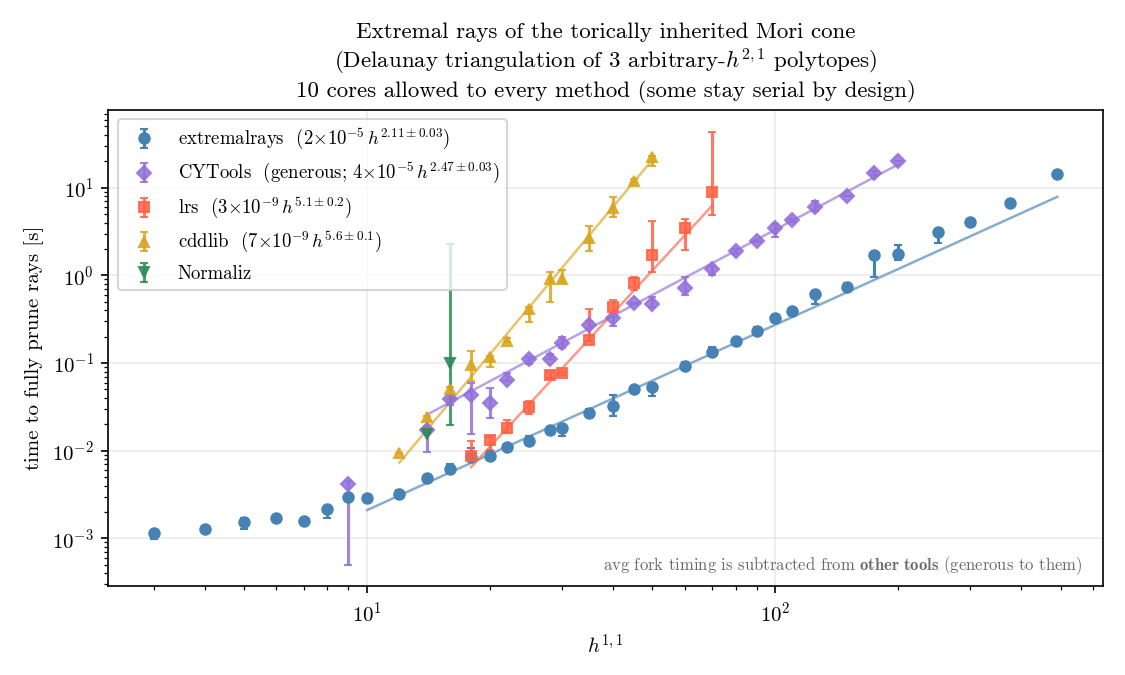
Compared against CYTools, lrs, cddlib and Normaliz on cone families built from the Kreuzer-Skarke polytopes, on an Apple M1 Pro (32 GB RAM, macOS 26). Each method gets all 10 cores, though several stay serial by design. Every method's answer is checked against this package's before it is timed, so a fast wrong answer cannot win, and the fork cost of the command-line tools is measured and subtracted. Points are medians over three polytopes per $h^{1,1}$; error bars are the spread between them. Recreate with the benchmarks/ scripts.
Torically inherited Mori cone, $h^{1,1} = 3$ to $491$:
Mcap, the intersection of the torically inherited Mori cones from all '2-face equivalent' CYs. Being an intersection it is a smaller cone than any of them, but a much bigger problem: 20,899 generators at $h^{1,1}=50$ against 333. Here the x-axis is generator count rather than $h^{1,1}$. The two are not monotonically related (126,363 generators at $h^{1,1}=90$ against 115,678 at $h^{1,1}=100$), so only the former orders these problems by size:
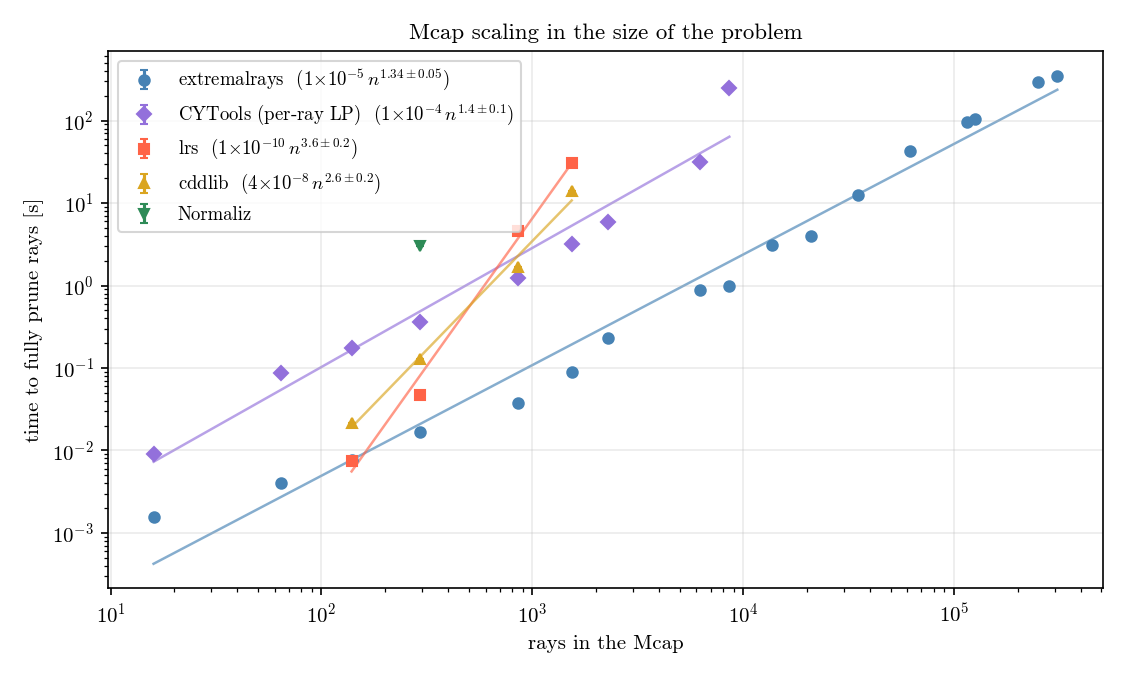
Against CYTools the exponents agree and the gap is a constant of roughly an order of magnitude. Against cddlib and lrs it is the exponent that differs ($n^{2.6}$ and $n^{3.6}$ against $n^{1.34}$), which is why they stop around 1,500 rays.
On the $h^{1,1}=491$ torically inherited Mori cone itself (3509 rays in 491 dimensions, 884 extremal):
| method | time |
|---|---|
| this package | ~13 s |
CYTools v1.4.12 extremal_rays |
does not finish |
| full certificate audit (optional) | ~11 s on 8 workers |
The largest run so far is the Mcap of that same CY: 10,026,843 rays in 491 dimensions, 1,218 extremal, in 79.6 min with n_workers=8 and the slice functional handed in via w=.
Citation
If you use extremalrays in your research, please cite it:
@software{extremalrays,
  author  = {MacFadden, Nate},
  title   = {extremalrays},
  url     = {https://github.com/LiamMcAllisterGroup/extremalrays},
  orcid   = {0000-0002-8481-3724},
}
Organization
extremalrays/
├── src/extremalrays/
│   ├── core.py                     # exhaustive(): the Clarkson sweep
│   ├── inner.py                    # sample(): cheap certified subset
│   └── verify.py                   # verify(): independent certificate audit
├── tests/
│   ├── conftest.py                 # shared test helpers (pytest)
│   ├── test_exhaustive.py          # tests of exhaustive
│   ├── test_parallel_checkpoint.py # tests of n_workers and checkpointing
│   ├── test_sample.py              # tests of sample
│   ├── test_verify.py              # tests of verify
│   ├── test_internals.py           # unit tests of the oracles and dedup
│   ├── test_readme_examples.py     # the README snippet runs as documented
│   └── data/                       # regression fixtures (Mcaps)
├── benchmarks/                     # perf benchmarks; double as usage examples + make the README figures
│   ├── benchmark_h11_491.py        # the flagship cone
│   ├── benchmark_mori_cone.py      # runtime vs h11 against the prior art
│   ├── benchmark_mcap.py           # the same for the Mcap
│   ├── benchmark_parallel.py       # where parallelism pays
│   ├── make_cones.py               # build the Mori cone family
│   ├── make_caps.py                # build the Mcap family
│   ├── _bench.py                   # shared timing helper
│   ├── _plot.py                    # the runtime-vs-h11 figure
│   ├── _plot_scaling.py            # the runtime-vs-ray-count figure
│   ├── _cytools_env.py             # pinned cytools==1.4.12 for the comparison
│   ├── _cytools_driver.py          # runs CYTools in a fresh interpreter
│   └── data/                       # cone and Mcap ray matrices
├── docs/                           # README figures (benchmark_*.png)
├── perf-work/                      # recorded benchmark results
└── pyproject.toml
Reproducing the figures
python benchmarks/make_cones.py --per-h11 3 --h11 3 5 10 20 50 100 200 491
python benchmarks/benchmark_mori_cone.py            # -> docs/benchmark_prior_art.png
python benchmarks/make_caps.py --h11 10 20 30 40 50
python benchmarks/benchmark_mcap.py                 # -> docs/benchmark_cap*.png
Comparisons are skipped for tools that are not installed, and every method's answer is checked against this package's before it is timed. Add --plot-only to redraw a figure from results already measured.
License
GPL-3.0-or-later (matching CYTools).
Metadata
Release files for extremalrays 0.4.1
For a detailed explanation of source distributions (sdists) and built distributions (wheels), please see the package formats documentation.
Source distribution (sdist)
| File | Size | Uploaded | |
|---|---|---|---|
| extremalrays-0.4.1.tar.gz | 66.7 kB | Details |
Built distribution (wheel)
| File | Interpreter | ABI | Platform | Reset |
|---|---|---|---|---|
| extremalrays-0.4.1-py3-none-any.whl | Python 3 | none | any | Details |
Total release size: 116.6 kB
Release files / extremalrays-0.4.1.tar.gz
| Download URL | extremalrays-0.4.1.tar.gz |
|---|---|
| Size | 66.7 kB |
| Tags | Source |
|
SHA-256 checksum How to use checksums |
4a320a5abb06d2f1798ede6476b8e09c3bd447fda25bd2a50e9235fbe28069ea
|
|
BLAKE2b-256 checksum How to use checksums |
613cb26ea9d3dcae4634cff249d53766b133d86a0a62e566706d66533d91094e
|
| Upload date | |
|
Uploaded using Trusted Publishing? What is trusted publishing? |
Yes |
| Uploaded via |
twine/7.0.0 CPython/3.13.14
|
Provenance
Provenance describes where a file came from. On PyPI, provenance is shared via attestations, which provide a verifiable record of the build or publishing details. View details, limitations and caveats.


PyPI Publish Attestation
PyPI verified that this artifact, at this checksum, originated from the publisher listed below.
Signed by GitHub Actions, verified by PyPI on Aug 26, 2026.
Transparency logRelease files / extremalrays-0.4.1-py3-none-any.whl
| Download URL | extremalrays-0.4.1-py3-none-any.whl |
|---|---|
| Size | 49.9 kB |
| Tags | Python 3 |
|
SHA-256 checksum How to use checksums |
70669cd57631b447f2c41dff1bcb9f5c423c022c6089482fed97804d1f3297cd
|
|
BLAKE2b-256 checksum How to use checksums |
e1b579629084a21c7869e3c250c56ac0f95ee5cdafb287bf1b249f69041e9f75
|
| Upload date | |
|
Uploaded using Trusted Publishing? What is trusted publishing? |
Yes |
| Uploaded via |
twine/7.0.0 CPython/3.13.14
|
Provenance
Provenance describes where a file came from. On PyPI, provenance is shared via attestations, which provide a verifiable record of the build or publishing details. View details, limitations and caveats.
PyPI Publish Attestation
PyPI verified that this artifact, at this checksum, originated from the publisher listed below.
Signed by GitHub Actions, verified by PyPI on Aug 26, 2026.
Transparency log













