
extremitypathfinder







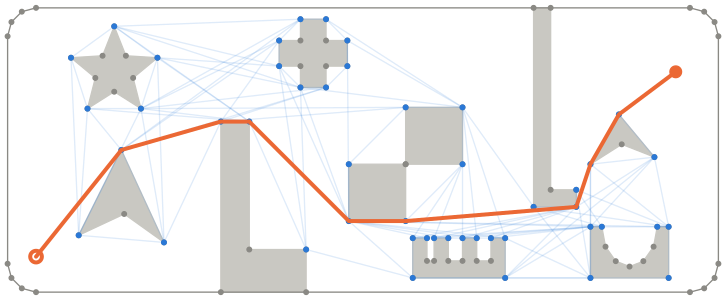
Python package for fast geometric shortest path computation in 2D multi-polygon or grid environments based on visibility graphs.
Exact Euclidean shortest paths with pip install, on the polygons you already have: touching and overlapping polygons and grids are used as they are, with well-defined and tested behaviour at contacts and other edge cases (what sets it apart).
Features
Exact shortest paths: the Euclidean shortest path between any two points of the free space, not an approximation on a grid or mesh.
Fast repeated queries: the visibility graph of an environment is computed once, each query then only connects its start and goal to it. Only the protruding corners (“extremities”) become graph nodes, which keeps the graph small.
Polygon environments: a boundary polygon with holes, or holes only (unbounded environments). Polygons may touch and overlap each other. Touching obstacles form a wall that paths cannot pass. The polygons are used directly: no triangulation or navigation mesh is needed.
Grids: convert a grid with blocked cells into a polygon environment.
Shapely and GeoJSON input (optional): pass Shapely geometries, GeoJSON or GeoPandas geometries directly. Agents with a size keep a clearance to the obstacles when these are inflated with Shapely (documented recipe).
Well-defined edge cases: touching obstacles, points on edges and collinear vertices follow one set of rules. The floating point decisions are audited against exact arithmetic, the results are identical with and without Numba.
Few dependencies: only NumPy. Optional Numba acceleration, export of the visibility graph to NetworkX.
Extras: input validation, plotting (Matplotlib), saving prepared environments to a file, and a command line interface.
Installation
pip install extremitypathfinderWith the optional Numba extra for a significant speedup (larger installation, initial compilation time):
pip install "extremitypathfinder[numba]"Python 3.12 or newer is required (CI tests CPython 3.12–3.15). Dependencies: NumPy >=2.3.3,<3 (NetworkX 3.x with the optional networkx extra). Cf. supported versions and dependencies for the support policy.
Quick Start
Polygon environment
from extremitypathfinder import PolygonEnvironment

# the boundary polygon (clockwise or counter clockwise vertex numbering)
boundary_coordinates = [(0.0, 0.0), (10.0, 0.0), (9.0, 5.0), (10.0, 10.0), (0.0, 10.0)]
# the holes (obstacles)
list_of_holes = [
    [
        (3.0, 7.0),
        (5.0, 9.0),
        (4.5, 7.0),
        (5.0, 4.0),
    ],
]
# computes the visibility graph once
environment = PolygonEnvironment(boundary_coordinates, list_of_holes)

# fast consecutive queries
path, length = environment.find_shortest_path((4.5, 1.0), (4.0, 8.5))
# path: [(4.5, 1.0), (3.0, 7.0), (4.0, 8.5)], length: 7.987...
path is [] and length is None when there is no path between start and goal. The input polygons are validated by default (self intersections, overlapping edges, …) and invalid input raises a ValueError. The validation costs little compared to the preparation of the environment. For trusted input it can be skipped (validate=False).
Grid environment
Coordinates refer to the corners of the grid cells, i.e. cell (x, y) spans [x, x+1] x [y, y+1]:
size_x, size_y = 5, 3
obstacle_iter = [(2, 1), (3, 1)]  # blocked grid cells (x, y)
environment = PolygonEnvironment.from_grid(size_x, size_y, obstacle_iter)
path, length = environment.find_shortest_path((0.5, 0.5), (4.5, 2.5))
# path: [(0.5, 0.5), (2.0, 2.0), (4.5, 2.5)], length: 4.670...
Command line
Environments stored as JSON (cf. example.json) can be queried from the command line:
extremitypathfinder ./example.json -s 2.5 3.2 -g 7.9 6.8Documentation
The documentation covers:
Usage: all features, the input requirements, plotting and caching
About: how it works and the handling of touching obstacles
Engineering Design: the architecture and the algorithms
Alternatives: similar packages and how they differ
Citing
If you use extremitypathfinder in your research, please cite it. The citation metadata is in CITATION.cff: GitHub converts it into APA and BibTeX (“Cite this repository” in the sidebar of the repository). Please cite the version you used.
Contributing and License
Contributions are welcome: see the contribution guidelines and the issue tracker. Questions and requests for help go to the issue tracker as well.
extremitypathfinder is distributed under the terms of the MIT license (LICENSE).
1 maintainer

Metadata
1 maintainer
Release files for extremitypathfinder 4.0.0
For a detailed explanation of source distributions (sdists) and built distributions (wheels), please see the package formats documentation.
Source distribution (sdist)
| File | Size | Uploaded | Provenance | Actions |
|---|---|---|---|---|
| extremitypathfinder-4.0.0.tar.gz | 171.3 kB | Without provenance | Details for extremitypathfinder-4.0.0.tar.gz |
Built distribution (wheel)
| File | Interpreter | ABI | Platform | Actions Reset |
|---|---|---|---|---|
| extremitypathfinder-4.0.0-py3-none-any.whl | Python 3 | none | any | Details for extremitypathfinder-4.0.0-py3-none-any.whl |
Total release size: 235.4 kB
Release files / extremitypathfinder-4.0.0.tar.gz
| Download URL | extremitypathfinder-4.0.0.tar.gz |
|---|---|
| Size | 171.3 kB |
| Tags | Source |
|
SHA-256 checksum How to use checksums |
a73e54cbbd9edbe8bfda537fd760453e6f8a06e1ba0cf0987b9bc678cfd265d2
|
|
BLAKE2b-256 checksum How to use checksums |
c42aaf977be2076ec952a82c5d27a06bbdf18e29507e584379ae772e158c42d5
|
| Upload date | |
|
Uploaded using Trusted Publishing? What is trusted publishing? |
No |
| Uploaded via |
twine/7.0.0 CPython/3.13.16
|
Release files / extremitypathfinder-4.0.0-py3-none-any.whl
| Download URL | extremitypathfinder-4.0.0-py3-none-any.whl |
|---|---|
| Size | 64.0 kB |
| Tags | Python 3 |
|
SHA-256 checksum How to use checksums |
b2ddd52b7a2dc1be41866ed74cac07b4949e532e6401af182d86a861c11609e6
|
|
BLAKE2b-256 checksum How to use checksums |
3d8302148261373be3009c71f31a63daa8f5a2d2cd9ff2d918fd7bded5f24490
|
| Upload date | |
|
Uploaded using Trusted Publishing? What is trusted publishing? |
No |
| Uploaded via |
twine/7.0.0 CPython/3.13.16
|
Security for extremitypathfinder 4.0.0
Provenance
Provenance describes where a file came from. On PyPI, provenance is shared via attestations, which provide a verifiable record of the build or publishing details. View details, limitations and caveats.
No provenance found
None of the files in this release were uploaded with provenance metadata.
A note on package security
PyPI is a repository for distributing packages, not a service for auditing them. While third-party security researchers and our staff do their best to detect and remove malicious packages, PyPI cannot guarantee the quality, security or suitability of any given package.
To learn more about protecting yourself from malicious actors, visit our package security documentation.














