
Developer CLI for Fabric feature-branch workspace provisioning.

Project description
Microsoft Fabric - Development Worfklows CLI




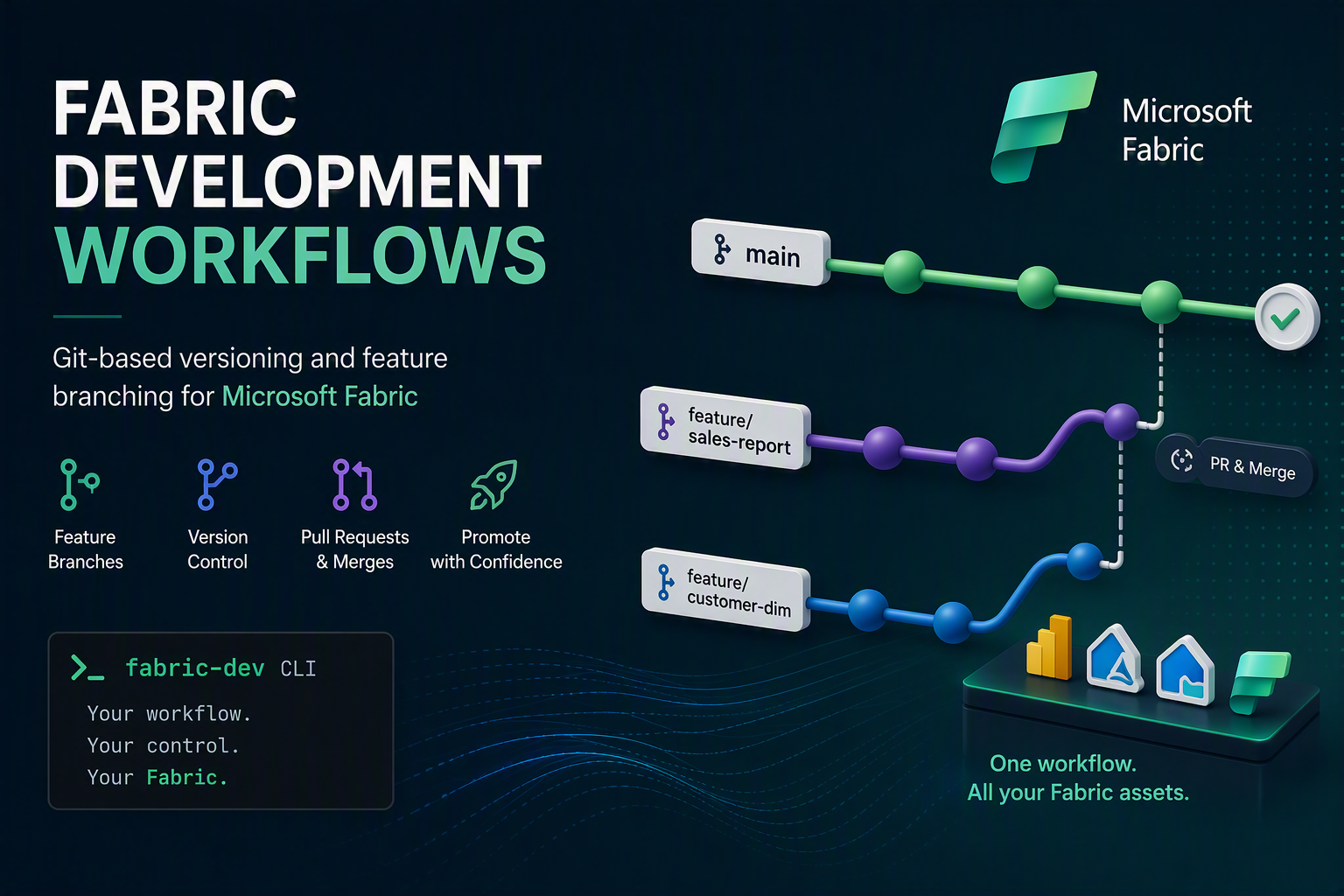
The Development Workflows CLI for Microsoft Fabric (fab-dev) is designed to support git-based development tasks on top of Fabric.
Quick start
# Install the CLI
pip install fab-dev

# Authenticate
fab-dev auth login                           # authenticate yourself

# Start developing on Fabric
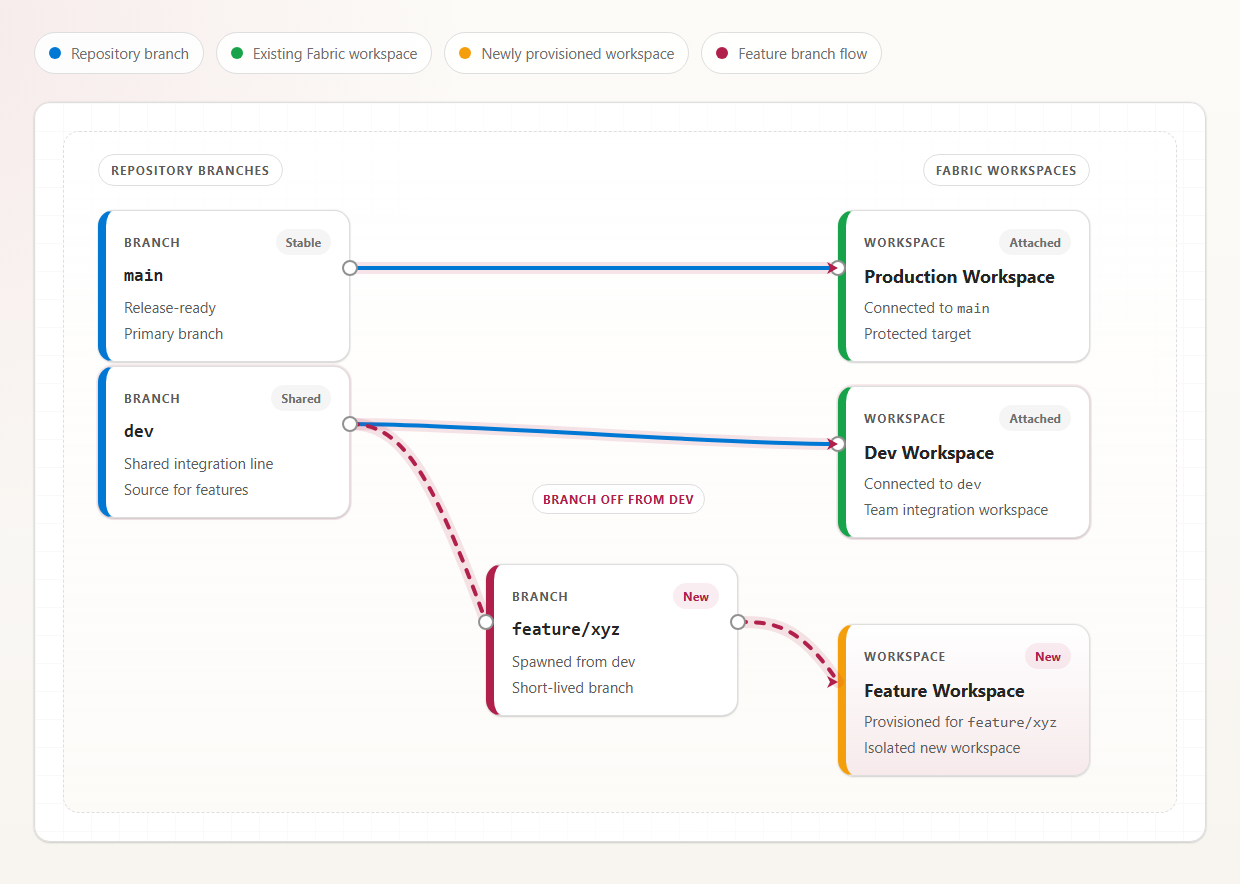
fab-dev create my_feature --dev-branch dev       # creates a workspace attached to a feature branch cut from dev branch
fab-dev sync push <workspace-id|workspace-url|workspace-name>     # push changes in the branch
fab-dev sync pull <workspace-id|workspace-url|workspace-name>     # downloads latest changes in workspace
fab-dev pr create                                                 # opens a Pull Request
✨ Key Features
🌱 Feature Branch Provisioning
- Create a feature branch and provision a corresponding Fabric workspace in one command.
- Validate branch ancestry against a configurable dev baseline.
- Reuse an existing target workspace when rerunning to keep workflows idempotent.
🔑 Built-In Authentication Commands
- Use
fab-dev auth loginfor interactive user, service principal, or managed identity sign-in. - Use
fab-dev auth statusto verify token availability and inspect active account/tenant. - Use
fab-dev auth logoutto clear local auth context and reset CLI token cache.
🔄 Git-Aware Workspace Sync
- Pull branch snapshots into a workspace with conflict-aware behavior.
- Push workspace changes back to the connected branch with an optional message.
- Inspect sync status in human-readable or JSON format.
🔐 Access and Governance Defaults
- Grant or revoke users and groups by role.
- Assign branch creator as workspace admin during provisioning.
- Support user/group identity mapping for enterprise directory scenarios.
🧹 Lifecycle Cleanup
- Remove feature workspaces safely when a branch is done.
- Optionally delete the feature branch from origin and local repo.
- Keep cleanup idempotent so repeated execution does not fail on missing resources.
🤝 PR Flow Integration
- Open pull requests to merge feature branches into dev.
- Works with GitHub and Azure DevOps remotes.
🧱 Environment Scaffolding
- Bootstrap baseline environments (
dev,test,prod) in one run. - Create/reuse environment branches and mapped Fabric workspaces using deterministic naming.
- Keep prod/main protected by default (no auto-sync unless explicitly enabled).
📦 Installation
Prerequisites
- Python 3.11+
- A Microsoft Fabric tenant and capacity
- A repository using a dev branch model (for example
devandfeat/*) - A dev workspace attached to that capacity and
devrepository - Multiple developers working from a
devbranch
Install from local source
pip install -e .
Verify installation
fab-dev --help
fab-dev --version
Developer tooling (formatting)
This repository uses black as the Python formatter.
# Install dev tools
pip install -r requirements-dev.txt

# Run formatter manually
black .

# Install git pre-commit hook (auto-format on commit)
pre-commit install
After pre-commit install, every local commit runs Black automatically.
🔐 Authentication
Current CLI operations authenticate using one of the following:
FABRIC_ACCESS_TOKEN, or- an authenticated Azure CLI session via
az login
CLI auth commands:
fab-dev auth loginfab-dev auth status [--json]fab-dev auth logout
For pull request creation:
- GitHub:
FAB_DEV_GITHUB_TOKEN(orGITHUB_TOKEN/GH_TOKEN) orgh auth login - Azure DevOps:
FAB_DEV_AZDO_PAT(orAZURE_DEVOPS_EXT_PAT) oraz login
🎯 Usage Examples
Authenticate and Verify Session
# Interactive sign-in
fab-dev auth login

# Service principal sign-in
fab-dev auth login -u <client_id> -p <client_secret> --tenant <tenant_id>

# Managed identity sign-in
fab-dev auth login --identity

# Verify current auth/session details
fab-dev auth status --json

# Sign out local auth context
fab-dev auth logout
Create and Provision
# Create from short feature name (expands to feat/my_feature)
fab-dev create my_feature --dev-branch dev

# Create from explicit branch name
fab-dev create feat/my_feature

# Override creator/capacity and grant access during create
fab-dev create my_feature \
  --creator alice@contoso.com \
  --capacity-id <fabric-capacity-guid> \
  --add-user alice@contoso.com:Contributor \
  --add-group data-eng:Viewer
Sync Workspace and Branch
# Check git sync status
fab-dev sync status <workspace-id|workspace-url|workspace-name>

# Pull latest branch snapshot into workspace
fab-dev sync pull <workspace-id|workspace-url|workspace-name>

# Pull and overwrite pending local workspace changes
fab-dev sync pull <workspace-id|workspace-url|workspace-name> --force

# Push workspace changes to branch
fab-dev sync push <workspace-id|workspace-url|workspace-name> --message "Update notebook"

# Push workspace changes with positional quoted message
fab-dev sync push <workspace-id|workspace-url|workspace-name> "Update notebook"
Manage Access
# Grant role assignments
fab-dev access grant <workspace-ref> --user alice@contoso.com:Contributor --group data-eng:Viewer

# Revoke assignments
fab-dev access revoke <workspace-ref> --group data-eng
Open Pull Requests
# Create PR from current branch to dev
fab-dev pr create

# Customize PR target/title/body
fab-dev pr create --target-branch dev --title "Add customer churn notebook" --body "Implements feature workflow"
Scaffold Environment Baseline
Prerequisites for scaffold:
0. Authenticate by running fab-dev auth login
- Clone the repository and change directory into the local clone.
- Resolve the Fabric capacity ID (GUID), or use capacity name.
- Open an existing workspace on that capacity.
- Copy the workspace ID from URL
/groups/<workspaceId>. - Run
fab-dev sync status <workspace-id|workspace-url|workspace-name> --json. - Use the
capacityIdfield from output.
# Dry-run scaffold plan
fab-dev scaffold init --capacity-id <fabric-capacity-guid> --workspace-prefix contoso --dry-run

# Interactive scaffold: enter capacity ID or capacity name, choose env profile
# (dev/test/prod | dev/prod | dev only), then enter branch names and workspace prefix
fab-dev scaffold init

# Non-interactive scaffold env branches and workspaces (prod maps to main)
fab-dev scaffold init \
  --capacity-id <fabric-capacity-guid> \
  --workspace-prefix contoso \
  --env-branches dev,test,prod \
  --non-interactive \
  --yes

# Use capacity name as alternative input
fab-dev scaffold init \
  --capacity-name "Contoso Capacity" \
  --workspace-prefix contoso \
  --yes

# Allow remapping existing workspace branch links and prod sync
fab-dev scaffold init \
  --capacity-id <fabric-capacity-guid> \
  --workspace-prefix contoso \
  --rebind \
  --sync-prod \
  --yes
Notes:
- Workspace mapping is deterministic:
<workspace-prefix>-<env>. - If prefix contains spaces, env suffix is appended with a space (example:
Scaffolding Try dev). - If prefix uses
_separators, env suffix uses_(example:scaffolding_try_dev). - Interactive runs always show a dry-run review phase (including planned workspace names) before execution.
- Review phase includes a topology diagram (
repo -> branch -> workspace -> capacity) for each environment. - If
maindoes not exist, scaffold bootstraps it with a minimal commit before creating env branches. - If a workspace already exists but is mapped to a different branch, scaffold fails unless
--rebindis provided. prodmaps tomainby default and is protected from auto-sync unless--sync-prodis set.
Cleanup
# Cleanup workspace resolved from current feature branch
fab-dev cleanup --yes

# Cleanup specific feature and delete branch locally/remotely
fab-dev cleanup feat/my_feature --yes --delete-branch

# Cleanup explicit workspace reference
fab-dev cleanup --workspace-ref <workspace-id|workspace-url|workspace-name> --yes
🧭 Command Groups
| Command | Purpose |
|---|---|
auth login |
Authenticate for Fabric operations |
auth status |
Show current authentication status and token source |
auth logout |
Clear local authentication context |
create |
Create/publish feature branch and provision Fabric workspace |
sync pull |
Pull connected branch snapshot into workspace |
sync push |
Push workspace changes to connected branch |
sync status |
Show workspace sync status |
access grant |
Grant users/groups roles in workspace |
access revoke |
Revoke users/groups from workspace |
workspace list |
List visible workspaces |
pr create |
Create pull request in git provider |
cleanup |
Delete feature workspace and optionally branch |
scaffold init |
Bootstrap env branches and mapped Fabric workspaces |
help |
Show command-specific help |
⚙️ Configuration
Common flags
--dev-branchcontrols the baseline branch for create/cleanup flows (defaultdev).--feature-prefixcontrols feature branch naming (defaultfeat/).--workspace-prefixprovides fallback workspace naming when discovery is unavailable.
Environment variables
FABRIC_ACCESS_TOKENFABRIC_CAPACITY_IDFABRIC_WORKSPACE_PREFIXFABRIC_AZ_CLI_PATHFAB_DEV_AZ_SUBSCRIPTIONFABRIC_PRINCIPAL_MAP_JSONFABRIC_USER_MAP_JSONFABRIC_GROUP_MAP_JSONFAB_DEV_GITHUB_TOKENGITHUB_TOKENGH_TOKENFAB_DEV_AZDO_PATAZURE_DEVOPS_EXT_PAT
🏗️ Architecture Notes
Current implementation is REST-first for deterministic request/response control and predictable automation behavior.
For a visual overview of branch-to-workspace relationships, open workspace-topology.html.
- Runtime entrypoint:
fab_dev/main.py - Parser wiring:
fab_dev/core/parser_setup.py - Command parsers:
fab_dev/parsers/ - Command handlers:
fab_dev/commands/ - Existing implementation core:
fab_dev/cli.py
🛡️ Operational Design Principles
- Deterministic workspace naming and branch-to-workspace mapping
- Idempotent command behavior for retries and reruns
- Least-privilege access assignment defaults
- Capacity-aware provisioning and safe failure handling
- Auditable lifecycle operations (provision, sync, cleanup)
📄 Project Status
This repository is focused on the first production-ready iteration of the fab-devworkflow.
Near-term evolution typically includes provider abstraction options and expanded parity tests for alternative execution paths.
🤝 Contributing
We welcome contributions from the community. Whether you are fixing bugs, adding features, improving documentation, or helping other users, your contributions are valuable.
Quick Start Contributing
- Check existing issues - Look for issues labeled
help-wanted. - Read our guidelines - See CONTRIBUTING.md for detailed instructions.
- Fork and clone - Set up your development environment.
- Create a pull request - Link it to the related issue.
Before contributing, please review our Contributing Guidelines and Code of Conduct.
🆘 Support & Community
Getting Help
- GitHub Issues - Bug reports and feature requests
- GitHub Discussions - Questions and community support
- Documentation - Usage guidance and examples in this repository
- Microsoft Community - Connect with other Fabric developers: https://community.fabric.microsoft.com/t5/Developer/bd-p/Developer
Feature Requests
- GitHub Issues - Technical feature requests
- Fabric Ideas Portal - Product-level feature suggestions: https://ideas.fabric.microsoft.com/
Enterprise Support
- Contact your Microsoft account manager.
- Microsoft Fabric Support - Official support: https://support.fabric.microsoft.com/
🔄 Release Notes
See VERSIONING.md for versioning policy and release workflow details.
📄 License
This project is licensed under the MIT License. See LICENSE for details.
Release history Release notifications | RSS feed


Download files
Download the file for your platform. If you're not sure which to choose, learn more about installing packages.
Source Distribution
Built Distribution
Filter files by name, interpreter, ABI, and platform.
If you're not sure about the file name format, learn more about wheel file names.
Copy a direct link to the current filters
File details
Details for the file fab_dev-0.1.1.tar.gz.
File metadata
- Download URL: fab_dev-0.1.1.tar.gz
- Upload date:
- Size: 46.6 kB
- Tags: Source
- Uploaded using Trusted Publishing? No
- Uploaded via: twine/6.2.0 CPython/3.14.5
File hashes
| Algorithm | Hash digest | |
|---|---|---|
| SHA256 |
b3c739dcfa96907a6150d4b28bed82e860935ccc01f61fe293ca1d2ea5448c16
|
|
| MD5 |
1d95df9446fe97a29fd4992bffd81d47
|
|
| BLAKE2b-256 |
39eb12d4a4c1a30a839218f4c85bfb81040294be2d99a5122a47a947f4ec7981
|
File details
Details for the file fab_dev-0.1.1-py3-none-any.whl.
File metadata
- Download URL: fab_dev-0.1.1-py3-none-any.whl
- Upload date:
- Size: 45.5 kB
- Tags: Python 3
- Uploaded using Trusted Publishing? No
- Uploaded via: twine/6.2.0 CPython/3.14.5
File hashes
| Algorithm | Hash digest | |
|---|---|---|
| SHA256 |
d758dad3ae1e9e146a4f8024d6209dff2f51ce8033eceef59ee65056d332f861
|
|
| MD5 |
366fcca27cd7e5dfc3f541577b008201
|
|
| BLAKE2b-256 |
956ce9b8f2e22ae55ecc7b23f26ea90725ee0c33d3380931d5e73c516c104892
|






