
Fabrica
The context layer for Python agents. Part of the Civitas platform.


pip install fabrica-context               # import fabrica
pip install fabrica-context[presidium]    # + RestPresidiumClient (real REST+mTLS governance client)
fabricaitself is already taken on PyPI by an unrelated project — the project and repo keep the name "Fabrica", only the distribution name differs (same pattern aspip install pyyaml→import yaml).
What this is
Agents don't fail because the model is weak — they fail because the context window is mismanaged. Every tool schema, every skill, every memory, every intermediate result gets stuffed into the prompt whether the model needs it or not, and both cost and accuracy degrade as a result.
Fabrica is the answer: it decides what an agent sees and where its code actually runs. Its headline mechanism is code-mode — a model writes code against a tool namespace instead of making individual tool calls, that code runs in an isolated sandbox, and only the final result crosses back into the model's context. Measured on real hardware, not claimed: ~79% cheaper and more correct than traditional tool-calling.
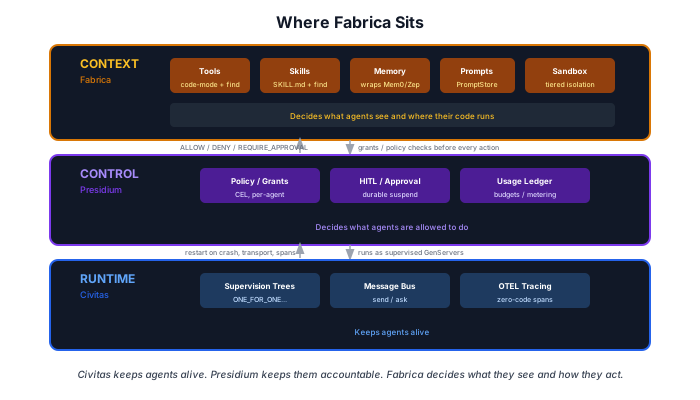
Civitas keeps agents alive. Presidium keeps them accountable. Fabrica decides what they see and how they act on it.
What it does
| Capability | Shape |
|---|---|
| Tools as code | A code-API namespace + isolated execution — the headline mechanism above. A find() retrieval fallback exists for models that don't do code-mode. |
| Skills gateway | Loads the open SKILL.md standard with progressive disclosure — validated against the real 81-skill bigpowers catalog. |
| Memory | A MemoryStore protocol wrapping mature backends (Mem0 today; Zep/Letta/Cognee planned) — working memory, compaction, and long-term recall as three separate facets, not one blended score. |
| Prompts | A versioned, addressable PromptStore — storage and retrieval only, deliberately not rendering or compression. |
| MCP, both directions | A real MCP client (MCPToolNamespace) and a real MCP server (FabricaMCPServer, stdio + HTTP) — external tools come in, Fabrica's own tools/skills/memory/prompts go out, without reintroducing the schema-dump cost code-mode exists to avoid. Client-side transports: stdio, sse, and streamable_http — see benchmarks below. |
| Tunnels | TunnelProvider for exposing a local dev deployment publicly — Tailscale Funnel and Cloudflare quick tunnels, both credential-free. |
MCP transport benchmarks — real, not estimated
Methodology, stated plainly: single OS process, single OS thread, for
both client and server (concurrency = concurrent anyio tasks on one event
loop, not real parallelism); one shared ClientSession/connection for all
concurrent callers, not independent simulated users; loopback only, zero
real network hop; a trivial, zero-work echo tool, to isolate transport
overhead specifically. Real hardware (AMD Ryzen 9 3900X, 24 threads),
matched dependency versions (mcp==2.0.0, uvicorn==0.51.0), no mocks.
Compared against two independently-published, real industry benchmarks
(TM Dev Lab's cross-language benchmark, Stacklok/ToolHive's transport
benchmark) — the honest conclusion: no fair, direct ranking is possible from
this spike alone, since neither the network topology nor the tool workload
match. What DOES hold up: this implementation's raw transport overhead is
the same order of magnitude as other real Python MCP implementations once
those differences are accounted for, and its throughput-plateau finding is
independently corroborated by Stacklok's own session-scaling data. Full
methodology, raw JSON, every finding, and the full industry comparison with
real citations:
specs/archive/spikes/SPIKE-mcp-transport-benchmark.md.
| Transport | p50 latency | p99 latency | throughput @ concurrency=10 | RSS growth / 2000 calls |
|---|---|---|---|---|
stdio |
0.69ms | 0.71ms | 2356 calls/s | 0.00 MB |
sse |
1.32ms | 1.61ms | 991 calls/s | 0.00 MB |
streamable_http |
2.01ms | 2.68ms | 673 calls/s | 0.00 MB |
streamable_http runs at roughly 3x stdio's p50 latency and ~1.5x sse's —
expected, given it layers a full HTTP request/response on top of what sse
does over an already-open stream. No transport showed measurable memory
growth at 2000 calls. A real, notable finding: throughput did not
meaningfully scale past ~5 concurrent callers sharing one ClientSession,
on any transport — see the spike doc for the full reasoning and the (still
open) question of whether multiple sessions would scale differently.
Isolation — the differentiator
Running model-generated code needs real isolation. Fabrica treats it as one
pluggable, tiered Sandbox protocol, auto-detected per host — callers never
choose a backend themselves.
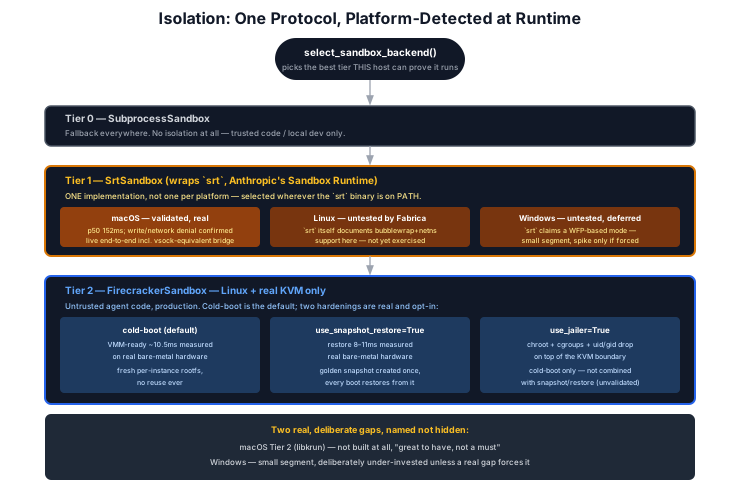
Tier 2 (Firecracker) is the real production target on Linux: microVM-per-agent
isolation, cold-boot by default, with opt-in snapshot/restore (~8–11ms
warm restores, measured) and opt-in jailer hardening (chroot + cgroups +
uid/gid drop on top of the KVM boundary) — both validated end to end on real
hardware, not simulated. Full detail: docs/isolation.md.
Status
Alpha, real and tested, not just designed. Nine contracts, fifteen spikes (all real
hardware/API evidence — specs/archive/spikes/),
every object-model component built and tested, not just designed:
Retriever, Sandbox/SandboxPool (all three tiers implemented), ToolManager,
SkillManager, MemoryManager, PromptManager, CivitasBridge, both MCP
directions, TunnelProvider, and -- as of v0.2.0 -- RestPresidiumClient, the real
REST+mTLS PresidiumClient implementation (circuit-breaker protected, fail-closed),
verified against civitas-io/presidium's
own real, live M7 server, not mocks. A real GitHub Actions pipeline lints, tests,
and builds on every push.
Genuinely open, not hidden: managed-provider adapters (E2B/Modal/AWS/Azure/GCP)
are blocked on real cloud credentials this project doesn't have yet; a
fabrica/fabrica-contrib package split is designed but deliberately
deferred until a real adapter needs it. Full, current, ordered state:
HANDOFF.md → docs/PLAN.md.
Documentation
| Start here | For |
|---|---|
HANDOFF.md |
Current state, what's done, what's next — read this first |
docs/architecture.md |
Visual tour of the whole system |
docs/system-design.md |
Internals: object model, deployment topology, state ownership |
docs/contracts/ |
Implementation-ready signatures for every component |
docs/PLAN.md |
The active, ordered work queue |
Discovery, design, and validation docs (personas, landscape research, per-
component design docs, spike write-ups) live under docs/ and
specs/archive/spikes/ — grouped and indexed in
HANDOFF.md's own reading-order section.
License
Apache 2.0.
1 maintainer

Metadata
1 maintainer
Release files for fabrica-context 0.6.0
For a detailed explanation of source distributions (sdists) and built distributions (wheels), please see the package formats documentation.
Source distribution (sdist)
| File | Size | Uploaded | Provenance | Actions |
|---|---|---|---|---|
| fabrica_context-0.6.0.tar.gz | 580.1 kB | With provenance | Details for fabrica_context-0.6.0.tar.gz |
Built distribution (wheel)
| File | Interpreter | ABI | Platform | Actions Reset |
|---|---|---|---|---|
| fabrica_context-0.6.0-py3-none-any.whl | Python 3 | none | any | Details for fabrica_context-0.6.0-py3-none-any.whl |
Total release size: 717.9 kB
Release files / fabrica_context-0.6.0.tar.gz
| Download URL | fabrica_context-0.6.0.tar.gz |
|---|---|
| Size | 580.1 kB |
| Tags | Source |
|
SHA-256 checksum How to use checksums |
6cb44ee77458025c43a3ee8db3ad853f35cc8140d5557ad1ac5d41e61e535b8c
|
|
BLAKE2b-256 checksum How to use checksums |
40903c4c2c8df10dc2dc073120d039d85bf939b0aaa313ab0a032f7b3b651f39
|
| Upload date | |
|
Uploaded using Trusted Publishing? What is trusted publishing? |
Yes |
| Uploaded via |
twine/7.0.0 CPython/3.13.14
|
Provenance
Provenance describes where a file came from. On PyPI, provenance is shared via attestations, which provide a verifiable record of the build or publishing details. View details, limitations and caveats.


PyPI Publish Attestation
PyPI verified that this artifact, at this checksum, originated from the publisher listed below.
Signed by GitHub Actions, verified by PyPI on Aug 26, 2026.
Transparency logRelease files / fabrica_context-0.6.0-py3-none-any.whl
| Download URL | fabrica_context-0.6.0-py3-none-any.whl |
|---|---|
| Size | 137.7 kB |
| Tags | Python 3 |
|
SHA-256 checksum How to use checksums |
a35a0cbf543f24bd35a3227b2fa58198bf538d889c5983457ce54c6e34cbb71a
|
|
BLAKE2b-256 checksum How to use checksums |
60257b18e83f14eb7bb34f77c1c16c5bbe389dbe9235e147f7837b78e71c98b4
|
| Upload date | |
|
Uploaded using Trusted Publishing? What is trusted publishing? |
Yes |
| Uploaded via |
twine/7.0.0 CPython/3.13.14
|
Provenance
Provenance describes where a file came from. On PyPI, provenance is shared via attestations, which provide a verifiable record of the build or publishing details. View details, limitations and caveats.
PyPI Publish Attestation
PyPI verified that this artifact, at this checksum, originated from the publisher listed below.
Signed by GitHub Actions, verified by PyPI on Aug 26, 2026.
Transparency logSecurity for fabrica-context 0.6.0
Provenance
Provenance describes where a file came from. On PyPI, provenance is shared via attestations, which provide a verifiable record of the build or publishing details. View details, limitations and caveats.
Full provenance
All 2 files in this release have been uploaded with provenance metadata.
Attestation for fabrica_context-0.6.0.tar.gz
PyPI Publish Attestation
PyPI verified that this artifact, at this checksum, originated from the publisher listed below.
Signed by GitHub Actions, verified by PyPI on Aug 26, 2026.
Transparency logA note on package security
PyPI is a repository for distributing packages, not a service for auditing them. While third-party security researchers and our staff do their best to detect and remove malicious packages, PyPI cannot guarantee the quality, security or suitability of any given package.
To learn more about protecting yourself from malicious actors, visit our package security documentation.














