
Seeing Faces in Things: A Model and Dataset for Pareidolia



Mark Hamilton, Simon Stent Vasha DuTell Anne Harrington Jennifer Corbett Ruth Rosenholtz William T. Freeman
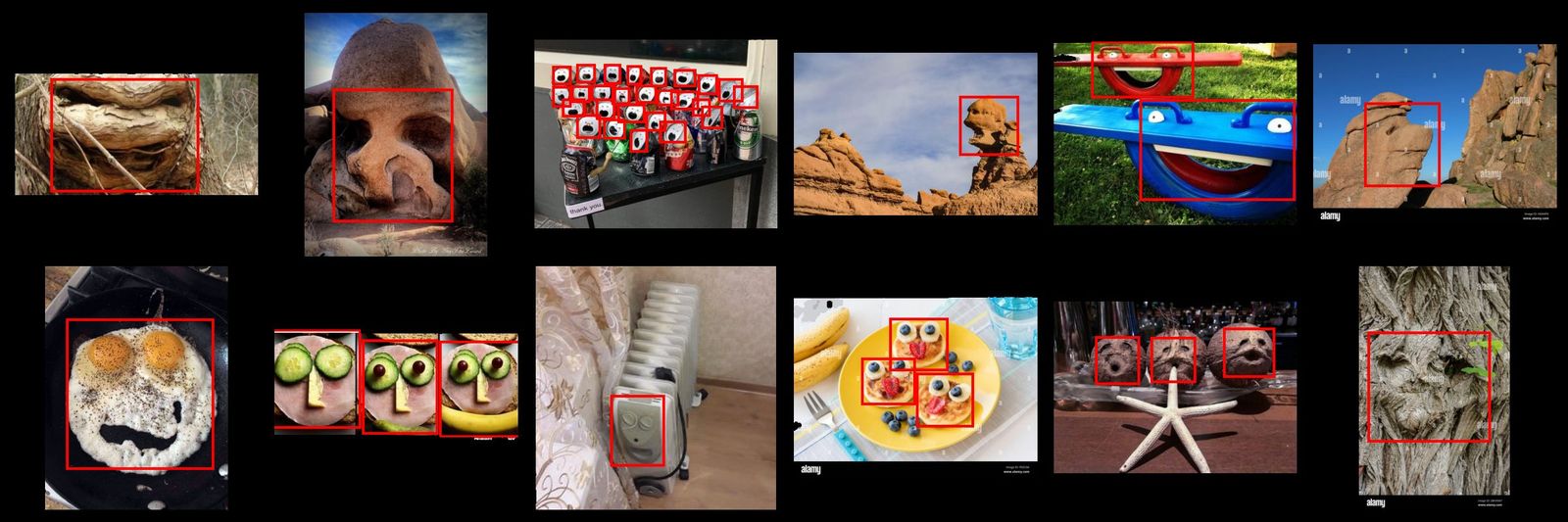
TL;DR:We introduce a dataset of over 5000 human annotated pareidolic images. We also link pareidolia in algorithms to the process of learning to detect animal faces.
We introduce an annotated dataset of five thousand human labeled pareidolic face images, called ``Faces in Things''. Faces in Things is derived from the LAION-5B dataset and annotated for key face attributes and bounding boxes

We show the average face computed from the FacesInThings, WIDER FACE, and Animal Web Datasets Respectively:

Installation
Clone the repository:
pip install facesinthings
git clone https://github.com/mhamilton723/FacesInThings.git
Install the required Python dependencies:
pip install -r requirements.txt
Usage
The dataset is downloaded automatically if not available locally.
See our Demo Usage Notebook for some quick examples of working with the dataset
Dataset Structure
FacesInThings.zip
│
├── images/
│   ├── 000000009.jpg
│   ├── 000000027.jpg
│   ├── ...
│
└── metadata.csv
The metadata.csv file contains the following fields:
file: Name of the image file.url: Direct URL to the image.boxes: Bounding boxes for the detected pareidolic faces. Stored in[x1, y1, w, h]formatis_primary: Whether the bounding box is the primary face.Is there a face?: Yes/No/Several.Hard to spot?: Difficulty in spotting the face (Easy/Medium/Hard).Accident or design?: Whether the face appears accidental or by design.Emotion?: Perceived emotion (Neutral, Happy, Sad, etc.).Person or creature?: Type of face (Human, Animal, Alien, etc.).Gender?: Perceived gender (Neutral, Female, Male).Amusing?: Whether the face is amusing (Yes/No/Somewhat).Common?:How common this type of pareidolia is.Flags: Any additional flags (e.g., ‘Interesting’, ‘NSFW’).num_boxes: Number of bounding boxes.train: Whether the image is part of the training split.
Citation
@inproceedings{hamilton2024seeing,
  title={Seeing Faces in Things: A Model and Dataset for Pareidolia},
  author={Hamilton, Mark and Stent, Simon and others},
  booktitle={ECCV},
  year={2024}
}
1 maintainer

Metadata
1 maintainer
Release files for facesinthings 0.1.0
For a detailed explanation of source distributions (sdists) and built distributions (wheels), please see the package formats documentation.
Source distribution (sdist)
| File | Size | Uploaded | Provenance | Actions |
|---|---|---|---|---|
| facesinthings-0.1.0.tar.gz | 5.3 kB | Without provenance | Details for facesinthings-0.1.0.tar.gz |
Built distribution (wheel)
| File | Interpreter | ABI | Platform | Actions Reset |
|---|---|---|---|---|
| facesinthings-0.1.0-py3-none-any.whl | Python 3 | none | any | Details for facesinthings-0.1.0-py3-none-any.whl |
Total release size: 10.6 kB
Release files / facesinthings-0.1.0.tar.gz
| Download URL | facesinthings-0.1.0.tar.gz |
|---|---|
| Size | 5.3 kB |
| Tags | Source |
|
SHA-256 checksum How to use checksums |
8a53b68bc66d7d166354b57e2f0d63cd5702c1b4bdb0b851aafb8222bcd82755
|
|
BLAKE2b-256 checksum How to use checksums |
5868141b0354c64cfd98c1a6c257b9a78a3e07196029ace32868877ae01852b1
|
| Upload date | |
|
Uploaded using Trusted Publishing? What is trusted publishing? |
No |
| Uploaded via |
twine/5.1.1 CPython/3.11.5
|
Release files / facesinthings-0.1.0-py3-none-any.whl
| Download URL | facesinthings-0.1.0-py3-none-any.whl |
|---|---|
| Size | 5.3 kB |
| Tags | Python 3 |
|
SHA-256 checksum How to use checksums |
06fe301f500718a80cc667f06b85e9fd23c43c5fc6416f3d3c7f6a4ccba557a7
|
|
BLAKE2b-256 checksum How to use checksums |
11d4a970a8e4b4aeddc08c47412dee98c291f31b377341a3f60c44a28a4e67a2
|
| Upload date | |
|
Uploaded using Trusted Publishing? What is trusted publishing? |
No |
| Uploaded via |
twine/5.1.1 CPython/3.11.5
|
Security for facesinthings 0.1.0
Provenance
Provenance describes where a file came from. On PyPI, provenance is shared via attestations, which provide a verifiable record of the build or publishing details. View details, limitations and caveats.
No provenance found
None of the files in this release were uploaded with provenance metadata.
A note on package security
PyPI is a repository for distributing packages, not a service for auditing them. While third-party security researchers and our staff do their best to detect and remove malicious packages, PyPI cannot guarantee the quality, security or suitability of any given package.
To learn more about protecting yourself from malicious actors, visit our package security documentation.













