
code-factory




One intent, seven software targets, and proof that the gates reject deliberately sabotaged builds.
New in 0.24.0: Unified Graph Ops
Graph Ops turns the local Product Graph, value slices, mission and approval receipts, completion evidence, content-addressed proofs, proof plans, traces, stage receipts, and bound artifacts into one deterministic visual map. It shows the exact path that exists, keeps unknowns visible, and chooses one fact-derived next action without running a command.
factory graph ops --root . --json
factory graph ops --root . --mermaid
factory graph impact --root . --changed src/app.py --json
factory studio --root .
Open Studio's Graph Ops link or visit /graph-ops on its loopback URL to
follow the graph in accessible lanes. The surface is read-only: it cannot
execute, approve, publish, deploy, sign, message, access credentials, or grant
connectors. Requirements count as evidenced only when a valid completion
receipt verifies them. See Unified Graph Ops.
New to Code Factory? Start with the outcome-first factory mvp "..." command,
then graduate through proof, Graph Ops, team review, and enterprise controls
without switching to a different workflow. See Start Here.
New in 0.23.0: reuse proof, not side effects
Code Factory can now record a completed read-only validation and route a future request to exactly one disposition: RUN, REUSE, SKIP, or BLOCK.
factory proofs record proofs.json --gate python-tests --elapsed-ms 600000 --root .
factory proofs plan proofs.json --changed src/app.py --auto-savings --out proof-plan.json --root .
factory proofs verify .factory/proofs/<proof-key>.json --root .
factory proofs challenge .factory/proofs/<proof-key>.json --root .
The proof key binds the relevant input hashes, command digest, toolchain, and environment. REUSE requires unchanged inputs and outputs plus a valid green receipt. SKIP requires an explicit reviewed relevance declaration. Ambiguity fails closed to RUN, while any gate that is not explicitly read-only is BLOCK.
Verified reuse can automatically create the existing paired savings receipt. That records the original full-run observation beside measured routing time; missing token observations remain null. Proof reuse never publishes, deploys, signs, approves, discovers credentials, or sends messages. See Content-addressed proof reuse.
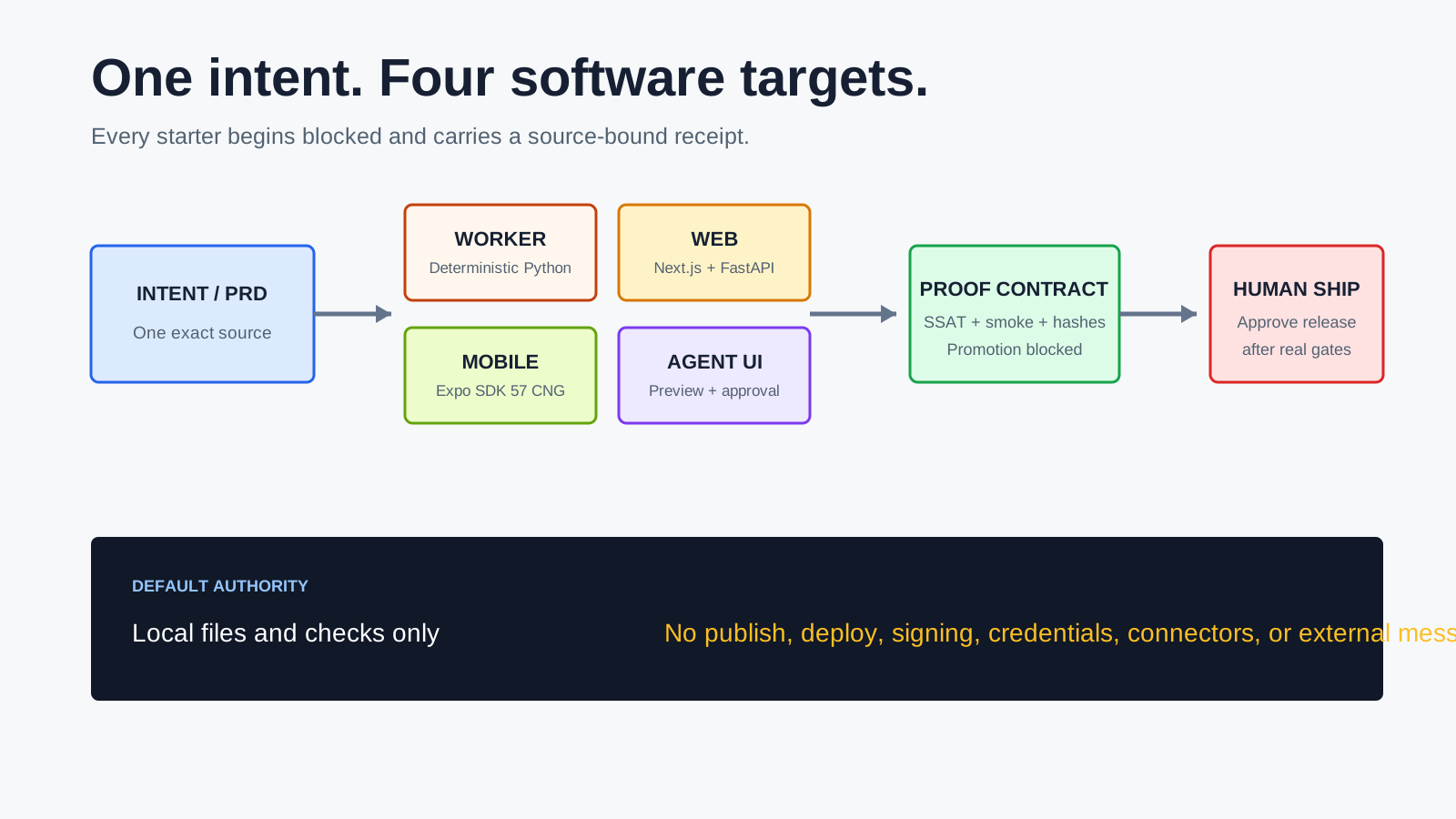
60-second first run
Exact shipped UI: the walkthrough below is rendered from the actual Factory Studio surface; it is not concept art.
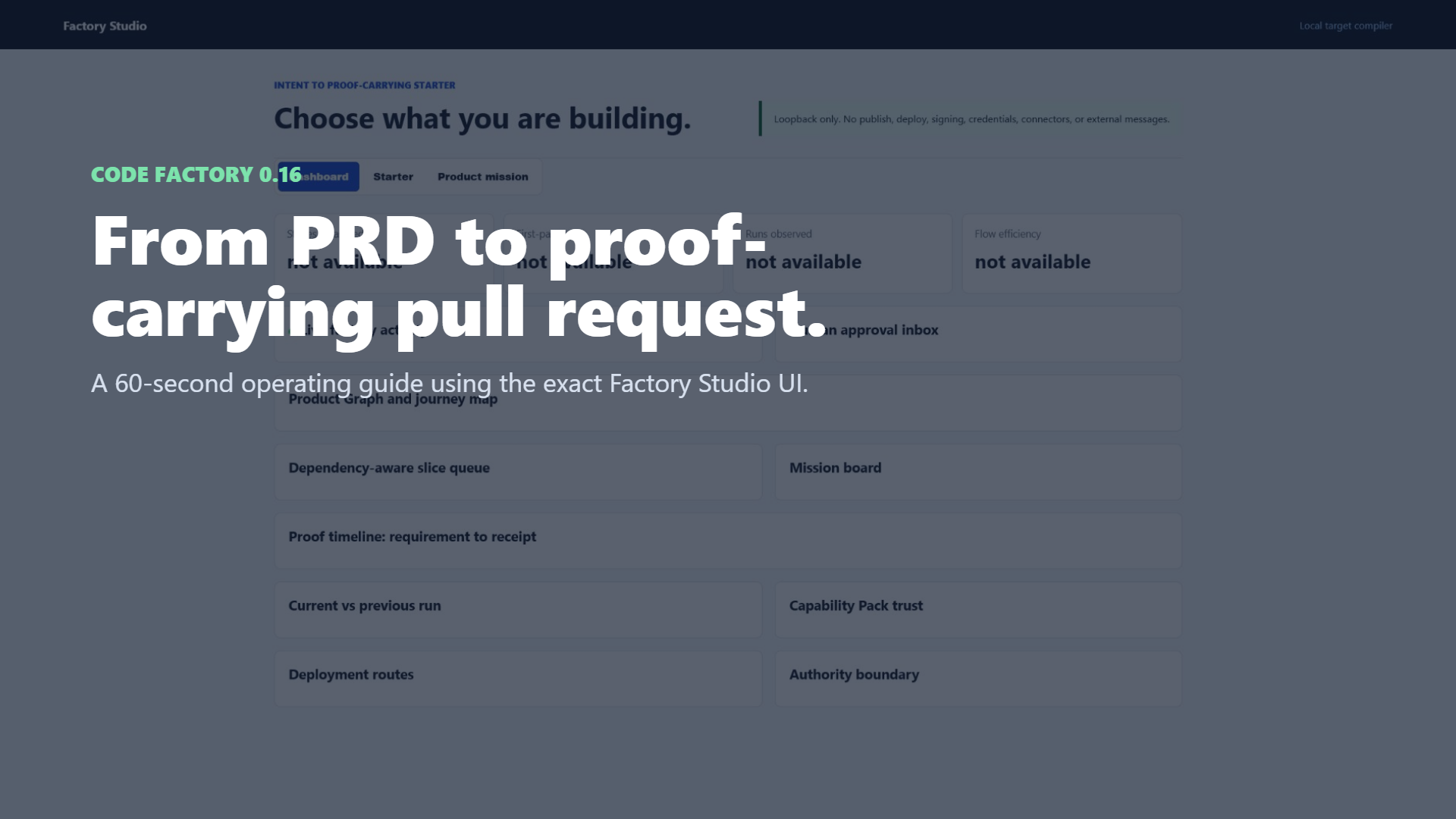
Watch or download the 60-second MP4. The absolute cover and release-asset URLs render from both GitHub and PyPI.
The one-minute walkthrough is rendered from an actual 1920x1080 Factory Studio capture. Its focus frames point to the shipped Product Graph, value slice, approval, proof, and Meter v2 panels; it does not substitute a mock dashboard for the product UI.
Concept illustrations: how the proof line works
The following concept illustrations explain the workflow; they are not UI screenshots or measured outcome evidence.



Open the complete nine-stage visual walkthrough.
Use Code Factory to create an app-shaped starting state, then immediately see which requirements it refuses to certify without real tests:
pip install factoryline-code-factory==0.24.0
factory targets --json
factory create "Build a simple approval tracker with an audit log" --target web --deployment-profile local-split --out approval-tracker --purpose saas
factory coverage --root approval-tracker --json
The last command intentionally exits nonzero on a fresh starter. It reports
"dominant_failure_class": "hollow_coverage" for every product requirement
that lacks a non-hollow test. The scaffold is useful starting state, not
software the factory pretends is ready to ship.
Use the same factory create command with --target cli, api, mcp,
worker, web, mobile, or agent-ui. Select a deployment route from factory targets --json; the
local or preview route is the safe default. Every output starts blocked and includes a governance manifest,
SSAT, smoke hook, Mermaid map, and source-bound compile receipt. Open the local
builder with factory studio, or from the VS Code and JetBrains integrations.
See Target Compiler and Factory Studio.
Resume the assembly line
Code Factory 0.22 can inspect the feature state and continue through safe local stages until completion, failure, or one explicit human boundary:
factory continue my-feature --root .
factory metrics --root . --out assembly-metrics.json
The first command uses distinct exit codes for completed, halted, and waiting-for-human states. Each non-dry run creates an atomic receipt. The metrics export is aggregate-only and leaves token, cost, and savings values unknown unless exact observations and a counterfactual baseline exist. The same continuation engine powers Factory Studio's Assembly tab and both editor integrations. See Assembly continuation and the privacy-safe Codex usage sample.
Measure exact time, token, and cost savings
The paired savings tracker records your baseline and Factory observations without inventing missing values or hiding regressions:
factory savings record checkout-2026-07-25 --root . \
  --baseline-elapsed-ms 600000 --factory-elapsed-ms 300000 \
  --baseline-tokens 12000 --factory-tokens 8000
factory savings report --root . --out savings-public.json
Time, token, and cost deltas are signed: slower or more expensive Factory runs
remain negative. Productivity gain is withheld unless you explicitly assert an
equivalent outcome and bind that assertion to an existing evidence file with
--equivalent-outcome --evidence <path>. Private pair identifiers and evidence
paths stay out of the aggregate-safe public report. See
Paired savings tracker.
Hosted enterprise PR assurance
The optional hosted adapter verifies GitHub webhooks and OIDC approvals at a real network boundary, isolates tenant records with PostgreSQL row-level security, and publishes GitHub Checks through a transactional outbox and short-lived GitHub App credentials.
pip install "factoryline-code-factory[hosted]"
gunicorn --bind 0.0.0.0:8080 \
  'factoryline.hosted_api:create_hosted_app_from_env()'
Tenant selection comes from an immutable GitHub installation mapping—not request headers. See the hosted deployment and security contract.
Supervised tenant control plane
Version 0.19 closes the onboarding gap around that adapter: a verified bootstrap administrator creates a tenant, pins tenant OIDC/JWKS configuration, maps directory groups, stores secret-manager references, and issues a 600-second one-time GitHub installation state. PostgreSQL stores no resolved secret values, and every successful administrative mutation joins a tenant-scoped hash chain.
The responsive /console surface is read-only. It shows installation, identity,
role, approval, outbox, and audit status without mutation, approval, connector,
credential, deployment, or release authority. See the
hosted control-plane contract.
Signed Capability Packs
The seven starter targets and 22 composable surface, language, capability, data, and operations contracts now come from 29 first-party Capability Packs. Every pack binds its complete file map to an offline DSSE Ed25519 signature and must reject ten structural mutations before it can be installed or composed.
factory pack list
factory pack validate factoryline/builtin_packs/target-worker
factory pack install factoryline/builtin_packs/target-worker --root .
factory pack compose factoryline/builtin_packs/target-web `
  factoryline/builtin_packs/surface-nextjs `
  factoryline/builtin_packs/language-typescript `
  factoryline/builtin_packs/capability-auth --root . --name review-portal
Pack installation grants no execution, network, connector, deployment, publication, signing, or external-message authority. See Capability Packs.
For target-by-target local, preview, and release routes, prerequisites, checks, and approval boundaries, see the Deployment Guide. The per-channel artifact and moderation boundaries are listed in Release Channels.
Product Missions: PRD to reviewer-ready value
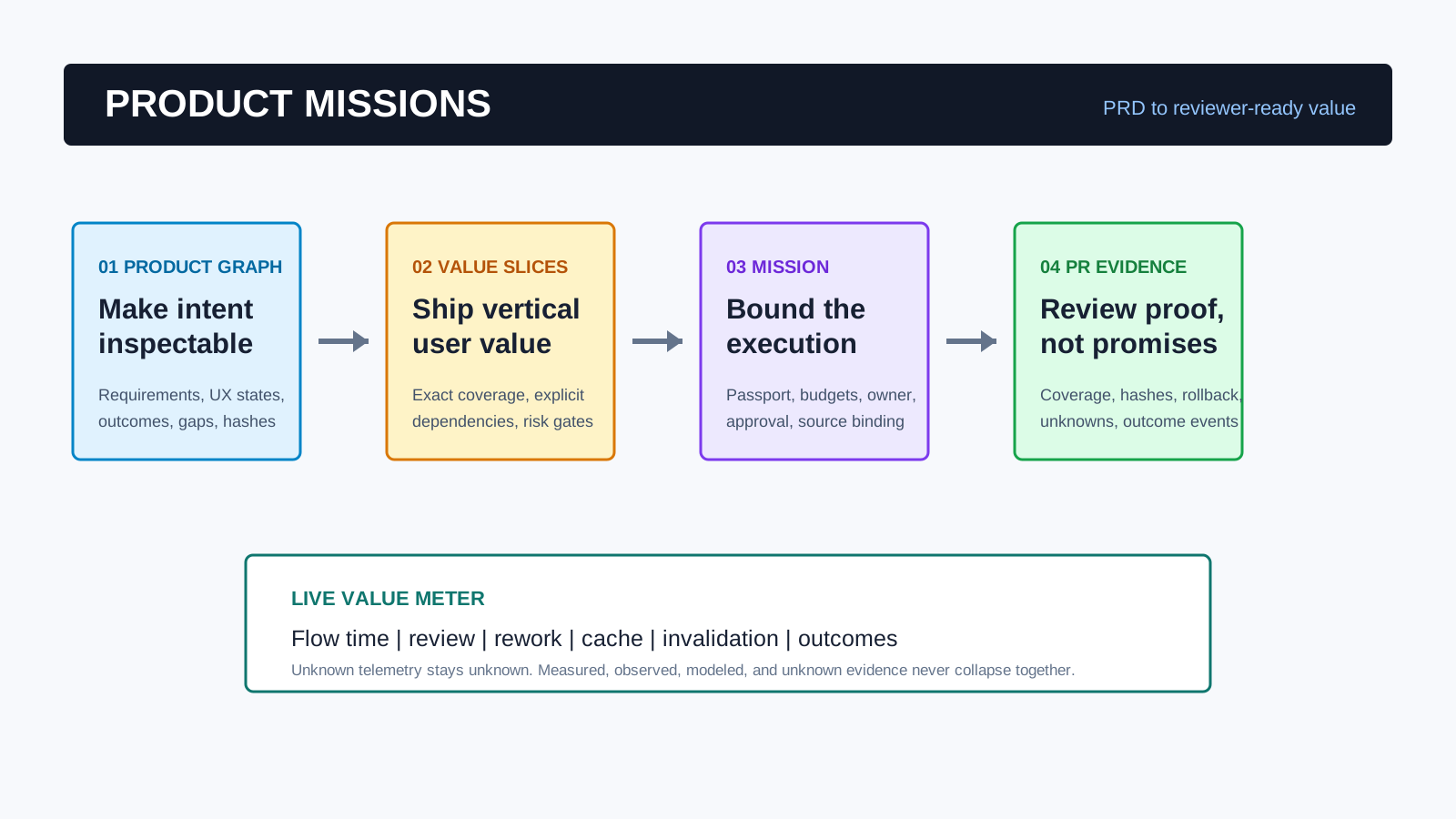
Version 0.17 completes the deterministic product-engineering layer above the existing spec-to-proof pipeline. It compiles a PRD into stable requirement atoms and a gap-audited Product Graph, assigns every requirement exactly once to a bounded value slice, and creates a supervised, hard-budgeted mission with a hash-bound Loop Passport. The output is an evidence-linked PR draft and a classified outcome chain, not an agent with hidden production authority.
factory product compile .\PRD.md --root . --json
factory product slices .\.factory\products\<project>\product_graph.json --root . --json
factory mission create .\.factory\products\<project>\value_slices.json <slice-id> `
  --root . --owner engineering-lead --executor codex --json
The live Meter v2 adds queue, review, rework, cache, invalidation, and outcome telemetry while preserving unknown values as unknown. Open the same workflow in Factory Studio or through the explicit Product Missions command in VS Code and all supported JetBrains IDEs. See Product Missions.
Version 0.20 added durable mission execution through a hash-linked SQLite event ledger with guarded transitions, human pause/revise/resume, independent validation, budget exhaustion, release separation, and an optional LangGraph checkpoint adapter. A secret-free multi-provider policy selects BYOK provider and model references across CLI, Studio, VS Code, and JetBrains while never reading, storing, or calling with credential values. Operators can select the IDE surface, provider/model preference, quality floor, budget ceiling, and cache-continuity rail while the runtime remains responsible for actual key injection and spend authorization. See Mission Graph Operations and Multi-Provider BYOK Routing.
Migration Missions: no finish without proof
Large migrations can bind an executable readiness receipt before a Mission is
created. Eight lanes are checked independently: unit, integration, E2E,
lint/type, architecture, coverage/fuzz, reproducible environment, and
telemetry/security. lane_registration_pct is never presented as behavioral
proof; only hash-bound executed evidence contributes to
executable_proof_pct.
factory migration assess .\migration-readiness.json --root . --json
factory context build --root . --json
factory mission create <value-slices.json> <slice-id> --root . `
  --owner migration-owner --executor codex `
  --readiness .\.factory\migration\readiness.json --json
Every mission binds falsifiable hypotheses to exact completion criteria. A user-facing slice also receives a computer-control criterion with an exact URL, fewer-than-four-interaction ceiling, passing assertions, and hashed visual evidence. Independent validators cannot see creator transcripts or failed-attempt history. See Migration Missions.
Signal Loop: owner-governed demand to independent proof
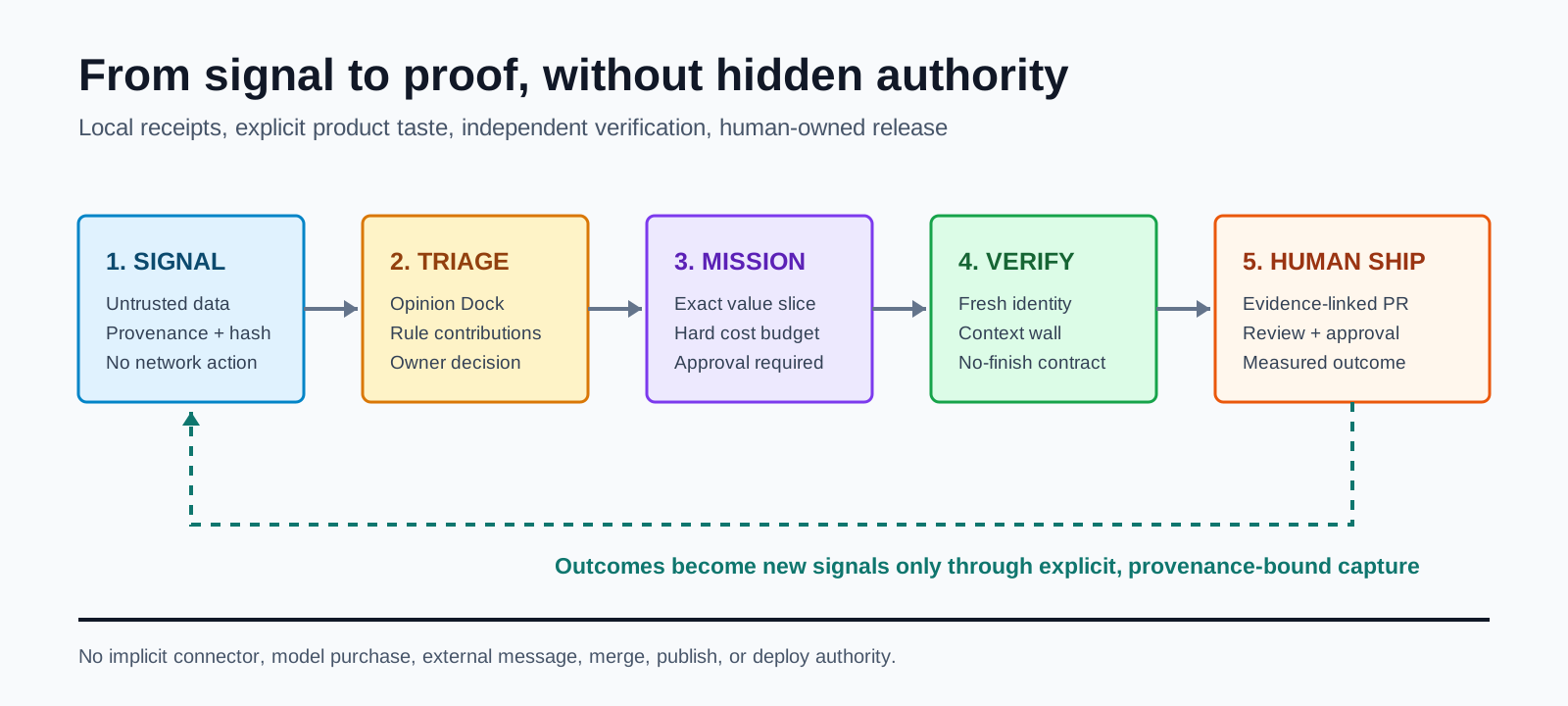
Signal Loop accepts explicitly supplied GitHub, Slack, Sentry, social, telemetry, internal, or manual evidence as untrusted local data. A compact owner-controlled Opinion Dock records product taste, architecture guardrails, temporary hands-off rules, and abstract cost/quality profiles. Explainable triage cannot promote work until a Product Owner records a bound decision.
factory opinion init --root . --owner product-owner --json
factory signal capture --root . --source github --authorization owner_supplied `
  --title "Export audit evidence" --body "Operators need a local export." --json
factory signal triage <signal.json> <opinion_dock.json> --root . --json
Complete approved facts compile into the Product Graph; incomplete facts stop
at a needs-input PRD draft. Mission owners receive an approval-ready Studio
panel or may choose Auto-resolve safe gaps, which is limited to deterministic
local corrections and cannot invent product intent. Independent completion
requires distinct creator/verifier identities, exact criteria, and local bound
evidence. Every rejection reports the causal stage, reason, and next action in
factory.failure_summary.v1. See the Signal Loop and
operations scenario matrix.
For an existing repository, start with forge adopt <feature> --root .; after
you review its SSAT and pass the human architecture gate, use
forge architect <feature> <ssat> --adopt-existing to validate and receipt the
working implementation without regenerating it. See
First Use On An Existing Repository.
Editor integrations
Both editor adapters run only an explicit local FactoryLine command and display local receipt data. Neither uploads the workspace, signs a receipt, or makes a release decision.
- VS Code: install the release VSIX. See FactoryLine for VS Code.
- IntelliJ Platform: install FactoryLine AI Proof from JetBrains Marketplace in IntelliJ IDEA, PyCharm, WebStorm, Rider, CLion, GoLand, RustRover, or DataGrip. JetBrains reviews new versions before they become the listed update. All features are free through December 31, 2026. The owner-approved future price is $4.95 USD per month from January 1, 2027, subject to JetBrains approval, with a planned 30-day trial. See the 2027 monetization runbook, FactoryLine for JetBrains IDEs, the Marketplace release runbook, and the control-room boundary.
Public workflow
Run factory with no arguments for a compact live view of installed bricks,
local proof counts, and the next valid commands. This agent-first home view
avoids a separate help/discovery turn while keeping --help available everywhere.
flowchart LR
    A["Intent or PRD"] --> B["Build and gate"]
    B --> C["Compile and verify"]
    C --> D["Signed receipts and human-owned ship"]
    classDef input fill:#e0f2fe,stroke:#0284c7,color:#10233f
    classDef build fill:#fef3c7,stroke:#d97706,color:#10233f
    classDef proof fill:#dcfce7,stroke:#16a34a,color:#10233f
    class A input
    class B build
    class C,D proof
The detailed engineering map, mutation challenges, Passports, and replay paths remain in the technical docs. Publicly, the product contract is simpler: the model may help design at build time; HSF compiles eligible decision logic into deterministic code; the generated starter does not inherit runtime model, network, connector, credential, publish, or deploy authority.
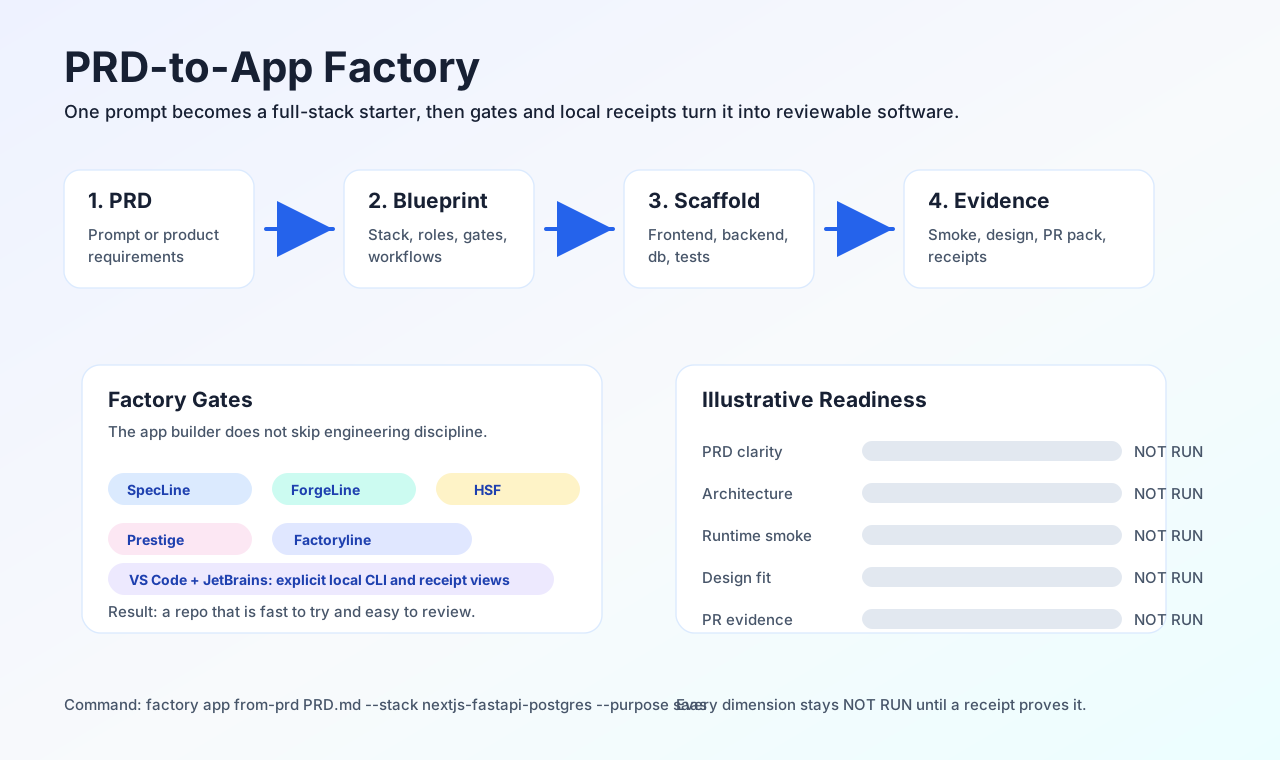
New: PRD-to-app building. Factoryline can now turn a PRD or prompt into a full-stack starter repo, then hand it to the same gated, receipted factory flow that powers proof-carrying PRs.
A code factory built like Lego. Five small, independent, open-source pieces that snap together into one assembly line: describe a feature in plain language, and the line checks it for ambiguity, builds it, runs a gauntlet of gates, actually runs the finished code to watch it behave, compiles any decision logic into permanent zero-cost code, and ships it with a receipt at every step.
Each piece is a separate repo you can install and use on its own. This repo is the
baseplate (factory) that lines them up. It depends on none of them.
Five-brick workflow
For the complete component, authority, mission, verification, IDE, and telemetry topology, see Code Factory Architecture.
flowchart LR
    V["VS Code"] -. "explicit local command" .-> G
    J["JetBrains IDEs"] -. "explicit local command" .-> G
    Q["Owner-supplied signal"] --> O["Opinion Dock triage"]
    O --> P
    P["PRD Product Graph"] --> S["Dependency-ordered value slices"]
    S --> M["Supervised mission passport"]
    M --> B
    A["Plain-language intent"] --> K["Signed Capability Pack"]
    K --> B["1 SpecLine: clarify and lock the spec"]
    B --> C["2 ForgeLine: build through gated phases"]
    C --> D{"What changed?"}
    D -->|"Business decision logic"| E["3 HSF: compile deterministic artifact"]
    D -->|"User-facing UI"| F["4 Prestige: design-quality gate"]
    E --> G["Receipts and signed artifacts"]
    F --> G
    C --> G
    G --> H["Ship with evidence"]
    G -. "local receipt view" .-> V
    G -. "local receipt view" .-> J
    classDef intent fill:#e0f2fe,stroke:#0284c7,color:#10233f
    classDef gate fill:#fef3c7,stroke:#d97706,color:#10233f
    classDef artifact fill:#dcfce7,stroke:#16a34a,color:#10233f
    classDef design fill:#dbeafe,stroke:#2563eb,color:#10233f
    classDef evidence fill:#ccfbf1,stroke:#0f766e,color:#10233f
    classDef editor fill:#ede9fe,stroke:#7c3aed,color:#10233f
    class A intent
    class B,C gate
    class E artifact
    class F design
    class G,H evidence
    class V,J editor
    class Q,O,P,S,M,K intent
Use the numbered repos like Lego bricks: start with the baseplate, add the spec brick when intent is fuzzy, add the forge brick when you want a state machine, add the compile brick when decisions must be deterministic, and add the design brick when the shipped thing has a user interface.
intent -> [1-spec] -> spec + strict contract -> handoff
                                                   |
          [2-forge] <---- tasks / plan <----------+
              |  architect -> build -> gates -> smoke -> ship
              |-> if UI -> [4-design] design-quality gate
              +-> if decision table -> [3-compile] -> deterministic artifact
The five pieces
| Repo | pip install | CLI | What it does |
|---|---|---|---|
| code-factory (this) | factoryline-code-factory |
factory |
the baseplate - snaps the bricks together, meters cost |
| code-factory-1-spec | code-factory-1-spec |
specline |
kills ambiguity before the AI writes code (anti-drift input contract) |
| code-factory-2-forge | code-factory-2-forge |
forge |
the assembly line: architect -> build -> gates -> runtime smoke -> ship |
| code-factory-3-compile | code-factory-3-compile |
hsf |
compiles a decision once into boring code that runs forever at zero AI cost |
| code-factory-4-design | code-factory-4-design |
prestige |
design-quality gate, for when what you ship has a face |
Numbered so the assembly order reads at a glance. Install one, some, or all.
The baseplate's PyPI distribution is named factoryline-code-factory because
PyPI reserves the more generic code-factory name. The repository and the
factory command deliberately keep the simpler Code Factory identity.
Enterprise knowledge activation
Code Factory treats agent instructions as Atomic Knowledge Units (AKUs): small, high-density, validated units of institutional knowledge. The goal is to move from "retrieve a long doc and hope the agent interprets it" to "activate the right procedure, tools, governance, and validators at the exact step of work."
See AKU_STANDARD.md for the enterprise schema and how each brick maps to codification, compression, injection, and validation.
The governed learning lane now turns task outcomes into task-specific AKUs
without transferring worker scratchpads. factory learning init|packet|propose|validate|promote
requires ordered milestone evidence, a validator distinct from the worker, and
the recorded human owner before any instruction becomes active. Harbor and
Terminal-Bench results can be bound as external evidence, but cannot self-approve
an instruction or edit the Architecture Opinion Dock. See
Governed Instruction Learning.
Install all five bricks
pip install factoryline-code-factory==0.24.0 code-factory-1-spec==0.5.4 code-factory-2-forge==0.10.7 code-factory-3-compile==0.5.5 code-factory-4-design==0.8.0
factory doctor --json
factory doctor reports two separate facts: installation_ok verifies the
CLIs, versions, and required commands; workflow_ok runs bounded,
non-mutating canaries; and provenance_ok requires a source commit plus a
build hash. The ForgeLine canaries exercise both ESM .mjs and TypeScript .ts
features and require measured symbols, so a Python-centric or zero-symbol QA
path cannot appear healthy. A normal package install can run correctly while
still reporting provenance_ok: false; strict doctor exits nonzero in that
state rather than presenting incomplete source identity as proof. Use signed
receipts or a clean source checkout when signer or source identity is required.
Identity-signed receipts
Authenticate any existing factory receipt with Sigstore's keyless OIDC flow:
pip install "factoryline-code-factory[sigstore]"
factory receipt sign .factory/receipts/<receipt>.json
factory receipt verify .factory/receipts/<receipt>.json \
  --cert-identity "https://github.com/OWNER/REPO/.github/workflows/WORKFLOW.yml@refs/heads/main" \
  --cert-oidc-issuer "https://token.actions.githubusercontent.com"
Verification binds the exact receipt bytes to the expected signer identity and
issuer. Unsigned receipts remain readable but report UNSIGNED, never
VERIFIED. See Signed Factory Receipts for the CI
workflow, expected JSON, failure behavior, and honest scope boundary.
Local control-plane foundation
The control-plane surface adds tenant-scoped evidence, explicit role authorization, independent human approvals, and a hash-linked audit stream:
factory control init --db .factory/control.sqlite3
factory control evidence-put receipts/build.json --db .factory/control.sqlite3 `
  --tenant acme --subject ci-runner --roles operator
factory control audit-verify --db .factory/control.sqlite3 `
  --tenant acme --subject auditor --roles viewer
See docs/CONTROL_PLANE.md for the approval workflow and exact boundary. This remains the deterministic local foundation. The optional hosted adapter adds supervised GitHub App and per-tenant OIDC flows, but does not claim SCIM, managed availability, or a hosted evidence service.
Enterprise Receipt v2 Foundation
The optional enterprise extra adds an offline-verifiable DSSE envelope with an Ed25519 signer identity, signed policy bundles, and signed revocation lists:
pip install "factoryline-code-factory[enterprise]"
factory enterprise keygen --out-dir .factory/keys --keyid ci-main \
  --identity "https://github.com/OWNER/REPO/.github/workflows/proof.yml@refs/heads/main" \
  --issuer "https://token.actions.githubusercontent.com"
factory enterprise receipt-seal receipt-v2.json \
  --private-key .factory/keys/ci-main.private.pem --keyid ci-main \
  --identity "https://github.com/OWNER/REPO/.github/workflows/proof.yml@refs/heads/main" \
  --issuer "https://token.actions.githubusercontent.com" --out receipt.dsse.json
factory enterprise verify receipt.dsse.json --trust-root .factory/keys/trust-root.json
Verification is local and fail-closed. It checks the DSSE signature, exact
payload digest, trusted key id, identity, issuer, policy digest, and supplied
revocation list without contacting a service. v1 receipts remain readable but
return LEGACY_UNVERIFIED in the enterprise verifier. The local control-plane
foundation is documented above; the optional hosted GitHub/OIDC adapter is
documented in Hosted Control Plane. SCIM,
managed HA, OSCAL packs, BBS credentials, and zkVM proofs remain future
roadmap work; see Enterprise Receipt v2.
Loop Passport
factory loop makes an autonomous-loop contract reviewable before it runs. The
manifest declares its trigger, workspace scope, named skills/connectors,
allowed actions, hard token/cost/time/iteration limits, required approvals,
validators, and state machine. The generated Passport hash-binds that contract
and includes a first-class Mermaid graph.
factory loop init dependency-audit --owner platform-team --root .
factory loop validate .factory/loops/dependency-audit.loop.json --json
factory loop passport .factory/loops/dependency-audit.loop.json --root . --json
factory loop budget .factory/loops/dependency-audit.loop.json usage.json --root . --json
factory loop verify .factory/loop-passports/dependency-audit.loop-passport.json --json
The budget command writes WITHIN_BUDGET, BUDGET_EXCEEDED, or
MANIFEST_INVALID receipts. It enforces declared ceilings over usage supplied
by a runtime adapter; it does not claim to independently enforce provider
billing, credential injection, host sandboxing, or network egress. Those are
runtime responsibilities that the Passport makes explicit for review.
Existing Repositories And PRs
Start from inherited code with forge adopt <feature> --root .. It writes a
reviewable architecture baseline and, for TypeScript, an explicit mutant
manifest for forge verify-tests-ts. FactoryLine exposes the operational
controls professionals need: factory overhead reports measured per-gate wall
time, factory override writes an owned exception receipt, and factory ci init --feature <feature> writes an opt-in GitHub PR-comment workflow.
factory doctor --json   # versions, workflow canaries, and provenance status
factory plan            # print the assembly pipeline
factory init .          # lay down the shared workspace
factory assemble my_feature   # run the line (skips any missing brick)
factory meter           # receipted cost + savings, computed on YOUR runs
factory meter --json    # current local overview for an IDE or dashboard
factory meter --watch   # refresh as measured stages finish
factory rollup my_feature      # aggregate receipt attribution for debugging
factory trace my_feature       # hash-link receipts into a proof bundle
factory verify-trace .factory/traces/my_feature.trace.json
factory replay .factory/traces/my_feature.trace.json --changed smoke/my_feature.json
factory evidence my_feature    # public-safe proof for a PR or release note
factory policy                 # write default policy-as-code thresholds
factory verify-policy --challenge policy.challenge.json # prove every policy rule is enforced
factory optimize-pr --changed specs/my_feature.md --feature my_feature
factory pr-pack my_feature     # reviewer-ready PR_EVIDENCE.md
factory app from-prd PRD.md --out my-app --purpose saas
factory challenge my_feature --trace .factory/traces/my_feature.trace.json
factory passport my_feature --trace .factory/traces/my_feature.trace.json --challenge .factory/challenges/factoryline.json
factory assemble is resumable and stops at human-owned authoring and approval
boundaries. Its JSON output names paused_at and the exact next_command; it
does not silently approve architecture or claim unfinished scaffolds are built.
For a concise existing-repository path and a first-run feedback route, see First Use On An Existing Repository. The best contribution right now is a real repo run, including where the workflow helped or failed.
See ProofLab and the Factory Passport for all five challenge commands and the generated Mermaid artifact.
For publication order, GitHub release steps, Claude Code/Codex setup, and launch links, see PUBLICATION_GUIDE.md.
Instant PRD-to-App Builder
factory app is the one-shot app-builder workflow: PRD or prompt in,
full-stack starter out, with gates and evidence hooks already attached.
Treat the output as app-shaped starting state that must still move through
SpecLine, ForgeLine, HSF, Prestige, and Factoryline proof before release.
factory app from-prompt "Build an expense approval app with manager review, audit logs, and policy-based approvals" --out expense-approval
factory app from-prd PRD.md --stack nextjs-fastapi-postgres --purpose healthcare --out prior-auth-portal
It generates app_blueprint.json, PRD.md, frontend/backend/db starter files,
smoke tests, and a workflow guide. The point is not to bypass engineering
judgment; the point is to make the first app-shaped repo appear instantly while
preserving the factory contract.
See docs/APP_BUILDER.md for the visual workflow, illustrative readiness model, generated file tree, and follow-up commands.
PR optimization control plane
Senior review is now a factory surface. factory optimize-pr turns a diff into
a bounded hardening plan: changed paths, invalidated gates, design/release
checks, terminal states, and the no-auto-merge authority boundary. It is
deterministic and safe to run before opening or updating a PR.
factory pr-pack <feature> writes a public-safe reviewer packet from the
hash-linked trace: what changed, which receipts proved it, what the meter can
honestly measure, and which claims remain scoped. factory policy keeps the
team rules visible: hollow-test proof, hollow-validator proof, release
readiness, design purpose, and approval boundaries.
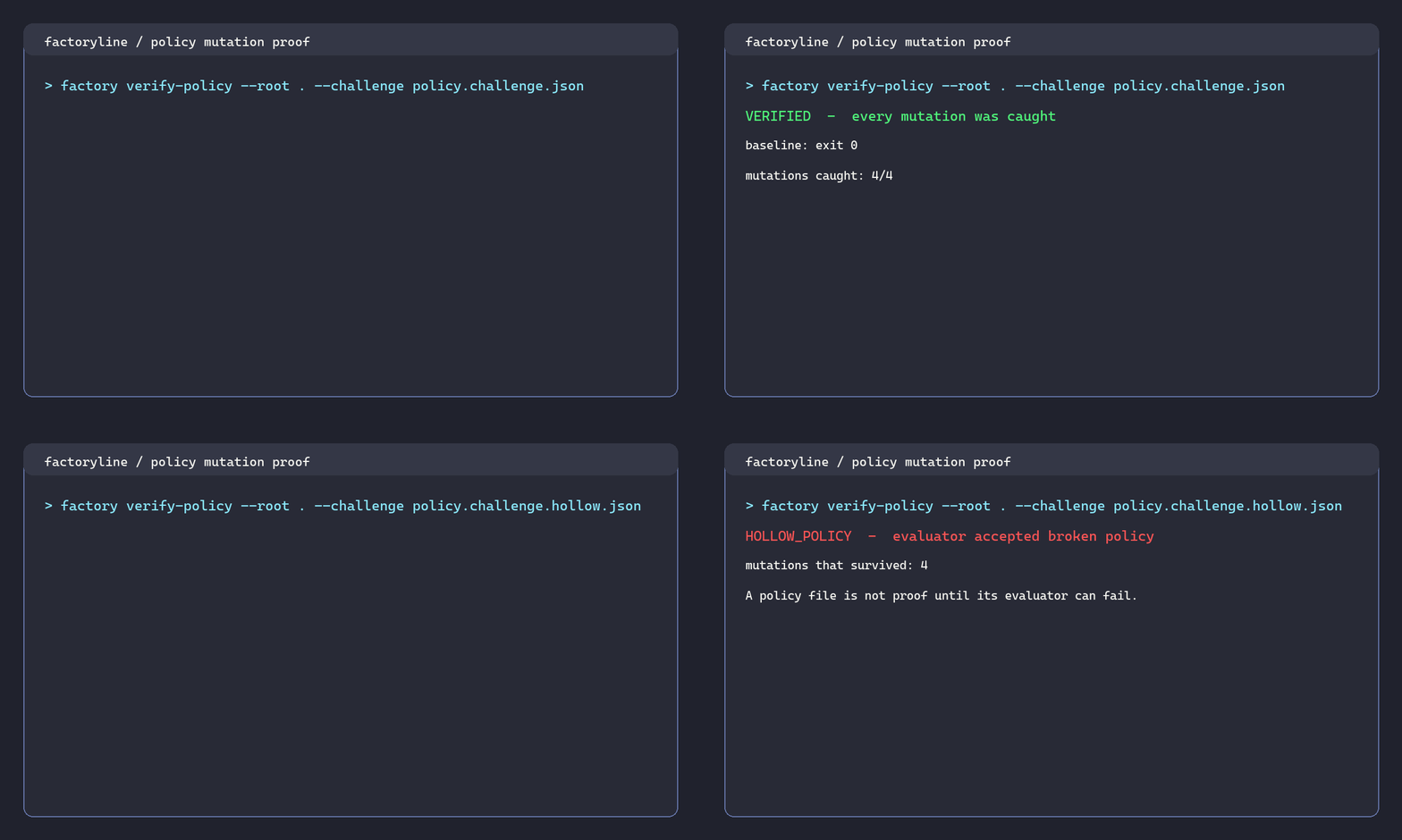
factory verify-policy --challenge policy.challenge.json completes the same
mutation doctrine for policy rules: it deletes or inverts every rule and requires
your evaluator to reject the changed policy. A rule that survives is reported as
HOLLOW_POLICY; see Verify Policy.
Why Lego, not a monolith
- Each brick stands alone. Install only what you need; a missing brick is skipped, not fatal.
- Filesystem interop = maximum portability. Bricks pass work on disk under a shared layout. Any IDE, agent (Codex / Claude Code / Cursor), CI runner, or OS that can run a subprocess drives the factory. No daemon, no network, no lock-in.
- No hidden coupling. The baseplate depends on none of the bricks — it shells out to their CLIs. Upgrade or swap a brick independently.
Honest metering
factory meter makes the "saves time and money" claim yours, computed from your runs:
- With no measured runs, it refuses to print a savings percentage — no number against zero data.
- When modules don't report token usage, it labels the figure a model, not a measurement, and says so.
- It prints the baseline assumption inline, so no number hides what it's compared against.
Wall-clock time is always measured. Projections are always labeled. Nothing is fabricated.
Use factory meter --json for the same local overview in an IDE, or factory meter --watch for a terminal that refreshes as new stages finish. To capture a
real local command without pretending it used a model:
factory meter --feature release --module codex --stage pytest \
  --capture -- python -m pytest -q
The capture records wall time, exit status, feature, and a run ID. It leaves tokens not reported until a module supplies a standard meter block.
Launch Measurement
Use scripts/capture_launch_metrics.ps1
to save raw PyPI and GitHub traffic observations as JSON receipts. It records
downloads, views, and clones without calling any of them unique users or
attributed conversions; see Launch Measurement.
Proof-carrying PRs
factory trace <feature> writes .factory/traces/<feature>.trace.json: a
deterministic proof bundle over the latest compatible receipts for that feature.
Each trace node records the stage, command, receipt hash, declared artifact
hashes, previous node hash, and attribution summary. The chain head makes receipt
or artifact tampering visible.
factory rollup <feature> is the lower-level receipt attribution view for
debugging failed stages; factory evidence <feature> is the public-safe view for
PRs, release notes, and README claims.
factory trace checkout_flow
factory verify-trace .factory/traces/checkout_flow.trace.json
factory rollup checkout_flow
factory risk-diff --changed smoke/checkout_flow.json
factory replay .factory/traces/checkout_flow.trace.json --changed smoke/checkout_flow.json
factory replay .factory/traces/checkout_flow.trace.json --changed smoke/checkout_flow.json --execute
factory attest .factory/traces/checkout_flow.trace.json
factory evidence checkout_flow
This is the enterprise Lego layer: the factory can say which guarantee a change
invalidates, which minimum stages must rerun, whether the trace still verifies,
and what public evidence can be shown without leaking raw logs. If a smoke check
is hollow, the public evidence can say hollow_test; if the trace was tampered
with, verify-trace fails before anyone trusts the PR. factory attest exports
unsigned in-toto/SLSA-shaped JSON statements for teams that want supply-chain
evidence attached beside a PR, release, or wheel.
Spec validator mutation
The assembly line now validates the spec instrument itself:
specline strict checkout_flow --json
specline verify-validators checkout_flow --json
verify-validators deletes or inverts one requirement at a time and requires
strict lint to kill the mutant. A requirement whose mutant still passes reports
hollow_validator: the spec looked valid, but no validator proved that
requirement mattered. In the default factory chain, this runs after
specline:strict and before spec gate signoff or downstream build stages.
Cross-platform
The baseplate runs on Python 3.10-3.12. The four numbered bricks run on Python 3.11-3.12. Their CI matrices cover Ubuntu, Windows, and macOS.
License
MIT OR Apache-2.0. Free and open source. Each brick carries both license texts. Commercial support and integration services available — see SUPPORT.md.
1 maintainer

Download files
Download the file for your platform. If you're not sure which to choose, learn more about installing packages.
Source Distribution
Built Distribution
Filter files by name, interpreter, ABI, and platform.
If you're not sure about the file name format, learn more about wheel file names.
Copy a direct link to the current filters
File details
Details for the file factoryline_code_factory-0.24.0.tar.gz.
File metadata
- Download URL: factoryline_code_factory-0.24.0.tar.gz
- Upload date:
- Size: 25.4 MB
- Tags: Source
- Uploaded using Trusted Publishing? Yes
- Uploaded via: twine/7.0.0 CPython/3.13.14
File hashes
| Algorithm | Hash digest | |
|---|---|---|
| SHA256 |
4484eb8a65039aec7290515e56e2cf14fcb7940dfefef544e325fae025ef47ab
|
|
| MD5 |
81d7a207d7dbed3c091484a2113c1fdf
|
|
| BLAKE2b-256 |
1dacac1f7e6c9b3b4345ed68436ccbe8fc3bd26ac6d14b5367778d4d257f3566
|
Provenance
The following attestation bundles were made for factoryline_code_factory-0.24.0.tar.gz:
Publisher:
publish.yml on zrk222/code-factory
-
Statement:
-
Statement type:
https://in-toto.io/Statement/v1 -
Predicate type:
https://docs.pypi.org/attestations/publish/v1 -
Subject name:
factoryline_code_factory-0.24.0.tar.gz -
Subject digest:
4484eb8a65039aec7290515e56e2cf14fcb7940dfefef544e325fae025ef47ab - Sigstore transparency entry: 2338236645
- Sigstore integration time:
-
Permalink:
zrk222/code-factory@ecb46bf8c152c50a74bf22b398caa8cb820176b0 -
Branch / Tag:
refs/tags/v0.24.0 - Owner: https://github.com/zrk222
-
Access:
public
-
Token Issuer:
https://token.actions.githubusercontent.com -
Runner Environment:
github-hosted -
Publication workflow:
publish.yml@ecb46bf8c152c50a74bf22b398caa8cb820176b0 -
Trigger Event:
release
-
Statement type:
File details
Details for the file factoryline_code_factory-0.24.0-py3-none-any.whl.
File metadata
- Download URL: factoryline_code_factory-0.24.0-py3-none-any.whl
- Upload date:
- Size: 398.2 kB
- Tags: Python 3
- Uploaded using Trusted Publishing? Yes
- Uploaded via: twine/7.0.0 CPython/3.13.14
File hashes
| Algorithm | Hash digest | |
|---|---|---|
| SHA256 |
752dacde3a147db1b8557caacced6a3d80beb95ccf20566ad5232a6d47746684
|
|
| MD5 |
5a8c68d61724abc79497986ab7f496da
|
|
| BLAKE2b-256 |
1ba6cae4829afb8a6a4ec594ce591ca10cd8cff0e08761e7a253091250c131a2
|
Provenance
The following attestation bundles were made for factoryline_code_factory-0.24.0-py3-none-any.whl:
Publisher:
publish.yml on zrk222/code-factory
-
Statement:
-
Statement type:
https://in-toto.io/Statement/v1 -
Predicate type:
https://docs.pypi.org/attestations/publish/v1 -
Subject name:
factoryline_code_factory-0.24.0-py3-none-any.whl -
Subject digest:
752dacde3a147db1b8557caacced6a3d80beb95ccf20566ad5232a6d47746684 - Sigstore transparency entry: 2338236652
- Sigstore integration time:
-
Permalink:
zrk222/code-factory@ecb46bf8c152c50a74bf22b398caa8cb820176b0 -
Branch / Tag:
refs/tags/v0.24.0 - Owner: https://github.com/zrk222
-
Access:
public
-
Token Issuer:
https://token.actions.githubusercontent.com -
Runner Environment:
github-hosted -
Publication workflow:
publish.yml@ecb46bf8c152c50a74bf22b398caa8cb820176b0 -
Trigger Event:
release
-
Statement type:







