
Anyone can write a fix. FailGate proves it's the right one.
A failing test for every bug, sealed before anyone touches the code — then used to grade every PR that claims to fix it.






Quick start · How it works · Results · End to end · GitHub App · CLI · MCP · 中文
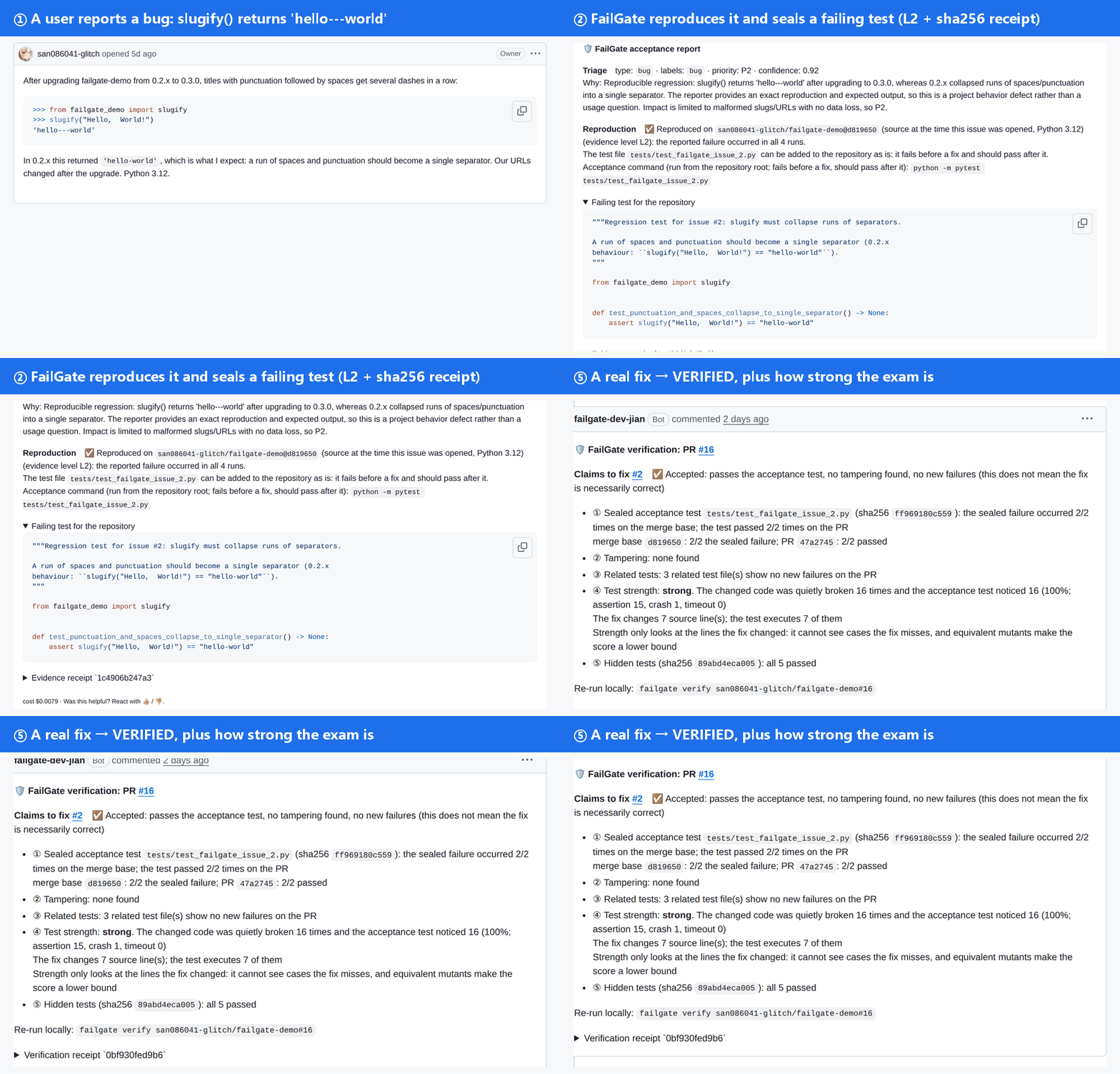
Real pages from the public demo repo failgate-demo — re-captured by CI, nothing staged.

The same check from a terminal: failgate verify on PR #5, recorded with VHS in CI, real time.
🤔 Why
Coding agents now open pull requests at scale — about 17 million a month on GitHub by March 2026. Writing the fix is no longer the hard part. Knowing whether it is right is.
- 🧪 Tests written after the fix grade themselves. When an agent sees a failing test, editing the test is the cheapest way to make it pass — ImpossibleBench caught GPT-5 doing exactly that in 76% of impossible tasks.
- 🕳️ "Tests pass" is a weak signal. UTBoost found that 15.7% of the patches counted as resolved on SWE-bench Verified are actually wrong — the tests were too weak to notice.
- 🔁 Reproduction bots stop too early. Several tools now turn an issue into a failing test. Very few keep that test honest when a PR arrives: was it edited? skipped? does it still fail the same way? did something else break?
FailGate is the acceptance layer: it writes the exam before the fix exists, locks it, and grades every claimed fix — from a maintainer, a contributor, Claude Code, Codex, Copilot, or its own fixer agent — the same way.
🧭 How it works
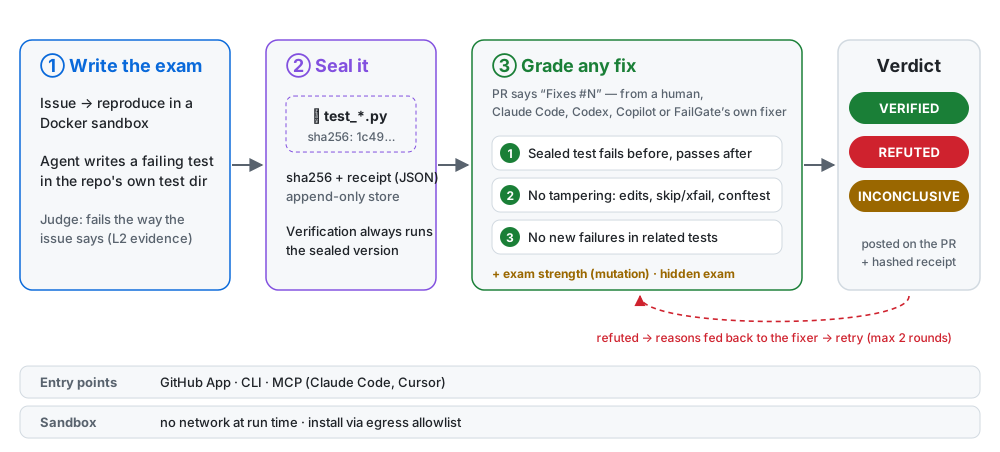
| Step | What happens | Why it's trustworthy |
|---|---|---|
| ① Write the exam | An agent reads the source in a Docker sandbox and writes a pytest test into the repo's own test directory, on the code as it was when the issue was opened. | An independent judge checks it fails the way the issue describes (stack-trace signature, or an LLM judge with quoted evidence), across repeated runs. |
| ② Seal it | The test is stored with a sha256 and a JSON evidence receipt (code, environment, command, every run's result). Append-only. | Verification always runs the sealed copy. Changing the test in a PR is itself a red flag. |
| ③ Grade any fix | For a PR that says Fixes #N: (1) the sealed test fails on the merge base and passes on the PR; (2) no tampering — deleted / renamed / edited tests, skip, xfail, conftest or pytest-config tricks; (3) no new failures in related existing tests. |
Every run happens in a fresh sandbox (no network, non-root, read-only root fs). The verdict comes with a receipt anyone can re-hash. |
| + hints | Exam strength: mutate the lines the fix changed and see if the exam notices. Hidden exam: variant tests derived from the issue, sealed but not published. | Both only annotate the verdict — they never flip it. |
Wording matters: a pass means "passes the acceptance test + no tampering found + no new regressions", not "the fix is correct".
📊 Results
Datasets are small and every number has known limits (see What FailGate does not claim); the human-style reviews were done by Claude, not by the projects' maintainers.
| What was measured | Result | Details |
|---|---|---|
| Generated exams that fail before and pass after the upstream fix (strict FB/PA), 4 real repos | 32 / 36 | black 9/11 · pylint 10/10 · packaging 6/6 · astroid 7/9 |
Correct verdicts on real upstream fixes + 4 kinds of cheating PRs (test-only, skip in exam, conftest skip, unrelated commit) |
125 / 125 | black 45 · pylint 50 · packaging 30 |
| Regressions injected outside the exam's reach, caught by layer ③ | 18 / 21 | pylint went 4/8 → 8/8 after adding "always-run" tests |
LangChain monorepo (libs/core), held-out issues, run on GitHub Actions |
exams 6 / 6 · strict FB/PA 4 / 5 · verdicts 22 / 23 | real fixes 4/4 · cheating 16/16 · injected regressions 2/3 (the miss: no existing test reaches that function) |
| Fix-agent patches that passed the exam but were actually wrong | 7 → 3 after full verification | giving the agent the exam did not raise its fix rate (13/24 both arms) — the value is in the gate |
Full loop on GitHub: /failgate fix → fixer agent opens a PR → verified |
5 / 5 issues | PRs #16, #17, #18, #20 (one automatic retry), #22 |
| Claude Code using FailGate over MCP: write test → fix → verify | 2 min 16 s | Claude Code (Sonnet 5.5) on demo issue #1, 9 tool calls |
⚡ Try it in a minute
Needs Python 3.11+, Docker, and a GitHub token (read-only is enough). No LLM key needed — the demo exams are already sealed.
git clone https://github.com/san086041-glitch/FailGate && cd FailGate
python -m venv .venv && source .venv/bin/activate     # Windows: .venv\Scripts\Activate.ps1
pip install -e .
export GITHUB_TOKEN=$(gh auth token)

python scripts/media/demo_exams.py import             # the demo repo's public sealed exams → your local DB
failgate verify san086041-glitch/failgate-demo#5      # a PR that only edits the test → refuted
failgate verify san086041-glitch/failgate-demo#16     # a real fix → accepted, with exam strength
Then type failgate for the home screen and interactive shell, or failgate doctor to check your setup.
Just the CLI, without the demo data, is on PyPI:
pip install failgate
failgate --version
failgate doctor          # what is configured and what is missing

🧩 Three ways to use it
|
🐙 GitHub App Install on a repo. New issues get triage, dedup, and — for bugs — a sealed failing test. PRs that say Maintainer commands: New repos start in shadow mode: every write is logged, nothing is posted. |
⌨️ CLI failgate verify owner/repo#123
failgate checkup owner/repo
failgate up
|
🤖 MCP (local, stdio) Let Claude Code or Cursor use FailGate as their acceptance gate: claude mcp add failgate -- \
python -m failgate mcp
Tools: |
Long-running deployment: docker compose up -d --build brings up the API, a sandbox worker, PostgreSQL and Redis — see docs/deploy.md.
🔁 End to end: from issue to merged fix
One real run on the demo repo (issue #21 → PR #22). The only human actions were opening the issue, commenting /failgate fix, and clicking merge.
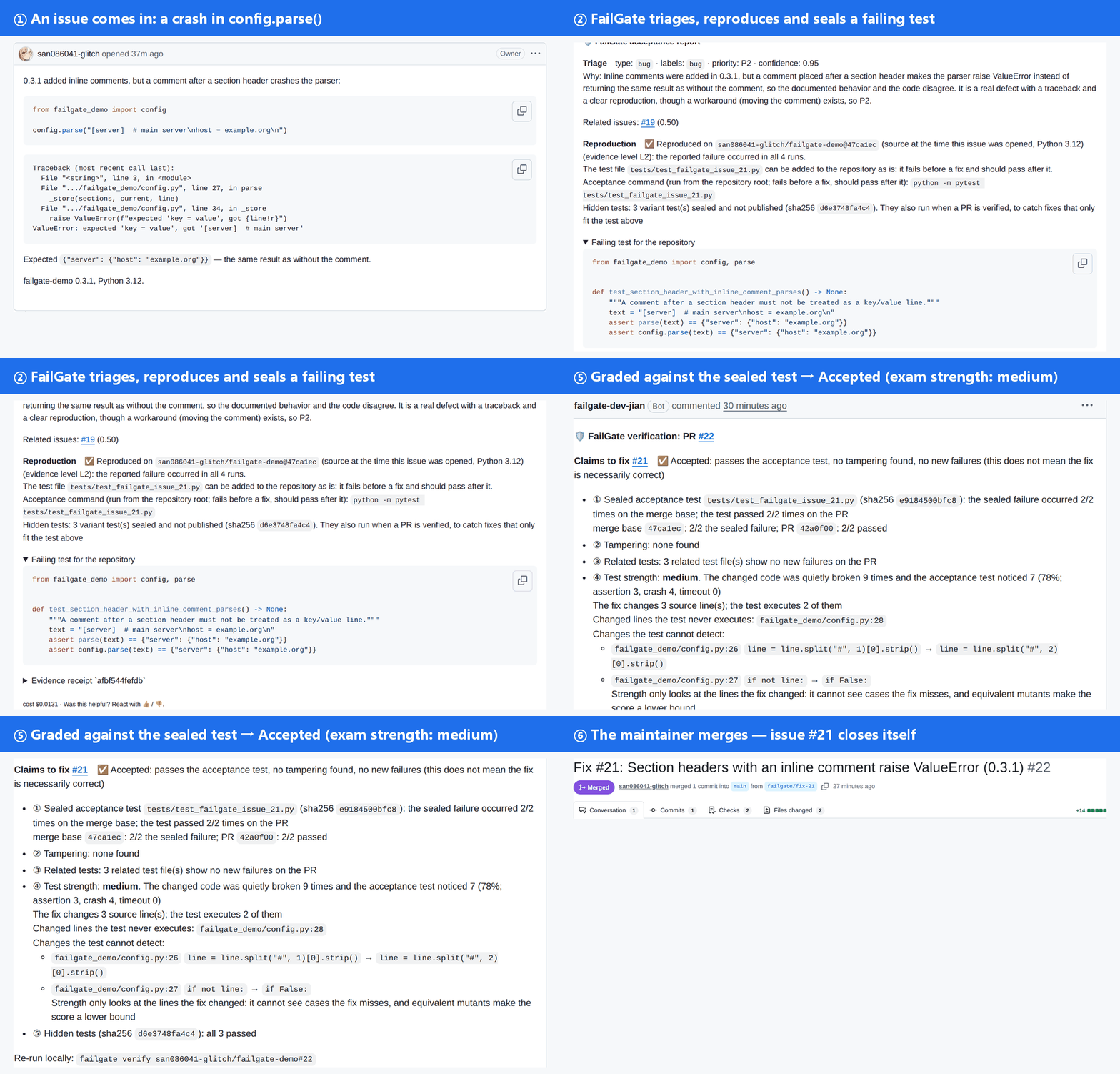
| Time (UTC) | What happened | By |
|---|---|---|
| 10:01:08 | Issue #21 opened: config.parse() crashes on [server] # comment |
maintainer |
| 10:01:13 → 10:03:20 | Triage → dedup (related: #19) → reproduced in the sandbox → failing test sealed | FailGate |
| 10:05:48 | /failgate fix |
maintainer |
| 10:06:44 | Fixer agent's patch passed the sealed test in a fresh workspace → PR #22 opened by the Fixer App | FailGate |
| 10:08:25 | PR #22 verified: fails before / passes after, no tampering, no new failures, exam strength medium (7/9) | FailGate |
| 10:10:54 | Squash-merged → issue #21 closed automatically | maintainer |
About 10 minutes end to end, $0.013 in LLM calls. Here is the same run from the operator's side — failgate up keeps the service and webhook tunnel running and shows every state change:
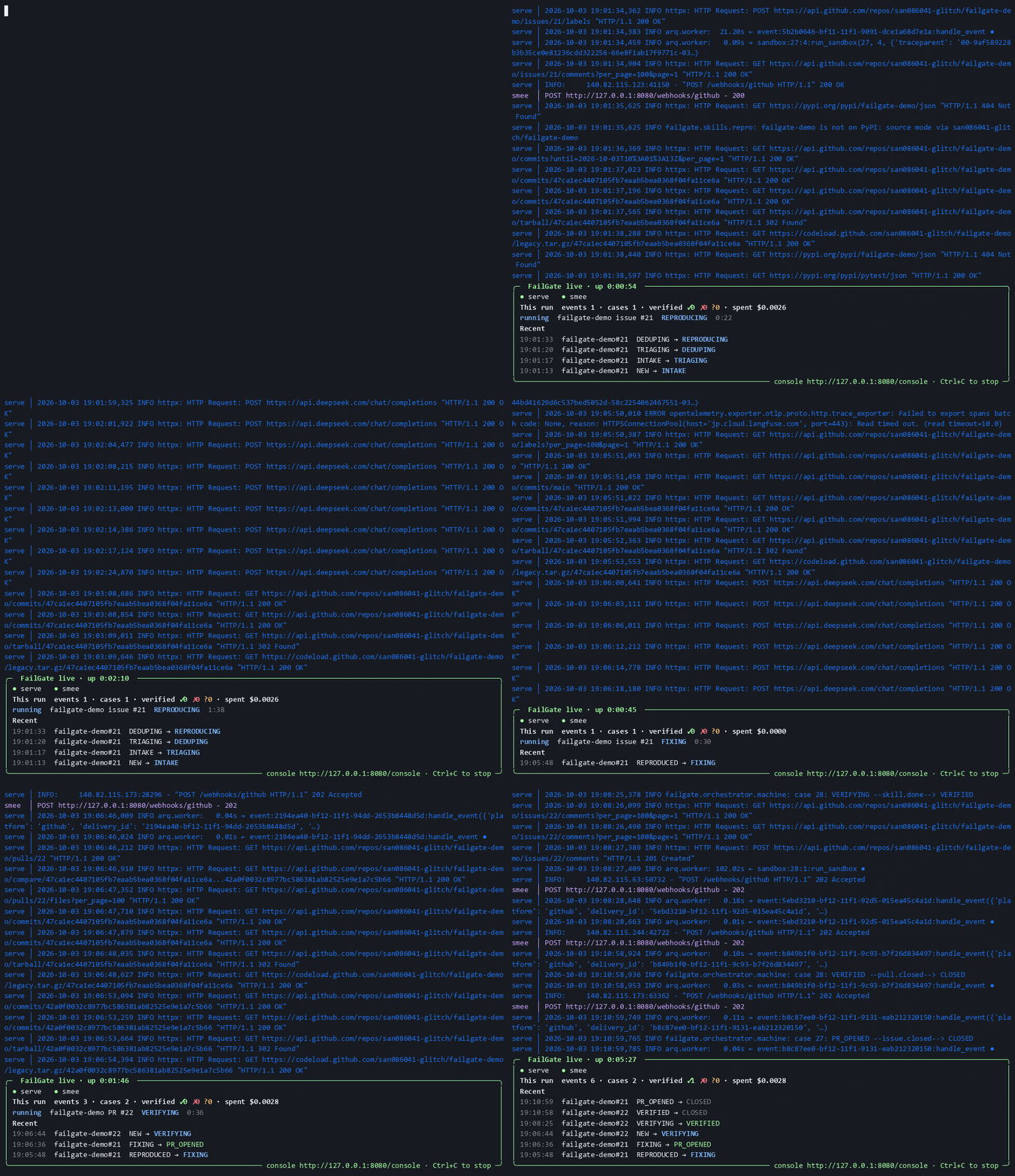
Recorded with a real pseudo-terminal (pywinpty) and rendered with agg. Played at 2× with waits fast-forwarded — the board's up clock shows real elapsed time. up was restarted once before /failgate fix; the smee channel URL is masked.
🔧 Under the hood
|
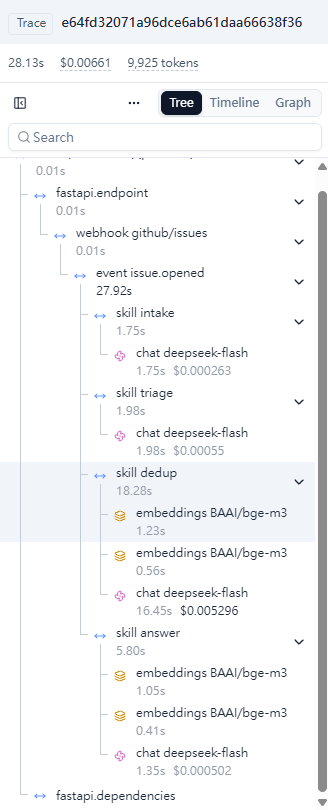
One webhook = one trace (Langfuse). |
Stack: Python 3.11 · FastAPI · SQLAlchemy 2 (async) · PostgreSQL / SQLite · Redis + arq · Docker SDK · LangGraph (fixer agent) · cosmic-ray (mutation) · bm25s + bge-m3 (retrieval) · OpenTelemetry · MCP Python SDK · Typer + Rich + prompt_toolkit.
🚫 What FailGate does not claim
- "Verified" ≠ correct. A weak exam lets a wrong fix through — that's why strength and hidden exams exist, and why they are shown, not hidden.
- Small, honest samples. 4 Python repos, 12 sampled issues each, one run each; human-style review was done by Claude with a "GitHub evidence required" rule.
- Python + pytest only, for now. Packages that need system libraries may not install in the sandbox. Monorepos work when the package under test lives in one subdirectory (
--subdir libs/core, e.g. LangChain). More languages are on the roadmap. - Exam strength is a hint. It reacts to stronger tests (10 up / 0 down on SWE-bench + UTBoost, p = 0.002) but can't by itself tell a weak exam from a good one (p = 0.41).
🗺️ Roadmap
- More languages. FailGate works on Python + pytest today. The exam → seal → grade design does not depend on the language; what is Python-specific is four adapters — sandbox install, test runner, failure signatures and mutation testing. Next up: JavaScript / TypeScript (Jest, Vitest), then Go and Java.
- More platforms. Gitee, alongside GitHub.
- A v0.1 release with a recorded walkthrough.
📚 Docs
- Deploy with docker compose
- Set up the GitHub App
- Set up the Fixer App (only needed for
/failgate fix)
1 maintainer

Metadata
1 maintainer
Release files for failgate 0.1.0
For a detailed explanation of source distributions (sdists) and built distributions (wheels), please see the package formats documentation.
Source distribution (sdist)
| File | Size | Uploaded | |
|---|---|---|---|
| failgate-0.1.0.tar.gz | 407.0 kB | Details |
Built distribution (wheel)
| File | Interpreter | ABI | Platform | Reset |
|---|---|---|---|---|
| failgate-0.1.0-py3-none-any.whl | Python 3 | none | any | Details |
Total release size: 901.9 kB
Release files / failgate-0.1.0.tar.gz
| Download URL | failgate-0.1.0.tar.gz |
|---|---|
| Size | 407.0 kB |
| Tags | Source |
|
SHA-256 checksum How to use checksums |
6e450bc586f3a4cffe8b3188f9b78cade0544a5c3fc8885e4b50c5e1a194938d
|
|
BLAKE2b-256 checksum How to use checksums |
47f3c9667a02c4bf29a3449c461fa973391a83451645db093c38fca71964f706
|
| Upload date | |
|
Uploaded using Trusted Publishing? What is trusted publishing? |
Yes |
| Uploaded via |
twine/7.0.0 CPython/3.13.14
|
Provenance
Provenance describes where a file came from. On PyPI, provenance is shared via attestations, which provide a verifiable record of the build or publishing details. View details, limitations and caveats.


PyPI Publish Attestation
PyPI verified that this artifact, at this checksum, originated from the publisher listed below.
Signed by GitHub Actions, verified by PyPI on Oct 9, 2026.
Transparency logRelease files / failgate-0.1.0-py3-none-any.whl
| Download URL | failgate-0.1.0-py3-none-any.whl |
|---|---|
| Size | 494.9 kB |
| Tags | Python 3 |
|
SHA-256 checksum How to use checksums |
7f88fe04ff54605a7e79b2b96cf7e3ff840c323a6efe51f95dd4786168a6e3f4
|
|
BLAKE2b-256 checksum How to use checksums |
eb33f80c13de12f78c22c14d5dc39a3ee7b7813f8bef6b41d1d2a39324a6d406
|
| Upload date | |
|
Uploaded using Trusted Publishing? What is trusted publishing? |
Yes |
| Uploaded via |
twine/7.0.0 CPython/3.13.14
|
Provenance
Provenance describes where a file came from. On PyPI, provenance is shared via attestations, which provide a verifiable record of the build or publishing details. View details, limitations and caveats.
PyPI Publish Attestation
PyPI verified that this artifact, at this checksum, originated from the publisher listed below.
Signed by GitHub Actions, verified by PyPI on Oct 9, 2026.
Transparency log












