
faiss-defuse
English | 한국어
Check, convert and load LangChain FAISS stores (index.faiss + index.pkl) without running the pickle and without allow_dangerous_deserialization=True. A Python library and a small CLI. The core uses only the standard library.
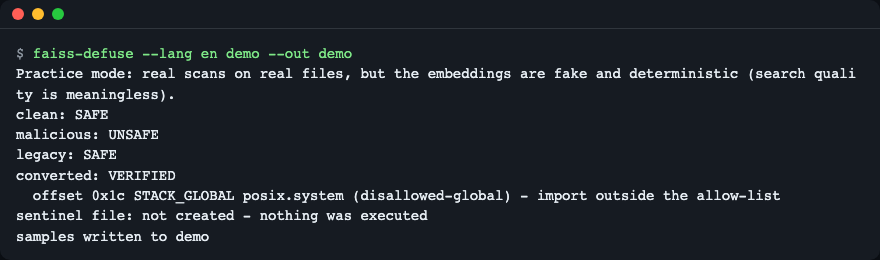
The built-in demo scans a clean store, a booby-trapped store and an old-format store, converts one, and proves nothing was executed.
What it does
FAISS.save_local() writes two files: index.faiss (the vectors) and index.pkl (your documents, as a Python pickle). FAISS.load_local() refuses to read the pickle unless you pass allow_dangerous_deserialization=True, and the usual advice is "only load files you made yourself". That is hard to follow when stores are downloaded, shared between teams or shipped in an image.
faiss-defuse gives you five things instead:
| Step | What it does | Needs FAISS? |
|---|---|---|
scan |
Reads the pickle's instructions without running them and says safe or unsafe, with the byte offset of each problem |
no |
inspect |
Prints the index.faiss header (index type, dimension, vector count, metric), the document count and the metadata keys |
no |
convert / save_safe |
Writes a pickle-free copy: index.faiss + docstore.jsonl + manifest.json (SHA-256 of both files) |
save_safe only |
load_safe |
Returns a normal LangChain FAISS object, no flag needed |
yes |
verify |
Checks hashes, then compares converted and original content and top-k search results | top-k part only |
Think of it as an X-ray machine plus a sealed box. The X-ray (scan) looks inside the parcel without opening it. The sealed box (the pickle-free format) is what you ship afterwards, with a tamper-evident sticker (the hashes).
Why the flag is dangerous
A pickle is not data. It is a list of instructions for a small stack machine, and one instruction (REDUCE) can call any function it has imported. Here are the first instructions of the demo's booby-trapped index.pkl (from pickletools.dis, truncated; offsets depend on the payload):
    0: \x80 PROTO      4
    2: \x95 FRAME      221
   11: \x8c SHORT_BINUNICODE 'posix'
   18: \x94 MEMOIZE    (as 0)
   19: \x8c SHORT_BINUNICODE 'system'
   27: \x94 MEMOIZE    (as 1)
   28: \x93 STACK_GLOBAL
   29: \x94 MEMOIZE    (as 2)
STACK_GLOBAL at offset 28 imports posix.system (the os.system of Linux and macOS). A later REDUCE calls it. load_local(..., allow_dangerous_deserialization=True) would run that call as the file loads. The demo's payload is harmless (echo creating a marker file), and the demo shows the marker is never created.
Install
uv add "faiss-defuse[langchain] @ git+https://github.com/LeeGyeongPil/faiss-defuse"
# or, from a clone:
git clone https://github.com/LeeGyeongPil/faiss-defuse && cd faiss-defuse && uv sync
Python 3.11 or newer. No runtime dependencies for scan, inspect and convert. The [langchain] extra adds langchain-community, langchain-core, faiss-cpu and numpy for load_safe, save_safe and the top-k check. Install uv with curl -LsSf https://astral.sh/uv/install.sh | sh if you do not have it (a minimal Linux image also needs git and curl).
Quick start (about a minute)
From a clone, with uv sync done:
uv run faiss-defuse demo --out /tmp/faiss-defuse-demo
Practice mode: real scans on real files, but the embeddings are fake and deterministic (search quality is meaningless).
clean: SAFE
malicious: UNSAFE
legacy: SAFE
converted: VERIFIED
  offset 0x1c STACK_GLOBAL posix.system (disallowed-global) - import outside the allow-list
sentinel file: not created - nothing was executed
samples written to /tmp/faiss-defuse-demo
Practice data. The demo builds its stores offline with fake, hash-based embeddings, so no model or API key is needed and search quality is meaningless. The scans, the conversion and the verification are real, run on real files. Real stores differ only in having real embeddings.
Now scan your own store (a directory made by save_local):
uv run faiss-defuse scan path/to/your_index_dir
Run it on the demo's booby-trapped store to see a rejection (exit code 1):

scan names the finding (disallowed-global), the opcode, the offset and the import. Nothing was executed.
Step by step
-
Scan the store you were given. The demo's clean store:
uv run faiss-defuse scan /tmp/faiss-defuse-demo/clean
SAFE  index.pkl  imports: datetime.date, InMemoryDocstore, Document  protocol 4  783 opcodes  2,233 bytes
Nothing was executed.
safemeans the pickle imports only the names a LangChain FAISS store uses (see limits). Everything else is rejected, not just "known bad" names. -
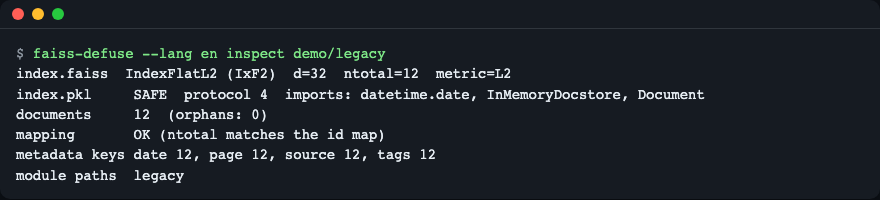
Inspect it. This works without FAISS installed and also reads old stores whose pickles use the former
langchain.*module paths:uv run faiss-defuse inspect /tmp/faiss-defuse-demo/legacy
index.faiss  IndexFlatL2 (IxF2)  d=32  ntotal=12  metric=L2
index.pkl     SAFE  protocol 4  imports: datetime.date, InMemoryDocstore, Document
documents     12  (orphans: 0)
mapping       OK (ntotal matches the id map)
metadata keys date 12, page 12, source 12, tags 12
module paths  legacy
Header facts come from reading the first bytes of
index.faisswith the standard library, before FAISS touches the file. -
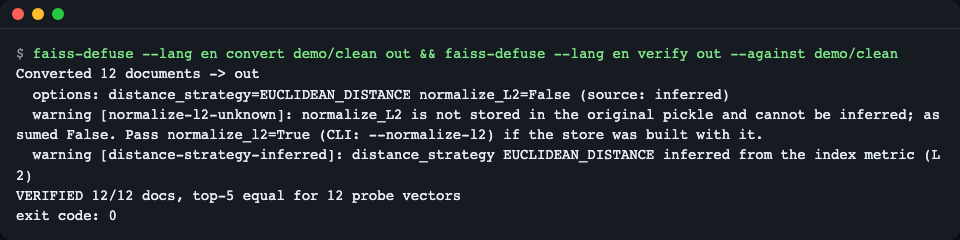
Convert and verify:
uv run faiss-defuse convert /tmp/faiss-defuse-demo/clean /tmp/faiss-defuse-demo/c2 --overwrite
uv run faiss-defuse verify /tmp/faiss-defuse-demo/c2 --against /tmp/faiss-defuse-demo/clean
Converted 12 documents -> /tmp/faiss-defuse-demo/c2
  options: distance_strategy=EUCLIDEAN_DISTANCE normalize_L2=False (source: inferred)
  warning [normalize-l2-unknown]: normalize_L2 is not stored in the original pickle and cannot be inferred; assumed False. Pass normalize_l2=True (CLI: --normalize-l2) if the store was built with it.
  warning [distance-strategy-inferred]: distance_strategy EUCLIDEAN_DISTANCE inferred from the index metric (L2)
VERIFIED 12/12 docs, top-5 equal for 12 probe vectors
LangChain does not save
normalize_L2or the distance strategy in the pickle. If your store was built withnormalize_L2=True, say so with--normalize-l2, otherwise scores can change silently. That is why the warning appears. -
Load it without any flag (see Library).
CLI
| Command | Purpose | Useful options |
|---|---|---|
faiss-defuse scan PATH |
Verdict without executing | --json, --index-name, --limit |
faiss-defuse inspect PATH |
Header, document count, mapping check, metadata keys | --json, --limit |
faiss-defuse convert SRC DST |
Pickle-free copy | --normalize-l2, --distance-strategy, --overwrite, --json, --limit |
faiss-defuse verify DIR |
Hashes; with --against also content and top-k |
--against ORIGINAL, --k, --probes, --trust-original, --json, --limit |
faiss-defuse demo |
Offline sample stores and the whole flow (needs the [langchain] extra) |
--out DIR |
Exit codes: 0 ok, 1 check failed (unsafe, unsupported content, mismatch), 2 usage error, 3 damaged, unreadable or over-limit input, 4 optional dependencies missing.
--json prints machine-readable output for CI. Keys and finding code values do not depend on the language; only message is translated. The clean store:
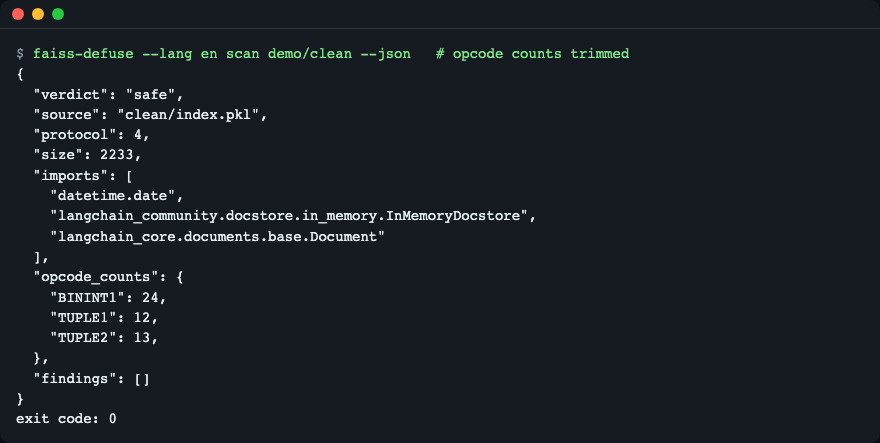
(opcode_counts is trimmed in the screenshot.)
verify --trust-original additionally loads the original with LangChain's own load_local. That executes the original pickle, so use it only on stores you built yourself. Plain verify never does.
Display language. --lang en|ko, or FAISS_DEFUSE_LANG=en|ko, then LC_ALL / LC_MESSAGES / LANG. Anything that is not Korean falls back to English. Korean output is shown in README.ko.md.
Library
from faiss_defuse import load_safe, save_safe, scan
One-line change in an application:

The same call, without the flag. load_safe accepts original save_local directories (scanned and decoded without running the pickle) and pickle-free stores (hashes checked first).
A runnable example, examples/quickstart.py (it uses a fake embedding class, so it works offline):
uv run python examples/quickstart.py
scan: safe ['langchain_community.docstore.in_memory.InMemoryDocstore', 'langchain_core.documents.base.Document']
files: ['docstore.jsonl', 'index.faiss', 'manifest.json']
top hit: dogs bark {'n': 2}
(langchain-community prints a DeprecationWarning on import because the package is no longer maintained; the output above was captured with python -W ignore::DeprecationWarning.)
API
| Name | What it does | Main arguments | Returns / raises |
|---|---|---|---|
scan(path) |
Static verdict for a store directory or an index.pkl |
limits, index_name |
ScanReport (verdict, imports, findings) |
scan_bytes(data) |
Same for bytes in memory | limits, source |
ScanReport |
read_faiss_header(path) |
Validates and parses the index.faiss header |
FaissHeader |
|
inspect(path) |
Header, document count, mapping and metadata summary | index_name, limits |
StoreInfo |
convert(src, dst) |
Original store to pickle-free store | distance_strategy, normalize_l2, overwrite, index_name |
Manifest; UnsafePickleError, UnsupportedContentError, OutputExistsError |
save_safe(vectorstore, dst) |
Save a live LangChain FAISS object pickle-free (records the real options) |
overwrite |
Manifest; needs the extra |
load_safe(path, embeddings) |
Load without the flag | distance_strategy, normalize_l2, allow_option_override, index_name |
LangChain FAISS; ManifestMismatchError, MalformedStoreError, OptionConflictError, UnsafePickleError |
verify(converted) |
Hash, header, mapping checks; with original= also content and top-k |
original, trust_original, k, probes |
VerifyReport |
Limits |
Size, opcode, node and depth limits for hostile input (see resource limits) | max_doc_nodes=... and the other fields |
dataclass |
All errors derive from DefuseError (also MissingExtraError when the extra is not installed).
CI recipe
Build step, after creating the index:
save_safe(store, "dist/index_store", overwrite=True)
Before publishing the artifact (this step compares against the original and fails the job on mismatch):
faiss-defuse scan build/index_dir          # exit 1 if the pickle is not safe
faiss-defuse verify dist/index_store --against build/index_dir
In the serving app, load_safe("dist/index_store", embeddings). A hash mismatch raises ManifestMismatchError before the file reaches FAISS. The hashes stop tampering in transit; they cannot stop someone who rewrites the files and the manifest together. verify --against catches that by comparing with the original.
The pickle-free format
Three files: index.faiss (unchanged), docstore.jsonl (one document per line, with type tags such as {"$tuple": [...]} and {"$date": "2025-01-01"} for values JSON lacks), and manifest.json (format version, SHA-256 and size of both files, index facts, FAISS options). Details and the full tag table are in docs/format.md.
How the checks work
Two gates, in order:
- Static scan.
pickletools.genopsreads the opcodes. A symbolic stack follows strings throughMEMOIZE/BINGET, sobuiltins.evalhidden behind a memo reference is still seen. Only an exact allow-list of(module, name)pairs passes. Trailing data afterSTOP, extension codes, persistent ids and dotted names are rejected. - Inert decoder. Only after a pass, a decoder rebuilds
(id, page_content, metadata)from the instructions using stub classes. It never imports LangChain, so a safe verdict does not depend on what LangChain's classes expose. Restricted unpicklers that return real allowed classes can be bypassed through attributes those classes expose, so this library does not use one.
index.faiss is also input: the header (known fourcc, plausible d and ntotal, file size matching the vector count for flat indexes) is checked with struct before faiss.read_index is called. Supported index kinds: IxF2 IxFI IxFl IHNf IwFl IxMp IxM2 IxPq. docstore.jsonl is checked against the manifest and the vector count.
Resource limits
A tiny hostile pickle can ask for a lot of work, because a pickle reference reuses an object instead of copying it. Every limit is checked before the memory is allocated or the bytes are written. Defaults:
| Limit | Default | What it bounds |
|---|---|---|
max_pickle_bytes |
512 MiB | size of index.pkl |
max_opcodes |
50,000,000 | opcodes the scan reads |
max_string_bytes |
64 MiB | one string in the pickle |
max_faiss_bytes |
16 GiB | size of index.faiss |
max_vectors |
200,000,000 | ntotal in the index header |
max_docstore_bytes |
2 GiB | docstore.jsonl, both when read and when written by convert |
max_findings |
200 | findings listed in one report |
max_depth |
100 | nesting depth |
max_doc_nodes |
100,000 | values in one document's metadata, shared references counted each time |
max_total_nodes |
10,000,000 | values in the whole store |
Going over a limit stops with limit-exceeded (exit 3 for convert, inspect and verify; scan reports UNSAFE with that finding). A second limit cannot be changed: while decoding, the data copied by constructors such as frozenset(...) may not exceed twice the pickle size plus 64 KiB. Beyond that the store is refused as reference-amplification (exit 3), because an honest pickle writes its constructor arguments out instead of reusing them. Integers with more than 4,300 digits are reported as unsupported (exit 1).
A big but honest store can raise a limit, from the command line or in Python:
faiss-defuse convert SRC DST --limit max_doc_nodes=500000 --limit max_docstore_bytes=8000000000
convert(src, dst, limits=Limits(max_doc_nodes=500_000))
--limit NAME=NUMBER can be repeated and works on scan, inspect, convert and verify. A bad value is a usage error (exit 2). If convert fails, it removes the destination folder it created.
What it does not guarantee
- FAISS's own parser is not sandboxed. Header and size checks, the hashes and a lower bound of
faiss-cpu>=1.16.0reduce the risk from a craftedindex.faiss; they do not remove it. An isolated read is planned. - A
safeverdict is about the pickle only, not about the text in your documents.scandecides whether code could run; it does not decode the store, so a pickle built to waste memory can still printSAFE. Such stores are stopped later, by the limits above, inconvert,inspect,verifyandload_safe. Within the default limits a small pickle can still makeconvertwrite up tomax_docstore_bytes(2 GiB) to disk, with memory use kept small. - Not supported yet (reported as
unsupported, not as unsafe, exit 1):serialize_to_bytes()output, Annoy and ScaNN stores, numpy-array and pandasTimestampmetadata. - The scan is pure Python: about 2.7 s for a 100,000-document store (20.8 MB
index.pkl) on the author's laptop; convert 3.7 s,load_safeof a converted store 0.7 s.
When to use it
- You receive, download or ship LangChain FAISS stores and want to stop enabling
allow_dangerous_deserialization. - You want a CI gate and a reproducible, hash-checked artifact for an index.
- Other tools: for generic pickle files (not LangChain-specific) see fickling and picklescan; for model weights prefer safetensors. faiss-defuse knows only the LangChain FAISS layout and rejects anything else.
Troubleshooting
| Symptom | Cause | Fix |
|---|---|---|
error: optional dependencies missing: ... (exit 4) |
load_safe, save_safe or top-k need the extra |
install faiss-defuse[langchain] |
UNSAFE ... disallowed-global on your own store |
the pickle imports something outside the allow-list (a custom metadata class, for example) | do not enable the flag; rebuild the store with plain-value metadata |
limit-exceeded or reference-amplification, exit 3 |
the file is larger than a limit, or built so that decoding would multiply its size | check where the store came from; if it is yours and large, pass --limit NAME=NUMBER (reference-amplification cannot be raised) |
unsupported-value-type, exit 1 |
metadata holds numpy arrays or pandas values | convert them to plain Python values and rebuild |
MISMATCH ... does not match manifest.json |
a file changed after it was written | rebuild with faiss-defuse convert from the original |
| scores differ after switching | normalize_L2 was not recorded |
convert --normalize-l2 or load_safe(..., normalize_l2=True) |
Versions and compatibility
Semantic Versioning. During 0.x, minor versions may change the API; see CHANGELOG.md. Tested with Python 3.11, 3.12, 3.13, langchain-community 0.4.2, langchain-core 1.8.4, faiss-cpu 1.16.0, numpy 2.5.5. LangChain has archived langchain-community; this library keeps the stub decoder independent of it and the [langchain] extra is capped below 0.5.
Development
uv sync
uv run pytest -q
Sources (checked 2026-11-22)
- LangChain
FAISS.load_local: https://reference.langchain.com/python/langchain-community/vectorstores/faiss/FAISS/load_local langchain-communitysunset notice: https://github.com/langchain-ai/langchain-community/issues/674- Python
pickletools: https://docs.python.org/3/library/pickletools.html - Hugging Face on pickle risks: https://huggingface.co/docs/hub/security-pickle
- CVE-2024-5998 (a deserialization vulnerability in FAISS loading): https://nvd.nist.gov/vuln/detail/CVE-2024-5998
License
MIT.
1 maintainer

Metadata
1 maintainer
Release files for faiss-defuse 0.1.1
For a detailed explanation of source distributions (sdists) and built distributions (wheels), please see the package formats documentation.
Source distribution (sdist)
| File | Size | Uploaded | Provenance | Actions |
|---|---|---|---|---|
| faiss_defuse-0.1.1.tar.gz | 491.9 kB | Without provenance | Details for faiss_defuse-0.1.1.tar.gz |
Built distribution (wheel)
| File | Interpreter | ABI | Platform | Actions Reset |
|---|---|---|---|---|
| faiss_defuse-0.1.1-py3-none-any.whl | Python 3 | none | any | Details for faiss_defuse-0.1.1-py3-none-any.whl |
Total release size: 550.7 kB
Release files / faiss_defuse-0.1.1.tar.gz
| Download URL | faiss_defuse-0.1.1.tar.gz |
|---|---|
| Size | 491.9 kB |
| Tags | Source |
|
SHA-256 checksum How to use checksums |
7b0a87379b608fdd6c726b612cd0de521184c4a4ca95680fdb87cae179b56450
|
|
BLAKE2b-256 checksum How to use checksums |
edde3b2b4f75e57f5e39e0315fb78f5f379a657643306afe4f72366dfc4213dd
|
| Upload date | |
|
Uploaded using Trusted Publishing? What is trusted publishing? |
No |
| Uploaded via |
uv/0.13.6 {"installer":{"name":"uv","version":"0.13.6","subcommand":["publish"]},"python":null,"implementation":{"name":null,"version":null},"distro":{"name":"macOS","version":null,"id":null,"libc":null},"system":{"name":null,"release":null},"cpu":null,"openssl_version":null,"setuptools_version":null,"rustc_version":null,"ci":null}
|
Release files / faiss_defuse-0.1.1-py3-none-any.whl
| Download URL | faiss_defuse-0.1.1-py3-none-any.whl |
|---|---|
| Size | 58.8 kB |
| Tags | Python 3 |
|
SHA-256 checksum How to use checksums |
9676aed99474d6fe646feb4a4c2581c64a75470731b18e231fd0d848eb6f13f8
|
|
BLAKE2b-256 checksum How to use checksums |
c9e323f7d7435bb7a93943efa8518302b22b4d67ee8e2e7c18609f5c8f68e1db
|
| Upload date | |
|
Uploaded using Trusted Publishing? What is trusted publishing? |
No |
| Uploaded via |
uv/0.13.6 {"installer":{"name":"uv","version":"0.13.6","subcommand":["publish"]},"python":null,"implementation":{"name":null,"version":null},"distro":{"name":"macOS","version":null,"id":null,"libc":null},"system":{"name":null,"release":null},"cpu":null,"openssl_version":null,"setuptools_version":null,"rustc_version":null,"ci":null}
|
Security for faiss-defuse 0.1.1
Provenance
Provenance describes where a file came from. On PyPI, provenance is shared via attestations, which provide a verifiable record of the build or publishing details. View details, limitations and caveats.
No provenance found
None of the files in this release were uploaded with provenance metadata.
A note on package security
PyPI is a repository for distributing packages, not a service for auditing them. While third-party security researchers and our staff do their best to detect and remove malicious packages, PyPI cannot guarantee the quality, security or suitability of any given package.
To learn more about protecting yourself from malicious actors, visit our package security documentation.













