
The repository or configuration that created this release differ from a previous release. View details.
falsify-inspect
PRML pre-registration for Inspect AI eval logs.




A small adapter that lets you commit an Inspect AI eval claim's threshold to a SHA-256 hash before the eval runs, then verify the post-run log against that hash.
Why
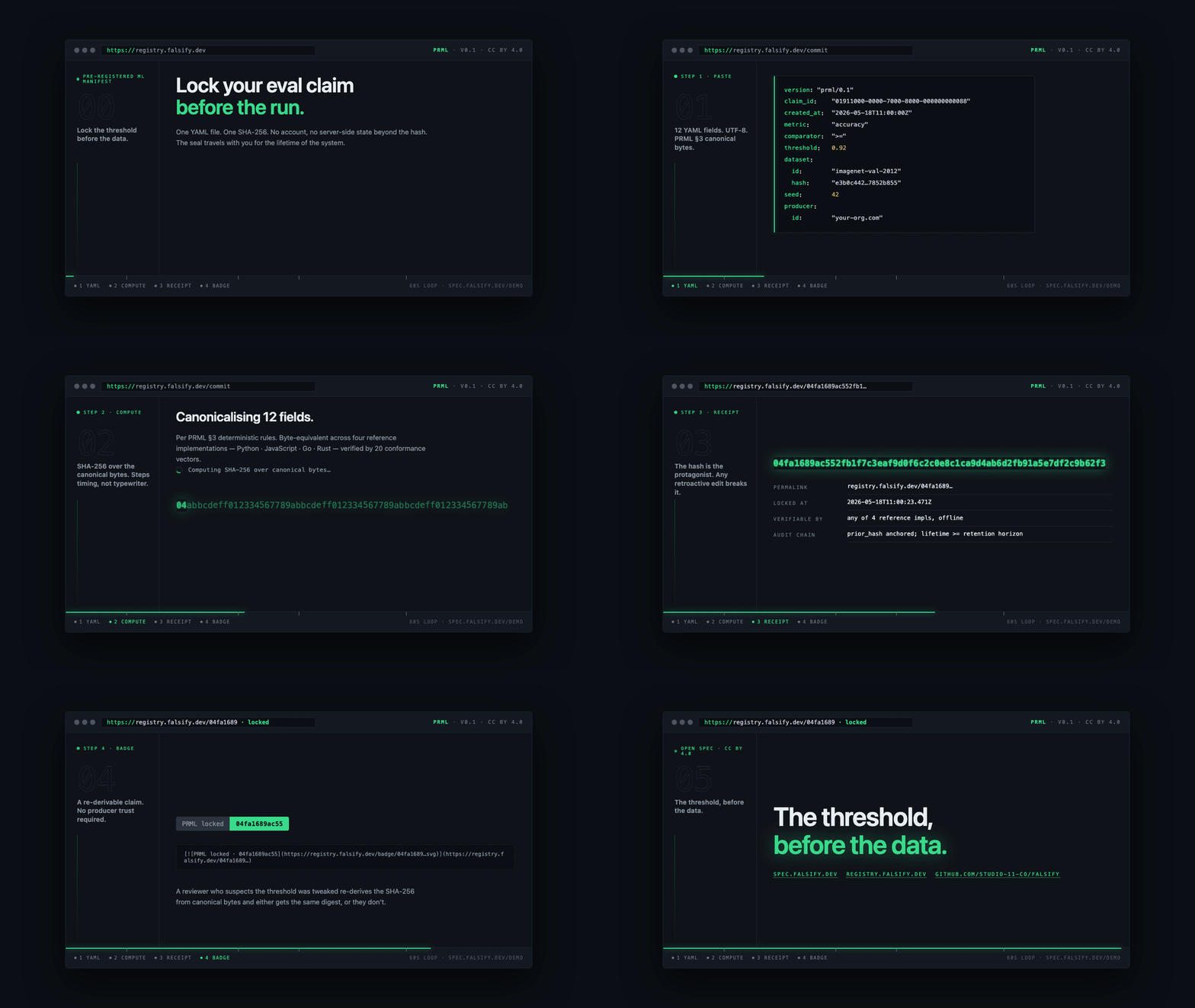
Inspect AI is the cleanest open eval framework available — UK AISI uses it for the work that backs national-level AI safety reporting. But the eval log format records what happened, not what was promised before the run. PRML closes that gap.
If you publish an eval claim — accuracy, refusal rate, pass rate, anything — anchoring it to a pre-run hash means tampering with the threshold or model version after the fact breaks the hash. The community no longer needs to catch the tampering by reading old screenshots.
Install
pip install falsify-inspect
Quickstart — Python API
from falsify_inspect import preregister, verify_eval_log

# 1. Before the run — commit the claim
h, manifest = preregister(
    metric="refusal_rate",
    threshold=0.95,
    threshold_direction=">=",
    dataset="harmbench-v1",
    dataset_hash="sha256:abc...",
    model_version="claude-3.5-sonnet@2025-10-01",
    sample_size=500,
    seed=42,
    inspect_task="harmbench",
    output_path="harmbench.prml.yaml",
)
print(h)
# sha256:e3b0c44298fc1c14...

# 2. Run your inspect eval as usual, producing eval.log
# (no changes to your inspect code)

# 3. After the run — verify
result = verify_eval_log(
    "eval.log",
    expected_hash=h,
    threshold=0.95,
    threshold_direction=">=",
    pre_registered=manifest.pre_registered,
)
assert result["ok"]
Quickstart — Inspect hook (automatic, recommended)
As of v0.2.0 falsify-inspect registers a native Inspect hook. Pre-register a manifest, point FALSIFY_PRML at it, and run your eval as usual. No changes to your Inspect code:
# 1. Pre-register the claim (writes harmbench.prml.yaml)
falsify-inspect lock \
  --metric refusal_rate --threshold 0.95 --threshold-direction ">=" \
  --dataset harmbench-v1 --dataset-hash sha256:abc... \
  --model-version "claude-3.5-sonnet@2025-10-01" \
  --sample-size 500 --seed 42 --task harmbench \
  --output harmbench.prml.yaml

# 2. Run the eval with the hook enabled
export FALSIFY_PRML=harmbench.prml.yaml
inspect eval harmbench.py --model anthropic/claude-3-5-sonnet-latest
At each task end the hook reads the realised metric, checks it against the committed threshold, confirms the run's identity (model, dataset, task) matches what you pre-registered, and writes a harmbench.prml-receipt.json with a PASS / FAIL / TAMPERED verdict. TAMPERED means the run did not match the pre-registration (for example a swapped model), so you cannot quietly change the claim after seeing results.
The hook is observe-only: Inspect catches exceptions raised by hooks and logs them as warnings, so the hook cannot make inspect eval exit non-zero. To gate CI, run falsify-inspect gate after the eval. It applies the same check to the newest eval log (or --log <file>) and exits 0 PASS, 10 FAIL, 3 TAMPERED, 2 if it cannot verify:
inspect eval harmbench.py --model anthropic/claude-3-5-sonnet-latest
falsify-inspect gate --manifest harmbench.prml.yaml --log-dir ./logs
FALSIFY_PRML_STRICT=1 still raises inside the hook on a non-PASS verdict, but Inspect records that as a hook warning; it does not fail the run (checked against inspect_ai 0.3.285, 28 October 2026).
Quickstart — CLI
# Pre-register an eval claim
falsify-inspect lock \
  --metric refusal_rate \
  --threshold 0.95 \
  --threshold-direction ">=" \
  --dataset harmbench-v1 \
  --dataset-hash sha256:abc... \
  --model-version "claude-3.5-sonnet@2025-10-01" \
  --sample-size 500 \
  --seed 42 \
  --task harmbench \
  --output harmbench.prml.yaml

# returns: sha256:e3b0c44298fc1c14...

# Later, verify the eval log
falsify-inspect verify eval.log \
  --hash sha256:e3b0c44298fc1c14... \
  --threshold 0.95 \
  --threshold-direction ">=" \
  --pre-registered "2026-05-08T20:00:00Z"
Exit codes:
0— pass (hash matches, threshold satisfied)10— fail (hash matches, threshold violated)3— tamper (hash mismatch — fields changed after pre-registration)2— log not found / structurally invalid
Inspect AI version troubleshooting
falsify-inspect 0.1.x supports the Inspect AI eval log shape produced by inspect_ai>=0.3.0, which is the version range installed by the optional inspect extra. If falsify-inspect verify reports that a log is structurally invalid, cannot find the expected score/metadata fields, or raises a parsing error immediately after an Inspect AI upgrade, first confirm that the package versions are in sync:
python -m pip show falsify-inspect inspect_ai
When the log was generated with a newer Inspect AI release, retry verification in an environment using the supported range, or regenerate the log after upgrading falsify-inspect to a release that documents support for the newer Inspect AI schema. If the versions look compatible, keep the failing eval.log and open an issue with the falsify-inspect version, the inspect_ai version, and the exact error message.
What this plugin does not do
- Does not modify
inspect_aiitself. It reads existing eval log JSON. - Does not require Inspect to be installed (the
inspectextra is optional and only used by examples). - Does not commit you to publishing every claim you pre-register. PRML §8.1 names this limit explicitly. Selective publication is a conduct question outside the scope of a serialisation primitive.
Spec & licensing
- PRML v0.1 spec: spec.falsify.dev/v0.1 (Community Specification License 1.0)
- This package: MIT
- Patent non-assertion grant: appendix of the spec
Audit & compliance crosswalks
Where this plugin fits in named AI governance frameworks (subcategory-by-subcategory, FULL / PARTIAL / NONE tagged):
- EU AI Act Article 12 crosswalk — automated-logging pattern for the 2 December 2027 deadline
- NIST AI RMF 1.0 crosswalk — GOVERN / MAP / MEASURE / MANAGE subcategory map
- ISO/IEC 42001:2023 crosswalk — AI Management System clause-by-clause evidence map
- Pattern 11 — PRML + Sigstore for execution integrity — closes the §8.1 gap with cosign + Rekor
Authors
Cüneyt Öztürk Contact: hello@falsify.dev · falsify.dev
Status
- v0.1 stable. v0.2 RFC open through 2026-05-22 — spec.falsify.dev/v0.2-rfc.
- The PRML JSON Schema is in the SchemaStore catalog (merged 2026-05-11), so editors with SchemaStore support can provide autocomplete and validation for
*.prml.yamlfiles out of the box.
Contributing
See CONTRIBUTING.md and the good first issue label for scoped work.
Cite the spec: Öztürk, C. (2026). PRML v0.1. Zenodo. https://doi.org/10.5281/zenodo.20177839
1 maintainer

Metadata
1 maintainer
Release files for falsify-inspect 0.4.2
For a detailed explanation of source distributions (sdists) and built distributions (wheels), please see the package formats documentation.
Change of provenance
The repository or configuration that created these release files differ from that of a previous release.
We recommend inspecting the repository and configuration before proceeding. View details.
Source distribution (sdist)
| File | Size | Uploaded | Provenance | Actions |
|---|---|---|---|---|
| falsify_inspect-0.4.2.tar.gz | 34.1 kB | With provenance | Details for falsify_inspect-0.4.2.tar.gz |
Built distribution (wheel)
| File | Interpreter | ABI | Platform | Actions Reset |
|---|---|---|---|---|
| falsify_inspect-0.4.2-py3-none-any.whl | Python 3 | none | any | Details for falsify_inspect-0.4.2-py3-none-any.whl |
Total release size: 52.7 kB
Release files / falsify_inspect-0.4.2.tar.gz
Change of provenance
This file belongs to a release with changed provenance: the repository or configuration that created the release files differ from that of a previous release.
We recommend inspecting the repository and configuration before proceeding. View details.
| Download URL | falsify_inspect-0.4.2.tar.gz |
|---|---|
| Size | 34.1 kB |
| Tags | Source |
|
SHA-256 checksum How to use checksums |
bc3fbaf48268827470edb8c77f1c4761af2aeda035d04db7878abd9d1fabbcba
|
|
BLAKE2b-256 checksum How to use checksums |
60f2b40d19eff3547825a7ea273b5b91dc9f69861ffbf93d0cd9f1e0a42df06e
|
| Upload date | |
|
Uploaded using Trusted Publishing? What is trusted publishing? |
Yes |
| Uploaded via |
twine/7.0.0 CPython/3.13.16
|
Provenance
Provenance describes where a file came from. On PyPI, provenance is shared via attestations, which provide a verifiable record of the build or publishing details. View details, limitations and caveats.


PyPI Publish Attestation
PyPI verified that this artifact, at this checksum, originated from the publisher listed below.
Signed by GitHub Actions, verified by PyPI on Nov 1, 2026.
Transparency logRelease files / falsify_inspect-0.4.2-py3-none-any.whl
Change of provenance
This file belongs to a release with changed provenance: the repository or configuration that created the release files differ from that of a previous release.
We recommend inspecting the repository and configuration before proceeding. View details.
| Download URL | falsify_inspect-0.4.2-py3-none-any.whl |
|---|---|
| Size | 18.6 kB |
| Tags | Python 3 |
|
SHA-256 checksum How to use checksums |
4fad80f6f30ff7769c8d58b44b8bdc05754b0c21f10ff5882b83c1100955da69
|
|
BLAKE2b-256 checksum How to use checksums |
4cee3c3e00f837ca71b2000fcbb67927f01c3b76356562c35d43f5163e93ec79
|
| Upload date | |
|
Uploaded using Trusted Publishing? What is trusted publishing? |
Yes |
| Uploaded via |
twine/7.0.0 CPython/3.13.16
|
Provenance
Provenance describes where a file came from. On PyPI, provenance is shared via attestations, which provide a verifiable record of the build or publishing details. View details, limitations and caveats.
PyPI Publish Attestation
PyPI verified that this artifact, at this checksum, originated from the publisher listed below.
Signed by GitHub Actions, verified by PyPI on Nov 1, 2026.
Transparency logSecurity for falsify-inspect 0.4.2
Provenance
Provenance describes where a file came from. On PyPI, provenance is shared via attestations, which provide a verifiable record of the build or publishing details. View details, limitations and caveats.
Change of provenance
The repository and configuration that created this release differ from a previous release.
While this could reflect a routine change by the project maintainers, it may also indicate that the release files have been compromised.
Repository
- Removed 0.4.1 github.com/studio-11-co/falsify-inspect
- Added 0.4.2 github.com/falsify-dev/falsify-inspect
Attestation for falsify_inspect-0.4.2.tar.gz
PyPI Publish Attestation
PyPI verified that this artifact, at this checksum, originated from the publisher listed below.
Signed by GitHub Actions, verified by PyPI on Nov 1, 2026.
Transparency logA note on package security
PyPI is a repository for distributing packages, not a service for auditing them. While third-party security researchers and our staff do their best to detect and remove malicious packages, PyPI cannot guarantee the quality, security or suitability of any given package.
To learn more about protecting yourself from malicious actors, visit our package security documentation.














