
PRML reference CLI — pre-register an ML evaluation claim as a SHA-256 manifest; verify PASS/FAIL/TAMPERED.
Verified details
These details have been verified by PyPIProject links
GitHub Statistics
Maintainers

Project description

ML evaluation claims should be locked before the experiment runs, not reported after.
PRML commits a claim — metric, threshold, dataset hash, seed — as a SHA-256 manifest. Run the eval. The hash either matches or it doesn't.
$ pip install falsify
$ falsify lock claim.prml.yaml
locked: claim.prml.yaml
  sha256:          c30dba8e0f566d1beebf4f8d468e6e07c821f0c72562dfb64ddf6596796f7797

$ falsify verify claim.prml.yaml --observed 0.934
PASS  metric=accuracy  observed=0.934  >=  threshold=0.9

# spec edited after locking → hash no longer matches:
$ falsify verify claim.prml.yaml --observed 0.934
TAMPERED  (exit 3)
No install? Verify any manifest in-browser at registry.falsify.dev. Byte-equivalent reference CLIs also ship for JS (npm i -g falsify-js), Go, and Rust.
4 reference implementations (Python, JavaScript, Go, Rust) byte-equivalent on all 21 conformance vectors (13 v0.1 stable + 8 v0.2). PRML v0.2 frozen 2026-05-22. The same day, Lock #2 (a public hypothesis on the spec's own distribution, target ≥3 external contributors in 14 days) resolved at 0/3. The mechanism worked, the post-mortem is at falsify.dev/notes/lock-2-postmortem. Designed for ML eval rigor. Maps to EU AI Act Article 12 evidence as a side effect.
Pre-registration + CI for AI-agent claims. Lock the claim and threshold with SHA-256 before running the experiment — or the result doesn't count.









Code: MIT. "FALSIFY" name and chevron logo: ™ reserved. See NOTICE · docs/COMMERCIAL.md.
Open *.prml.yaml in your IDE: as of May 2026 the PRML JSON Schema is in the SchemaStore catalog. VS Code, JetBrains IDEs, Helix, Zed, and anything using yaml-language-server autocomplete and validate manifest files out of the box. No config.
Try it without installing: registry.falsify.dev — paste a PRML manifest, get a SHA-256 permalink and a README badge. No account, no server-side state beyond the hash.
Add it to your CI in five lines: studio-11-co/prml-verify-action@v2 — composite GitHub Action wrapping the falsify CLI (listed on the GitHub Marketplace). Block merges on tampered or regressed eval claims. Optional public registry anchor.
Already on MLflow? pip install mlflow-falsify — discoverable plugin that tags every MLflow run with the PRML manifest hash, version, metric, comparator, threshold, and dataset id. Zero code changes to your existing MLflow workflow. Source: studio-11-co/mlflow-falsify.
Need it locked for one of your published claims? falsify.dev/sprint — Diagnostic Sprint, fixed-scope engagement for regulated AI teams. PRML manifest authored, verifier deployed in CI, audit report shipped. Pricing scoped per client; single-claim review available as a sub-procurement option.
Embedding PRML in your platform? docs/EMBED.md — three pure functions (validate_manifest / manifest_hash / evaluate_predicate), a 5-line lock-before-run hook, and an in-toto / ITE-6 attestation bridge (falsify attest / to_intoto_statement). No CLI required.
What is PRML? falsify.dev/what-is-prml — plain-English answer page.
The problem
Your team claims the model hits 94% accuracy. You ship it. Three weeks later a customer proves the real number is 71%.
The claim was never falsifiable. Nobody wrote down — cryptographically, before the experiment ran — what "94%" meant, which dataset, which metric, which threshold. So when the number changed, nobody could say whether the claim was wrong, the data drifted, or the metric got silently relaxed.
This isn't what MLflow, Docker, or Model Cards do. MLflow tracks what happened during a run. Docker and DVC let you re-run. Model Cards and Datasheets describe a model after it ships. All three are post-hoc — written after the result is known. PRML is pre-hoc: the claim is committed before the result is observable. After the fact every other tool still lets you quietly adjust the story; PRML changes the hash and breaks the audit trail the moment you try.
PRML does not prove an ML result is true. It proves that a specific evaluation claim was committed before it could be silently rewritten. That is a smaller guarantee than reproducibility — and a different one.
Falsify fixes this with a single idea from science: you must pre-register the claim before you run the experiment. If you change the spec after seeing the data, the hash changes, the audit trail breaks, and CI fails with exit code 3.
$ falsify-engine lock accuracy_claim        # SHA-256 the spec
$ falsify-engine run  accuracy_claim        # reproducible experiment
$ falsify-engine verdict accuracy_claim     # exit 0 = PASS, 10 = FAIL, 3 = tampered
Deterministic exit codes are the API. CI gates on them. Humans read the audit trail. The claim either survives contact with the data or it doesn't.
60-second demo
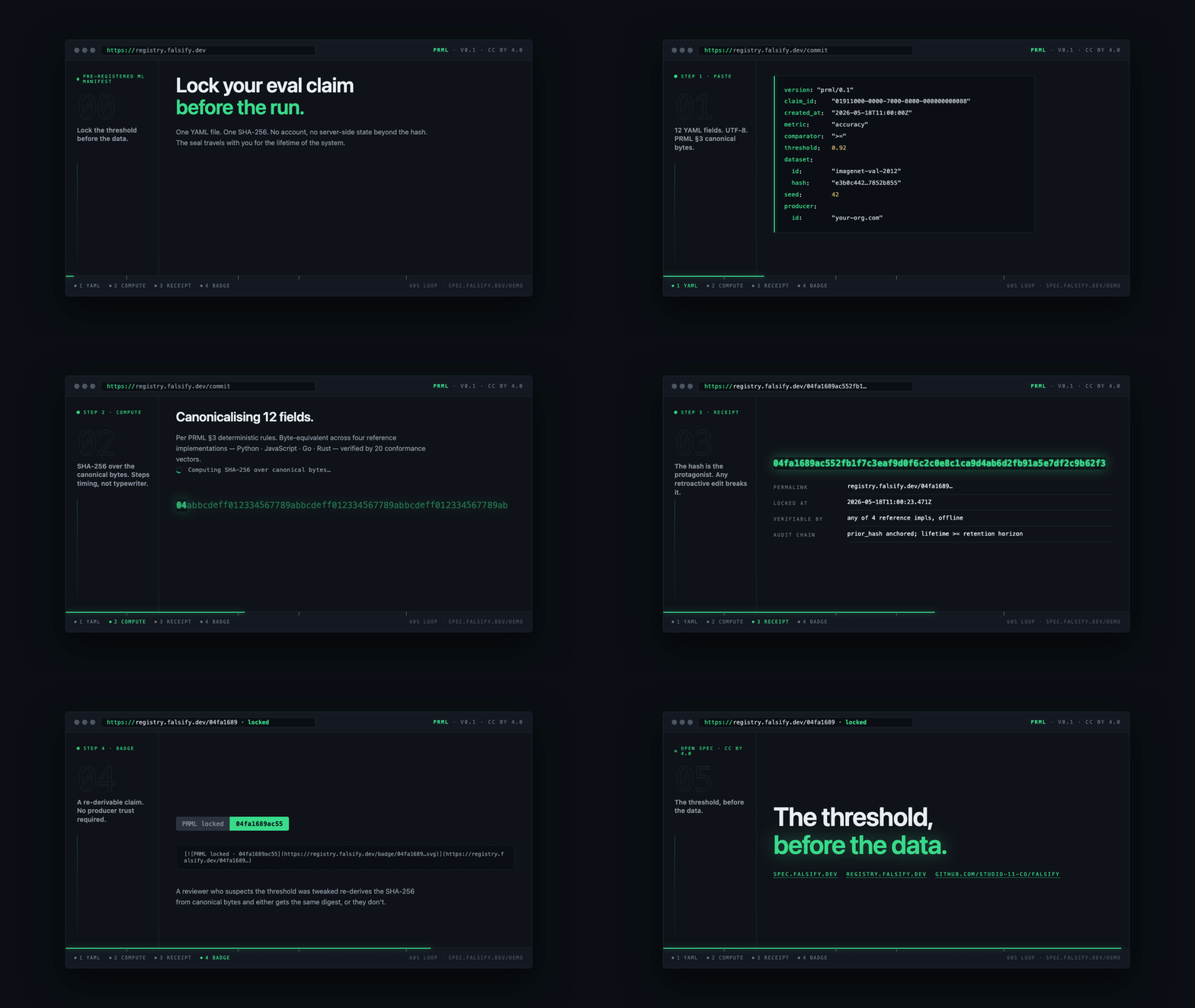
Click for the live looping version, or watch the MP4. Full storyboard in docs/DEMO_SCRIPT.md.
▶ Watch the longer 90-second walkthrough on YouTube (lock, run, tamper, CI block).
Why this matters
Every week another paper, blog post, or product launch claims an AI metric that quietly evaporates under scrutiny. It's not usually malice — it's that the claim was never structured to be falsifiable. Falsify is the smallest possible tool that forces that structure.
- ML teams — gate deploys on pre-registered accuracy / NDCG / recall
- DevOps — treat p95 latency claims the same way you treat tests
- LLM pipelines — pin prompt + eval + threshold so "it works" means something
- Research — replicate a paper by running its spec.lock.json
See docs/CASE_STUDIES.md for three concrete adoption stories.
Current version: falsify 0.3.9 (PRML CLI) · falsify-engine 0.3.9 — falsify --version.
Working with Claude Code? See CLAUDE.md.
Specification artifacts
This repository is the home of PRML v0.1 — Pre-Registered ML Manifest Specification. The spec, conformance suite, reference implementations (impl/, JS/Go/Rust + a Python reference target), and adjacent documents live under spec/:
spec/PRML-v0.1.md— the spec (RFC-style, CC BY 4.0)spec/test-vectors/v0.1/— 13 conformance vectors with locked SHA-256 digestsspec/analysis/positioning-v0.1.md— PRML vs in-toto / SLSA / Model Cards / HELM / ClinicalTrials.govspec/analysis/canonicalization-portability-v0.1.md— three cross-language findings from the JS second implementationspec/compliance/AI-Act-mapping-v0.1.md— EU AI Act Article 12/17/18/50/72/73 mappingspec/compliance/landing.md— compliance-audience landing copyspec/paper/— 14-page arXiv preprint (LaTeX, CC BY 4.0)spec/v0.2/ROADMAP.md— v0.2 RFC roadmap (freeze 2026-05-22)
Audit & compliance crosswalks (subcategory-by-subcategory maps from major AI governance frameworks to PRML fields, FULL/PARTIAL/NONE tagged):
- EU AI Act Article 12 — code-level pattern for the 2 December 2027 high-risk applicability deadline
- Article 12 readiness diagnostic — 10-question browser-only self-assessment
- NIST AI RMF 1.0 crosswalk — GOVERN / MAP / MEASURE / MANAGE subcategory map (incl. AI 600-1 GenAI Profile)
- ISO/IEC 42001:2023 crosswalk — AIMS clause-by-clause evidence map (Clauses 7-9 + Annex A controls)
Long-form working notes (2026-05-23, written for compliance leads, AI governance officers, and notified body assessors preparing for the 2 December 2027 deadline; CC BY 4.0):
- EU AI Act readiness assessment — six binding articles, ten-question gap check, evidence shape per obligation
- 2 August 2026 deadline — three application dates, Article 99 penalty structure, ten-week plan
- Article 12 logging checklist — ten closeable questions, six event categories, printable single-page summary
- Notified body evidence — Annex VI vs Annex VII conformity assessment, six artefact families
- ISO/IEC 42001 readiness — seven clauses, EU AI Act Article 17 overlap, twelve-month certification path
- Lock #2 post-mortem — field report on running a falsifiable spec in public
Reference implementations (four languages, 13 v0.1 + 8 v0.2 candidate vectors = 21 total; multi-lang CI runs all 21 byte-for-byte per push and daily at 04:00 UTC):
- Python:
falsify.py— original reference, uses PyYAML - Node.js:
impl/js/— second reference, ~400 LOC, hand-rolled, zero deps - Go:
impl/go/— third reference, ~450 LOC, hand-rolled, stdlib only - Rust:
impl/rust/— fourth reference, ~600 LOC, hand-rolled, two deps (serde_json,sha2)
Hosted spec at spec.falsify.dev/v0.1. Public review thread at GitHub Discussion #6. Comments via hello@falsify.dev.
Companion projects (separate repos under studio-11-co, each MIT or CC0 licensed):
falsify-cookbook— field manual for the spec: 13 patterns + 4 anti-patterns, every one a single page with a runnable example, including Pattern 11: PRML + Sigstore for execution integrity closing the §8.1 gap. CC0.falsify-integrity-index— public scorecard of how 25+ well-known ML eval claims meet the 9 PRML falsifiability criteria. Live at falsify.dev/integrity. CC0 data, MIT tooling.falsify-inspect— Inspect AI adapter: anchor an Inspect AI eval claim's threshold to a SHA-256 hash before the run, verify the post-run log against it. MIT.prml-verify-action— composite GitHub Action (listed on Marketplace) for CI integration. MIT.mlflow-falsify— MLflow plugin (pip install mlflow-falsify) auto-tags every run with the PRML manifest hash. MIT.falsify-js— JS reference implementation,npm install falsify-js. MIT.
Listed in / referenced by (independent curation — discoverability and third-party review, not adoption claims):
- SchemaStore — the PRML JSON Schema is in the catalog;
.prml.yamlautocompletes and validates in VS Code, JetBrains, Cursor, Zed, and anything usingyaml-language-server. (real tooling integration) - theopenlane/awesome-compliance — Compliance Specs (PR reviewed + merged by an Openlane co-founder)
- AthenaCore/AwesomeResponsibleAI — Responsible-AI Audit section
- GenAI-Gurus/awesome-eu-ai-act — EU AI Act Reference Implementations
- leipzig/awesome-reproducible-research — Scientific Data Management
- ASSERT-KTH/awesome-open-science-software — Tools (KTH research group)
Why
AI agents make empirical claims all day — "accuracy is up", "the new retriever is faster", "this filter catches every edge case". We rarely pin down the threshold, the metric, or the stopping rule before the data arrives.
Without pre-registration, every verdict is post-hoc rationalization: the goalposts move a little, the sample is chosen a little, the winning explanation is kept.
Falsification Engine forces scientific discipline onto that loop. You declare the test, lock the spec with a cryptographic hash, run the experiment, and read the exit code. PASS or FAIL is mechanical, not rhetorical — and CI enforces it on every push.
What you get
- A single-file CLI (
falsify) with 18 subcommands:init,lock,run,verdict,guard,list,stats,diff,hook,doctor,version,export,verify,replay,why,trend,score,bench. - A
commit-msggit hook that blocks commits whose messages contradict a locked verdict. - A GitHub Actions workflow that re-verdicts every push and PR across Python 3.11 and 3.12.
- Five Claude Code skills and two forked-context subagents that draft specs, audit arbitrary text against the verdict log, review PR diffs for honesty violations, and keep the log itself fresh.
Install
pip install falsify
That's it. The falsify command is on your PATH, the docs site
is at https://falsify.dev, and the project page is at
https://pypi.org/project/falsify.
Requires Python 3.11+.
Two commands, one install.
falsifyis the PRML manifest CLI —lock/verify/hash/init/test-vectorson a*.prml.yamlmanifest (shown at the top).falsify-engineis the separate pre-registration workflow engine — theinit→lock→run→verdict/guardloop over.falsify/<name>/specs. The workflow sections further down usefalsify-engine; substitute it forfalsifythere. No install needed to verify a manifest: paste it at registry.falsify.dev.
Development install (from the repo)
git clone https://github.com/studio-11-co/falsify
cd falsify
pip install -e .
The -e editable form is for hacking on falsify itself — your
edits to falsify.py take effect immediately without reinstalling.
Docker
docker build -t falsify-demo . && docker run --rm -it falsify-demo
Runs the auto-demo in a clean container. See docs/DOCKER.md for interactive and repo-mount modes.
pre-commit integration
Consume falsify's hooks from your own repo:
repos:
  - repo: https://github.com/studio-11-co/falsify
    rev: v0.1.4
    hooks:
      - id: falsify-guard
      - id: falsify-doctor
Then pre-commit install && pre-commit install --hook-type commit-msg.
See docs/PRE_COMMIT.md for the full list of
exported hooks and how this repo eats its own dog food.
Quickstart
# The falsify PRML CLI — lock a manifest, run your eval, verify.
falsify init accuracy.prml.yaml          # writes a skeleton manifest
# edit accuracy.prml.yaml: metric, comparator, threshold, dataset.hash, seed, producer
falsify lock accuracy.prml.yaml          # canonicalize + SHA-256 + write sidecar
# ... run your eval, get the observed value ...
falsify verify accuracy.prml.yaml --observed 0.934
# PASS (exit 0) · FAIL below threshold (exit 10) · TAMPERED if the spec changed (exit 3)
The pre-registration workflow engine (claim/falsification specs, init → lock → run → verdict → guard over .falsify/<name>/) ships in the same install as the falsify-engine command:
./demo.sh                                # auto-narrated engine demo (PASS → tamper → FAIL → guard)
falsify-engine init my_claim
# edit .falsify/my_claim/spec.yaml to fill in the template
falsify-engine lock my_claim
falsify-engine run my_claim
falsify-engine verdict my_claim
falsify-engine hook install      # enable the commit-msg guard
Exit code 0 on PASS, 10 on FAIL. Everything else is documented
below.
New to pre-registration? Walk through TUTORIAL.md — 15 minutes, zero to first locked claim.
Start from a template
falsify init --template accuracy
falsify lock accuracy
falsify-engine run accuracy
falsify-engine verdict accuracy
Five templates ship with a runnable spec + metric + dataset:
accuracy— classifier holdout accuracy ≥ 0.80latency— p95 request latency ≤ 200 msbrier— probabilistic calibration Brier ≤ 0.25llm-judge— LLM-judge agreement rate ≥ 0.75ab— A/B test absolute lift ≥ 0.05
Each scaffolds into claims/<name>/ (sources) and mirrors
spec.yaml into .falsify/<name>/ so the CLI runtime works
without further setup. Override the default name with --name
or the directory with --dir.
Developer commands
make install   # pip install pyyaml
make test      # run unittest suite
make smoke     # run tests/smoke_test.sh
make demo      # calibration end-to-end (lock → run → verdict)
See Makefile for all targets (make help).
Questions and objections? See docs/FAQ.md — 15 direct answers to "why not just X?" questions.
Feature matrix vs adjacent tools: docs/COMPARISON.md.
Explain any claim
falsify-engine why <name> is the human-friendly companion to verdict
— it always exits 0 and tells you exactly what the next honest
move is:
claim: calibration
state: STALE
reasoning: the spec has been edited (sha256:1038219d75a8) but no run
  exists against this hash. Last run was against sha256:164f619d4860.
locked: yes (sha256:164f619d4860, 2h ago)
last run: 2026-04-22T02:10:17+00:00 (2h ago)
next action: `falsify-engine run <name>` to produce a fresh verdict against
  the current spec.
Add --json for a scripted pipeline, --verbose for full hashes
and the last five runs.
Spot drift with a sparkline
falsify-engine trend <name> draws an ASCII sparkline of the metric
across its recorded runs, marks the threshold line, and classifies
the trajectory as improving, degrading, flat, or
mixed.
claim: calibration
threshold: 0.25 (direction: below)
runs: 20 shown (of 20)

▁▂▂▃▃▄▄▅▅▆▆▆▇▇████
                    TT
threshold=0.25 (shown)

first: 0.12 @ ... (PASS)
last:  0.23 @ ... (PASS)
min:   0.09
max:   0.23
mean:  0.17
latest verdict: PASS
trend: degrading
--ascii swaps in _.oO#; --width resizes the sparkline;
--last caps history (default 20, max 200).
Measure the CLI itself
falsify-engine bench spawns each subcommand under a fresh temporary
directory and records per-command latency (min / median / p95 /
max / mean / stddev). Useful as a sanity check before a release
or when investigating a suspected startup-time regression.
falsify-engine bench --runs 5 --commands "--help,list,stats,score"
falsify-engine bench --runs 5 --json     # machine-readable output
--runs <N> sets the timed-iteration count (default 5, capped at
100); --warmup <N> discards the first N spawns so JIT / import
caches stabilize before timing (default 1).
Exit codes
| Code | Meaning |
|---|---|
| 0 | PASS |
| 10 | FAIL |
| 2 | Bad spec / INCONCLUSIVE |
| 3 | Hash mismatch (spec tampered) |
| 11 | Guard violation (commit blocked) |
The Opus 4.7 layers
Skills (.claude/skills/) — in-session helpers that fire on
trigger phrases.
hypothesis-authorwalks the user through a 5-question dialogue and writes a falsifiablespec.yaml.falsifyis the orchestrator: routes any empirical claim to the right place in the init → lock → run → verdict pipeline.claim-auditruns a fast keyword+regex audit over pasted text and escalates to theclaim-auditorsubagent when paraphrases or2 claims show up.
claim-reviewreads a PR diff and flags unlocked specs, silent threshold edits, andmetric_fnreferences to missing modules — runs in PR CI, exits1on any CRITICAL finding. Seedocs/PR_REVIEW.md.falsify-ci-doctoringestsmake release-checkoutput and maps each FAIL gate to a likely cause and an exact fix command — one-shot triage when CI is red.
Subagents (.claude/agents/) — forked-context agents invoked
via the Task tool for heavier work.
claim-auditordoes the semantic cross-reference that the keyword-passclaim-auditskill deliberately skips; used on PR bodies, release notes, and README edits.verdict-refresherscans.falsify/*/for STALE, INCONCLUSIVE, or UNRUN verdicts and re-runs them through the CLI — keepingguarddecisions trustworthy.
Slash commands (.claude/commands/) — in-IDE shortcuts that
compose the skills and CLI.
/new-claim <template> [name]— guided scaffold → lock → run → verdict for one of the five templates./audit-claims— repo-wide semantic audit; mergeslist/stats/scorewith findings from theclaim-auditskill into a single markdown report./ship-verdict <name>— four-gate release check (verdict, freshness, replay, audit-chain). Exits non-zero on any gate failure. Does not ship; only verifies.
CI (.github/workflows/falsify.yml) — on every push and PR,
the workflow runs the unittest suite, tests/smoke_test.sh, the
calibration end-to-end (lock → run → verdict), a guard self-check,
and a skill-lint pass over every SKILL.md and agent file.
Demo
- Walk through the pipeline in 5 runnable steps: DEMO.md.
- Second-by-second shooting script for the 3-minute video: docs/DEMO_SHOT_LIST.md.
- Four more claim types (accuracy regression, latency gate, prediction calibration, LLM agreement, AB test): docs/EXAMPLES.md.
MCP integration
Expose the verdict store to Claude Desktop / Claude Code via
Model Context Protocol with four read-only tools (list_verdicts,
get_verdict, get_stats, check_claim) and three resource URIs.
pip install -e '.[mcp]'
python -m mcp_server   # speaks MCP over stdio
Then merge the snippet in
mcp_server/claude_desktop_config.example.json
into your Claude Desktop config, pointing cwd at your local
clone. Every Claude session in your org can now query live
verdicts — no more "I think the latency claim still passes";
Claude just asks the MCP server. Falsify itself runs without the
SDK; if mcp isn't installed, python -m mcp_server exits 2 with
a clear install hint. Full surface in
mcp_server/README.md.
Managed Agents (optional)
Deploy the two subagents (verdict-refresher, claim-auditor)
to Anthropic Console for scheduled and on-demand execution.
See docs/MANAGED_AGENTS.md for the
setup recipe and manifests under
managed_agents/.
Install the git hook
cp hooks/commit-msg .git/hooks/commit-msg
chmod +x .git/hooks/commit-msg
Or, as a symlink so hook updates propagate automatically:
ln -sf "$(pwd)/hooks/commit-msg" .git/hooks/commit-msg
Repository layout
falsify.py— single-file Python CLI, stdlib + pyyaml only.impl/js/falsify.js— Node.js second reference implementation (13/13 v0.1 + 8/8 v0.2 = 21/21 vectors). Also published to npm asfalsify-js.impl/go/falsify.go— Go third reference implementation (21/21 vectors).impl/rust/— Rust fourth reference implementation (21/21 vectors).spec/PRML-v0.1.md+spec/test-vectors/v0.1/(12) +spec/test-vectors/v0.2/(8) — spec + conformance suite.spec/analysis/— positioning + canonicalization portability findings.spec/compliance/— EU AI Act mapping + compliance landing copy.spec/paper/— 14-page arXiv preprint (LaTeX).spec/v0.2/ROADMAP.md— v0.2 RFC roadmap.hypothesis.schema.yaml— spec schema (claim, falsification, experiment, environment, artifacts).examples/hello_claim/— tiny smoke-test fixture.examples/calibration_sample/— anonymized 20-row prediction ledger for the Brier score demo.hooks/commit-msg— the guard hook.tests/—unittestsuite plussmoke_test.shend-to-end driver..claude/skills/— the five in-session skills..claude/agents/— the two forked-context subagents..claude/commands/— the three slash commands..github/workflows/— CI + PRML manifest verification.
Self-dogfooding
Falsify uses itself. Three real claims about this codebase live
under claims/self/:
cli_startup— CLI startup stays under 500ms mediantest_coverage_count— test suite has more than 400 test methodsclaude_surface— Claude integration ships more than 8 artifacts
Run make dogfood to re-verify. CI runs these on every PR.
Changelog
See CHANGELOG.md for release history.
Latest — 2026-05-23 · PRML v0.2 frozen with all 21 conformance vectors (13 v0.1 stable + 8 v0.2) passing byte-for-byte across the four reference implementations. Lock #2 (public hypothesis on spec's own distribution) resolved at 0/3 external contributors, mechanism worked, post-mortem published.
mlflow-falsifyv0.2.0 shipped withMLFLOW_FALSIFY_TAG_SCOPE=experimentfor HPO sweeps; MLflow community plugin showcase PR is live and under review. Five long-form working notes published for EU AI Act readiness: readiness assessment, 2 August 2026 deadline, Article 12 ten-item checklist, notified body evidence, ISO/IEC 42001 readiness. DOI 10.5281/zenodo.20177839. PRML JSON Schema in SchemaStore (Mads Kristensen / Microsoft) —.prml.yamlfiles autocomplete in VS Code, JetBrains, Helix, Zed, and Cursor.registry.falsify.devlive with README badges atregistry.falsify.dev/badge/<hash>.svg.
Roadmap
Two roadmaps run alongside each other:
- CLI tool roadmap: ROADMAP.md —
falsifyfeatures, integrations, dependencies. CLI v0.2.0 shipped 2026-05-22. v0.3 features tracked alongside the v0.3 spec backlog. - Specification roadmap: spec/v0.2/ROADMAP.md — PRML format evolution, canonicalization grammar, conformance. Spec v0.2 frozen 2026-05-22. v0.3 design backlog open under
spec/v0.3-backlog/(claim trees, suite manifests, selective-disclosure resistance vialeaves_total).
The CLI is downstream of the spec: spec v0.2 frozen 2026-05-22, CLI v0.2.0 shipped to PyPI the same week. CLI v0.3 is loosely scoped for Q4 2026, tracking the v0.3 spec backlog.
Trust model
Falsify is a discipline tool, not a zero-trust system. For a full enumeration of attacks defended and NOT defended, with the exact exit code or command that catches each, see docs/ADVERSARIAL.md. For private disclosure of invariant breaks, see .github/SECURITY.md.
License
MIT. See LICENSE.
See CODE_OF_CONDUCT.md for community standards. See .github/CODEOWNERS for module-level reviewers and .github/dependabot.yml for automated dependency updates. See docs/GLOSSARY.md for definitions of every term used across the docs. See docs/CASE_STUDIES.md for three concrete adoption scenarios: ML team, DevOps team, research group.
Built with
Claude Opus 4.7 (1M context), in three days, for the Anthropic Built with Opus 4.7 hackathon.
Cite the spec: Öztürk, C. (2026). PRML v0.1. Zenodo. https://doi.org/10.5281/zenodo.20177839
Project details
Verified details
These details have been verified by PyPIProject links
GitHub Statistics
Maintainers
Release history Release notifications | RSS feed


Download files
Download the file for your platform. If you're not sure which to choose, learn more about installing packages.
Source Distribution
Built Distribution
Filter files by name, interpreter, ABI, and platform.
If you're not sure about the file name format, learn more about wheel file names.
Copy a direct link to the current filters
File details
Details for the file falsify-0.3.9.tar.gz.
File metadata
- Download URL: falsify-0.3.9.tar.gz
- Upload date:
- Size: 126.9 kB
- Tags: Source
- Uploaded using Trusted Publishing? Yes
- Uploaded via: twine/6.1.0 CPython/3.13.12
File hashes
| Algorithm | Hash digest | |
|---|---|---|
| SHA256 |
a719f6ac97e210e5aae6e6d02c95c79201d0ae9ca92222221c047a5b08ad2144
|
|
| MD5 |
9f16aed1acb71f488cc23ab30071a813
|
|
| BLAKE2b-256 |
07524c4d6d344882407f4a471399c0b6e520d1808ea55b90dbc95ad9638790bb
|
Provenance
The following attestation bundles were made for falsify-0.3.9.tar.gz:
Publisher:
release.yml on studio-11-co/falsify
-
Statement:
-
Statement type:
https://in-toto.io/Statement/v1 -
Predicate type:
https://docs.pypi.org/attestations/publish/v1 -
Subject name:
falsify-0.3.9.tar.gz -
Subject digest:
a719f6ac97e210e5aae6e6d02c95c79201d0ae9ca92222221c047a5b08ad2144 - Sigstore transparency entry: 1885495101
- Sigstore integration time:
-
Permalink:
studio-11-co/falsify@79ee63ef6ee0b4228559f1a9fb93d3fbf914aa95 -
Branch / Tag:
refs/tags/v0.3.9 - Owner: https://github.com/studio-11-co
-
Access:
public
-
Token Issuer:
https://token.actions.githubusercontent.com -
Runner Environment:
github-hosted -
Publication workflow:
release.yml@79ee63ef6ee0b4228559f1a9fb93d3fbf914aa95 -
Trigger Event:
push
-
Statement type:
File details
Details for the file falsify-0.3.9-py3-none-any.whl.
File metadata
- Download URL: falsify-0.3.9-py3-none-any.whl
- Upload date:
- Size: 58.0 kB
- Tags: Python 3
- Uploaded using Trusted Publishing? Yes
- Uploaded via: twine/6.1.0 CPython/3.13.12
File hashes
| Algorithm | Hash digest | |
|---|---|---|
| SHA256 |
604069a6e10e50742f32c79a7741ed36685bb7fbd19c9a3c537a8df263aa53dd
|
|
| MD5 |
0edb7190b33f08f2e79bed97bcb6c65e
|
|
| BLAKE2b-256 |
84df34ce3e1b88e023fadd1ec82accdb69346b833aa5a65f115dd314083e9b37
|
Provenance
The following attestation bundles were made for falsify-0.3.9-py3-none-any.whl:
Publisher:
release.yml on studio-11-co/falsify
-
Statement:
-
Statement type:
https://in-toto.io/Statement/v1 -
Predicate type:
https://docs.pypi.org/attestations/publish/v1 -
Subject name:
falsify-0.3.9-py3-none-any.whl -
Subject digest:
604069a6e10e50742f32c79a7741ed36685bb7fbd19c9a3c537a8df263aa53dd - Sigstore transparency entry: 1885495166
- Sigstore integration time:
-
Permalink:
studio-11-co/falsify@79ee63ef6ee0b4228559f1a9fb93d3fbf914aa95 -
Branch / Tag:
refs/tags/v0.3.9 - Owner: https://github.com/studio-11-co
-
Access:
public
-
Token Issuer:
https://token.actions.githubusercontent.com -
Runner Environment:
github-hosted -
Publication workflow:
release.yml@79ee63ef6ee0b4228559f1a9fb93d3fbf914aa95 -
Trigger Event:
push
-
Statement type:






