

fastapi-health-check
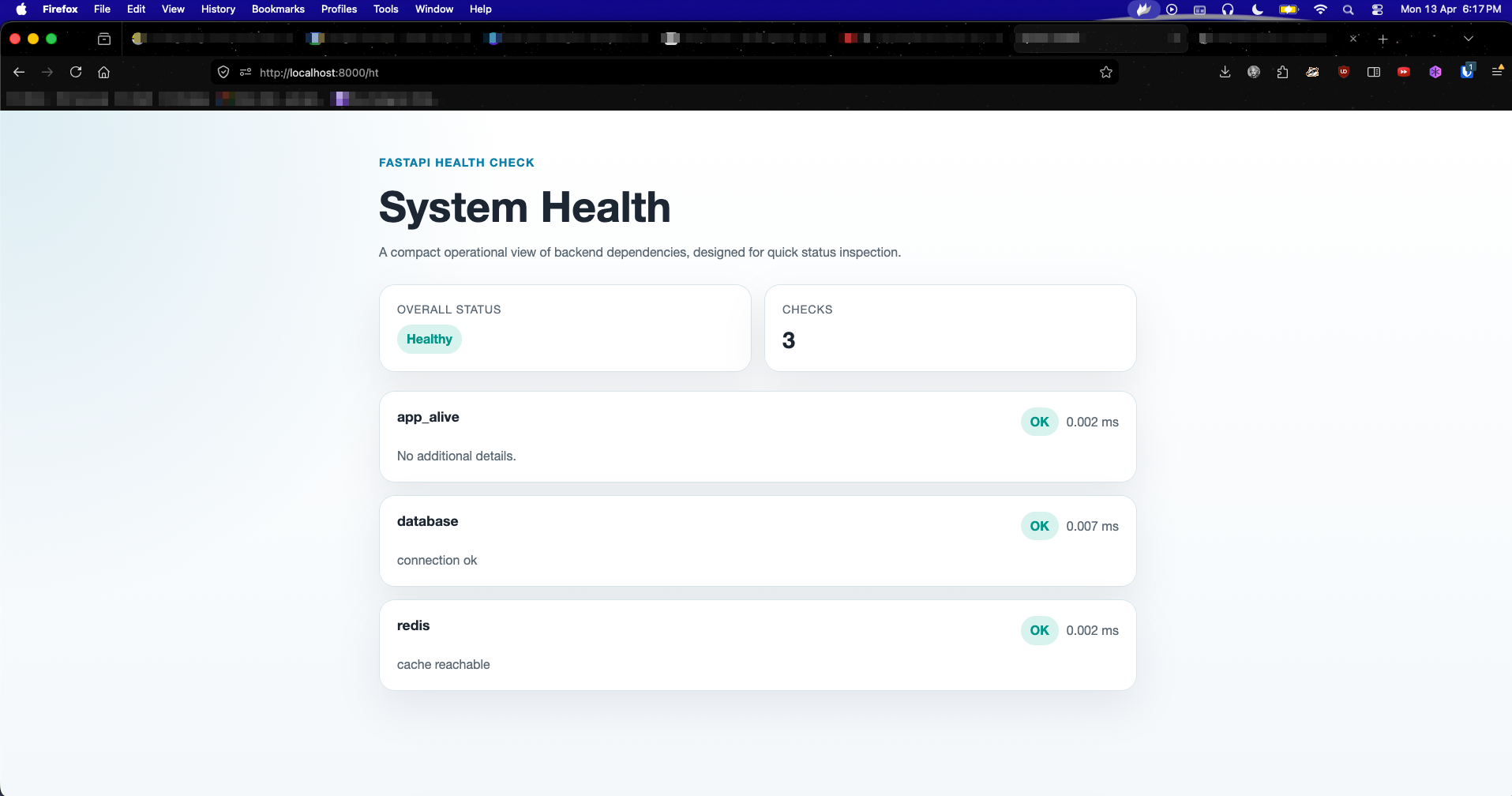
FastAPI health checks with separate liveness and readiness probes, a visual status page, and JSON responses.
Example interface
Installation
Install with uv:
uv add fastapi-ht
Install with pip:
pip install fastapi-ht
What the library provides
- A base contract for advanced checks
- A lightweight registry for collecting and running checks
- Separate
/health/liveand/health/readyJSON endpoints - A combined
/htendpoint with HTML by default - JSON responses when the client sends
Accept: application/json - A simple way to monitor any custom area of your system
Built-in checks
The package includes AppAliveCheck for application availability and RedisCheck for Redis connectivity.
RedisCheck reuses an async client supplied by the application and executes PING. The core package does not install a Redis client. Install and configure an async client such as redis in the application when this check is needed.
from redis.asyncio import Redis

from fastapi_health_check import HealthRegistry, RedisCheck


redis_client = Redis.from_url(redis_url)
registry = HealthRegistry([RedisCheck(redis_client)])
The default check name is redis. A custom name can distinguish multiple Redis deployments:
registry.register(RedisCheck(session_redis, name="session_cache"))
Redis failures are critical like every health check currently registered in HealthRegistry. Connection errors use a sanitized message and never expose credentials from the underlying client exception.
Databases, queues, external APIs, or any other monitored area are meant to be registered by the user.
The package includes AppAliveCheck for application availability and PostgreSQLCheck for PostgreSQL connectivity.
PostgreSQLCheck reuses an async pool supplied by the application and executes SELECT 1. The core package does not install a PostgreSQL driver. Install and configure an async driver such as asyncpg in the application when this check is needed.
import asyncpg

from fastapi_health_check import HealthRegistry, PostgreSQLCheck


pool = await asyncpg.create_pool(database_url)
registry = HealthRegistry([PostgreSQLCheck(pool)])
The default check name is postgresql. A custom name can distinguish multiple databases:
registry.register(PostgreSQLCheck(reporting_pool, name="reporting_database"))
PostgreSQL failures are critical like every health check currently registered in HealthRegistry. Connection errors use a sanitized message and never expose credentials from the underlying driver exception.
Redis, queues, external APIs, or any other monitored area are meant to be registered by the user.
SQLAlchemy
Install the optional SQLAlchemy support:
uv add "fastapi-ht[sqlalchemy]"
SQLAlchemyCheck supports SQLAlchemy >=2.0,<3.0 and accepts an existing Engine, AsyncEngine, sessionmaker, or async_sessionmaker.
from sqlalchemy.ext.asyncio import create_async_engine

from fastapi_health_check import HealthRegistry, SQLAlchemyCheck


engine = create_async_engine(database_url)
registry = HealthRegistry([SQLAlchemyCheck(engine)])
The check executes SELECT 1 through the supplied engine or session factory. Synchronous SQLAlchemy operations run in a worker thread so health checks do not block the application event loop.
Quick start
from fastapi import FastAPI

from fastapi_health_check import AppAliveCheck, HealthRegistry, health_check, install_health_check


app = FastAPI()
registry = HealthRegistry()
registry.register(AppAliveCheck(), readiness=True, liveness=True)
registry.register(health_check("database", lambda: "connection ok"))
registry.register(health_check("redis", lambda: "cache reachable"))

install_health_check(app, registry)
This exposes three routes:
GET /health/livereturns the liveness report as JSONGET /health/readyreturns the readiness report as JSONGET /htkeeps the combined status page and content-negotiated JSON response
Liveness and readiness
Liveness answers whether the application process should be restarted. Keep this probe lightweight and independent of databases, caches, external APIs, and other dependencies. A failing liveness check returns 503.
Readiness answers whether the application can serve traffic. Dependency checks belong here so an unavailable dependency returns 503 and the orchestrator can remove the instance from service without restarting it.
Checks belong to readiness by default:
registry.register(health_check("database", check_database))
Assign a check to liveness or both probes with registration options:
registry.register(process_check, readiness=False, liveness=True)
registry.register(AppAliveCheck(), readiness=True, liveness=True)
Probe paths can be configured independently while retaining /ht:
install_health_check(
    app,
    registry,
    path="/status",
    liveness_path="/livez",
    readiness_path="/readyz",
)
For Kubernetes, configure livenessProbe to request /health/live and readinessProbe to request /health/ready. Dependency failures then stop traffic to an unready pod without creating unnecessary restart loops. Kubernetes manifest settings are deployment-specific and outside this library's configuration.
Monitoring custom areas
If you want to monitor anything beyond the built-in app liveness check, the easiest option is the health_check() factory.
You can use it for:
- databases
- Redis or cache layers
- background queues
- external APIs
- storage services
- internal domain-specific dependencies
Synchronous checks
from fastapi_health_check import health_check

database_check = health_check("database", lambda: "connection ok")
redis_check = health_check("redis", lambda: "cache reachable")
Asynchronous checks
from fastapi_health_check import health_check


async def payments_api_check() -> str | None:
    return "payments API available"


payments_check = health_check("payments_api", payments_api_check)
Class-based checks for advanced cases
from fastapi_health_check import HealthCheck


class QueueCheck(HealthCheck):
    default_name = "queue"

    async def check(self) -> str | None:
        return "queue connected"
Use class-based checks when you want:
- dependency injection through
__init__ - reusable state
- more structured custom behavior
Local manual testing
The repository includes a local example application at src/examples/basic_app.py.
Run it with:
uv run uvicorn src.examples.basic_app:app --reload
Then open:
http://127.0.0.1:8000/htfor the HTML pagecurl -H "Accept: application/json" http://127.0.0.1:8000/htfor JSONcurl http://127.0.0.1:8000/health/livefor livenesscurl http://127.0.0.1:8000/health/readyfor readiness
1 maintainer

Download files
Download the file for your platform. If you're not sure which to choose, learn more about installing packages.
Source Distribution
Built Distribution
Filter files by name, interpreter, ABI, and platform.
If you're not sure about the file name format, learn more about wheel file names.
Copy a direct link to the current filters
File details
Details for the file fastapi_ht-0.3.0.tar.gz.
File metadata
- Download URL: fastapi_ht-0.3.0.tar.gz
- Upload date:
- Size: 918.1 kB
- Tags: Source
- Uploaded using Trusted Publishing? Yes
- Uploaded via:
twine/7.0.0 CPython/3.13.14
File hashes
| Algorithm | Hash digest | |
|---|---|---|
| SHA256 |
27451ef96ed9353eef2241a197e69011f97450b656cd6f2473aca1616f5566d5
|
|
| MD5 |
ca9019d76efffaf1f7afce4228820560
|
|
| BLAKE2b-256 |
4c77b46e42b72bbe2e09eb39d56ad2c4521cff0e45ad9fc48b31021a763db1b5
|
Provenance
The following attestation bundles were made for fastapi_ht-0.3.0.tar.gz:
Publisher:
publish.yml on PinnLabs/fastapi-health-check
-
Statement:
-
Statement type:
https://in-toto.io/Statement/v1 -
Predicate type:
https://docs.pypi.org/attestations/publish/v1 -
Subject name:
fastapi_ht-0.3.0.tar.gz -
Subject digest:
27451ef96ed9353eef2241a197e69011f97450b656cd6f2473aca1616f5566d5 - Sigstore transparency entry: 2703552112
- Sigstore integration time:
-
Permalink:
PinnLabs/fastapi-health-check@706065ccc1837d22c5ab7d9065f11391f5dd52de -
Branch / Tag:
refs/tags/v0.3.0 - Owner: https://github.com/PinnLabs
-
Access:
public
-
Token Issuer:
https://token.actions.githubusercontent.com -
Runner Environment:
github-hosted -
Publication workflow:
publish.yml@706065ccc1837d22c5ab7d9065f11391f5dd52de -
Trigger Event:
release
-
Statement type:
File details
Details for the file fastapi_ht-0.3.0-py3-none-any.whl.
File metadata
- Download URL: fastapi_ht-0.3.0-py3-none-any.whl
- Upload date:
- Size: 21.9 kB
- Tags: Python 3
- Uploaded using Trusted Publishing? Yes
- Uploaded via:
twine/7.0.0 CPython/3.13.14
File hashes
| Algorithm | Hash digest | |
|---|---|---|
| SHA256 |
00fd566a85963332562faf586346663e1fdb116e3150347301530634da9102c9
|
|
| MD5 |
28c63758cd1a8a3fc810fb09aa6ce6a2
|
|
| BLAKE2b-256 |
3fdc858f44241c15ababfdfbc2644d6d43a5c5b8334398014ac8389be5f278fa
|
Provenance
The following attestation bundles were made for fastapi_ht-0.3.0-py3-none-any.whl:
Publisher:
publish.yml on PinnLabs/fastapi-health-check
-
Statement:
-
Statement type:
https://in-toto.io/Statement/v1 -
Predicate type:
https://docs.pypi.org/attestations/publish/v1 -
Subject name:
fastapi_ht-0.3.0-py3-none-any.whl -
Subject digest:
00fd566a85963332562faf586346663e1fdb116e3150347301530634da9102c9 - Sigstore transparency entry: 2703552541
- Sigstore integration time:
-
Permalink:
PinnLabs/fastapi-health-check@706065ccc1837d22c5ab7d9065f11391f5dd52de -
Branch / Tag:
refs/tags/v0.3.0 - Owner: https://github.com/PinnLabs
-
Access:
public
-
Token Issuer:
https://token.actions.githubusercontent.com -
Runner Environment:
github-hosted -
Publication workflow:
publish.yml@706065ccc1837d22c5ab7d9065f11391f5dd52de -
Trigger Event:
release
-
Statement type:














