
The fast, robust, strongly-typed Google Flights scraper (API) implemented in Python.

Project description
✈️ fast-flights (v3.1.0)
The fast and strongly-typed Google Flights scraper (API) implemented in Python. Based on Base64-encoded Protobuf string.
Documentation (v2) • Issues • PyPi (v3.0rc0)
$ pip install fast-flights
At a glance
from fast_flights import (
    FlightQuery,
    Passengers,
    create_query,
    get_flights
)

query = create_query(
    flights=[
        FlightQuery(
            date="YYYY-MM-DD",   # change the date
            from_airport="MYJ",  # three-letter name
            to_airport="TPE",    # three-letter name
        ),
    ],
    seat="economy",  # business/economy/first/premium-economy
    trip="one-way",  # multi-city/one-way/round-trip
    passengers=Passengers(adults=1),
    language="zh-TW",
)
res = get_flights(query)
Round-trip (return flights)
For round-trip searches, Google Flights uses a two-step flow: first you query outbound flights, then you select one and query return flights. fast-flights now supports this:
from fast_flights import (
    FlightQuery, Passengers,
    create_query, get_flights,
    select_flight, get_return_flights, # new!
)

# Step 1 – query outbound flights
query = create_query(
    flights=[
        FlightQuery(date="2026-03-15", from_airport="CDG", to_airport="TPE"),
        FlightQuery(date="2026-03-19", from_airport="TPE", to_airport="CDG"),
    ],
    seat="economy",
    trip="round-trip",
    passengers=Passengers(adults=1),
)
outbound = get_flights(query)

# Step 2 – pick a flight, then query return flights
return_query = select_flight(query, outbound[0])
returning = get_return_flights(return_query)
Each outbound result carries an internal session token (select_token) that links to the available return options. The select_flight() helper wraps it into a ReturnQuery that get_return_flights() can consume.
Note: This also works with integrations (e.g.
get_return_flights(rq, integration=BrightData())).
Multi-city (N legs)
For multi-city/multi-leg trips, you have two options:
Option 1: get_flights_multicity_chained (Recommended)
Makes a single call to Google's internal GetShoppingResults RPC. Google's response already contains all available first-leg flight options, each priced as the total cost of the entire multi-city trip — no sequential chaining required.
from fast_flights import FlightQuery, get_flights_multicity_chained

legs = [
    FlightQuery(date="2026-03-15", from_airport="SIN", to_airport="TPE"),
    FlightQuery(date="2026-03-21", from_airport="TPE", to_airport="NRT"),
    FlightQuery(date="2026-03-24", from_airport="NRT", to_airport="TPE"),
    FlightQuery(date="2026-03-27", from_airport="TPE", to_airport="SIN"),
]

result = get_flights_multicity_chained(legs)

# All legs share the same flights list and total_price
for flight in result[0].flights:
    print(f"{flight.airlines} — total trip: ${flight.price}")
⚙️ Technical Note:
fast_flightscalls Google's hiddenGetShoppingResultsHTTP RPC endpoint with all legs in a singlef.reqpayload. The response includes complete flight options with per-option total-trip prices parsed directly from the JSON payload — no Playwright or Selenium required.Caveats:
- The
flightsfield on eachMulticityLegChainedreflects first-leg options only (e.g. SIN→TPE). Subsequent legs' specific flight times are encoded in each result'sselect_tokenfor further chaining.- Integrations / Fallbacks are not supported:
get_flights_multicity_chaineduses aprimpHTTP session and cannot use BrightData or Playwright integrations.
Option 2: Manual Selection (fine-grained control)
You can manually chain select_flight() calls to step through each leg yourself:
query = create_query(
    flights=[
        FlightQuery(date="2026-03-15", from_airport="SIN", to_airport="TPE"),
        FlightQuery(date="2026-03-21", from_airport="TPE", to_airport="NRT"),
        FlightQuery(date="2026-03-24", from_airport="NRT", to_airport="TPE"),
        FlightQuery(date="2026-03-27", from_airport="TPE", to_airport="SIN"),
    ],
    seat="economy",
    trip="multi-city",
    passengers=Passengers(adults=1),
)

# Leg 1
leg1 = get_flights(query)
rq = select_flight(query, leg1[0])

# Leg 2
leg2 = get_return_flights(rq)
rq = select_flight(rq, leg2[0])       # pass ReturnQuery to chain

# Leg 3
leg3 = get_return_flights(rq)
rq = select_flight(rq, leg3[0])

# Leg 4
leg4 = get_return_flights(rq)
Integrations
If you'd like, you can use integrations.
Bright data:
from fast_flights import get_flights
from fast_flights.integrations import BrightData

get_flights(..., integration=BrightData())
What's new
v3.4.0– Native Multi-City Support inget_flights()usingGetShoppingResultsRPC.get_flights_multicity_chainedmakes a single API call to fetch all first-leg options with full trip prices — no sequential chaining needed.v3.1.0– Round-trip return flights and multi-city (N-leg) support viaselect_flight()+get_return_flights().v3.0rc0– Uses Javascript data instead.v2.2– Now supports local playwright for sending requests.v2.0– New (much more succinct) API, fallback support for Playwright serverless functions, and documentation!
Contributing
Contributing is welcomed! A few notes though:
- please no ai slop. i am not reading all that.
- one change at a time. what your title says is what you've changed.
- no new dependencies unless it's related to the core parsing.
- really, i cant finish reading all of them, i have other projects and life to do. really sorry
How it's made
The other day, I was making a chat-interface-based trip recommendation app and wanted to add a feature that can search for flights available for booking. My personal choice is definitely Google Flights since Google always has the best and most organized data on the web. Therefore, I searched for APIs on Google.
🔎 Search
google flights api
The results? Bad. It seems like they discontinued this service and it now lives in the Graveyard of Google.
🧏♂️ duffel.com
Google Flights API: How did it work & what happened to it?The Google Flights API offered developers access to aggregated airline data, including flight times, availability, and prices. Over a decade ago, Google announced the acquisition of ITA Software Inc. which it used to develop its API. However, in 2018, Google ended access to the public-facing API and now only offers access through the QPX enterprise product.
That's awful! I've also looked for free alternatives but their rate limits and pricing are just 😬 (not a good fit/deal for everyone).
However, Google Flights has their UI – flights.google.com. So, maybe I could just use Developer Tools to log the requests made and just replicate all of that? Undoubtedly not! Their requests are just full of numbers and unreadable text, so that's not the solution.
Perhaps, we could scrape it? I mean, Google allowed many companies like Serpapi to scrape their web just pretending like nothing happened... So let's scrape our own.
🔎 Search
google flightsapiscraper pypi
Excluding the ones that are not active, I came across hugoglvs/google-flights-scraper on Pypi. I thought to myself: "aint no way this is the solution!"
I checked hugoglvs's code on GitHub, and I immediately detected "playwright," my worst enemy. One word can describe it well: slow. Two words? Extremely slow. What's more, it doesn't even run on the 🗻 Edge because of configuration errors, missing libraries... etc. I could just reverse try.playwright.tech and use a better environment, but that's just too risky if they added Cloudflare as an additional security barrier 😳.
Life tells me to never give up. Let's just take a look at their URL params...
https://www.google.com/travel/flights/search?tfs=CBwQAhoeEgoyMDI0LTA1LTI4agcIARIDVFBFcgcIARIDTVlKGh4SCjIwMjQtMDUtMzBqBwgBEgNNWUpyBwgBEgNUUEVAAUgBcAGCAQsI____________AZgBAQ&hl=en
| Param | Content | My past understanding |
|---|---|---|
| hl | en | Sets the language. |
| tfs | CBwQAhoeEgoyMDI0LTA1LTI4agcIARID… | What is this???? 🤮🤮 |
I removed the ?tfs= parameter and found out that this is the control of our request! And it looks so base64-y.
If we decode it to raw text, we can still see the dates, but we're not quite there — there's too much unwanted Unicode text.
Or maybe it's some kind of a data-storing method Google uses? What if it's something like JSON? Let's look it up.
🔎 Search
google's json alternative
🐣 Result
Solution: The Power of Protocol BuffersLinkedIn turned to Protocol Buffers, often referred to as protobuf, a binary serialization format developed by Google. The key advantage of Protocol Buffers is its efficiency, compactness, and speed, making it significantly faster than JSON for serialization and deserialization.
Gotcha, Protobuf! Let's feed it to an online decoder and see how it does:
🔎 Search
protobuf decoder
🐣 Result
protobuf-decoder.netlify.app
I then pasted the Base64-encoded string to the decoder and no way! It DID return valid data!
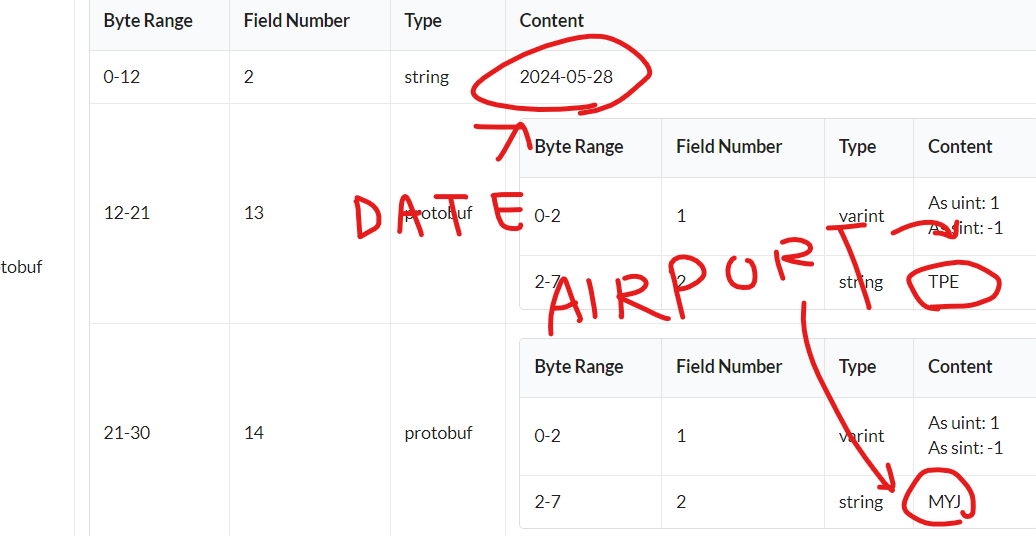
I immediately recognized the values — that's my data, that's my query!
So, I wrote some simple Protobuf code to decode the data.
syntax = "proto3"

message Airport {
    string name = 2;
}

message FlightInfo {
    string date = 2;
    Airport dep_airport = 13;
    Airport arr_airport = 14;
}

message GoogleSucks {
    repeated FlightInfo = 3;
}
It works! Now, I won't consider myself an "experienced Protobuf developer" but rather a complete beginner.
I have no idea what I wrote but... it worked! And here it is, fast-flights.
(c) 2024-2026 AWeirdDev, and all the awesome people
Release history Release notifications | RSS feed


Download files
Download the file for your platform. If you're not sure which to choose, learn more about installing packages.
Source Distribution
Built Distribution
Filter files by name, interpreter, ABI, and platform.
If you're not sure about the file name format, learn more about wheel file names.
Copy a direct link to the current filters
File details
Details for the file faster_flights-3.4.0.tar.gz.
File metadata
- Download URL: faster_flights-3.4.0.tar.gz
- Upload date:
- Size: 24.0 kB
- Tags: Source
- Uploaded using Trusted Publishing? Yes
- Uploaded via: twine/6.1.0 CPython/3.13.7
File hashes
| Algorithm | Hash digest | |
|---|---|---|
| SHA256 |
b7f74b8306130aef987e10f461f5f2b7b099ef209265a85fc63c954d5377e803
|
|
| MD5 |
8284cb1b50cd589d322980eb5f62816e
|
|
| BLAKE2b-256 |
ffe6459f690415387bcfb51335f92691fe05b22f25987853d88a32b7484c71f6
|
Provenance
The following attestation bundles were made for faster_flights-3.4.0.tar.gz:
Publisher:
workflow.yml on jamexhuang/flights
-
Statement:
-
Statement type:
https://in-toto.io/Statement/v1 -
Predicate type:
https://docs.pypi.org/attestations/publish/v1 -
Subject name:
faster_flights-3.4.0.tar.gz -
Subject digest:
b7f74b8306130aef987e10f461f5f2b7b099ef209265a85fc63c954d5377e803 - Sigstore transparency entry: 1008461107
- Sigstore integration time:
-
Permalink:
jamexhuang/flights@b1721d5eec5cdaa44c2bb471450e6a6e20f49e64 -
Branch / Tag:
refs/tags/v3.4.0 - Owner: https://github.com/jamexhuang
-
Access:
public
-
Token Issuer:
https://token.actions.githubusercontent.com -
Runner Environment:
github-hosted -
Publication workflow:
workflow.yml@b1721d5eec5cdaa44c2bb471450e6a6e20f49e64 -
Trigger Event:
release
-
Statement type:
File details
Details for the file faster_flights-3.4.0-py3-none-any.whl.
File metadata
- Download URL: faster_flights-3.4.0-py3-none-any.whl
- Upload date:
- Size: 24.2 kB
- Tags: Python 3
- Uploaded using Trusted Publishing? Yes
- Uploaded via: twine/6.1.0 CPython/3.13.7
File hashes
| Algorithm | Hash digest | |
|---|---|---|
| SHA256 |
301519fdb17a7fed1606a2484671fd1479aed409ae98c6417c46f01dc59c064b
|
|
| MD5 |
6d7feffb83124dedb13c6a5afcfe344f
|
|
| BLAKE2b-256 |
8640e1913cf9b75813427283e074c8b54ca7f3e2e9fe34f3534932f7669bb6a3
|
Provenance
The following attestation bundles were made for faster_flights-3.4.0-py3-none-any.whl:
Publisher:
workflow.yml on jamexhuang/flights
-
Statement:
-
Statement type:
https://in-toto.io/Statement/v1 -
Predicate type:
https://docs.pypi.org/attestations/publish/v1 -
Subject name:
faster_flights-3.4.0-py3-none-any.whl -
Subject digest:
301519fdb17a7fed1606a2484671fd1479aed409ae98c6417c46f01dc59c064b - Sigstore transparency entry: 1008461109
- Sigstore integration time:
-
Permalink:
jamexhuang/flights@b1721d5eec5cdaa44c2bb471450e6a6e20f49e64 -
Branch / Tag:
refs/tags/v3.4.0 - Owner: https://github.com/jamexhuang
-
Access:
public
-
Token Issuer:
https://token.actions.githubusercontent.com -
Runner Environment:
github-hosted -
Publication workflow:
workflow.yml@b1721d5eec5cdaa44c2bb471450e6a6e20f49e64 -
Trigger Event:
release
-
Statement type:






