
fastrho
Fine-scale recombination maps from population genotypes, without per-dataset training.






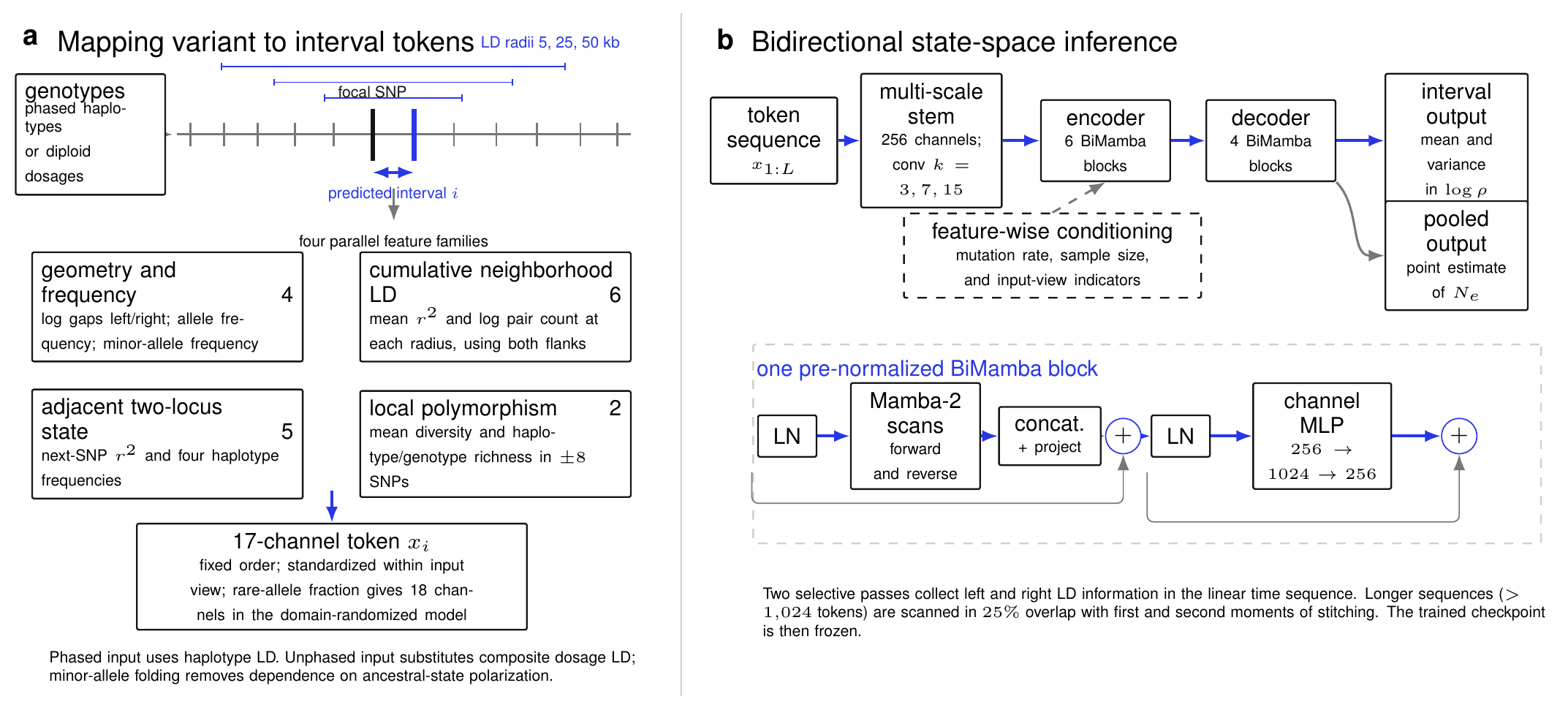
fastrho is a research package for amortized, fine-scale recombination-map inference. A
bidirectional Mamba-2 encoder-decoder reads one order-invariant feature token per SNP and estimates
the population-scaled recombination rate for every adjacent-SNP interval.
What it does
| Input | Phased or compatible unphased population genotypes, including single-contig VCFs |
| Output | Adjacent-SNP interval estimates and optional 0-based, half-open BED maps |
| Inference | One pretrained model with overlapping-context inference; no per-dataset retraining |
| Backbone | Bidirectional Mamba-2 state-space encoder-decoder |
| Rates | Population-scaled rho and absolute rate conditional on the recorded Ne_used |
| Stage | Public research alpha |
Installation
Install the CPU package and common VCF/DataFrame helpers from PyPI:
python -m pip install "fastrho[io]"
GPU inference requires Linux, an NVIDIA GPU, and compatible PyTorch, CUDA, and Mamba-SSM builds. For the fully locked inference environment, clone the public source repository:
git clone https://github.com/kevinkorfmann/fastrho.git
cd fastrho
uv sync --frozen --extra inference --extra io
source .venv/bin/activate
Inference is tested on Python 3.10 and 3.12. uv is recommended for inference because the lockfile
also records the extension build requirements. CPU-only VCF inspection, simulation, and data
conversion do not load the model. Record the environment used for a run with its checkpoint IDs.
Download the verified model bundle
The domain-randomized-v1 release contains the checkpoint and its required feature-statistics
companion. Keep the two files together; feat_stats.npz is part of the trained model and must not
be recomputed from a prediction cohort.
fastrho-fetch-model \
  --model-id domain-randomized-v1 \
  --output-dir downloaded-models
The public, checksummed model artifacts are also available from the
domain-randomized-v1 release.
Make a map
fastrho predict \
  --vcf cohort.vcf.gz \
  --chrom chr1 \
  --checkpoint downloaded-models/domain-randomized-v1/model.ckpt \
  --stats downloaded-models/domain-randomized-v1/feat_stats.npz \
  --mutation-rate 1.5e-8 \
  --ne 10000 \
  --input-mode auto \
  --missing drop-site \
  --window-size 50000 \
  --out chr1.50kb.bed
VCF input is restricted to one contig per prediction call. Missing sites are dropped rather than
imputed as reference, and positions are converted to 0-based, half-open BED coordinates.
input_mode="auto" distinguishes phased from unphased genotype separators; it cannot establish
ancestral polarization.
Python API
from pathlib import Path
import fastrho

bundle = Path("downloaded-models/domain-randomized-v1")

pred = fastrho.quick_map_from_vcf(
    "cohort.vcf.gz",
    bundle / "model.ckpt",
    bundle / "feat_stats.npz",
    contig="chr1",
    mutation_rate=1.5e-8,
    Ne=10_000,
    input_mode="auto",
    missing="drop-site",
    device="cuda:0",
)

df = fastrho.to_dataframe(pred, chrom="chr1")
fastrho.write_bed(pred, "chr1.50kb.bed", chrom="chr1", window_size=50_000)
Before interpreting a map
An LD-based estimate is a population recombination map, not a direct observation of contemporary crossovers. Demographic history, structure, inversions, selection, relatedness, selfing, and gene conversion can change the signal. For a new cohort, record the checkpoint and statistics hashes, input view, filtering, mutation rate, effective population size, coordinates, and reporting window; then evaluate split-sample repeatability, realistic simulations, or an independent map.
Documentation
The public documentation contains the software guide, method schematic, and synthetic example.
- Quickstart
- Python API
- Use fastrho with your dataset
- Interpret the output
- Checkpoints
- Known-answer simulation
Verification
python -m pytest tests/test_io_api.py tests/test_phase1_target.py \
  tests/test_phase2_features.py tests/test_stitching.py
python scripts/release_check.py
python -m build
Citation and license
Citation metadata are provided in CITATION.cff. Code is licensed under the MIT License; external
datasets and pretrained weights retain their own licenses and terms.
1 maintainer

Metadata
1 maintainer
Release files for fastrho 0.1.1
For a detailed explanation of source distributions (sdists) and built distributions (wheels), please see the package formats documentation.
Source distribution (sdist)
| File | Size | Uploaded | |
|---|---|---|---|
| fastrho-0.1.1.tar.gz | 416.0 kB | Details |
Built distribution (wheel)
| File | Interpreter | ABI | Platform | Reset |
|---|---|---|---|---|
| fastrho-0.1.1-py3-none-any.whl | Python 3 | none | any | Details |
Total release size: 476.6 kB
Release files / fastrho-0.1.1.tar.gz
| Download URL | fastrho-0.1.1.tar.gz |
|---|---|
| Size | 416.0 kB |
| Tags | Source |
|
SHA-256 checksum How to use checksums |
875ba99bc2f67c3106d7f1cf41f6d96b70725f79796515a1c7d9969741dc202c
|
|
BLAKE2b-256 checksum How to use checksums |
b60b123e7dbad035d3c242858463e4d73c71ef8d2f62dba355e03fed04de5271
|
| Upload date | |
|
Uploaded using Trusted Publishing? What is trusted publishing? |
Yes |
| Uploaded via |
twine/7.0.0 CPython/3.13.14
|
Provenance
Provenance describes where a file came from. On PyPI, provenance is shared via attestations, which provide a verifiable record of the build or publishing details. View details, limitations and caveats.


PyPI Publish Attestation
PyPI verified that this artifact, at this checksum, originated from the publisher listed below.
Signed by GitHub Actions, verified by PyPI on Aug 2, 2026.
Transparency logRelease files / fastrho-0.1.1-py3-none-any.whl
| Download URL | fastrho-0.1.1-py3-none-any.whl |
|---|---|
| Size | 60.6 kB |
| Tags | Python 3 |
|
SHA-256 checksum How to use checksums |
0595aecf3a237625de3abe785eb2c830040d216389f6e9a949885de12ae6a1ff
|
|
BLAKE2b-256 checksum How to use checksums |
5d9712af797cd74c3e1468a9b9a363e3dfedd9d9d43b5ccf0fdccdb77774b814
|
| Upload date | |
|
Uploaded using Trusted Publishing? What is trusted publishing? |
Yes |
| Uploaded via |
twine/7.0.0 CPython/3.13.14
|
Provenance
Provenance describes where a file came from. On PyPI, provenance is shared via attestations, which provide a verifiable record of the build or publishing details. View details, limitations and caveats.
PyPI Publish Attestation
PyPI verified that this artifact, at this checksum, originated from the publisher listed below.
Signed by GitHub Actions, verified by PyPI on Aug 2, 2026.
Transparency log













